TRC20 token decimals convert raw integer units into readable token quantities. With six decimals, 1,000,000 base units represent one token. Check the exact contract and scale before comparing amounts.
This TRC20 token decimals guide includes a tested six-case worksheet and a copyable evidence note. Every numerical example is synthetic. No wallet connection or payment is needed.
Table of Contents
TRC20 token decimals: a six-case conversion worksheet
The official TRC20 interface reference explains decimals as token metadata. Its six-decimal example means one token has one million base units. That example does not make six the default for every token. Read the metadata belonging to the particular contract you are investigating.
| Raw integer | Decimals | Exact token amount | What this tests |
|---|---|---|---|
| 1 | 6 | 0.000001 | The smallest unit in this example |
| 12345678 | 6 | 12.345678 | Ordinary fractional amount |
| 1000000 | 6 | 1 | Whole-token boundary |
| 0 | 6 | 0 | Zero remains zero |
| 123456789012345678901234 | 6 | 123456789012345678.901234 | Preserving large integers |
| 12345678 | 18 | 0.000000000012345678 | Same raw integer, different scale |
We checked all six results locally on 26 October 2026 with integer and string operations. No chain request or transaction was needed. The last row deliberately changes the decimal count: copying a raw number without its scale can radically change its interpretation.
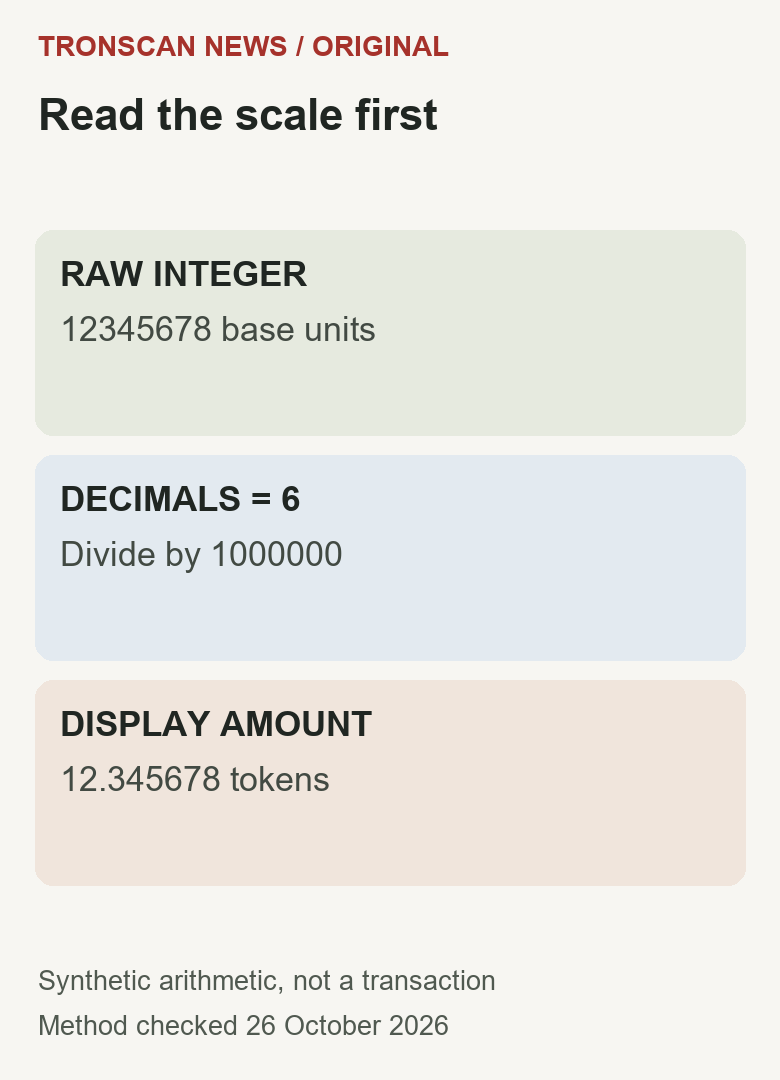
Find the correct TRC20 token decimals before converting
- Establish the network. Preserve the network shown by the source record. A familiar token name alone does not identify the chain or deployment.
- Match the complete contract. Compare it with the issuer’s official reference. For USD₮, Tether’s supported-protocols page provides network-specific contract links. Do not infer an issuer from an icon or ticker.
- Identify the field’s unit. Decide whether you copied a raw integer or an amount already formatted into tokens. Dividing a formatted amount a second time creates an error.
- Read the decimal count for that contract. If a trusted record does not provide it, preserve the quantity as unresolved. Guessing a familiar token’s precision is not verification.
- Convert once. Move the decimal point left by the specified count, inserting leading zeroes when necessary.
- Keep both representations. Save the raw integer, decimal count, exact display amount and source date together so another reader can reproduce your result.
These are field-level checks rather than a claim that a particular current button was tested. During preparation, the explorer’s public interface was behind a security check; we did not bypass it. The calculation method and worksheet were tested locally. For the broader network and asset distinctions, use our TRON USDT guide.
TRC20 token decimals and display rounding answer different questions
Suppose a synthetic exact amount is 12.345678 tokens. A compact phone layout might show 12.35 when rounding to two decimal places. The shorter label is useful for scanning, but it is not an exact substitute for the underlying quantity. Preserve the expanded value when comparing a receipt or preparing a support note.
Similarly, an amount smaller than the displayed precision can look like zero. That appearance does not establish that the raw integer was zero. Check the full field, its formatting and the contract’s scale before drawing that conclusion. This is a diagnostic possibility, not a statement about every wallet’s formatting behavior.
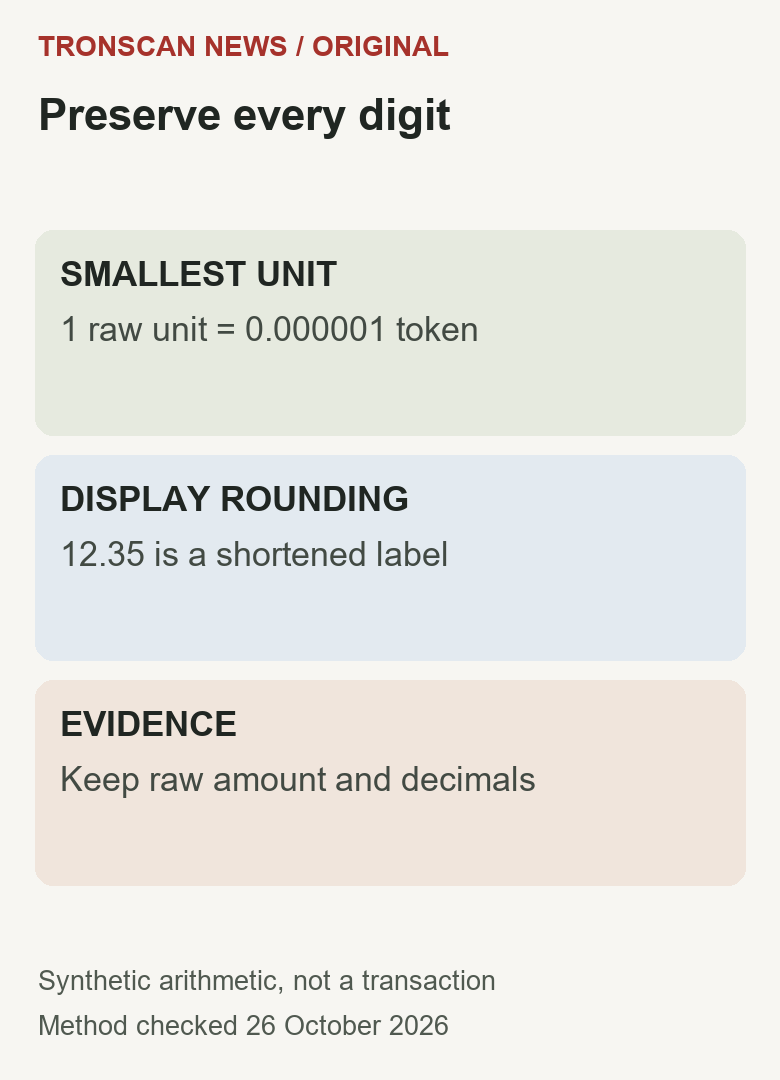
The quantity is also separate from a dollar estimate. Converting base units into tokens does not set a market price. If the token quantity matches but the estimated USD value differs, investigate the valuation source and observation time separately. Do not change the decimal count to make two dollar estimates agree.
Use exact integers for large TRC20 token decimals calculations
A calculator or spreadsheet may silently shorten a long integer, switch to scientific notation or round a fraction. Once digits have been lost, moving a decimal point cannot recover them. Keep the original quantity as text when copying it between tools, and compare the copied string with the source before calculating.
A simple manual method avoids division rounding: write the raw integer, count the required positions from its right edge, insert a decimal point, and add leading zeroes if the integer is too short. In the synthetic six-decimal example, 1 becomes 0.000001. Removing unnecessary trailing fractional zeroes changes the formatting, not the quantity.
Our large-number test preserved every digit of 123456789012345678901234. Treat that as a formatting test case, not a plausible balance or a claim about network supply. The method does not authenticate a token or prove that a source record is accurate.
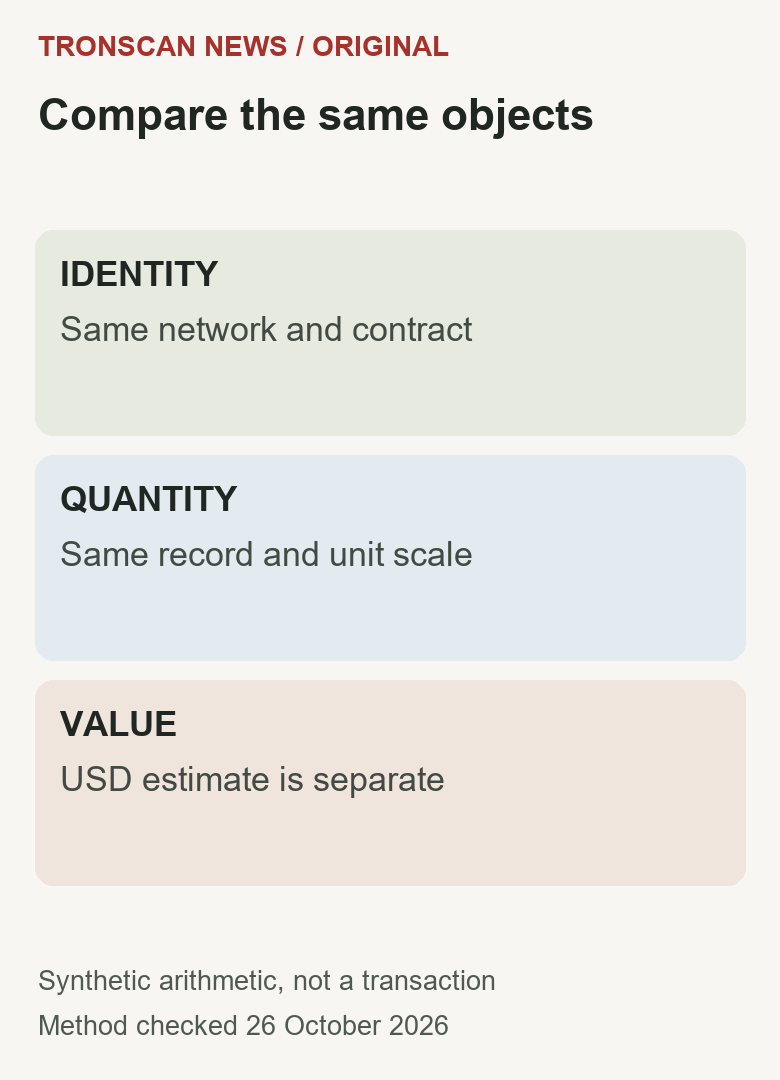
Reverse-check TRC20 token decimals before reporting a mismatch
A second calculation can expose a misplaced decimal point. Start with the exact formatted amount, restore the specified number of fractional places and remove the point. In our synthetic example, 12.345678 with six decimals returns 12345678. If your reverse calculation produces a different integer, resolve that formatting difference before comparing records.
Three outcomes lead to different next steps. If the raw integers match and the decimal counts match, the exact quantities match; compare display rounding separately. If the raw integers match but the decimal counts differ, you may have copied metadata from another contract or interpreted a token amount as base units. If the contract and scale match but the integers differ, preserve both records and check their observation times and record types. A current balance and an earlier transfer amount are not expected to be identical.
For a synthetic amount of 12.3456789 and a scale of six, the extra fractional digit cannot be represented exactly in that unit scale. Do not silently round it and call the result an exact copy of the source. Mark the discrepancy and return to the original field. This worksheet is for interpreting records, not preparing or authorizing a payment.
TRC20 token decimals checks are complete when another reader can reproduce the same integer-to-quantity conversion from your note. They are not complete merely because two shortened screenshots look similar. Keep any remaining question explicit: unknown contract metadata, a missing raw field, a different date or an unresolved valuation source.
What if TRC20 token decimals metadata is missing?
Do not infer the scale from the length of the raw integer. The integer 12345678 can represent different quantities under different decimal counts, as the worksheet demonstrates. Nor does a familiar ticker establish the scale: the ticker and contract identity need separate confirmation.
Preserve the raw field without adding a token-unit label you have not established. A useful unresolved note says: raw integer copied, contract identified, decimal count not verified. That is more informative than an invented precise-looking amount. Ask the record provider or consult the issuer-linked contract documentation for the missing metadata.
Once you obtain the scale, repeat the conversion from the preserved original string. Do not reuse a shortened intermediate number from a phone screenshot or spreadsheet cell. Document which source supplied the missing value and when you checked it. This closes the evidence gap without pretending the first observation contained information that it did not.
TRC20 token decimals: compare two exact amounts
Here is another synthetic reconciliation. Record A contains 12600000 base units and record B contains 12345678, with six decimals established for both. The exact quantities are 12.6 and 12.345678 tokens. Subtracting the raw integers first gives 254322 base units, which represents 0.254322 tokens at the same scale. This method preserves the fractional difference without relying on two rounded screen labels.
The calculation alone cannot identify why those two quantities differ. They might describe different observations, records or accounts. Do not label the difference a network fee, tax or missing payment without separate evidence. First confirm that the two records were intended to describe the same thing.
When checking TRC20 token decimals, a reliable note records both the subtraction and its scope. If a receiving platform quotes a separate withdrawal charge, retain that quote as a separate source rather than deriving it from an unexplained amount difference. A correct subtraction is evidence about numbers; it is not evidence about an undisclosed charging policy.
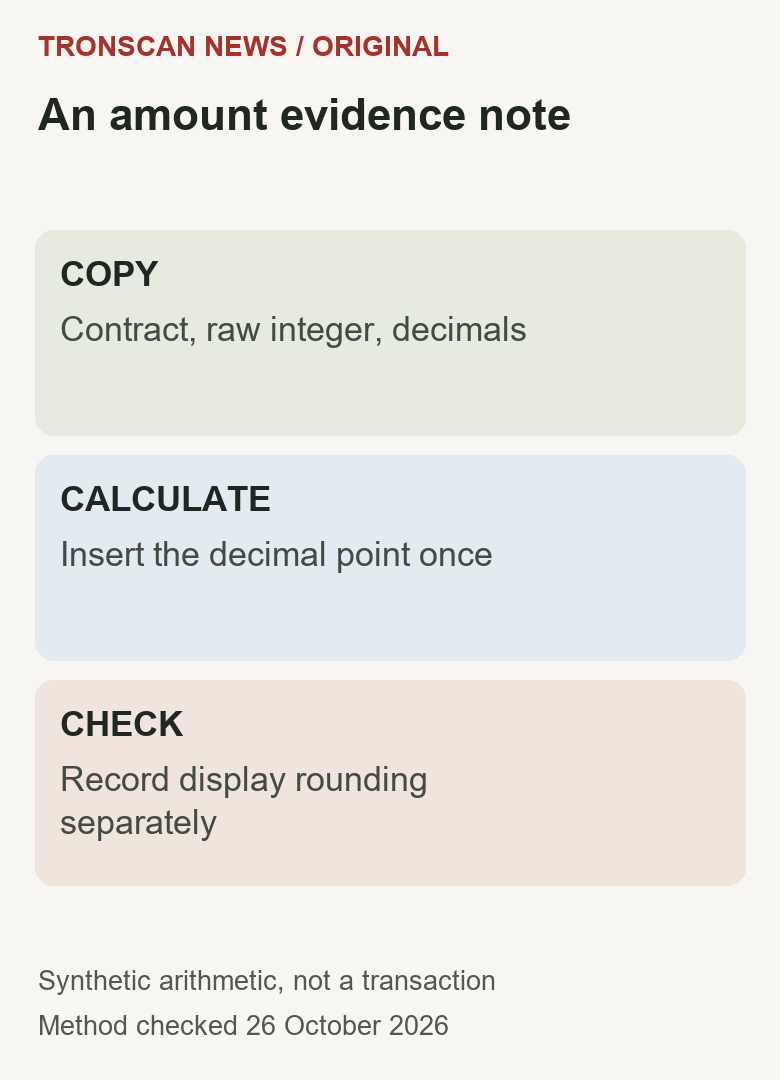
A copyable TRC20 token decimals evidence note
Use this note when two records appear inconsistent. It keeps the calculation separate from questions about transfer execution or private platform credit.
Network:
Complete token contract:
Source URL and check date:
Field label and stated unit:
Original raw integer, copied as text:
Decimal count and metadata source:
Exact converted token quantity:
Rounded display, if different:
Separate USD estimate and its time:
Unresolved question and next check:
The official TronWeb token reference separates decimals(), balanceOf() and totalSupply(). Those are different reads, not interchangeable descriptions of one person’s holdings. You do not need to sign a transfer or approve a spender simply to understand a decimal scale.
For a checked eight-versus-six decimal comparison, use the jUSDT receipt and underlying USDT worksheet. A separate display multiplier is another layer: our scaled UI amount and rounding worksheet reviews the TRC-8056 draft with sixteen local arithmetic cases and four interface-ID checks. It does not establish adoption by a live token. Link checked November 3, 2026.
TRC20 token decimals FAQ
1. Do all TRC20 tokens use six decimals?
No. Obtain the decimal count for the exact contract. A standard’s example value is not a universal rule for every deployed token.
2. Should I divide an explorer amount by one million?
Only if you have established that the field is raw base units and the contract uses six decimals. An already formatted token amount must not be converted again.
3. Can a rounded zero hide a small positive quantity?
A limited-precision display can round a small positive quantity to zero. Check the full number and source units; do not assume this is how every interface behaves.
4. Do TRC20 token decimals determine a token’s USD price?
No. Decimals define the unit scale. A USD estimate requires separate valuation information, and matching quantities can have different estimates at different times.
5. Does a correct conversion prove that a transfer succeeded?
No. Arithmetic checks the interpretation of a quantity. Execution status, the correct recipient and any receiving service’s credit still require their own evidence.
Sources, testing and independent scope
Prepared 26 October 2026 by the Tronscan News editorial team with AI assistance and source review. The original six-case worksheet was tested locally; no wallet transaction, live contract call or current explorer interaction is claimed. This publication is independent of TRONSCAN and TRON. Find more guides and our editorial standards through Tronscan News. Corrections should identify the source record, unit and affected passage.
Leave a Reply