A scaled UI amount is a display-adjusted token quantity; it is not automatically a new raw balance, mint or transfer. The TRC-8056 scaled UI draft proposes a multiplier for displaying TRC20 holdings while leaving ordinary token operations in raw units. This review does not establish adoption by USDT, TRONSCAN, a wallet or an exchange.
We checked the draft on November 3, 2026. It was opened July 10 and its saved GitHub issue was last updated September 3. This is a dated explanation with sixteen original local arithmetic and boundary checks plus four interface-ID comparisons, not an announcement that a new standard launched today. No contract was deployed, wallet connected, multiplier changed or token transferred.
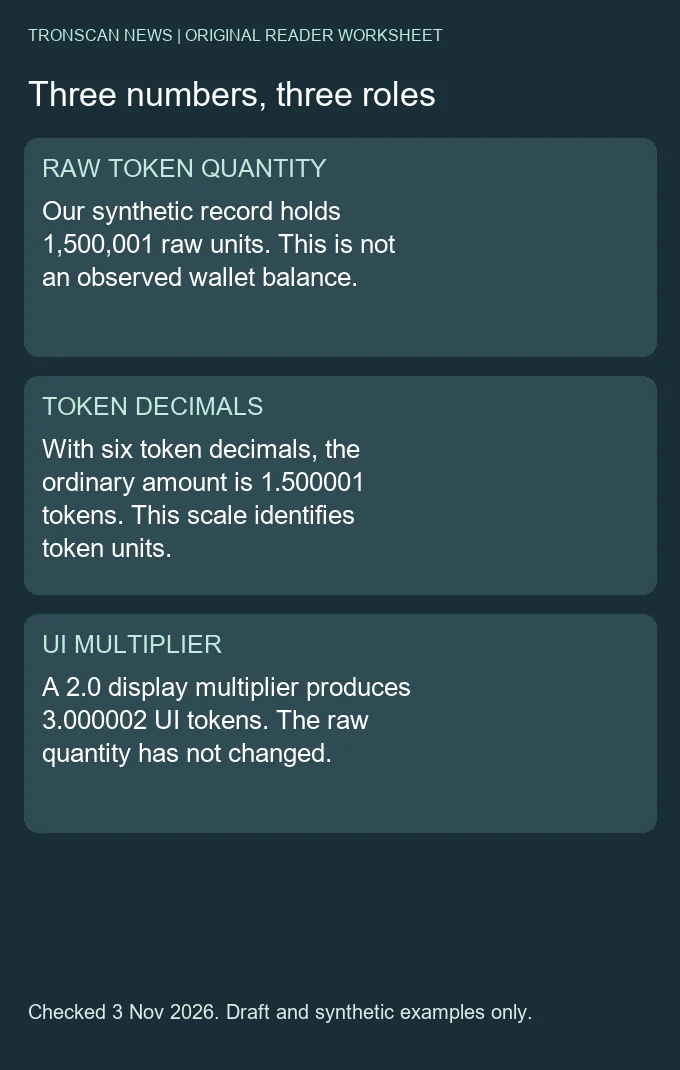
Table of Contents
Four critical checks for a scaled UI amount
- Raw quantity: preserve the original balance or transfer integer.
- Token decimals: identify the token’s own scale independently of the display feature.
- Multiplier and time: identify the multiplier that applies to the observation, including any pending effective time.
- Support and rounding: verify the actual interface and keep integer-floor effects visible.
The primary TRC-8056 discussion is labelled Draft. Its stated purpose includes stock-split-style displays. A proposed method name does not prove that any particular token contract implements it. We did not discover or certify a live adopting contract in this review.
Separate token decimals from scaled UI multiplier precision
The scaled UI draft represents its multiplier with eighteen decimal places: the integer 1000000000000000000 represents 1.0. This is the multiplier’s scale. It does not change a token’s decimals field to eighteen or turn a native TRX balance into an ERC20 amount.
In our synthetic scaled UI example, the token has six decimals and a raw holding of 1500001. The ordinary token amount is 1.500001. Applying a multiplier integer of 2000000000000000000 yields a UI integer of 3000002, displayed as 3.000002 with those same six token decimals. The raw record remains 1500001 throughout.
| Synthetic input | Value | Role |
|---|---|---|
| Raw holding | 1500001 | Underlying token integer |
| Token decimals | 6 | Ordinary unit formatting |
| Multiplier integer | 2000000000000000000 | 2.0 under an eighteen-place scale |
| UI integer | 3000002 | Display calculation |
| Formatted UI amount | 3.000002 | Clearly labelled display result |
Raw transfers and scaled UI amounts have different roles
The draft keeps standard TRC20 balanceOf, transfer and transferFrom quantities in raw units. Optional UI helpers add another reading layer. Treating a displayed number as the argument to an ordinary transfer without understanding that distinction can produce a wrong-unit request. This article does not build such a request.
A market-value column is separate again. A doubled UI quantity is not evidence that the dollar value doubled. Our worksheet uses no price feed, oracle, exchange quote or valuation model. If a display also shows a currency value, record its pricing source and time rather than assigning a financial interpretation to the multiplier.
The pending scaled UI multiplier introduces a time boundary
The current scaled UI draft exposes a pending multiplier and its effectiveAt timestamp through a required extension. Its reference getter selects the pending value when the current time is at or beyond that boundary. The update mechanism itself is an issuer implementation choice, so we do not treat one setter example as every implementation’s administrative design.
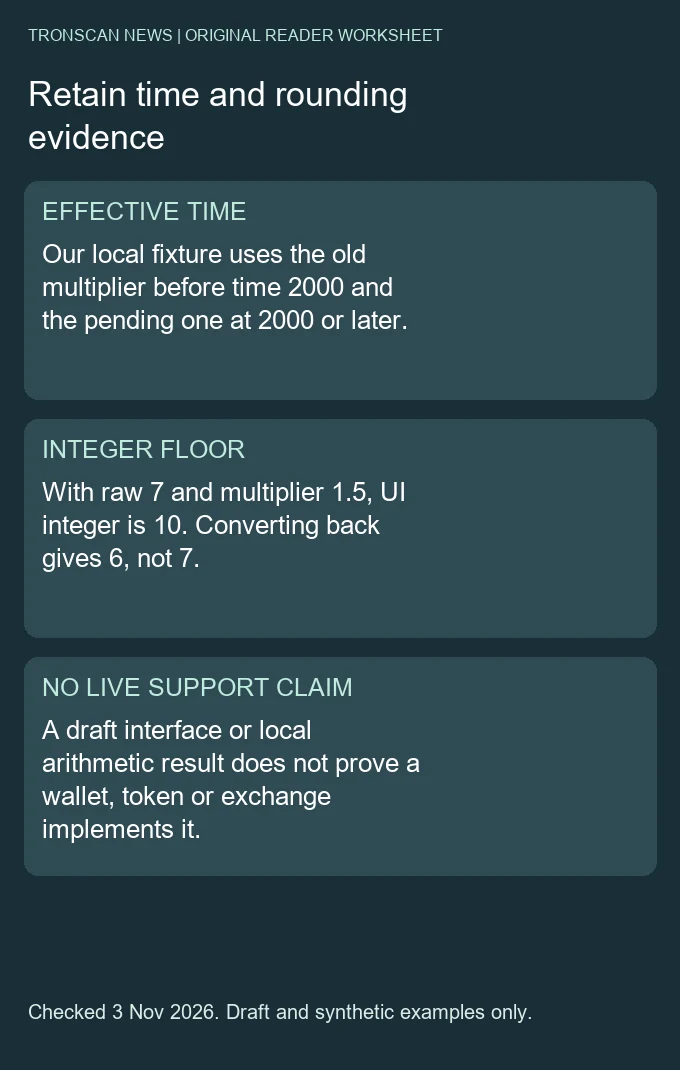
Our local scaled UI time fixture used an old multiplier of 1.0, a pending multiplier of 2.0 and an invented effectiveAt value of 2000. These small timestamps are boundary-test labels, not a live stock-split date. With raw quantity 1500001, time 1999 produced UI integer 1500001; times 2000 and 2001 each produced 3000002.
The equality case matters: our model used greater-than-or-equal, not strictly greater-than. It tested the selected getter expression only. It did not execute the full Solidity reference contract, schedule an update or check a real chain timestamp. A cached display that omits the effective time cannot explain which multiplier it applied.
Scaled UI rounding can prevent an exact round trip
The scaled UI reference arithmetic multiplies before integer division. For non-negative values, this floors any fractional remainder. Our synthetic raw value 7 with multiplier 1.5 produced UI integer 10. Converting that UI integer back with the inverse floor expression produced 6, not the original 7.
This difference is not an observed missing token. It is lost fractional information in our local arithmetic fixture. Raw value 1 at the same multiplier produced UI integer 1 and inverse result 0. A separate exact case, raw 10 at multiplier 2.5, produced UI integer 25 and inverse result 10.
These scaled UI cases explain why a rounded display value should not replace the original raw record in an archive or internal ledger. If an application needs an exact quantity for another operation, it must retain the appropriate original quantity and follow that operation’s documentation. An inverse display helper cannot be assumed to reconstruct discarded precision.
Our sixteen scaled UI checks and their limits
Six positive conversion cases covered multiplier 1.0, multiplier 2.0, two fractional-floor examples, multiplier 2.5 and zero raw holding. Three time-boundary cases covered the instant before, at and after the synthetic effective time. Four rejection cases covered a negative raw integer, zero multiplier, Boolean input and an overflowing intermediate product. Three round-trip cases produced the results above.
All sixteen matched their declared local expectations. We used exact Python integers, then explicitly rejected raw times multiplier when the product exceeded uint256. That guard models an intermediate multiplication limit, even if a later mathematical division would reduce the final result. It does not model every Solidity compiler, optimized arithmetic library or contract implementation.
SCALE = 10**18
UINT256_MAX = 2**256 - 1
def ui_integer(raw, multiplier):
    if type(raw) is not int or type(multiplier) is not int:
        raise ValueError("Exact integers required")
    if (raw < 0 or multiplier <= 0 or raw > UINT256_MAX
            or multiplier > UINT256_MAX or raw * multiplier > UINT256_MAX):
        raise ValueError("Outside this local model")
    return raw * multiplier // SCALE
Verify scaled UI support before applying the display layer
The scaled UI draft uses TRC-165 interface detection. It distinguishes the core UI-multiplier interface from optional conversion and balance helpers. A contract can therefore require different reading paths depending on which extensions it actually supports. A symbol, ABI pasted into a tool or familiar token name is not sufficient proof of support.
Scaled UI interface IDs checked locally
We added four local interface-ID comparisons using TronWeb 6.5.1. For each declared function signature, we took the first four bytes of its Keccak hash and XORed the selectors belonging to that interface. All four results matched the IDs printed in the saved draft. These were local string calculations, not supportsInterface calls to a token.
| Draft interface | Functions used in our calculation | Computed and draft ID |
|---|---|---|
| Core scaled UI | uiMultiplier() | 0xa60bf13d |
| Pending scaled UI multiplier | newUIMultiplier(); effectiveAt() | 0x4bd27648 |
| Optional conversion | toUIAmount(uint256); fromUIAmount(uint256) | 0x57854fc3 |
| Optional balances | balanceOfUI(address); totalSupplyUI() | 0xd890fd71 |
For example, the pending interface combines two selectors rather than using only the one for newUIMultiplier(). Our check kept the exact canonical argument types and omitted parameter names. The optional transfer event was not a function selector and was not included in the XOR. This matters when reviewing an ABI that lists both functions and events together.
A matching interface ID is a narrow consistency result. It does not establish deployed bytecode, access control, an honest support response or the correctness of a token implementation. We did not deploy the reference implementation or execute its optional helpers. The four comparisons supplement the sixteen integer and timing cases; they do not convert those synthetic fixtures into observed wallet behavior.
Use this table as a source-review aid before a future read-only support check. Keep each actual contract response separate from our calculated ID. An unavailable request should remain unavailable, while a confirmed unsupported extension should retain its own evidence. Neither result authorizes changing the original raw token quantity or inventing a display multiplier.
A repeatable scaled UI review note
- Record network, exact token contract and the public source used for its identity.
- Preserve the raw balance or transfer quantity and the token’s decimals.
- Record confirmed scaled UI extension support, multiplier values and the relevant observation and effective times.
- Calculate with exact integers and state the rounding rule before formatting the result.
- Label the output as a UI amount, retain the original raw value and list any untested service behavior.
Success means a reproducible scaled UI calculation with preserved raw inputs and a clear effective time. Our local work did not test contract access control or adoption. Confirm interface support before using an optional reader; an RPC failure is not proof that the interface is absent.
Continue with our fixed token-decimal reading guide, token amount versus dollar-value explanation, and verified-contract evidence limits. Each handles a different question that remains relevant before interpreting an extra display multiplier.
Frequently asked questions
Does a scaled UI amount prove new tokens were minted?
No. In our synthetic model, the display changed while the retained raw holding stayed the same.
Does the eighteen-place multiplier change token decimals?
No. Multiplier precision and token-unit decimals are separate inputs.
Does this scaled UI review prove USDT implements TRC-8056?
No. We did not verify adoption by USDT or another live token, wallet, explorer or exchange.
Can the inverse conversion always recover the raw quantity?
No. Our fractional-floor fixtures lost information and did not always round-trip exactly.
Did these tests update a contract multiplier?
No. The sixteen tests were local integer and timing models. No contract or account state changed.
Independent Tronscan News review with AI assistance, checked November 3, 2026. The primary draft and original local test materials support the stated limits. This is a tutorial, not a new activation announcement or investment recommendation. Find our editorial standards and correction route through the Tronscan News homepage.
Leave a Reply