A TRON call path identifies how an operation reaches the network: a native system transfer and a smart-contract trigger are different routes. Sending TRX to a contract address does not by itself mean that contract’s receive or fallback code ran. Read the transaction type before interpreting a contract deposit or missing event.
This guide is for a reader investigating contract accounting or adapting a deposit-monitoring integration. Success means identifying the recorded call path, preserving the relevant fields and separating execution evidence from a service’s crediting decision. We checked two existing public records and nine local classifier fixtures on November 3, 2026. We did not send TRX, invoke a contract or test a service deposit.
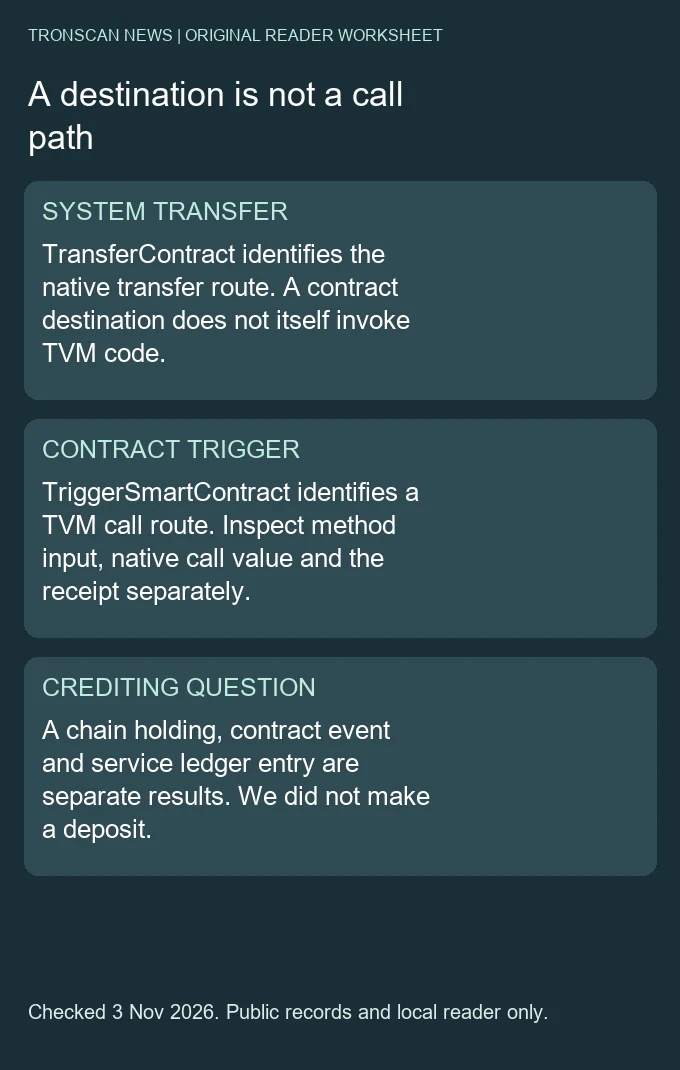
Table of Contents
Four critical call path checks
- Read the transaction type. Distinguish TransferContract from TriggerSmartContract before inspecting a selector.
- Read the value’s role. A native transfer amount, a trigger’s native call value and a token-method argument are not interchangeable.
- Read the receipt and logs. Preserve actual fields, including missing fields, without turning a local classification into proof of execution.
- Read the recipient’s documented accounting rules. A public holding does not prove an application credited a customer.
The official contract-migration guide distinguishes two native-TRX delivery mechanisms. A plain TransferContract uses a system transfer and bypasses TVM receive/fallback code. A TriggerSmartContract can run payable contract code with native call value. This is a documented mechanism distinction, not our claim that a particular production deposit was credited or lost.
Why a contract address does not settle the call path
The destination identifies where a value or call is directed. The call path identifies the operation’s mechanism. A developer accustomed to an Ethereum callback assumption can therefore ask the wrong question if they inspect only the destination address and amount. First preserve the TRON transaction type from the public body.
For a hypothetical contract whose internal ledger is updated only in receive or fallback code, a native system transfer cannot be assumed to trigger that bookkeeping. This is an invented integration scenario, not an observed failure at a named service. We did not audit any recipient contract’s code, access controls or recovery options.
A native balance and an internal contract ledger are different observations. If an application expects a particular method, record that requirement from its official instructions. Do not improvise a second payment to test a guess. An explorer can show a chain record without establishing the receiving application’s private crediting result.
Actual record one: the native system-transfer route
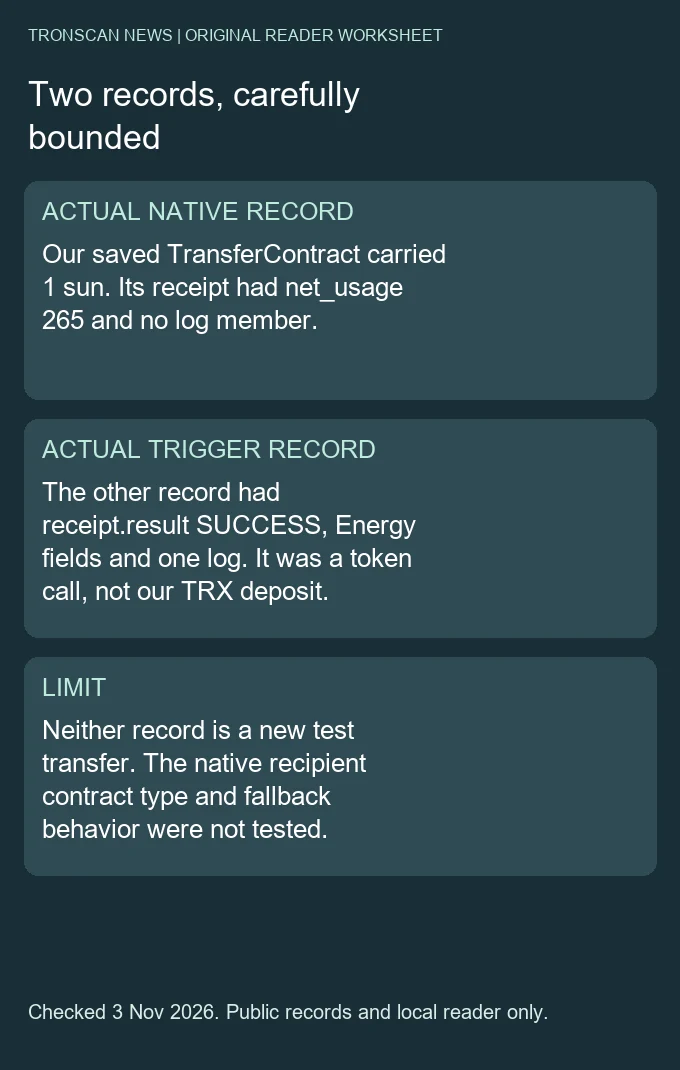
Our saved block 87669202 contained transaction ce42f6a73283a53722b877990b0f500cb2558eccaa8bb3c711d7a3f5459dfeb1. Its raw contract entry was TransferContract, with an amount integer of 1 sun. That is 0.000001 TRX under the native six-place scale; it is not one TRX.
A separate public gettransactioninfobyid read returned the same block number and receipt.net_usage 265. The response had no log member and no receipt.result member. Its contractResult array contained an empty string. We retain those exact distinctions instead of converting absent members into a numeric zero or decoding the empty string as Boolean true.
We did not verify that this native record’s recipient was a smart contract. It is an actual transaction-type example, not a live experiment showing funds sent to a contract without a callback. The documented call path rule and the observed record serve different evidence roles.
Actual record two: the contract-trigger route
The same saved block contained transaction 318a21c143dc69b1beb0140bbe1222cbe31f5719c1766aa970806b07121d3415. Its type was TriggerSmartContract. The public body included contract_address and method data beginning with a9059cbb. That selector and its encoded arguments belong to a contract-method task, unlike the first record’s native amount field.
The trigger receipt returned receipt.result SUCCESS, energy_usage_total 64285 and one log. We did not treat that as a successful TRX deposit experiment: the saved body was a token-method call, and we did not create it. Native call value was not explicitly present in the saved request body; this article does not replace that omission with a verified positive TRX payment.
| Observed item | Native record | Trigger record |
|---|---|---|
| Type | TransferContract | TriggerSmartContract |
| Native amount field | 1 sun | Different field context; no explicit call_value observed |
| receipt.result | Not present | SUCCESS |
| Energy usage total | Not present | 64285 |
| log member | Not present | One returned entry |
These are two different historical records, not a controlled experiment with every other variable held constant. Their receipt differences are observations; we do not attribute every difference to the call path alone or use them to estimate a typical fee. No address ownership, application balance or receiving-service decision was established.
Our narrow local call path classifier
The helper below reads only one contract entry’s type. It labels a route for further review, not a validated transaction. It deliberately rejects missing and multi-entry input because this small reader has no policy for those shapes. That local boundary is not a claim about every protocol or node validation rule.
def call_path(contracts):
    if not isinstance(contracts, list) or len(contracts) != 1:
        raise ValueError("This reader needs one contract entry")
    kind = contracts[0].get("type")
    return {
        "TransferContract": "native system-transfer path",
        "TriggerSmartContract": "smart-contract trigger path",
        "TransferAssetContract": "TRC10 path, outside this native-TRX comparison"
    }.get(kind, "unclassified type")
We ran nine synthetic cases: the two named routes, a TRC10 TransferAssetContract, an unknown type, a missing type, a TransferContract carrying a misleading data-like field, an empty list, a two-entry list and null. All matched their declared local expectations. We also applied the classifier to the two saved real transaction bodies.
The misleading-field case is useful: a data string that resembles a selector does not change the type label to a smart-contract trigger. Our helper still does not validate whether that invented object would be accepted by a node. Field presence, request validity, execution and application accounting remain separate checks.
Value, method arguments and logs answer different questions
For a contract-trigger call path, determine whether a value is native call value or an argument in method data. A number embedded in a token transfer method is not automatically a native TRX amount. Likewise, an event’s data must be decoded under the emitting contract and event schema rather than relabelled as the source transaction’s native amount.
Read the method’s documented purpose before interpreting a log as an application receipt. The call path does not identify an exchange customer, guarantee a deposit memo was handled or certify that an internal ledger updated. Those outcomes need their own records and the service’s current instructions.
If the public record is unavailable, preserve that failure rather than guessing the call path from a wallet screenshot. If the type is unknown, keep it unclassified. If the recipient’s implementation has not been reviewed, state that gap; a plausible callback explanation is not proof of what happened inside that particular application.
Repeat the receipt lookup for this call path review
Our two receipt reads used the public endpoint https://api.trongrid.io/wallet/gettransactioninfobyid. Each request body contained a value field with that record’s full transaction identifier. This read returned a receipt for an existing record; it did not build or re-execute the transaction. Keep the original response beside the body used for classification.
{"value":"ce42f6a73283a53722b877990b0f500cb2558eccaa8bb3c711d7a3f5459dfeb1"}To repeat the other observation, use its separately printed identifier without changing the endpoint or relabelling the response as a new operation. Record your own check time and HTTP status. If a provider limits or rejects the read, retain that failure and follow its access policy; do not turn an unavailable receipt into a failed transaction or a zero-valued field.
Check the returned id and blockNumber against the saved source record before using its fields in the call path worksheet. This is a matching-record check, not independent validation of that block or its consensus finality. Our comparison did not use a solidified receipt endpoint or certify an exchange’s deposit policy.
A repeatable call path review note
- Record the network and full transaction identifier, then save the original public body.
- Copy the type and relevant owner, destination, amount or method-data fields without changing their labels.
- Save the matching receipt, block number, execution fields and logs as a separate observation.
- Record whether recipient contract type or code was actually verified. Ours was not for the native example.
- Compare the observed route with the application’s documented required route and state the unresolved question.
A useful note might say: “The saved body uses TransferContract; recipient callback execution was not tested; application credit is unresolved.” That is more precise than saying only that the contract failed. Keep internal account numbers and signing secrets out of a public worksheet.
Start with the TRONSCAN record-selection guide, continue to contract input and method-argument reading when a trigger is present, and use event-log interpretation for the separate log schema. Those are next steps after identifying the call path, not substitutes for it.
Frequently asked questions
Does a TRX transfer to a contract always run receive or fallback?
No. The official TRON reference distinguishes the system-transfer route, which bypasses that TVM code, from a smart-contract trigger.
Did the two actual records test a contract deposit?
No. They were existing public type-and-receipt examples. We did not send funds or verify callback behavior at the native recipient.
Does TriggerSmartContract prove native TRX was paid?
No. Inspect native call value separately from token-method arguments and other fields.
Does a missing log member prove an exchange did not credit a user?
No. The response shape and the service’s internal crediting outcome are different evidence questions.
Does the classifier validate a transaction?
No. It labels a recorded type under a narrow input policy. It does not sign, broadcast, execute or verify a chain.
Independent Tronscan News tutorial, checked November 3, 2026 with AI assistance. Evidence: two retained public bodies, two actual receipt reads, nine synthetic classifier cases and two original diagrams. The call path explanation does not certify a recipient contract or service. The Tronscan News homepage links to editorial standards and corrections.
Leave a Reply