TRON contract input describes the function and arguments a transaction supplied; decoding it does not prove the operation succeeded. This guide reproduces a narrow, read-only audit of a real 68-byte call. Its parameters decode cleanly, while the matching receipt reports failure. The goal is to keep requested arguments, contract identity and execution outcome in separate columns.
Checked October 28, 2026. Tronscan News is independent of TRON and TRONSCAN. We used AI assistance, primary documentation and public node responses, then tested the original local parser below. We did not connect a wallet, sign, broadcast, transfer assets or inspect private account information. The record is an observed public transaction, not a payment we performed.
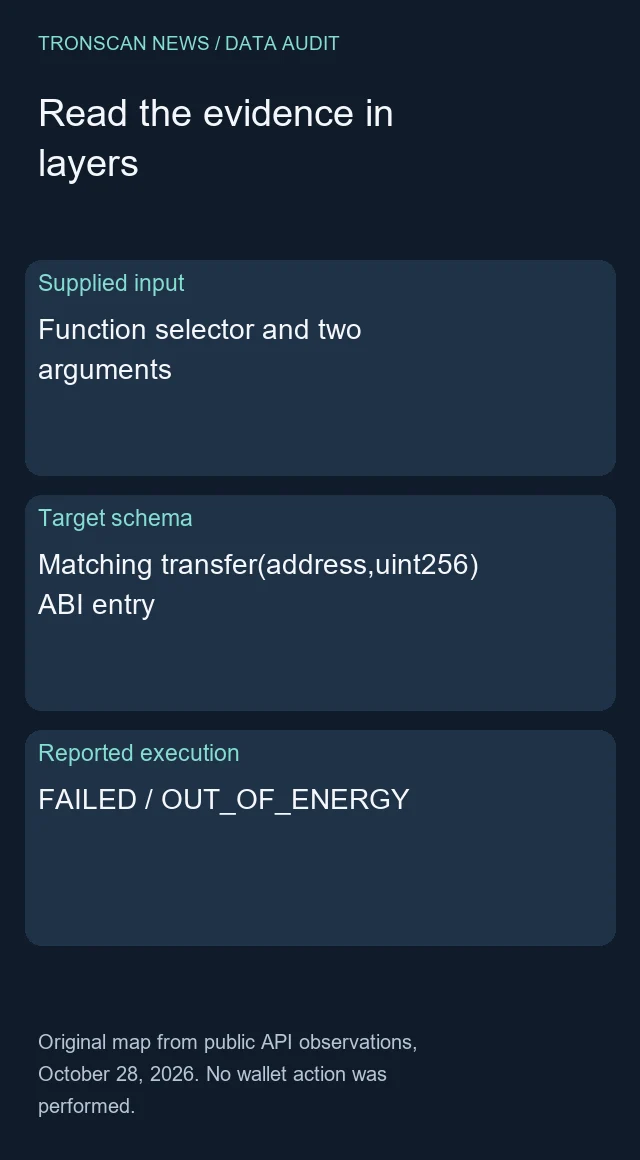
Table of Contents
1. Select the correct TRON contract input field
Start with the transaction’s contract type. This example requires one TriggerSmartContract entry. Its function bytes are at raw_data.contract[0].parameter.value.data. The surrounding value object also names contract_address. Keep those two fields together; a function-looking byte sequence copied without its target address loses essential context.
Do not substitute a transaction memo, serialized raw_data_hex or a receipt’s event payload. They answer different questions even when all are displayed as hexadecimal strings. Before selecting a function decoder, use our native-transfer versus contract-trigger call path worksheet to identify the recorded mechanism. A system transfer does not become a TVM call merely because a data-like value is present. Link checked November 3, 2026.
The official TRON encoding guide describes a four-byte function selector followed by ABI-encoded arguments. For the selected signature transfer(address,uint256), the selector is a9059cbb. Our parser uses that documented selector for one known signature; it is not a general function-discovery service.
The Solidity ABI specification explains why encoded input needs a schema. A byte string does not carry a complete human-readable type definition. Static parameters occupy fixed words, while dynamic parameters use different layouts. This sample supports only the selected static address and integer pair.
Success for this task means reproducing the address argument and raw integer, checking that the metadata belongs to the same target and reporting the receipt separately. It does not mean proving a token brand, recipient ownership, exchange credit or economic payment.
2. Preserve the real TRON contract input sources
At 10:24 UTC on October 28 we retrieved one Mainnet getnowblock response from api.trongrid.io. We selected the first transaction in that response containing a single TriggerSmartContract with selector a9059cbb and exactly 136 hexadecimal characters. This is a stated selection rule, not a representative sample of network activity.
| Saved observation | Value | Boundary |
|---|---|---|
| Block number | 87503256 | One observed block, not a trend |
| Transaction ID | 74edbce060e3310952b15e6dba91945f9d51914a6238aecbc8a0ab64def38248 | Matches body and receipt IDs |
| Target contract, hex | 41a614f803b6fd780986a42c78ec9c7f77e6ded13c | Retained exactly; no asset-identity claim from this parser |
| Matching returned ABI entry | transfer(address,uint256) | One Function entry in the queried contract metadata |
| Full-node receipt | FAILED; OUT_OF_ENERGY | An outcome observation, separate from argument decoding |
| Solidified-endpoint recheck | Same ID, block and failure labels | Retrieved at 10:25:41 UTC; not an independent consensus audit |
We queried the body with wallet/gettransactionbyid, metadata with wallet/getcontract and a receipt with wallet/gettransactioninfobyid, then rechecked the receipt through walletsolidity/gettransactioninfobyid. These were read-only API requests. The returned sources were HTTP 200; the receipt’s transaction result was FAILED. Transport status and transaction execution are not the same status.
The official GetContract reference identifies the address parameter and returned contract information. Its documentation example uses a test-network host. Our observation used the Mainnet host explicitly stated above. Copying a documentation example’s host without checking the intended network would change the investigation.
You can inspect the record through the official TRONSCAN transaction entry. We tested the API responses and local interpretation described here; we do not claim to have tested every current explorer tab or interface control.
3. Split this TRON contract input into bytes
For this two-argument static example, four selector bytes plus two 32-byte words give 68 bytes. Two hexadecimal characters represent one byte, giving 136 characters without a display prefix. Our program deliberately requires that exact unprefixed shape and rejects extra or truncated data.
a9059cbb
00000000000000000000000082dbd06c7622b030220b6fc524964025d1162b3f
00000000000000000000000000000000000000000000000000000002540be400
The three displayed lines above are an annotated split of one actual input string. The API string itself contains no line breaks. Preserve the untouched source separately from the explanatory layout, especially when comparing lengths or creating a file fingerprint.
| Byte position, starting at zero | Hex-character slice in our code | Interpretation under the selected ABI |
|---|---|---|
| 0 through 3 | 0:8 | Known selector a9059cbb |
| 4 through 35 | 8:72 | Address argument word |
| 36 through 67 | 72:136 | Unsigned raw integer argument |
In the actual address word the leading twelve bytes are zero. The final twenty bytes are the argument’s address payload. Our output prepends 41 to display a full TRON hex address: 4182dbd06c7622b030220b6fc524964025d1162b3f. That is a formatting result, not proof of who controls the address.
The TRON encoding guide also documents a compatibility form with eleven zero bytes followed by 41 and the same twenty-byte payload. Our narrow parser recognizes both forms and labels which it saw. The actual record used the standard zero-padded form; the compatibility form was tested only with a clearly labelled synthetic fixture.
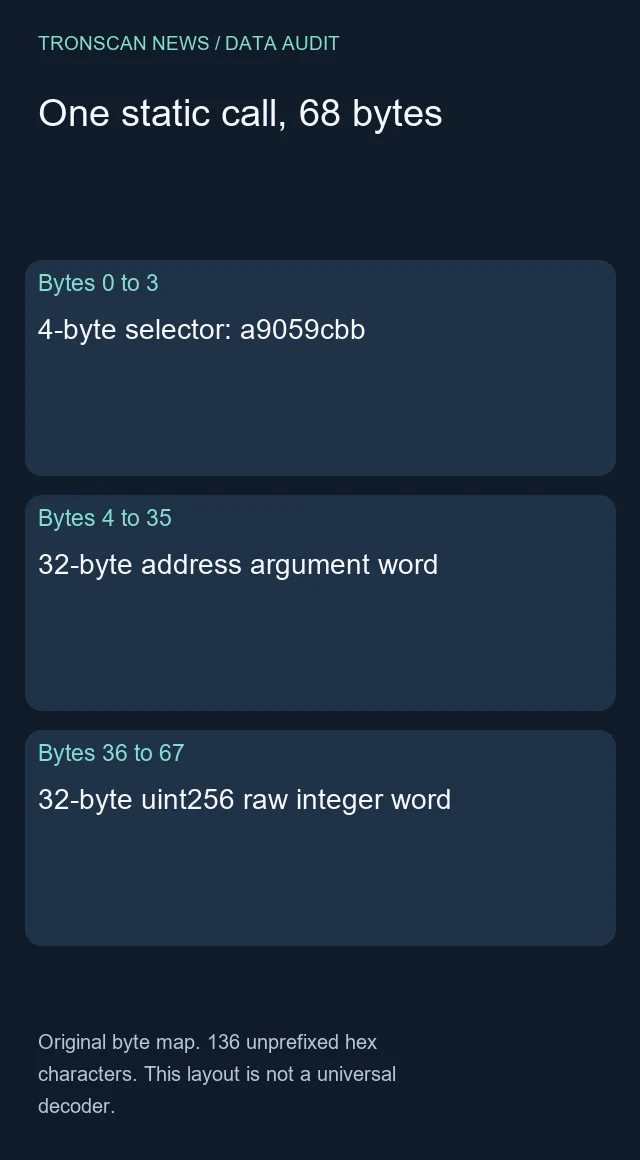
The last word converts to the raw integer 10000000000. This parser does not query decimals or attach a token symbol. To turn a raw integer into a displayed token quantity, establish the exact contract and its scale separately; our TRC20 token-decimal guide covers that next task. Never divide every contract’s integer by one million by habit.
4. Run the local TRON contract input parser
Save the following original example as decode_input.py beside three source files: body.json, contract-source.json and solidified-receipt.json. It uses only the Python standard library. Running it reads local files and prints a bounded interpretation; it does not request a wallet signature or submit a blockchain action.
To collect a fresh read-only copy, send the transaction ID as the value parameter to the body and receipt endpoints, and send the complete target contract as value to GetContract. Save each returned JSON object under the corresponding name. Check the response for Error fields before treating HTTP 200 as a useful observation.
curl -X POST https://api.trongrid.io/wallet/gettransactionbyid -H "Content-Type: application/json" -d '{"value":"74edbce060e3310952b15e6dba91945f9d51914a6238aecbc8a0ab64def38248"}' -o body.json
curl -X POST https://api.trongrid.io/wallet/getcontract -H "Content-Type: application/json" -d '{"value":"41a614f803b6fd780986a42c78ec9c7f77e6ded13c","visible":false}' -o contract-source.json
curl -X POST https://api.trongrid.io/walletsolidity/gettransactioninfobyid -H "Content-Type: application/json" -d '{"value":"74edbce060e3310952b15e6dba91945f9d51914a6238aecbc8a0ab64def38248"}' -o solidified-receipt.json
python decode_input.py
The commands use a shell supporting single-quoted JSON, such as Bash. Shell quoting differs across environments; keep the request body unchanged when adapting it. The endpoints were publicly accessible during our collection, but a later rate limit or provider error should be recorded as a failed retrieval, not converted to empty successful data.
import json
import re
from pathlib import Path

def hex_address(value):
    if not isinstance(value, str) or re.fullmatch(r"41[0-9a-fA-F]{40}", value) is None:
        raise ValueError("Expected a full TRON hex address")
    return value.lower()

def decode_input(body, metadata, receipt):
    if any(not isinstance(x, dict) or "Error" in x for x in (body, metadata, receipt)):
        raise ValueError("Expected three non-error source objects")
    contracts = body.get("raw_data", {}).get("contract")
    if not isinstance(contracts, list) or len(contracts) != 1:
        raise ValueError("This sample requires exactly one contract")
    contract = contracts[0]
    if contract.get("type") != "TriggerSmartContract":
        raise ValueError("Expected smart contract call input")
    value = contract["parameter"]["value"]
    target = hex_address(value.get("contract_address"))
    if hex_address(metadata.get("contract_address")) != target:
        raise ValueError("Metadata belongs to another contract")
    entries = metadata.get("abi", {}).get("entrys", [])
    matches = [e for e in entries if e.get("type") == "Function"
        and e.get("name") == "transfer"
        and [i.get("type") for i in e.get("inputs", [])] == ["address", "uint256"]]
    if len(matches) != 1:
        raise ValueError("Expected one matching transfer ABI entry")
    data = value.get("data")
    if not isinstance(data, str) or re.fullmatch(r"[0-9a-fA-F]{136}", data) is None:
        raise ValueError("This sample requires exactly 68 bytes of unprefixed hex")
    data = data.lower()
    if data[:8] != "a9059cbb":
        raise ValueError("Not the selected transfer signature's selector")
    address_word = data[8:72]
    padding = address_word[:24]
    if padding == "0" * 24:
        form = "standard 20-byte ABI address"
    elif padding == "0" * 22 + "41":
        form = "TRON 21-byte compatibility form"
    else:
        raise ValueError("Address padding outside this example's accepted forms")
    txid = body.get("txID")
    if not isinstance(txid, str) or re.fullmatch(r"[0-9a-fA-F]{64}", txid) is None:
        raise ValueError("Expected a transaction ID")
    if receipt.get("id") != txid:
        raise ValueError("Receipt ID does not match the body")
    return {
        "contract_hex": target,
        "signature_scope": "transfer(address,uint256) only",
        "selector": data[:8],
        "input_bytes": len(data) // 2,
        "address_form": form,
        "argument_to_hex": "41" + address_word[-40:],
        "argument_value_raw": str(int(data[72:136], 16)),
        "displayed_token_amount": "not calculated; decimals not queried here",
        "receipt_result": receipt.get("result", "not provided"),
        "receipt_execution": receipt.get("receipt", {}).get("result", "not provided"),
        "scope": "Input interpretation and reported receipt, not proof of payment or asset identity"
    }

if __name__ == "__main__":
    def load(name):
        return json.loads(Path(name).read_text(encoding="utf-8"))
    print(json.dumps(decode_input(load("body.json"), load("contract-source.json"),
        load("solidified-receipt.json")), indent=2))
The actual output identified 68 input bytes, the standard address form, the address argument above and the raw integer 10000000000. It also printed receipt_result FAILED and receipt_execution OUT_OF_ENERGY. It intentionally left displayed_token_amount uncalculated. Those output fields preserve different evidence levels instead of collapsing everything into a successful-transfer label.
We ran nine synthetic local checks alongside the real record. The parser rejected a wrong contract type, wrong selector, truncated data, non-hex input, different metadata address, missing ABI, mismatched receipt ID and API error. The ninth check supplied the compatibility address form and recovered the same low twenty-byte address. None of these fixtures was submitted to the network.
Our parser checks that one matching Function entry was returned for the queried target. It does not prove bytecode equivalence, audit contract behavior or resolve selector collisions across arbitrary signatures. A documented selector is a useful boundary for a narrow example; it is not a unique global identity certificate.
5. Read the failed receipt separately
The actual receipt demonstrates the central distinction. The supplied arguments can be interpreted under the returned ABI even though the provider reports failed execution. The decoder tells you what this call supplied. The receipt tells you what the queried source reported about execution. Neither should overwrite the other.
Our full-node receipt and later solidified-endpoint response both labelled this record FAILED with OUT_OF_ENERGY. The local parser did not simulate execution or independently reproduce the node’s computation. It reports those source labels and their matching transaction ID. We did not perform a successful transfer comparison or infer an exchange’s deposit-credit decision.
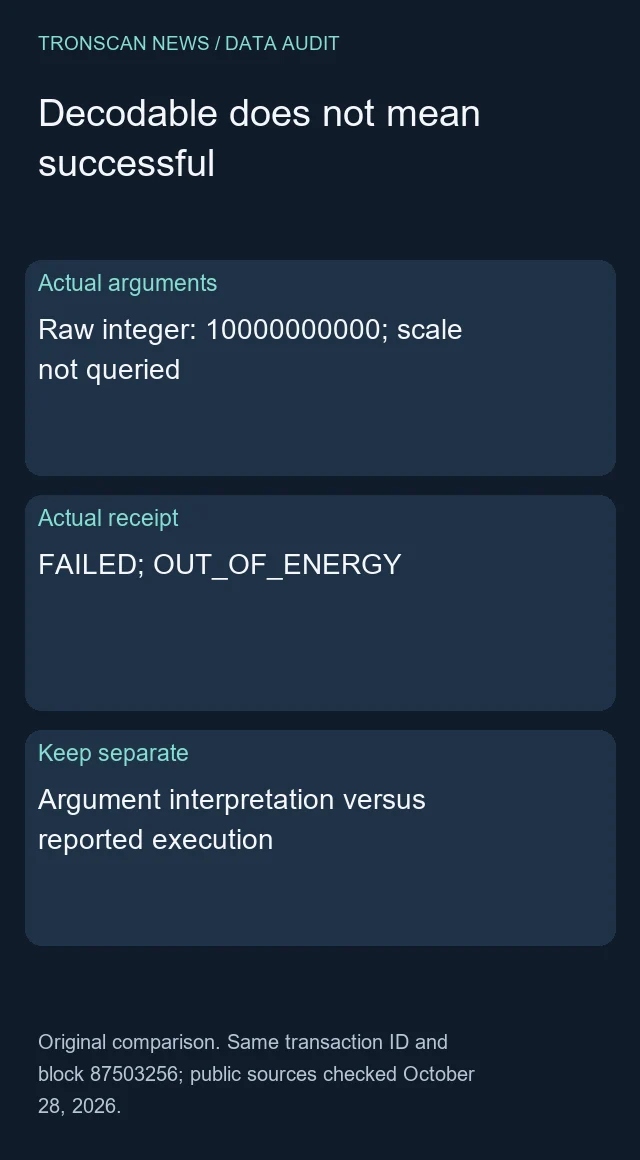
A nonempty contractResult array is not automatically a successful boolean return. In this observation its entry was an empty string. We did not interpret that as true. Always examine the exact return data and execution status in context rather than relying on array presence or the name of the requested function.
If the required interface metadata is unavailable, use the missing ABI read-only decision worksheet before selecting a decoder. It separates a failed metadata request from an empty method list and keeps the declaration tied to the target. Matching metadata here does not authorize a new transaction, establish recipient identity or replace a contract-behavior audit.
6. Handle TRON contract input that does not match
Different selector: stop this parser and obtain the intended contract’s ABI. Do not rename unfamiliar bytes to transfer simply because the string has the same length. Multiple methods can have static arguments, and four selector bytes have a finite range.
Different length: preserve the source before changing it. An additional parameter, dynamic value, display prefix or truncated copy may need a different interpretation. This example rejects those shapes by design; its rejection is not a universal judgment that the on-chain transaction is invalid.
Unexpected address padding: this sample accepts only the documented standard and compatibility layouts. It does not strip arbitrary leading bytes until the address looks plausible. If the target uses a different input structure, investigate its schema with appropriate tools and explicit tests.
Missing or different ABI: keep decoding unresolved. The GetContract response may be incomplete for your purpose, or a different contract may have been queried. Do not silently borrow another token’s ABI because its symbol or display name looks familiar.
Receipt mismatch: match the complete transaction ID before comparing outcomes. A receipt from a nearby block or another similarly sized call does not verify this input. Our code refuses a mismatched ID so that an accidental copy cannot create a false success statement.
Provider error: record both transport status and response body. An API error is different from a transaction’s FAILED execution label. One concerns the observation request; the other concerns the public record returned by a successful observation.
7. Keep a TRON contract input evidence worksheet
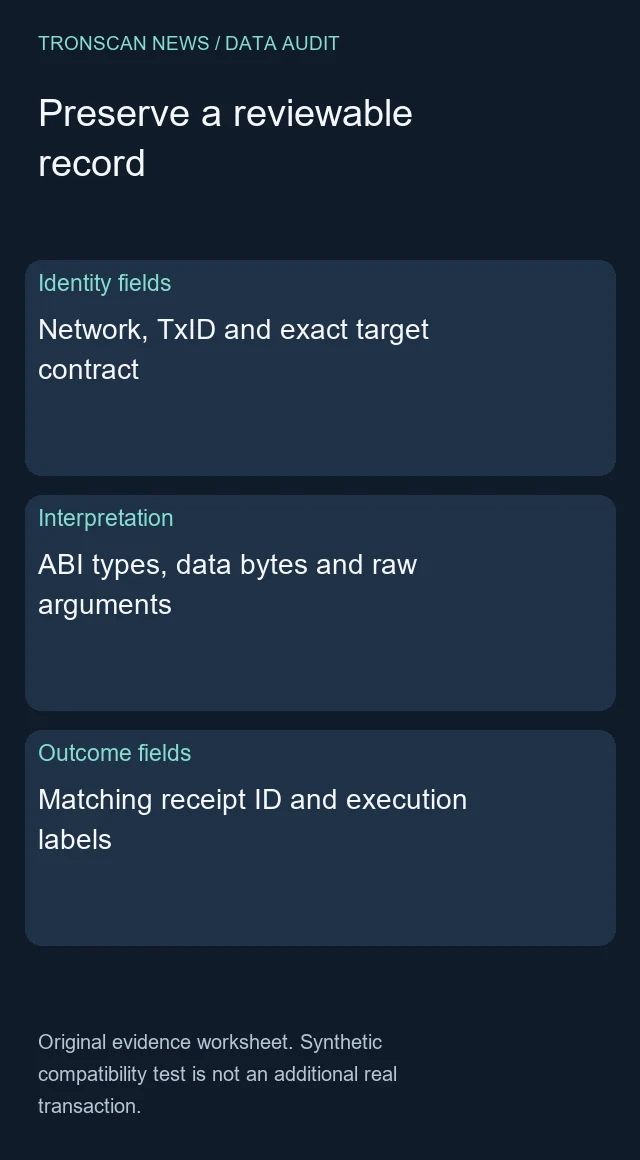
Use this original on-page worksheet for the next case. It is a review template, not a downloadable proof of payment. Copy exact identifiers and leave unresolved fields explicit so the note remains useful when another reviewer checks it later.
| Evidence layer | Preserve | Do not infer automatically |
|---|---|---|
| Source | Network host, retrieval UTC, full transaction ID, block reference | Representative network behavior |
| Input | Contract type, target address, exact data, length and selector | Successful execution |
| Schema | Queried contract address, matching function and ordered types | Brand identity or complete behavioral audit |
| Interpretation | Address form, raw integer and any separately verified scale | Recipient ownership or available balance |
| Outcome | Matching receipt ID, status labels, return data and observation endpoint | Off-chain deposit credit |
Synthetic review exercise: suppose a receipt is replaced by one marked successful while the original input remains unchanged. Even if the decoder still prints the same address and integer, the comparison is invalid when the receipt ID differs. Reproduce that failure locally before trusting a worksheet assembled from several browser tabs.
Now suppose the raw integer is formatted with six decimals without checking the target’s scale. The arithmetic might be internally consistent, but the interpretation depends on an unverified assumption. Keep the integer in the evidence column and move the display conversion into a separate, explicitly sourced step.
Finally, suppose a later source gives a different metadata response. Save it with its own retrieval time and compare the exact target and schema. Do not overwrite the first capture and describe the new metadata as though it had been used in the original test. The inputs needed to reproduce an audit include the schema observation, not just the transaction bytes.
More English tutorials are available from the Tronscan News homepage. Choose the next step by the unresolved question: argument structure, token scaling, contract behavior or receipt interpretation. A precise partial result is more useful than turning a decodable input into an unsupported payment claim.
8. Distinguish the contract target from the address argument
The actual record contains several addresses with different roles. The outer owner_address identifies the caller field supplied in the transaction. The outer contract_address selects the contract being called. The address inside the ABI word is an argument to the selected function. Copying one of these into another column changes the question, even though every string may have a valid-looking TRON format.
Our code matches metadata against the outer contract target, then decodes the inner address word separately. It does not query the argument address as though it were automatically the token contract. This distinction matters when collecting decimals or investigating verification: those tasks require the exact contract whose behavior and units you are interpreting.
Synthetic role-swap exercise: replace the metadata’s contract address with the decoded argument address while keeping the original call. The parser should reject the comparison. Do not repair that failure by weakening the address match. Return to the source and retrieve metadata for the actual target.
For this TRON contract input audit, the observed address roles remain public record fields, not identity assertions. No field alone proves that a person owns an account, that an exchange accepts deposits there or that a payment reached an off-chain customer. Preserve the role label with the complete value whenever you share an investigation note.
Frequently asked questions
Does decoding TRON contract input prove a transfer succeeded?
No. Our real record’s arguments decoded, while its matching receipt reported FAILED and OUT_OF_ENERGY. Keep input interpretation and execution outcome separate.
Can the selector alone identify a trustworthy token?
No. This example checks one documented signature against the target’s returned ABI. It does not establish brand identity, recipient ownership or a complete behavioral audit.
Why does the decoded address need a 41 prefix?
The actual ABI word stores a twenty-byte address payload with zero padding. Our output adds 41 for full TRON hex display. That formatting step does not identify the network endpoint or owner.
Why is the TRON contract input amount left as a raw integer?
The parser did not query decimals. A display conversion needs a separately verified scale for the exact contract, so no token amount or symbol is invented.
Does the local parser sign or broadcast anything?
No. It reads saved JSON files. The collection commands query public data; they do not build, sign or broadcast a new transaction.
Leave a Reply