A missing ABI on TRON means the interface description needed by your reader is unavailable in that context. It does not by itself prove that the contract is invalid, empty, safe or malicious. The next task is to establish the exact contract and an authoritative method declaration before interpreting any returned bytes.
This guide is for readers who cannot see a useful contract method list, or whose read-only application cannot construct one automatically. The success condition is a reproducible note linking the target, method, declared output type and actual result. It is not a wallet transaction. Our 2 November 2026 test used a public TUSD proxy whose stored ABI was available, so it demonstrates a typed read and decoder check, not a live repair of a cleared ABI.
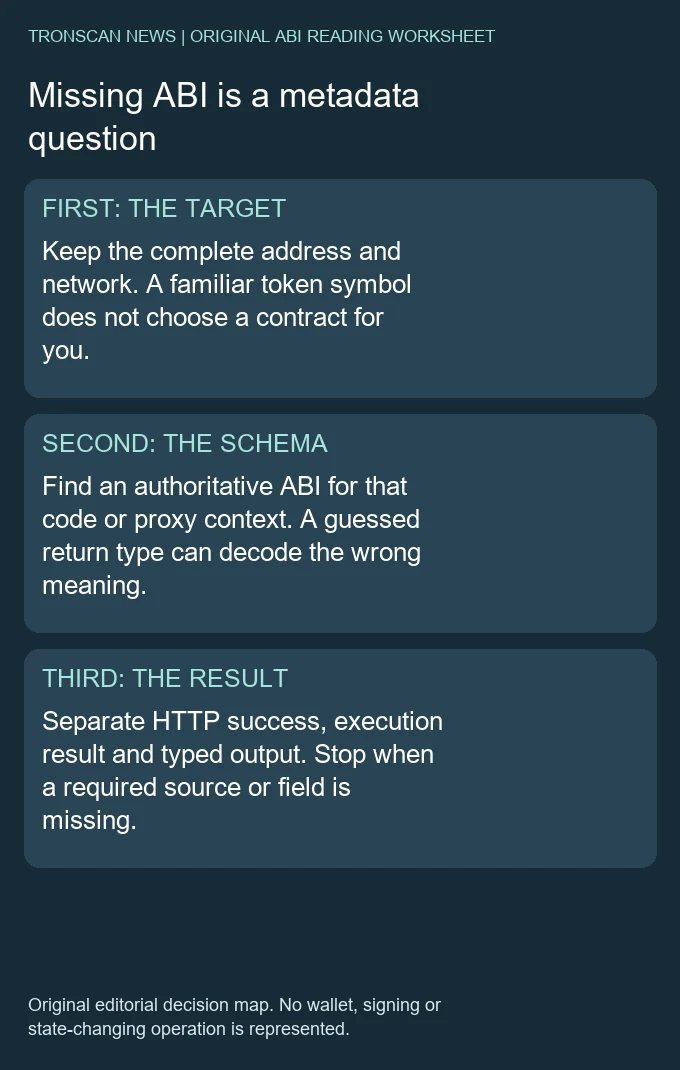
Table of Contents
Four ABI checks before trying another reader
- Identify the exact target. Preserve Mainnet or the named testnet, the full address and the public page you used. A symbol alone cannot identify a token contract.
- Identify the missing layer. An absent explorer panel, a failed metadata request and an empty ABI response are different observations. Retain the actual response or visible error.
- Find a matching declaration. Use verified source or an issuer-maintained reference for that target and proxy context. Keep the provenance with the function signature.
- Use a read-only method and inspect its output. Separate an HTTP response from the method’s execution result and decode only the declared type. Stop if any required evidence is unavailable.
TRON’s official troubleshooting FAQ describes contracts whose ABI was cleared through the deprecated clearAbi API, as well as internally created contracts without a registered ABI. Those are documented possibilities. We did not identify one of those cases merely from a missing button or a slow page.
Which evidence is actually missing?
| Observation | What it establishes | Next useful check |
|---|---|---|
| Read panel is absent or still loading | The current interface has not supplied a usable method list | Keep the page state; check the exact target and documented metadata source |
| Metadata request times out or returns an error | That request failed | Record the error; do not turn it into an empty ABI or a zero balance |
| A successful metadata response contains no usable method entries | No usable entries were supplied by that response | Look for authoritative source and the correct proxy reading context |
| A response contains methods but a decoder fails | The available bytes do not satisfy this decoder’s expected layout | Recheck the declared output type and preserve the raw output |
| A typed result is decoded successfully | The selected decoder accepted those bytes under that schema | State the narrow result; do not infer ownership, safety or payment receipt |
This is an editorial decision table, assembled from the official interface documentation and our bounded reading test. It distinguishes unavailable evidence from a measured result. It does not diagnose every node implementation or explorer outage, and it does not make a partial response trustworthy just because it uses familiar field names.
Use the right ABI for a proxy
A proxy address and its implementation address can have different roles. Keep the code reference separate from the address used for the read. A method list for one context should not be silently treated as an authority map for another. The contract owner and implementation worksheet shows the actual field separation in this TUSD example.
A verified source match is a useful provenance clue, but it is not a complete behavior audit. Use the verified-contract evidence guide when assessing what a source match establishes. Neither an ABI file nor a verified label proves that a returned address belongs to a particular person.
What an explicit ABI changes in a reader
The TronWeb contract documentation shows construction with an explicitly supplied ABI and address. It distinguishes calls for view or pure methods from state-changing sends. Supplying a declaration tells the client how to construct and interpret a method; it does not verify that the declaration matches the deployed code.
We did not install or execute TronWeb in this test. Our actual test used an anonymous HTTP constant-contract request with the exact selector name(). There was no signing key, wallet connection or broadcast. The request’s owner_address was set to the public target as simulation context; it was not proof of authority over that address.
Before adapting an SDK example, verify its documented version and keep it read-only. Do not replace call with send to make an error disappear. Do not enter a private key into a reader to fetch an ABI. If the only available declaration comes from an unverified message or an unrelated token with the same symbol, the method remains unqualified.
The actual Mainnet name() test
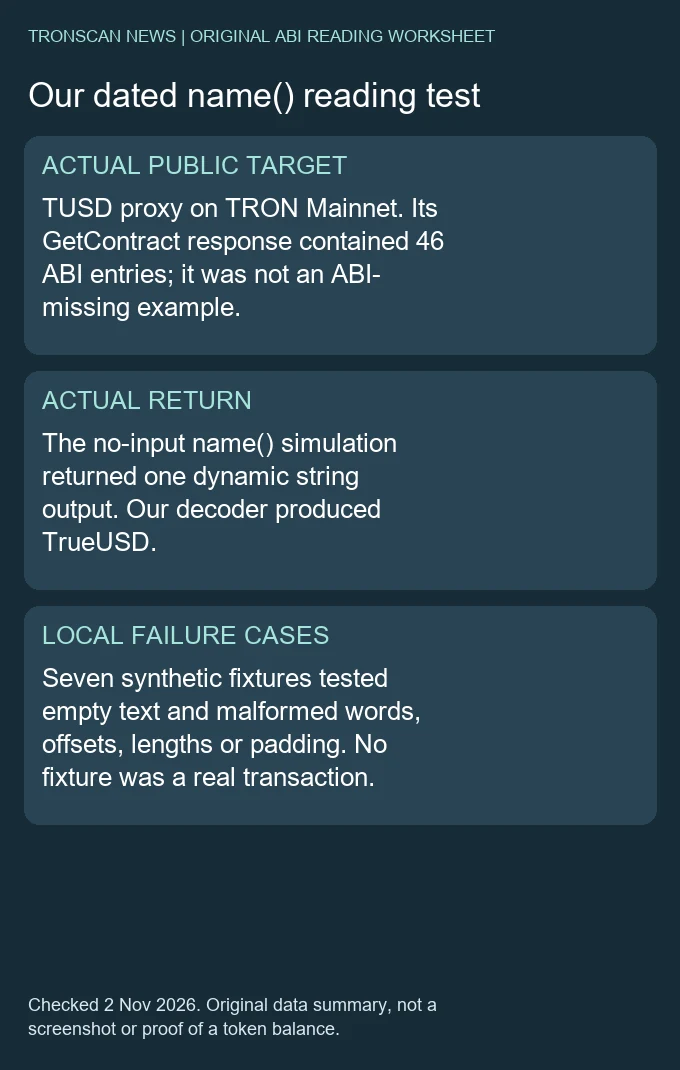
The target was TUpMhErZL2fhh4sVNULAbNKLokS4GjC1F4. Our retained GetContract response contained 46 ABI entries. This matters: an example with available metadata cannot establish that a particular cleared-ABI contract works. We kept that limitation alongside the result instead of presenting it as a repair.
The constant-contract response returned HTTP 200, top-level result.result true and one constant_result value. The retained ABI declares name as a no-input Pure function returning string. The transaction.ret array was [{}], so this response did not provide an explicit TVM ret code; the top-level true is request status, not a mined receipt. The selected output was a dynamic string. Its first word pointed to offset 32, the length word was 7, and the seven content bytes decoded as TrueUSD. The surrounding padding was checked separately. This was a name observation at a time, not a balance or successful transfer.
The request and result format are documented by triggerconstantcontract; output interpretation follows the declared ABI type and the parameter encoding reference. HTTP 200 alone would not have supplied the missing execution or type evidence.
A deliberately narrow local decoder
The copyable Python function below accepts exactly one dynamic string in the tested standard ABI layout. It checks word alignment, offset, total length, zero padding and strict UTF-8. It is not a generic ABI decoder, does not detect a forged contract response, and does not decide whether a token name is authentic. Passing it an address, integer, tuple, multiple output values or historical alternative layout is outside its scope.
def decode_one_string(raw):
    import re
    if not isinstance(raw, str) or not re.fullmatch(r"[0-9a-fA-F]+", raw) or len(raw) % 64:
        raise ValueError("Incomplete ABI words")
    data = bytes.fromhex(raw)
    if len(data) < 64 or int.from_bytes(data[:32], "big") != 32:
        raise ValueError("Expected one dynamic string output")
    length = int.from_bytes(data[32:64], "big")
    end = 64 + length
    total = 64 + ((length + 31) // 32) * 32
    if len(data) != total or any(data[end:]):
        raise ValueError("Length or padding mismatch")
    return data[64:end].decode("utf-8", errors="strict")
Eight local cases passed: one actual public output decoded to TrueUSD; a synthetic empty-string layout decoded to empty text; six malformed synthetic layouts were rejected. The rejection cases changed the offset, truncated the bytes, added an extra word, used odd-length hexadecimal, used non-hexadecimal text or changed the padding. These are local fixture results, not eight on-chain reads.
An empty string can be a syntactically valid string result. It should stay empty text, not become an asset balance of zero. A rejected layout should remain an error. Keep the original bytes for investigation and choose another decoder only after confirming the actual declaration, rather than trying return types until one looks plausible.
When to stop and what to preserve
Stop before a read if the network, target, method provenance or read-only status cannot be established. Stop interpretation if execution failed, the output is missing, or its layout contradicts the declaration. Rate limits and service failures belong in the evidence note; they do not prove that the contract has no code or no tokens.
For a separate output-schema task, use the Boolean return value versus receipt-status worksheet. It compares one saved zero word under a later provider-supplied ABI with execution status and logs, then tests fourteen strict-reader fixtures. A current metadata read does not establish historical ABI correctness or a payment outcome. Link checked November 3, 2026.
Network / complete target / check time:
Observed interface or metadata failure:
Authoritative ABI or source reference:
Proxy address and implementation context, kept separate:
Exact function signature / declared output type:
HTTP status / execution result / missing fields:
Original output bytes / decoder and version:
Typed result / limitations / next required evidence:
This note is the useful deliverable even when no qualified query can be made. It gives a developer or support team a bounded problem to reproduce without exposing signing material. We did not clear an ABI, deploy a contract, alter a proxy, transfer tokens or test the behavior of a live ABI-missing target.
Frequently asked questions
Does a missing ABI mean a TRON contract is invalid?
No. Missing interface metadata alone does not establish deployed code validity or behavior. Preserve the exact observation and check authoritative sources.
Can I use an ABI from a token with the same name?
A shared name is insufficient. The declaration must match the specific target and relevant proxy context.
Do I need a private key to obtain read-only metadata?
Our anonymous metadata request and name simulation used no private key, wallet connection or signature.
Did this test repair a contract with a cleared ABI?
No. Our TUSD example had 46 stored ABI entries. It tested a bounded name read and local output checks.
Does a decoded name prove that a transfer succeeded?
No. A name result is present-state metadata. Transfer execution and historical asset movements require their own transaction and receipt evidence.
Independent Tronscan News review, with AI-assisted drafting and primary-source checks on 2 November 2026. Evidence: two anonymous Mainnet requests, one actual decoded output, seven synthetic fixtures and two original diagrams. No live cleared-ABI repair, SDK execution, signing or broadcast is claimed. Browse the Tronscan News homepage; use About & Standards for corrections.
Leave a Reply