A verified contract on TRONSCAN has passed a source-code matching process; that status is not a security audit, issuer endorsement or promise of a successful payment. Read the status as evidence about the code at a particular address and network. Check identity and the proposed action separately.
This guide is for readers inspecting public contract information. It provides an original evidence matrix and a repeatable seven-question review. It does not verify a new deployment, audit a contract or ask you to connect a wallet.
Table of Contents
What a verified contract status establishes
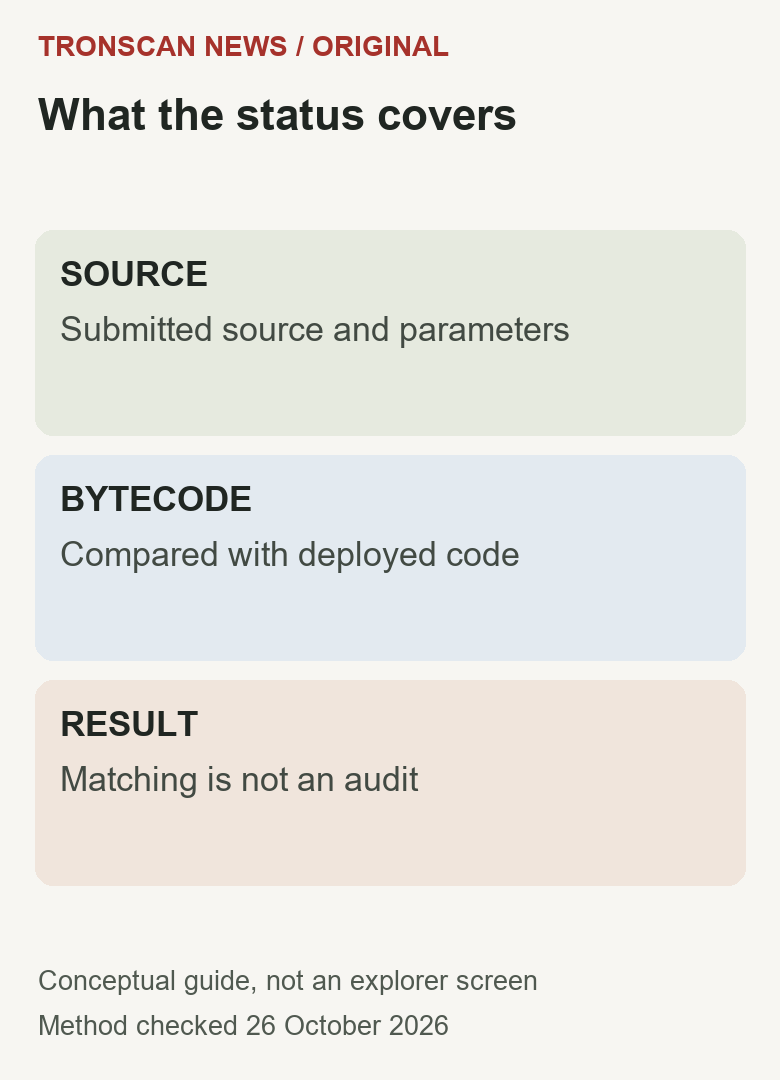
The official TRON verification guide explains that source is compiled with the submitted parameters and compared with deployed bytecode. A successful match makes the source available on the contract page. That is useful: readable source can be reviewed rather than leaving a reader with bytecode alone.
Keep the object of that statement precise. The evidence concerns a contract address, a network and the source matching result. It does not by itself identify every person operating the project, establish a token’s issuer or evaluate whether a particular transaction is appropriate for a reader.
| Observed evidence | Supported conclusion | Additional evidence required |
|---|---|---|
| Verified source status | A source matching result for that deployment | Independent security review for vulnerability claims |
| Source contains a named function | The submitted source exposes that definition | Relevant access conditions and current state |
| Recognizable token symbol | A descriptive label is displayed | Issuer-published network and contract identity |
| Successful parent receipt | That execution’s reported outcome | Asset movement and any platform credit evidence |
This original matrix is an evidence boundary checklist. Use it to stop a valid code-verification finding from expanding into unrelated claims.
Seven questions to ask before interpreting a verified contract
- Which network am I reading? Preserve Mainnet or the named testnet with the address.
- Is this the intended full contract address? Compare against a trusted project or issuer reference, not just a search result’s title.
- What exactly is marked verified? Record the source status and the specific deployment being inspected.
- Which source and compiler settings are published? Keep the available version, optimization and dependency context with your note.
- Which function or behavior matters to my question? Read its arguments, conditions and relevant role checks rather than relying on a method name.
- What independent evidence supports safety or identity? Distinguish source matching, a named audit report and an issuer’s address publication.
- What remains unresolved? State missing information before deciding whether any further action is justified.
Use our TRONSCAN guide for general account and transaction navigation. The review here starts with an already located contract and remains read-only throughout.
A verified contract is not an audit report
A source match allows review; it is not a substitute for that review. A contract can have publicly readable logic while the reader has not assessed its behavior. Treat an audit claim as a separate claim requiring an identifiable report, its scope, date and the exact version or deployment to which it applies.
If a project links a report, compare the contract or version described there with the one you are reading. A report about another deployment does not automatically cover this address. A report can also have exclusions and unresolved findings. Merely seeing the word audited next to a verified contract does not tell you whether those details match.
This article does not rate any project as safe or unsafe. Its practical output is a list of evidence gaps. A reader who cannot establish that an audit covers the relevant version should write “audit scope not established,” rather than converting a missing check into a favorable rating.
Identity remains a separate question
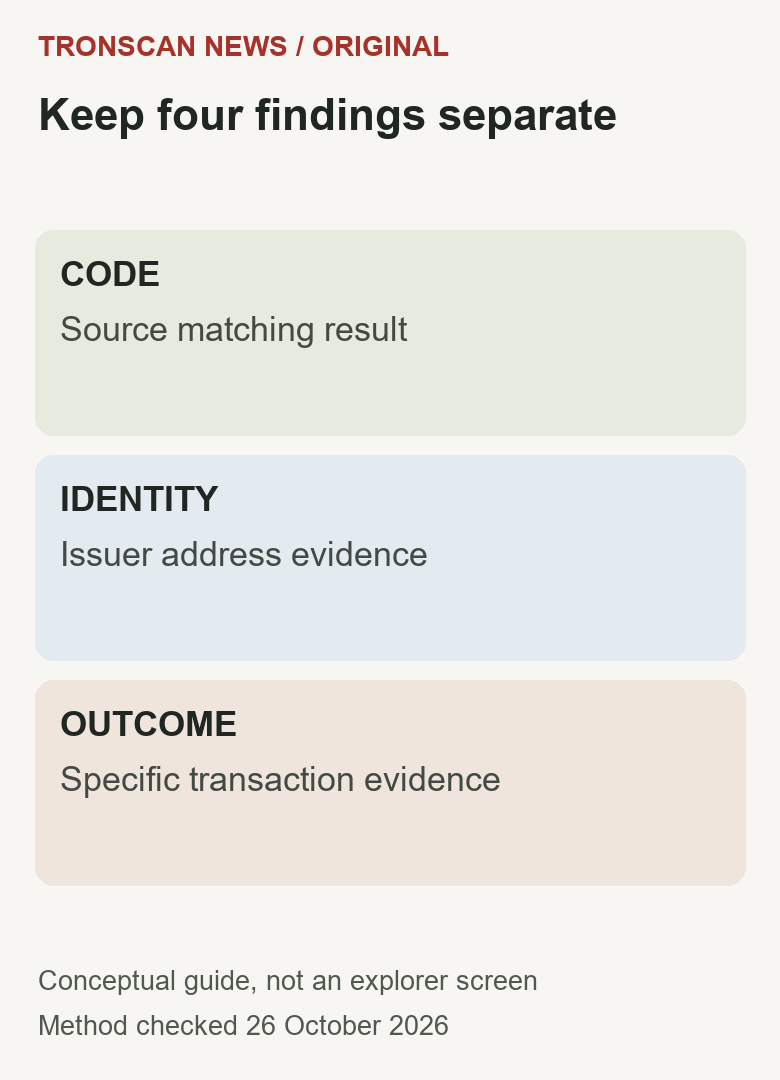
For a token such as USDt, an issuer’s own network and contract publication is an appropriate starting point. The Tether supported-protocols page lists network-specific details. A similar name or symbol on another verified contract is not enough to identify the issuer’s token.
Compare the whole contract address. A shortened prefix and suffix are convenient for display, but they are not the retained identity evidence. Preserve the complete address and network in the worksheet. If a third-party page and the issuer reference disagree, keep the discrepancy unresolved rather than choosing whichever page has a more attractive badge.
For a detailed contract-identity workflow, use the USDT TRC20 contract guide. A verified contract status and an independently matched issuer address can support different parts of the same investigation without replacing each other.
Source visibility does not explain every permission
A function’s name alone is not a permission summary. A method called transfer, withdraw or update may have conditions that matter to the question under review. Read the relevant definition and the associated access checks. If you cannot interpret the code, record that limitation rather than presenting a quick text search as a security review.
Likewise, a published owner-related function does not identify a real-world individual. Keep contract roles, transaction signers and account permission settings conceptually separate. The contract owner and proxyOwner reading worksheet checks three public address returns and separates request context from results, with the scope of each observation stated explicitly.
Not every verified contract has the same governance structure. Do not add a proxy, administrator or upgradeability conclusion simply because those features exist elsewhere. The worksheet has a field for “relevant control mechanism,” but that field can remain unestablished until the source and current context support an answer.
A synthetic three-claim review
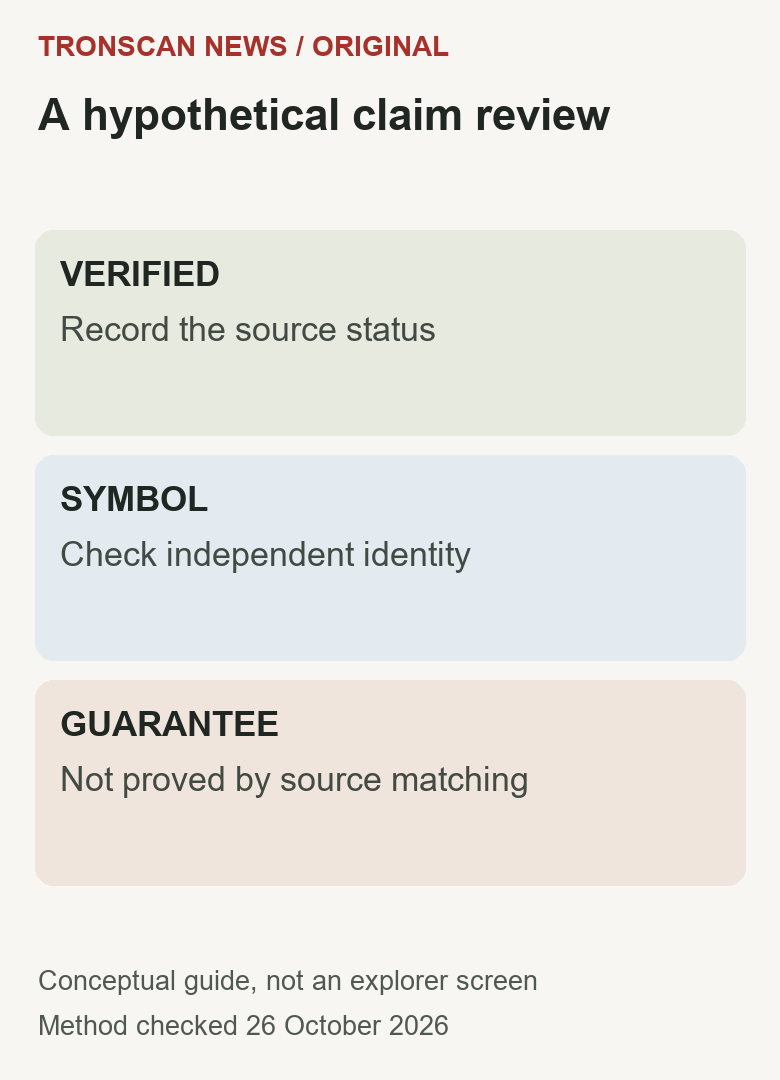
Consider a hypothetical page that displays a source-verification status, the symbol USDt and a sentence claiming that a deposit is guaranteed. These are three separate claims. Our matrix would record the first as a source-matching observation, the second as a label requiring issuer identity evidence and the third as a claim unsupported by the verification status.
Now suppose the same page also links an audit report. The next task is to compare the report’s address or version and scope. That link is a lead for review, not a reason to merge all three claims into one verified-contract conclusion. This exercise describes no real project, contract or deposit.
The useful result is a short table with four columns: claim, available evidence, evidence gap and next read-only check. The absence of one item does not erase the evidence already observed for another. Equally, a valid source match cannot fill an unrelated identity or crediting gap.
How to retain a reproducible verification note
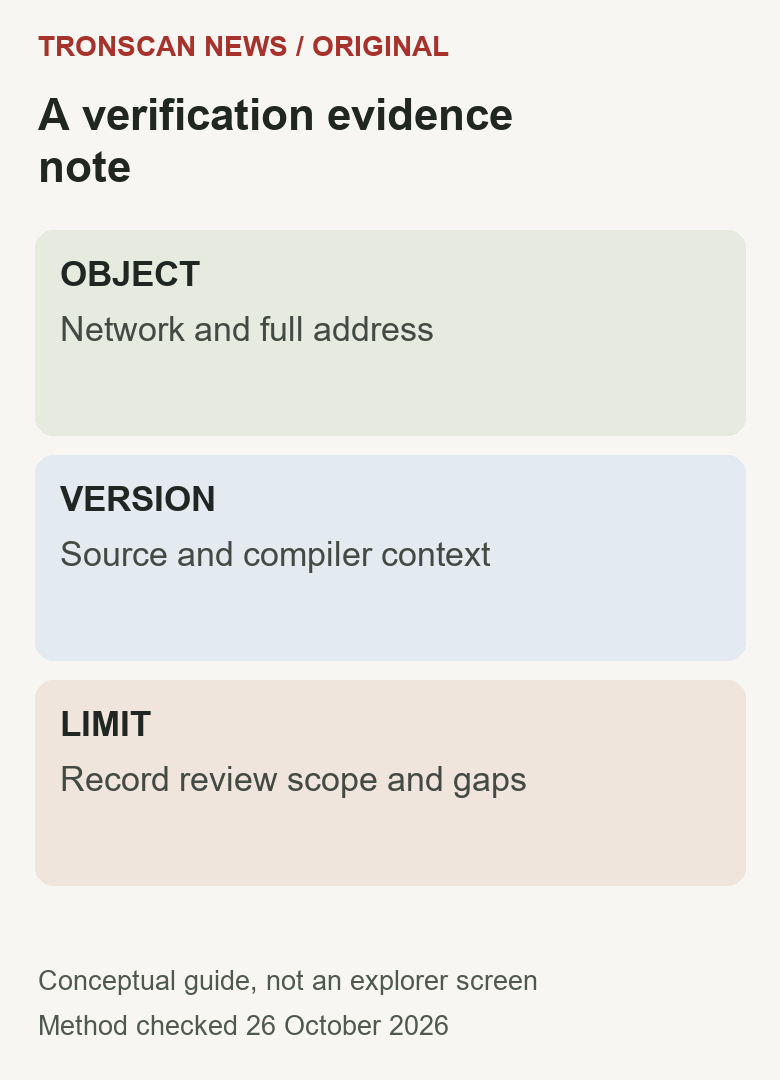
Record the public URL, complete address, network and observation date. Copy the displayed source-verification status and the available source/compiler identifiers. If a version or dependency cannot be established, preserve that uncertainty rather than filling in a familiar default.
Next, write the particular behavior being investigated. “Is this contract safe?” is too broad for a small record check. A narrower question might be whether a published definition includes a particular role restriction. State exactly which source section you reviewed and what additional state or expertise would be needed to interpret it.
Finish with separate findings for code matching, issuer identity, independent review and transaction outcome. A second reader should be able to repeat each observation from the retained references. Do not describe the entire verified contract as audited when the actual work was only a status and identity check.
When a verified contract result is unavailable
The TRONSCAN support instructions explain that verification depends on the correct deployment, source and compiler parameters. A mismatch or wrong network can prevent verification. Those instructions are for submitters; this article has not tested a new verification submission.
For a reader, a loading error is not equivalent to an unverified result. Keep the actual error, address and time. If the public source is unavailable, say so. Do not infer maliciousness from a temporary connection failure or infer safety from the lack of a visible warning.
Reading a verified contract does not require approving token spending. If a site unexpectedly asks for a signature while your intended task is only to read source information, pause and reassess the task. Source visibility is not a reason to authorize a separate wallet action.
Verified contract FAQ
1. Does verified mean officially endorsed?
No. Source matching is a technical status. Official issuer identity requires its own trusted evidence.
2. Does a verified contract guarantee no bugs?
No. It makes matched source available for review; it does not replace an independent assessment of the logic.
3. Can I read source without connecting a wallet?
Public source inspection is a read-only task. This guide requires no signature or transaction.
4. Is an unverified result proof of a scam?
No. Record the actual status and limits of available evidence. Do not turn missing source evidence into an unsupported accusation.
5. Does verification prove my payment was credited?
No. Review the particular parent receipt, asset movement and any receiving platform’s separate crediting record.
Sources and review scope
Checked 26 October 2026 by Tronscan News with AI-assisted drafting and official-source review. The matrix and hypothetical claim exercise are original editorial materials. No contract was deployed, submitted for verification, audited or signed during this work. This independent publication does not certify projects. More guides and the corrections policy are available from Tronscan News.
Leave a Reply