A TRON memo is the optional byte string in a transaction body’s raw_data.data field. If the API represents it as hexadecimal, convert those exact bytes first and attempt text decoding only with an explicit encoding. Readable output does not establish who wrote the message, whether a payment succeeded or whether you should follow a link inside it.
This guide helps you inspect a TRON memo without connecting a wallet, editing a transaction or broadcasting anything. It includes a tested local decoder, synthetic examples and an evidence worksheet. Success means identifying the correct field and reporting absent, empty, malformed, non-UTF-8 or readable results without silently changing the source.
Checked October 28, 2026 by the independent Tronscan News editorial team. AI assisted drafting and original diagrams; we checked the primary sources, performed one read-only Mainnet body query and ran the local fixtures described below. We did not sign a transaction, test exchange credit or establish a real memo author’s identity. The About & Standards navigation explains our editorial and corrections policy.
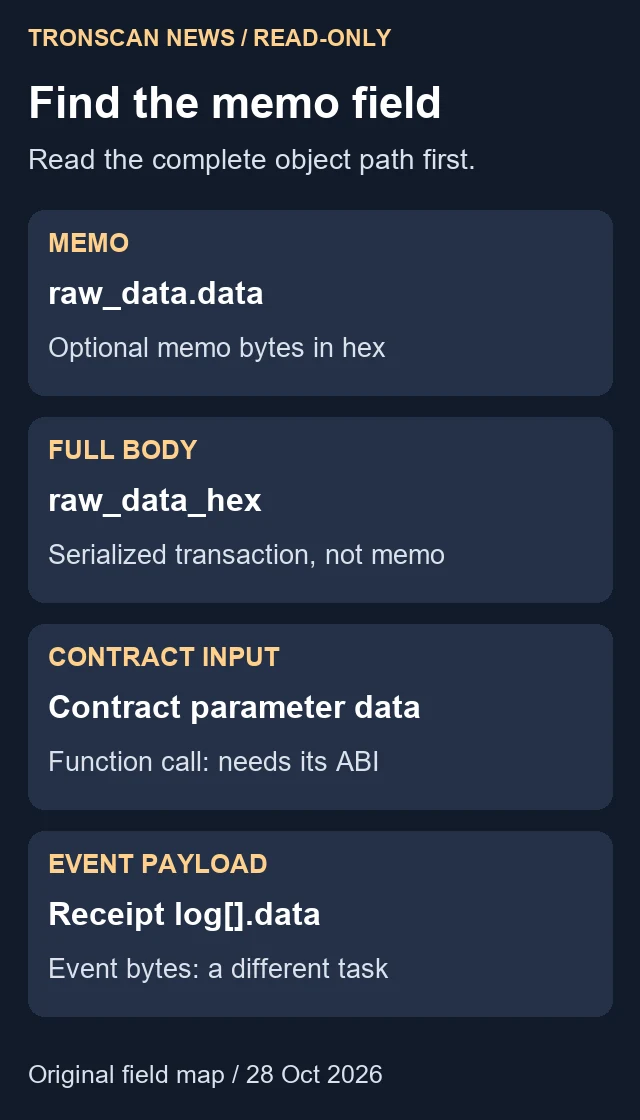
Table of Contents
1. Find the correct TRON memo field
The official transaction-structure guide identifies raw_data.data as an optional memo represented by hex bytes. That path is more specific than the word data. Start with a transaction body from the intended network and retain its complete transaction ID.
| Field or object | What you are inspecting | Use this memo decoder? |
|---|---|---|
raw_data.data |
The optional transaction memo byte string | Yes, when supplied as the hex string described here |
raw_data_hex |
Serialized transaction body | No; it is not a memo-only string |
| Data inside a contract parameter | Smart-contract call input | No; select the correct contract and ABI interpretation |
log[].data in a receipt |
Event payload | No; event decoding is a different task |
The official encoding documentation distinguishes structured raw_data from the serialized raw_data_hex body. Converting the entire serialized body to text and finding a few readable characters does not isolate a TRON memo.
Our field map is a selection rule, not a claim that an explorer currently presents all four fields in the same screen. We tested the API response and local decoding path below. We did not test a changing explorer interface’s memo button or promise that a particular wallet exposes a memo panel.
If your starting point is an event record, use our guide to TRON event logs before choosing a decoder. Mixing event bytes with memo bytes can produce convincing-looking text while answering the wrong question.
2. Retrieve a TRON memo through a read-only body lookup
- Confirm the network and complete transaction ID from your original record. A similarly named asset or shortened address does not select a transaction.
- Use the documented transaction-body lookup for that network. For Mainnet, the tested endpoint here was
https://api.trongrid.io/wallet/gettransactionbyid. - Send a read-only POST query with the JSON body
{"value":"YOUR_COMPLETE_TRANSACTION_ID"}. Replace the placeholder only with the transaction you intend to inspect. - Check both the HTTP result and response body. An Error response is not a transaction with an empty memo.
- Save the complete response as
transaction-source.json, then inspectraw_dataand itsdatamember without modifying the saved source. - Run the local decoder or follow the decision table. Keep the lookup result separate from any interpretation of the message.
The GetTransactionById reference describes a transaction-body query, not an execution-receipt query. Its example host is Shasta, so explicitly select Mainnet when working with a Mainnet record. It also warns that HTTP 200 can accompany an Error-only body.
For a reproducible method check, we requested the current Mainnet block and selected the first transaction in that one response. At 04:47:05 UTC on October 28, 2026, the block query and the subsequent transaction-body query each returned HTTP 200. The returned block number was 87,496,515.
The selected transaction ID was c9b38bc4f2cdce616d2b23e8d45e118438128fbc592d33e1c4f5a7f28cf931f2. Its returned raw_data object did not contain a data member. Our decoder therefore reported absent_in_response.
That is one actual lookup result, not a representative survey of memo use. It supplies no real message to quote and no estimate of how often TRON transactions include memos. We did not request its execution receipt or independently verify finality for this exercise. Every readable message used in the remaining examples is synthetic.
If you still need to locate the correct transaction, follow our transaction lookup guide. A failure to find a body on one network must be resolved before treating its memo as absent.
3. Classify a TRON memo before displaying it
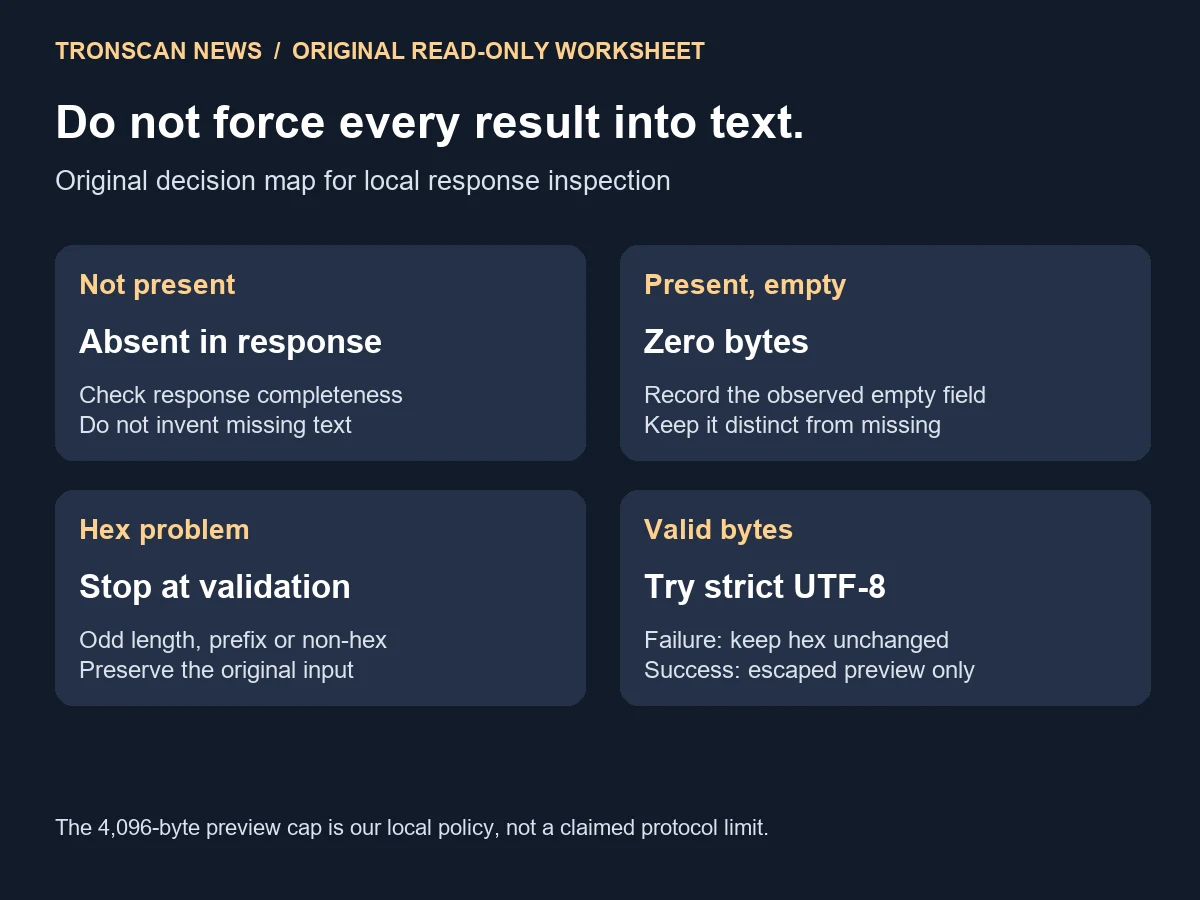
Use this original decision table before trying to read a sentence. The states describe our inspection workflow. They are not transaction execution statuses and cannot replace a receipt result.
| Observation | Report | Next action |
|---|---|---|
| No usable transaction body or raw_data object | Lookup or input unavailable | Resolve the source; do not infer a memo value |
| raw_data exists, data member absent | Absent in this response | Preserve the response and scope |
| data equals an empty string | Present and empty; zero decoded bytes | Keep distinct from a missing member |
| Odd-length or non-hex string | Invalid under this decoder’s input policy | Recheck the original field; do not auto-repair it |
| Valid bytes, strict UTF-8 fails | Non-UTF-8 bytes preserved as hex | Do not invent replacement text |
| UTF-8 succeeds | Decoded preview with control/format flag | Keep output escaped and treat meaning as unverified |
An empty string and a missing member may both produce no visible message, but the source observations differ. Keep that difference in your note instead of inventing a story about whether someone intentionally removed a message. The local decoder does not establish the reason for either response shape.
Hexadecimal uses two digits for each byte. A seven-byte message has fourteen hex digits, but a seven-character message need not have seven bytes under UTF-8. Keep byte length and character count in separate columns when comparing records.
We deliberately reject whitespace and a 0x prefix in this example’s input. Some general-purpose conversion libraries accept alternative formatting, but silent cleanup would obscure what was actually copied. If an interface adds display formatting, save the original representation and document a separate normalization step before using another decoder.
Non-UTF-8 does not mean that the bytes are fraudulent, encrypted or damaged. It means only that this chosen text interpretation failed. Another encoding might be appropriate if the source specifies it, but guessing encodings until a readable phrase appears is not reliable evidence of the writer’s intended message.
4. Run the tested local TRON memo decoder
Save the code below as inspect_memo.py beside transaction-source.json. Run python inspect_memo.py in that folder. The code uses Python’s standard library, reads one local file and prints escaped JSON. It contains no wallet connection, network request, signing or broadcast method.
import json
import re
import unicodedata
from pathlib import Path

MAX_BYTES = 4096  # Local preview policy, not a TRON protocol limit.

def inspect_memo(transaction):
    if not isinstance(transaction, dict) or "Error" in transaction:
        raise ValueError("Expected a transaction body")
    raw = transaction.get("raw_data")
    if not isinstance(raw, dict):
        raise ValueError("Missing raw_data object")
    if "data" not in raw:
        return {"status": "absent_in_response"}
    value = raw["data"]
    if not isinstance(value, str):
        return {"status": "invalid_type"}
    if value == "":
        return {"status": "empty", "bytes": 0}
    if len(value) > MAX_BYTES * 2:
        return {"status": "preview_limit", "hex_characters": len(value)}
    if len(value) % 2 or re.fullmatch(r"[0-9a-fA-F]+", value) is None:
        return {"status": "invalid_hex"}
    data = bytes.fromhex(value)
    result = {"bytes": len(data), "hex": data.hex()}
    try:
        text = data.decode("utf-8", errors="strict")
    except UnicodeDecodeError:
        return dict(result, status="non_utf8")
    flagged = any(unicodedata.category(c).startswith("C") for c in text)
    return dict(result, status="utf8", text=text,
                control_or_format_present=flagged)

if __name__ == "__main__":
    tx = json.loads(Path("transaction-source.json").read_text(encoding="utf-8"))
    print(json.dumps(inspect_memo(tx), ensure_ascii=True, indent=2))
The Python byte-conversion documentation describes hex-to-bytes conversion and strict decoding errors. Our added validation narrows the accepted input format. The 4,096-byte preview cap is our local inspection policy, not a statement about TRON’s protocol maximum.
For our real lookup response, the program printed {"status": "absent_in_response"}. It did not print synthetic text as though it came from that transaction. You can reproduce that branch with the synthetic object {"raw_data":{}}, but that fixture is not a substitute for the complete retrieved response.
The preview limit is checked before decoding so a very large local string is not expanded into a large display. A preview_limit result means the program declined to inspect that input under its policy; it does not mean the transaction itself violates a network rule. Preserve the source and choose a deliberately reviewed workflow if a larger record needs analysis.
The code normalizes valid hex to lowercase only in its derived output. It leaves the source file untouched. Uppercase and lowercase hex digits encode the same bytes, so a casing difference alone is not a different memo. A changed digit can change the bytes and must be investigated separately.
For valid UTF-8, the code flags Unicode categories beginning with C, including controls and format characters. This is a limited display warning, not a complete detector for misleading text. A message can be deceptive without containing any flagged character. The JSON output uses ASCII escapes so a hidden control or direction marker is represented visibly rather than interpreted as terminal formatting.
5. Check the TRON memo examples and test boundaries
We ran sixteen synthetic local fixtures on October 28. All produced the expected classification or deliberate input error. These fixtures test our program’s behavior; they do not simulate a signed transfer, certify an exchange process or prove the identity of a sender.
| Synthetic input | Expected result | What it tests |
|---|---|---|
| data absent; data empty | absent_in_response; empty | Two source states remain distinct |
4e6f7465203432 |
7 bytes; text Note 42 | Ordinary ASCII carried as hex |
436166c3a9 |
5 bytes; text Café | UTF-8 byte count differs from visible characters |
123; zz |
invalid_hex | Odd length and invalid characters |
41 42; 0x4142 |
invalid_hex | No silent whitespace or prefix removal |
fffe |
non_utf8; exact two bytes retained | Strict decoding instead of replacement |
410042; 41e280ae42 |
UTF-8; control/format flag true | NUL and a direction-format character remain escaped |
| Integer instead of hex string | invalid_type | Input type is checked before conversion |
| 4,097 repeated bytes | preview_limit | Our local cap is enforced |
| Error-only object; missing raw_data; raw_data list | ValueError in each case | Invalid body shapes do not become empty memos |
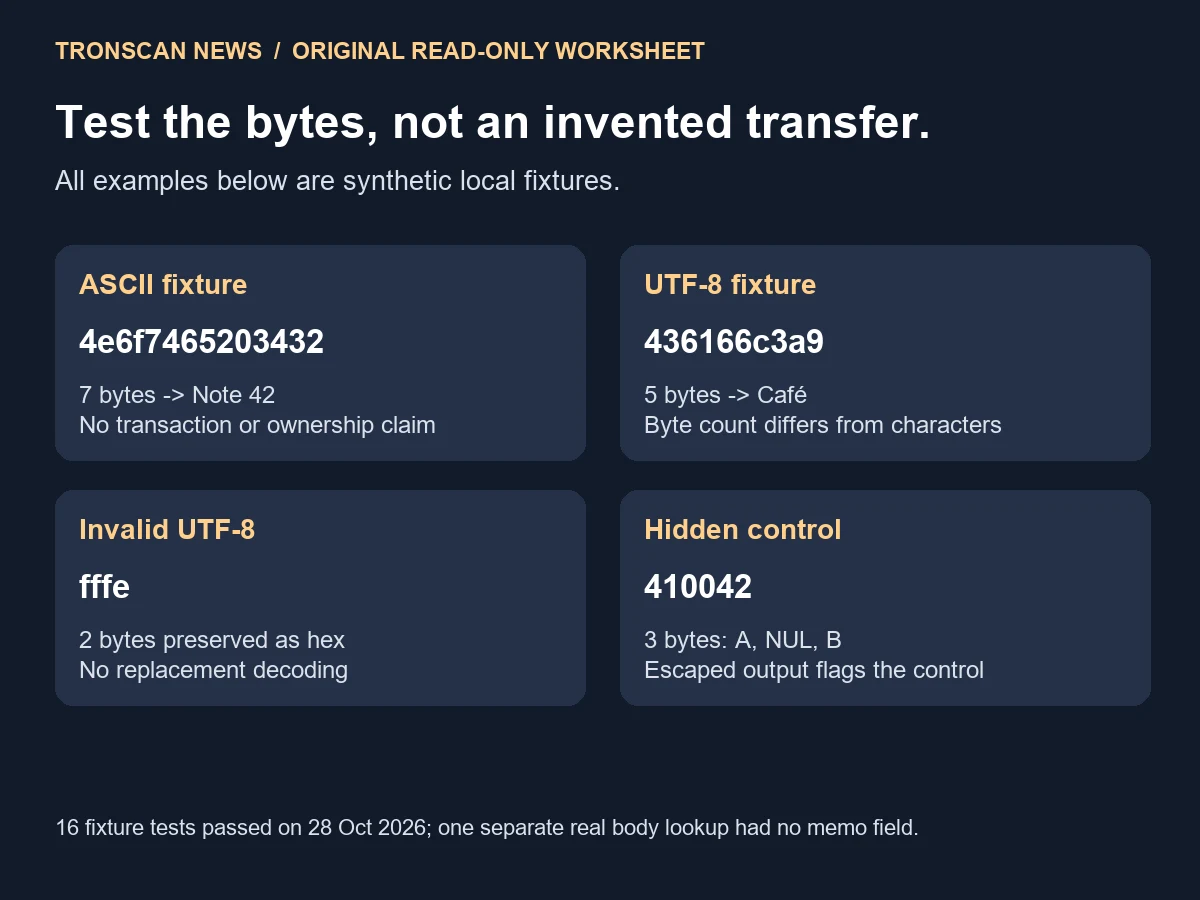
If a different tool displays a replacement symbol for the fffe fixture, the two tools have not produced equally strict interpretations. Compare their error policies before comparing the displayed text. A convenient preview may discard information that a source-preservation workflow needs.
Similarly, a rendered NUL may look like nothing, and a direction-format character may affect how nearby characters appear. Copying only the visible sentence can therefore lose evidence. Retain original hex and an escaped output alongside any human-friendly rendering.
A successful UTF-8 result is only one completed step. The program does not validate signatures, prove that a body belongs to a particular block or inspect the transfer asset and amount. Those questions require their own records and should remain separate in your report.
Synthetic comparison exercise: suppose two tools show Note 42 for the same example. One preserves the original fourteen hex digits; the other gives only a screenshot of the visible words. The displayed text agrees, but the supporting records are different. Ask for the original field and decoding policy before claiming that the two tools independently verified a real transaction.
Now suppose another display shows the same words after silently discarding a control byte. The visible agreement does not establish byte equality. Compare the complete hex values first, then identify the deliberate transformation. This exercise concerns local representations, not a claim that any specific wallet or explorer performed such a transformation.
6. Preserve a TRON memo without following its instructions
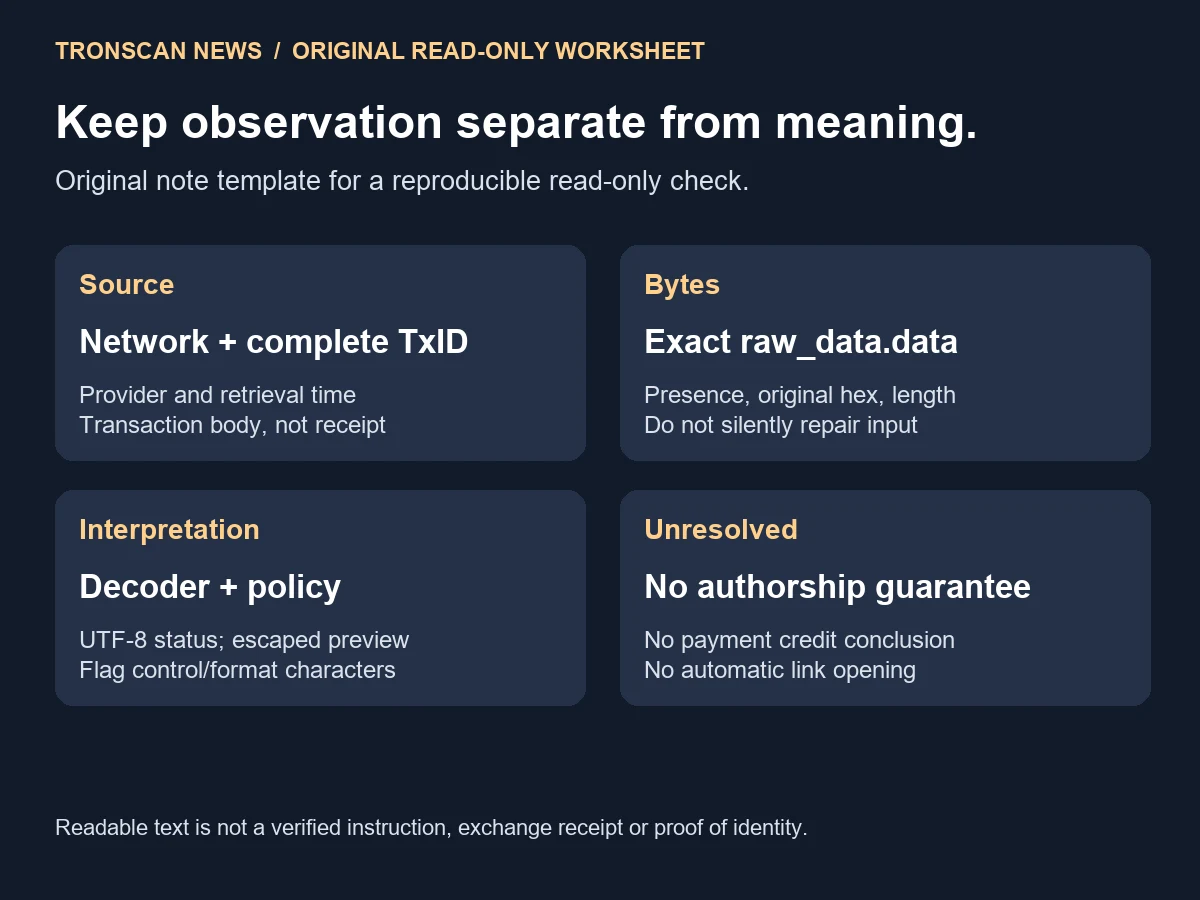
Use the original worksheet below when another person needs to reproduce your check. It is a note template, not a downloadable file or an official transaction receipt. Complete it with your actual observation rather than copying our synthetic text into a real support case.
| Record group | Fields to retain | Interpretation boundary |
|---|---|---|
| Source | Network, complete TxID, provider, retrieval UTC, response status | One provider observation, not universal availability |
| Field | Exact raw_data.data presence, original hex, decoded byte count | Do not substitute contract or event data |
| Method | Decoder version, encoding, error policy, preview cap | A text preview is a derived interpretation |
| Result | Classification, escaped preview, control/format flag | Readable does not mean verified or trustworthy |
| Unknowns | Authorship, purpose, execution outcome, exchange credit | Keep unsupported conclusions explicitly unresolved |
Do not open a web address, run a command, call a phone number or connect a wallet merely because decoded memo text requests it. Treat the message as untrusted source material. A memo can contain words that resemble an official notice without supplying evidence of that authority.
If you need an exchange or wallet provider to review a transaction, use its independently verified support path. Keep the source record and your decoded interpretation clearly labelled. A memo containing an invoice number does not by itself establish that the exchange credited the deposit or that the invoice belongs to the person asking you to pay.
Preserve an untouched response file and separate derived notes. Our read-only record preservation workflow explains how to detect later file edits while keeping the limits of a local fingerprint clear. Do not edit the body of an already signed transaction as a way to fix its recorded memo.
Before sharing the output, review whether it includes unnecessary personal information. A public transaction field can still contain text that you should not repeat widely. Preserve enough context to support the task and avoid presenting an unrelated person’s message as your own evidence.
For a support note, distinguish three statements: what the source returned, what your decoder displayed and what you still need the provider to investigate. For example, an absent field is an observation; a proposed reason for the absence is an interpretation. Keeping them separate makes a support request easier to assess without overstating the result.
If the source response later changes, retain both retrieval times and compare the exact field paths. Do not overwrite the earlier note with a new text preview and describe the resulting document as the original observation. The worksheet is useful because it preserves the boundary between collection and interpretation, even when the final answer remains unknown.
More English read-only tutorials are available from the Tronscan News homepage. Choose the next guide according to the remaining task: transaction identity, event interpretation and file preservation need different evidence.
Frequently asked questions
Where is a TRON memo stored in the transaction body?
The optional memo field is raw_data.data. This guide expects its hex representation. It is different from raw_data_hex, smart-contract call input and receipt event data, even when an interface uses a similar label.
Why does my TRON memo not decode into readable text?
The field may be absent, empty, copied incorrectly or contain bytes that are not valid UTF-8. Report the observed state. Do not silently replace bytes or guess an encoding solely to obtain a readable phrase.
Does decoded memo text prove that a payment succeeded?
No. Text decoding does not inspect an execution receipt or exchange credit. A readable message and a transaction’s execution outcome are separate questions, and an invoice-like message is not proof of identity.
Can the local decoder change or approve a transaction?
No. The example reads a local JSON file and prints an escaped interpretation. It contains no signing, broadcast or wallet-connection operation. Keep the original response untouched when preserving evidence.
Is the decoder’s 4,096-byte cap a TRON network limit?
No. It is our local preview policy to keep the example bounded. A preview_limit result does not establish that a transaction violated a protocol rule, and it should not be reported as a failed transfer.
Leave a Reply