USDT transfer Energy can differ between successful TRON calls to the same token contract. Compare the recorded Energy total, its penalty component and the payment fields separately. A higher resource count does not automatically mean a larger TRX burn, and two receipts alone do not prove why their execution paths differed.
We checked two successful calls in Mainnet block 87521304 on October 29, 2026. Their recorded Energy totals were 130285 and 64285. This guide provides the exact identifiers, a reproducible comparison program and an evidence worksheet. It is for readers investigating an observed difference, rather than shopping for a guaranteed transfer price. The Tronscan News homepage provides the wider independent guide collection.
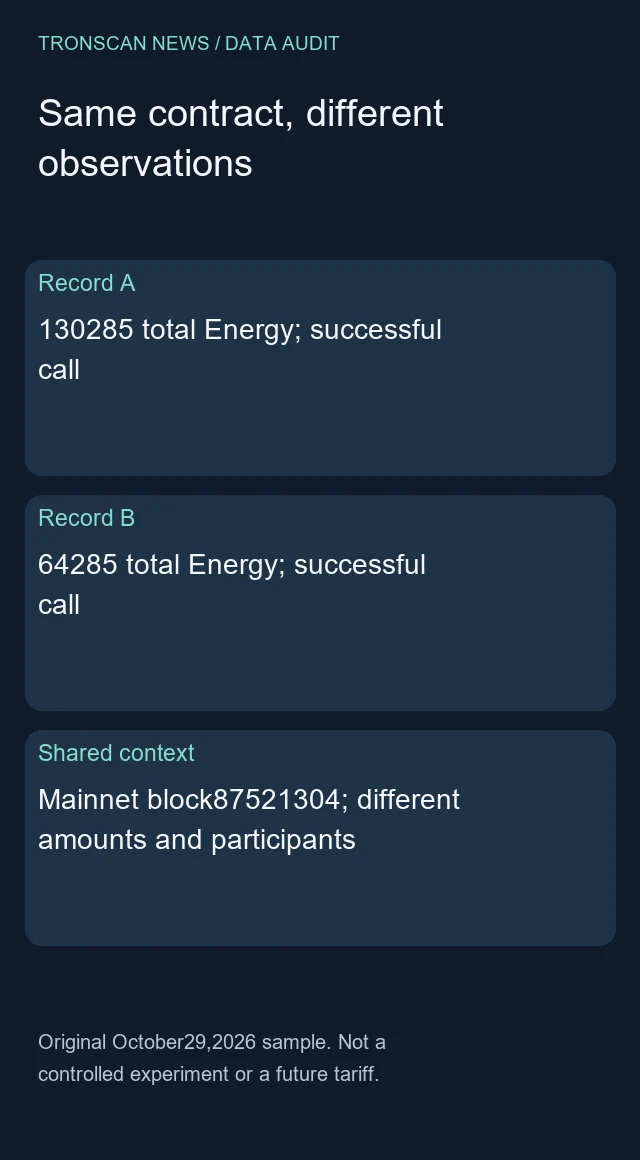
Table of Contents
1. Select records that answer the same question
Start with a clear success criterion: two complete bodies and their matching successful receipts, on one network, calling the same contract operation. That makes their resource fields worth comparing. It does not make them identical experiments. Amounts, participants, prior storage and caller resources can still differ.
- Keep the network and source endpoint with each export. A testnet receipt and a Mainnet receipt should not be presented as one current fee comparison.
- Match each body’s complete TxID with the receipt’s identifier. A fee from a neighboring account-history row is not evidence about your selected transaction.
- Check the contract address and operation. A token symbol alone cannot distinguish an issuer’s token from an unrelated contract with the same name.
- Check execution status. This worked comparison deliberately uses successful calls; it does not mix a completed transfer with an out-of-Energy failure.
- Retain the raw numeric fields, including whether a field was absent. Do not replace blanks with zeros while building the worksheet.
The official receipt API reference separates transaction execution information from the submitted body. It also warns that an API error may arrive with HTTP 200. Check content, not just transport status, before treating a response as a usable receipt.
For this sample, the contract was 41a614f803b6fd780986a42c78ec9c7f77e6ded13c, the hex form of the TRON USDT contract listed by Tether’s supported-protocols page. Both saved inputs began with the transfer selector a9059cbb. We did not connect a wallet, pay for a transfer or infer a private exchange relationship.
The TRON USDT guide separates the token, native TRX and network choice before this resource-level comparison.
2. Inspect the dated USDT transfer Energy pair
Record A was 0cc9921b51da05794785892f8a80ce2c2de48cc402eef7ed875cf1040cff847f. Record B was 0ac1f639ac633839cc23df001f25fd435646e939c147a753bada7bf91a8a16c2. Both receipts placed the calls in block 87521304 and reported SUCCESS.
| Saved field | Record A | Record B |
|---|---|---|
| energy_usage_total | 130285 | 64285 |
| energy_penalty_total | 100635 | 49635 |
| Total minus penalty | 29650 | 14650 |
| energy_usage | 130284 | 64285 |
| origin_energy_usage | 1 | Not supplied in this JSON |
| net_fee | 345000 SUN | Not supplied in this JSON |
| net_usage | Not supplied in this JSON | 345 |
| Top-level fee | 345000 SUN | Not supplied in this JSON |
The TRONSCAN transaction-field reference documents the named total, penalty and payment fields. Our numbers below come from the saved node receipts, not a claim that we tested that separate explorer API.
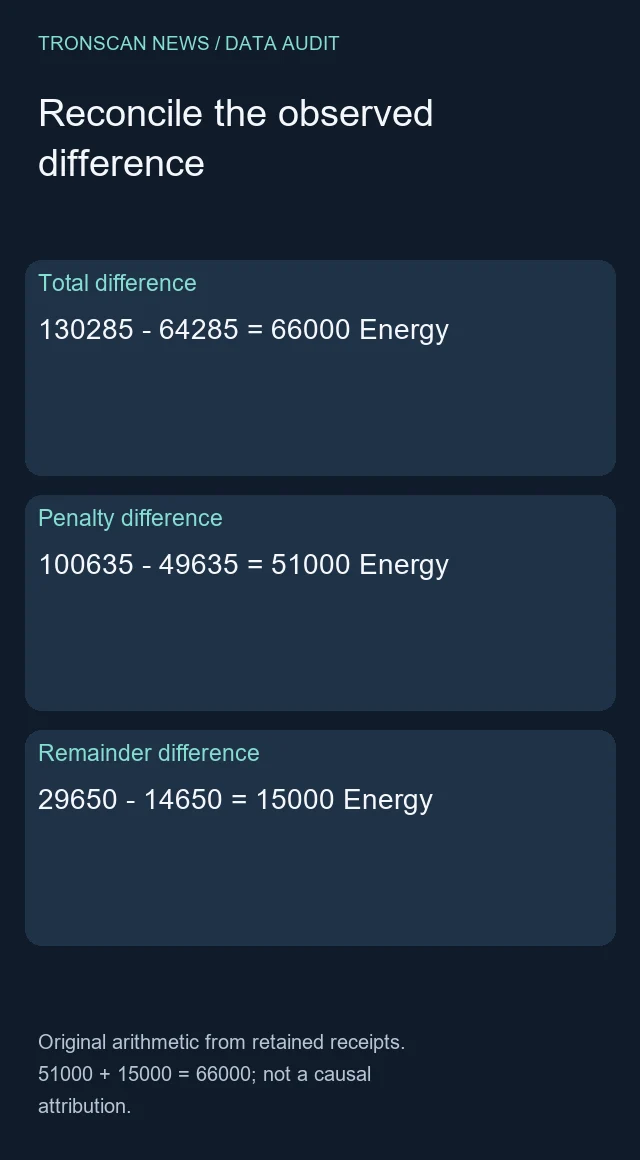
The total difference is 66000 Energy. The penalty-component difference is 51000, and the arithmetic remainder difference is 15000. These differences reconcile: 51000 plus 15000 equals 66000. We label the subtraction result a non-penalty remainder because that is exactly what the worksheet calculates. It is not a measurement of elapsed CPU time or a standalone opcode trace.
The two raw transfer quantities were 1503000000 and 100000000 token base units, respectively. They were not equal-amount calls. We therefore do not describe the sample as a controlled comparison with only one changing variable. Nor did we replay either recipient’s pre-transaction storage to establish a cause.
Sample selection was bounded and explicit: we inspected a saved block response, selected successful single calls to this contract with this selector, and stopped when the next distinct Energy total appeared among a maximum of eight candidates. Three receipts were read in the successful resumed sample. An earlier attempt encountered a rate limit; we paused, then resumed with sequential requests. The sample is illustrative, not random, a population average or a network-wide distribution.
3. Keep resource consumption separate from payment
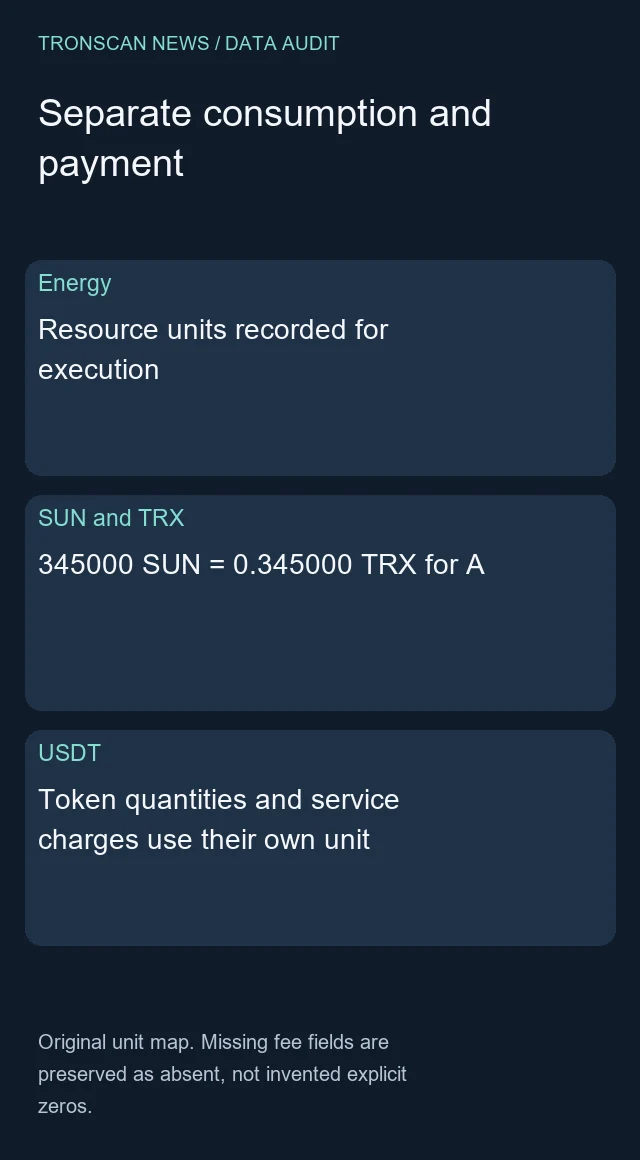
energy_usage_total describes a resource quantity. Fee fields use SUN, a native-currency denomination. USDT transfer quantity is yet another unit. Adding 130285 Energy to 345000 SUN would produce a meaningless total, even though both numbers appear in one receipt.
For A, the supplied top-level fee of 345000 SUN converts to 0.345000 TRX. Its net_fee also shows 345000 SUN. We do not add the component to the total and report 690000 SUN. For B, the saved JSON omitted the top-level fee, so our strict comparison reports an absent field rather than claiming it explicitly contained zero.
The official resource-payment documentation explains that available resources, TRX burning and contract-deployer sharing affect payment. Its parameter values can change. We did not query a current resource balance for either caller and treat it as the balance at the historical execution time.
If your practical question is reconciling a service’s charge with the blockchain record, use the separate withdrawal-fee reconciliation worksheet. A service can quote a charge in USDT while the network accounts in resources and TRX. This Energy comparison does not identify what an exchange quoted, debited or later credited.
4. Reproduce the arithmetic with strict local inputs
Save the four complete exports as body-A.json, receipt-A.json, body-B.json and receipt-B.json. Save this code locally as compare_energy.py. With Python installed, run python compare_energy.py body-A.json receipt-A.json body-B.json receipt-B.json. These filenames describe a local workflow; this page does not claim to provide hosted downloads.
import json
import re
import sys


def nonnegative_integer(value, name):
    if type(value) is not int or not 0 <= value <= 9223372036854775807:
        raise ValueError(name + ' must be a nonnegative int64 integer')
    return value


def summarize(body, info):
    if not isinstance(body, dict) or not isinstance(info, dict):
        raise ValueError('Expected body and receipt objects')
    txid = body.get('txID')
    if not isinstance(txid, str) or not re.fullmatch(r'[0-9a-fA-F]{64}', txid):
        raise ValueError('Missing or malformed body txID')
    if info.get('id', '').lower() != txid.lower():
        raise ValueError('Body and receipt IDs do not match')
    contracts = body.get('raw_data', {}).get('contract', [])
    if len(contracts) != 1 or contracts[0].get('type') != 'TriggerSmartContract':
        raise ValueError('Expected one smart-contract call')
    value = contracts[0].get('parameter', {}).get('value', {})
    contract = value.get('contract_address')
    data = value.get('data', '')
    if not isinstance(contract, str) or not re.fullmatch(r'41[0-9a-fA-F]{40}', contract):
        raise ValueError('Expected a hex TRON contract address')
    if not isinstance(data, str) or not re.fullmatch(r'a9059cbb[0-9a-fA-F]{128}', data):
        raise ValueError('Expected the bounded transfer(address,uint256) input shape')
    receipt = info.get('receipt')
    if not isinstance(receipt, dict) or receipt.get('result') != 'SUCCESS':
        raise ValueError('This comparison accepts successful receipts only')
    total = nonnegative_integer(receipt.get('energy_usage_total'), 'total Energy')
    penalty = nonnegative_integer(receipt.get('energy_penalty_total'), 'penalty Energy')
    if penalty > total:
        raise ValueError('Penalty exceeds total Energy')
    fee = None
    if 'fee' in info:
        fee = nonnegative_integer(info['fee'], 'fee SUN')
    return {
        'txid': txid.lower(), 'contract': contract.lower(),
        'selector': data[:8], 'total_energy': total,
        'penalty_energy': penalty, 'non_penalty_remainder': total - penalty,
        'fee_field_present': 'fee' in info, 'fee_sun': fee
    }


def compare(a_body, a_info, b_body, b_info):
    a = summarize(a_body, a_info)
    b = summarize(b_body, b_info)
    if a['contract'] != b['contract'] or a['selector'] != b['selector']:
        raise ValueError('Select the same contract and operation')
    if a['txid'] == b['txid']:
        raise ValueError('Choose two distinct transactions')
    return {
        'A': a, 'B': b,
        'A_minus_B_total_energy': a['total_energy'] - b['total_energy'],
        'A_minus_B_penalty_energy': a['penalty_energy'] - b['penalty_energy'],
        'A_minus_B_remainder': a['non_penalty_remainder'] - b['non_penalty_remainder'],
        'scope': 'Observed arithmetic; no causal attribution or future fee quote'
    }


if __name__ == '__main__':
    if len(sys.argv) != 5:
        raise SystemExit('Usage: compare_energy.py body-A.json receipt-A.json body-B.json receipt-B.json')
    inputs = []
    for filename in sys.argv[1:]:
        with open(filename, encoding='utf-8') as source:
            inputs.append(json.load(source))
    print(json.dumps(compare(*inputs), indent=2))
The program accepts one bounded contract-input shape and successful receipts only. It checks matching body/receipt identifiers, a common contract and operation, distinct transaction identifiers and nonnegative integer resource fields. It rejects a penalty larger than the total instead of returning a negative remainder as if that were a valid resource observation.
It does not authenticate a provider, verify transaction signatures, decode emitted transfer events or prove finality. The operation-shape check also does not establish an asset’s issuer: the reader must match the contract to an authoritative issuer source. Use the code for the declared comparison, rather than treating successful parsing as a complete blockchain audit.
We ran the displayed function against the retained public bodies and receipts. The output reported A minus B as 66000 total Energy, 51000 penalty Energy and 15000 remainder. The fee outputs remained 345000 for A and null, with fee_field_present: false, for B. That keeps the exact saved representation visible for review.
5. Test missing fields and invalid comparisons
| Controlled test | Expected behavior | Reason |
|---|---|---|
| Observed A and B | Report the three measured differences | The selected comparison case |
| Receipt ID changed | Reject | Prevent mixing another transaction’s receipt |
| Second contract changed | Reject pair | Common-symbol labels are insufficient |
| SUCCESS changed to a failure | Reject | Stay within this tutorial’s comparison scope |
| Negative, Boolean or decimal resource value | Reject | Do not silently coerce invalid counters |
| Penalty greater than total | Reject | The declared subtraction is inconsistent |
| Fee field absent | Preserve absence | Do not invent an explicit zero |
| Synthetic explicit fee of zero | Preserve zero and field presence | Distinguish a supplied value from omission |
All altered inputs in this matrix are synthetic local fixtures. They were never submitted to the network. An invalid fixture tests the program’s handling of that condition; it does not show that either real public transaction contained the error.
When adapting the script, retain a positive sample and failure cases. Removing validation to accommodate a malformed response can make a later comparison look precise while mixing strings, missing counters or unmatched transactions. If your provider uses another representation, document that mapping and test it explicitly rather than changing a missing field into a convenient number.
6. Investigate possible causes with additional evidence
TRON’s contract troubleshooting guide identifies recipient storage state and the Dynamic Energy Model as reasons similar TRC20 calls can consume different Energy. These are diagnostic directions, not proof about our two records. Contract-specific logic and other state changes can also matter.
A storage-state hypothesis needs the target contract’s implementation and relevant pre-execution state. A currently visible token balance is not automatically the balance immediately before a historical transfer. The account could have received or sent tokens since then. Do not infer the cause from an explorer’s present-day balance alone.
A dynamic-factor hypothesis needs the relevant contract and cycle information for the time being studied. We did not collect a historical factor sequence for this pair. The fact that both calls were in one block narrows their time context but does not independently measure every execution condition or prove that one particular factor explains the entire difference.
For readers who need the general resource model before comparing records, the TRON Energy guide explains the basic concepts. A dated comparison should add evidence to that model rather than replacing it with two fixed “normal prices.” Our observed values must not be advertised as guaranteed low and high tariffs.
7. Turn the comparison into a reviewable conclusion
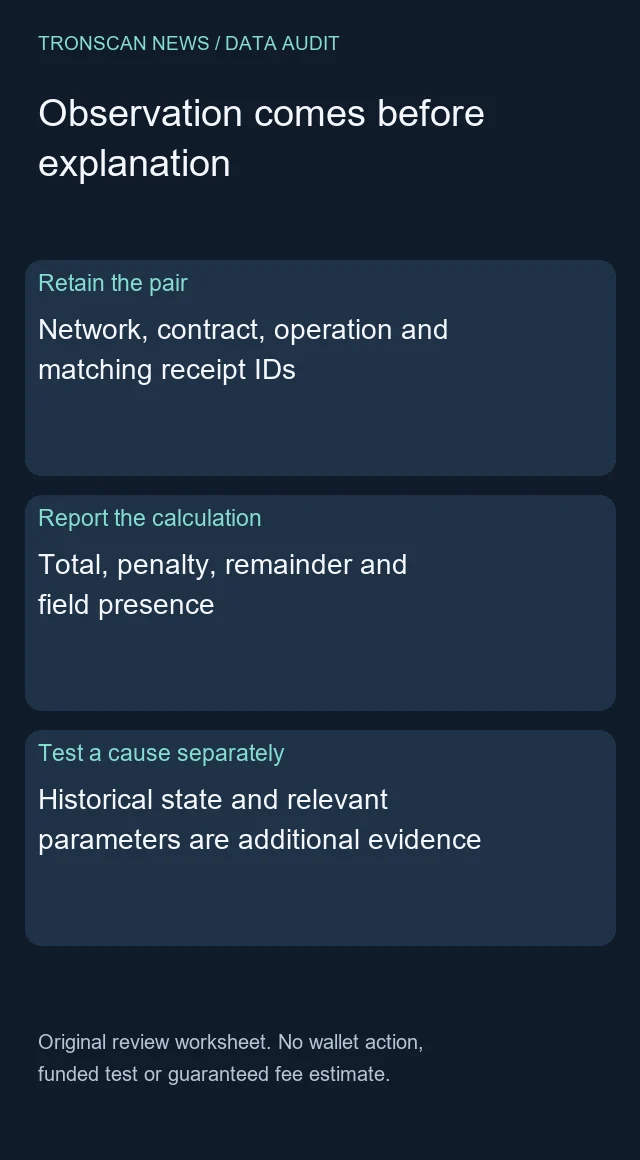
Write an observation first: which network, contract, operation, block and numeric fields were compared? Then write the calculation, including field absence and units. Only after that state a hypothesis and the additional evidence needed to test it. This prevents a plausible explanation from being reported as a measured fact.
| Question | Evidence to retain | Our sample’s boundary |
|---|---|---|
| Were the calls comparable? | Bodies, contract, selector and successful receipts | Same operation; different amounts and participants |
| What differed numerically? | Total, penalty and explicit subtraction | Measured differences, not a causal model |
| What was paid? | Fee fields, units and field presence | No private service tariff or credit record |
| Why did it differ? | Implementation, historical state and relevant parameters | Not established by this pair |
| What happens next time? | A fresh estimate for the intended call and current conditions | No future quote from historical receipts |
The next action depends on the unresolved question. For an export error, obtain the complete matching response. For execution interpretation, inspect the receipt and relevant event records. For a prospective call, use an appropriately supported estimation workflow before committing funds; this article has not tested a paid transaction or provided a spending instruction.
If a calculation is disputed, share the complete public identifiers, dated source and exact field names. Include the program version and output so another reader can reproduce the subtraction. Avoid reporting a percentage change without naming the denominator, and avoid converting resources to currency with an unverified historical rate.
8. Choose a denominator before reporting a percentage
For this observed pair, A minus B is 66000 Energy. Relative to B’s 64285 total, the difference is approximately 102.67 percent. Relative to A’s 130285 total, the same absolute difference is approximately 50.66 percent. The two percentages answer different questions. Label the denominator rather than writing an unexplained “Energy changed by 51 percent” headline.
The ratio A divided by B is approximately 2.027. It describes this pair’s recorded totals, not a multiplier that a reader should apply to every USDT transfer. Selection deliberately stopped at a different total, so it would also be misleading to estimate the percentage of transfers in either group from the two displayed examples.
We did not calculate a fee ratio for the pair. A’s top-level fee was supplied, while B’s was absent from the saved JSON. Under this worksheet’s strict representation rule, a missing denominator is unresolved. Substituting zero would manufacture an infinite or undefined ratio and could turn a missing-field issue into a false claim about cost savings.
| Proposed statement | Assessment for this pair |
|---|---|
| A used 66000 more total Energy than B | Supported arithmetic from the retained totals |
| A used about 2.027 times B’s recorded total | Supported when clearly limited to the sample |
| The larger token quantity caused that ratio | Unsupported: other conditions were not controlled |
| The higher resource total doubled the fee | Unsupported: payment and field presence differ |
| Every future transfer will fit one of these two totals | Unsupported: historical sample is not a tariff schedule |
Keep the original integer counters beside rounded percentages. Rounding is appropriate for readable commentary, while the raw values allow another reader to reproduce the calculation. If you later add more receipts, state how they were selected and whether the source or date window changed. Do not append unrelated records and silently describe the enlarged set as the original single-block sample.
If a source becomes rate-limited while you are collecting the pair, preserve the responses already received and pause the collection. A rejected request does not establish an empty receipt, zero resource consumption or absence from the chain. Resume only within the provider’s normal access conditions, record the later collection time, and verify the same complete identifiers again. Keep an incomplete pair labeled incomplete until both matching receipts are available. This avoids producing a technically neat comparison from one real record and one invented fallback value.
Frequently asked questions
Does sending more USDT always consume more Energy?
This pair does not establish an amount-to-Energy rule. The calls had different raw amounts and other uncontrolled conditions. Contract logic and state matter; do not scale a historical resource count directly with token quantity.
Can I add energy_penalty_total to energy_usage_total?
Do not add a penalty component to an already inclusive total. Keep the reported fields separate. Our worksheet subtracts the penalty field to show an arithmetic remainder and labels that result explicitly.
Does an omitted fee field mean the export explicitly says zero?
No. This strict workflow records omission separately from a supplied zero. If your application applies protocol-default conventions, document and verify that interpretation rather than pretending the JSON included the value.
Are 64285 and 130285 permanent USDT transfer prices?
No. They are two dated resource observations from one block, not currency prices or guaranteed estimates. Future calls need their own conditions and evidence.
Can the comparison explain an exchange withdrawal charge?
Not by itself. A service charge belongs to the service’s quote or ledger. The blockchain receipt provides resource and native-fee evidence. Reconcile those records with their units and labels kept separate.
Checked October 29, 2026 by the Tronscan News editorial team. AI assisted drafting; local comparison code and synthetic failure cases were executed against retained public responses. Independent publication, not official TRONSCAN support. Report a reproducible correction through this page’s comments with the affected field and public source details; omit private account data and signing secrets.
Leave a Reply