TRON mainnet vs testnet is a network choice, not a switch that moves a balance. Mainnet is the production network; Shasta and Nile are separate public testing networks. Match the network named in the original sending record with the corresponding explorer before deciding whether an address or transaction is missing.
This guide is for phone users who see a familiar TRX or TRC20 label but cannot reconcile two screens. It explains how to identify the network, choose the right TRONSCAN site and preserve a useful lookup record. Tronscan News is an independent educational publication, not the official explorer or a wallet service.
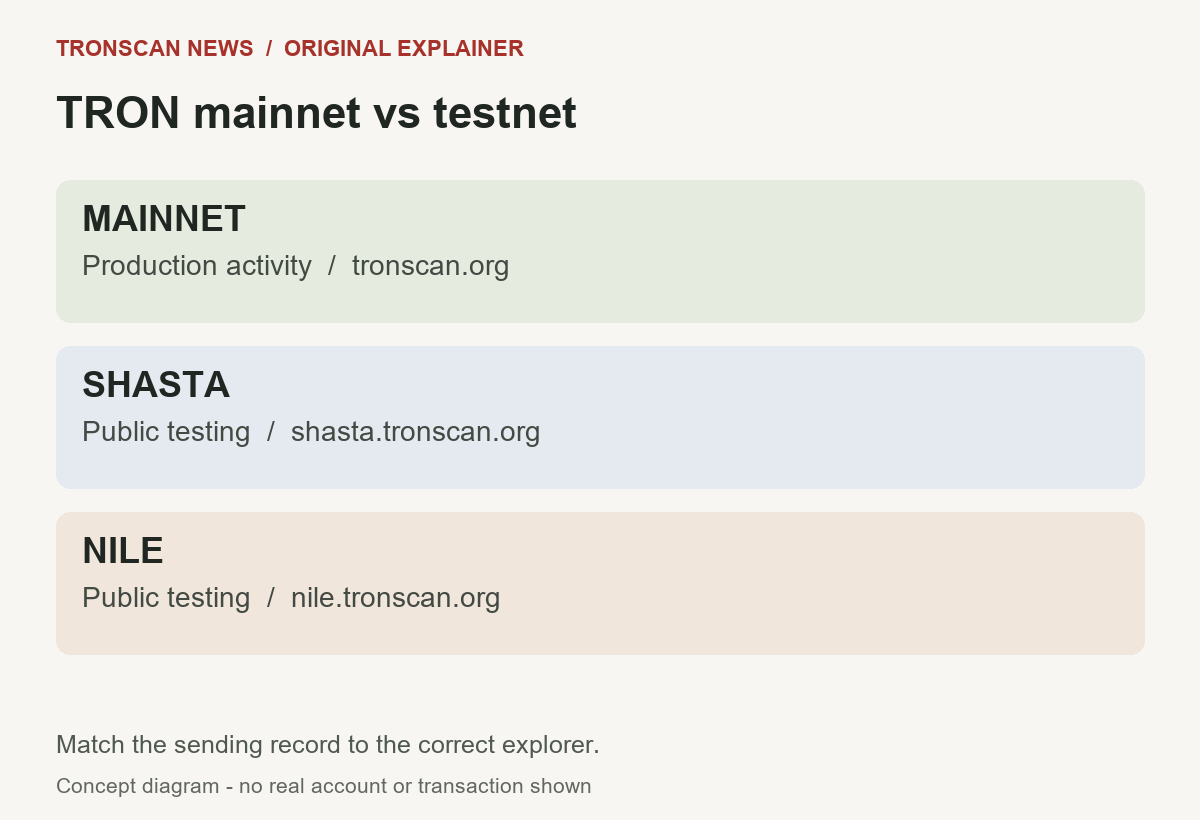
Table of Contents
TRON mainnet vs testnet: the quick comparison
The official TRON network reference separates production Mainnet from Shasta and Nile testing environments. For a lookup, the most useful distinction is which network produced the record. A successful search on one network does not establish activity on another.
| Network | Purpose | Explorer domain |
|---|---|---|
| Mainnet | Production activity | tronscan.org |
| Shasta | Public testing | shasta.tronscan.org |
| Nile | Public testing | nile.tronscan.org |
Use those domain names as a comparison aid, then reach the explorer from current official documentation. Do not infer a network from the page’s colors, a token logo or the number of tokens shown. Those visual cues do not identify the chain that recorded an operation.
5 easy TRON mainnet vs testnet checks on a phone
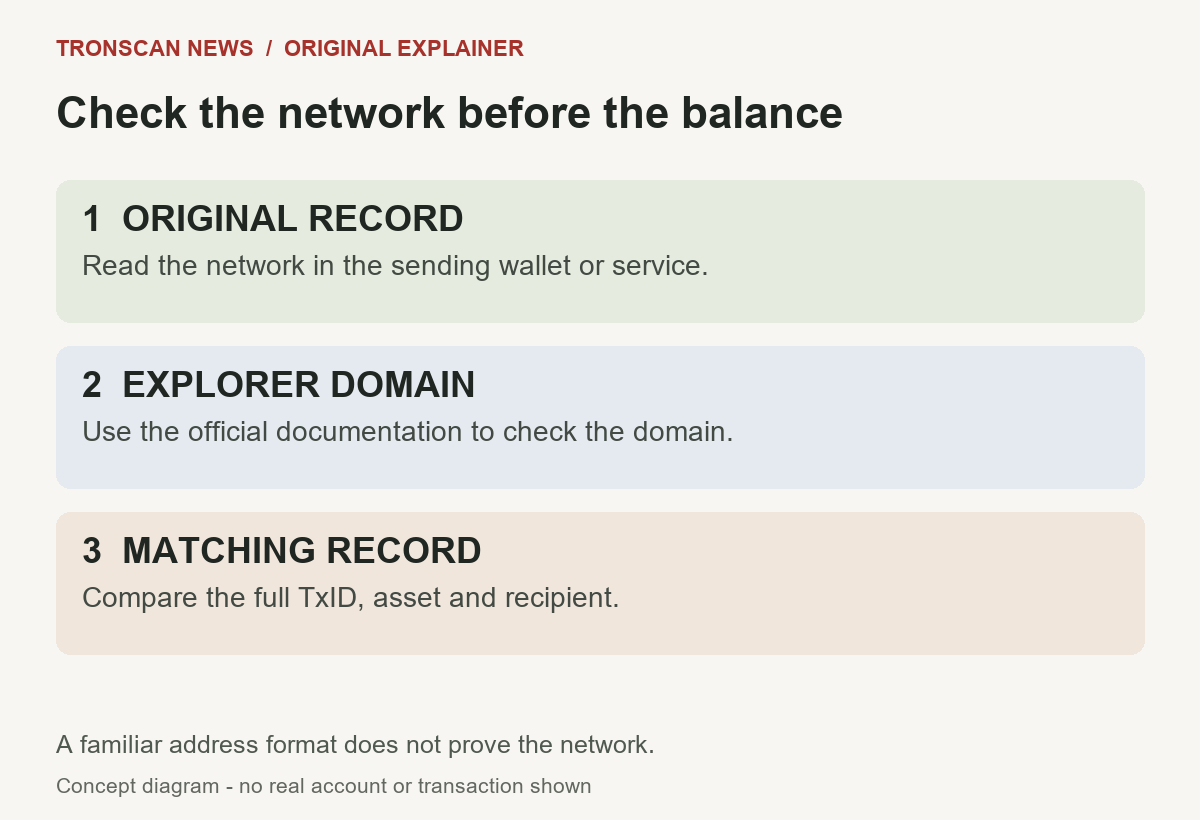
- Open the original record. In the sending wallet or service, find the specific transfer or account view. Read its selected network and sending status before copying a transaction hash. An exchange order number is not necessarily a blockchain TxID.
- Write down the complete network name. Distinguish Mainnet, Shasta and Nile. The word testnet alone leaves two public testing environments unresolved. If the original screen does not state the network, consult that product’s official instructions or support rather than guessing.
- Check the explorer domain. Use the matching entry in the official network reference. On a small screen, expand the address bar and read the complete hostname. A search result title is not a substitute for checking where the browser actually opened.
- Search the full public identifier. Paste the complete TxID for one transaction, or the full public address for an account lookup. Check the result type. A token contract, account and transaction record answer different questions.
- Compare the result with your task. For a payment, compare execution, asset, recipient and quantity. For holdings, inspect the correct token on that network. Save the explorer URL and time checked without adding a private key, recovery phrase or login code.
These TRON mainnet vs testnet checks are read-only. They do not require signing, connecting a wallet to this website or sending a second payment. If the task unexpectedly changes from reading a record to granting permissions, stop and identify why that separate action is being requested.
Why the address prefix does not settle TRON mainnet vs testnet
A familiar address shape can make two screens look connected even when they display different networks. The official accounts and keys guide describes TRON’s common Base58Check address format. Format tells you how an identifier is represented; it is not a history of where an operation occurred.
Keep the address and network together in your notes. Writing only a shortened address beside a balance loses the context needed to repeat the check. A useful entry says which network was selected, which full address was inspected and when the observation was made.
Also avoid confusing ownership with visibility. Reading an address in an explorer does not prove that you control it. Likewise, finding an address on a test network is not evidence that a production exchange recognizes a deposit. Each conclusion needs the record relevant to that question.
For TRON mainnet vs testnet troubleshooting, compare the source network first and the address second. Repeatedly searching the same string in unrelated explorers can create more screenshots without resolving the missing piece of evidence.
Shasta and Nile: name the testnet precisely
Shasta and Nile are different testing choices, not interchangeable names for one shared balance. If a tutorial identifies Shasta, follow its Shasta references. If a product explicitly asks for Nile, preserve that name throughout the lookup and any support request.
The TronLink network reference lists separate network identifiers, service endpoints and explorer domains. This guide does not require editing those endpoints or switching a wallet. It uses the reference to help you interpret a network label already present in your own record.
Do not copy custom network settings from a comment merely because an explorer search failed. First establish which network the sending application used. A configuration change without that context can make later comparisons harder to explain, especially when several browser tabs look similar.
Testing conditions can also differ from production. A successful test demonstrates behavior in the environment used for that test; it does not establish the current state of another network. Keep test results labelled instead of presenting them as evidence about a Mainnet payment.
TRON mainnet vs testnet token balances
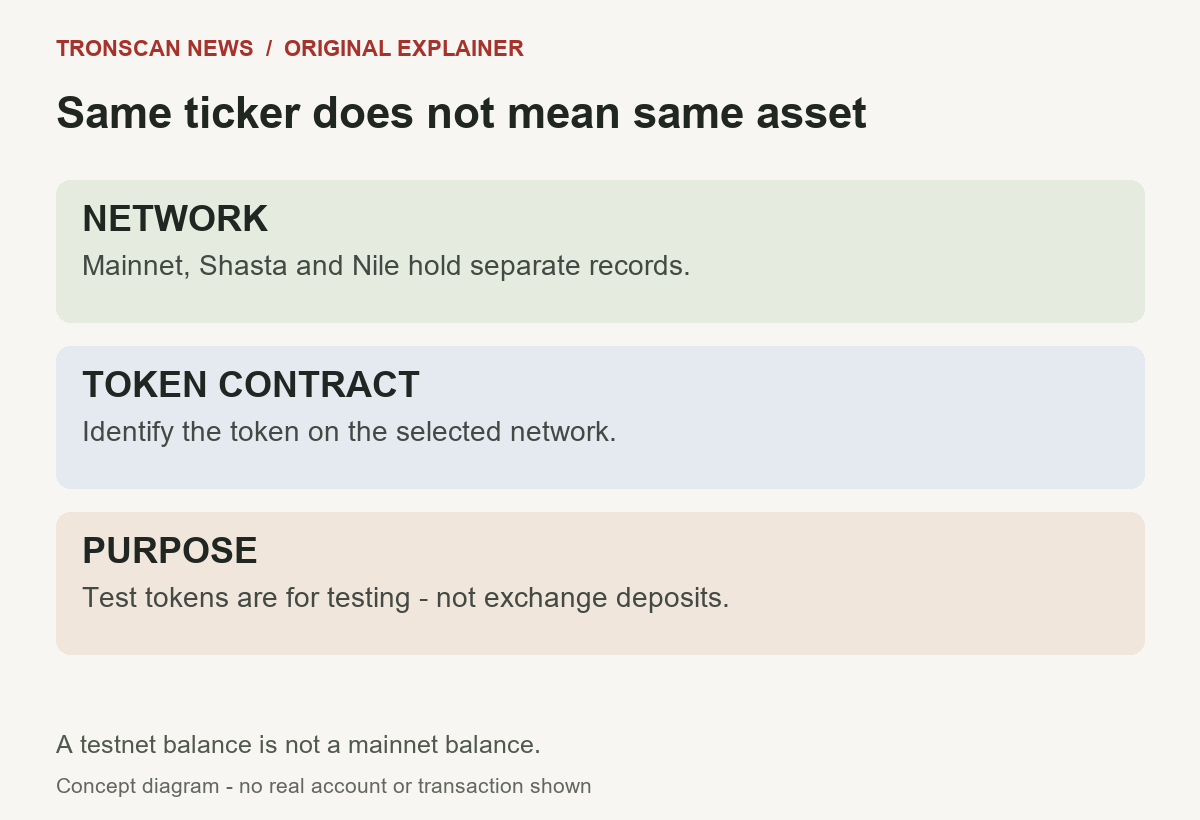
A token ticker is a label, not a complete identity. Record the network and token contract alongside the amount. A test token bearing a familiar name is not evidence that the same quantity is available in a Mainnet wallet or an exchange account.
The official test-token guide identifies test tokens as testing resources with no financial value. It also recommends dedicated test credentials. This article does not ask you to claim tokens, use a faucet or import an existing production wallet into development tooling.
For a production USDt identity check, our USDT TRC20 contract verification guide starts from the issuer reference. Keep that Mainnet verification separate from any asset deployed for a test. A shared name cannot transfer the issuer relationship between networks.
When comparing TRON mainnet vs testnet holdings, write the quantity without assuming it represents spendable cash. An explorer holding, a market estimate and a service’s internal customer balance are different observations. Determine which one you actually need before comparing numbers.
A missing result needs more than a TRON mainnet vs testnet guess
If a lookup returns no matching transaction, recheck the copied string and original network before drawing a conclusion. Then check whether the sender actually provided a blockchain TxID and whether its own record describes a completed broadcast. An unsuccessful search by itself does not identify the cause.
Do not interpret every missing result as a wrong-network transfer. It may be the wrong identifier, an incomplete copied value or an unresolved sending status. Preserve those possibilities until the original record narrows them. Avoid inventing a definitive explanation simply to give the problem a name.
If the network matches and you have the correct TxID, continue with our mobile TRON transaction lookup guide. That guide covers execution, confirmation and transfer details. Here the narrower job is to ensure you are looking at the correct environment first.
When a wallet shows a T-address but an API record shows a 41-prefixed value, use our Base58Check versus hex address comparison to establish whether they represent the same address. That format check does not select the network or prove account activation. A missing account result still needs account-state context; do not make a payment simply to test a guess or satisfy an unsolicited support message.
TRON mainnet vs testnet examples without real transactions
Hypothetical example 1: a tutorial and a production wallet disagree. Imagine a learning exercise shows a test-token balance, while a wallet’s production view shows no such holding. Compare the network labels. If the exercise used Shasta and the wallet view is Mainnet, those are different observations, not two reports of one shared balance.
Hypothetical example 2: the right testnet category, the wrong testnet. A developer gives you a Nile transaction hash, but the browser is on Shasta. Record the sender’s Nile label and use the matching official explorer reference. Do not alter the hash or interpret the missing Shasta result as proof that the operation failed.
Hypothetical example 3: a Mainnet receipt, no exchange credit. Suppose the TxID is present on the intended production network and the recipient matches the exchange’s instructions. That settles part of the chain investigation. It does not settle the exchange’s internal crediting process, supported assets or deposit requirements.
These examples are invented explanations, not observed transactions or claims about a particular service. None requests a transfer. Their purpose is to show which piece of evidence changes the next step and which questions remain open.
What switching a view does and does not prove
In a TRON mainnet vs testnet comparison, opening a different explorer changes the records you are viewing. It is not a transfer instruction, a conversion or a recovery operation. If an account display changes, label the new network rather than describing the difference as funds moving.
Similarly, a screenshot is evidence of what a screen displayed at a time, not a complete explanation of ownership, token identity or execution. Save the original URL when possible. Another reader can then distinguish the network and inspect the relevant record rather than guessing from a cropped image.
When a service offers a separate migration, bridge or recovery product, evaluate its documentation and eligibility as a separate task. Do not assume that a network selector provides those functions. This article neither verifies such a service nor claims that test tokens can be redeemed for production assets.
Keep a useful TRON mainnet vs testnet support note
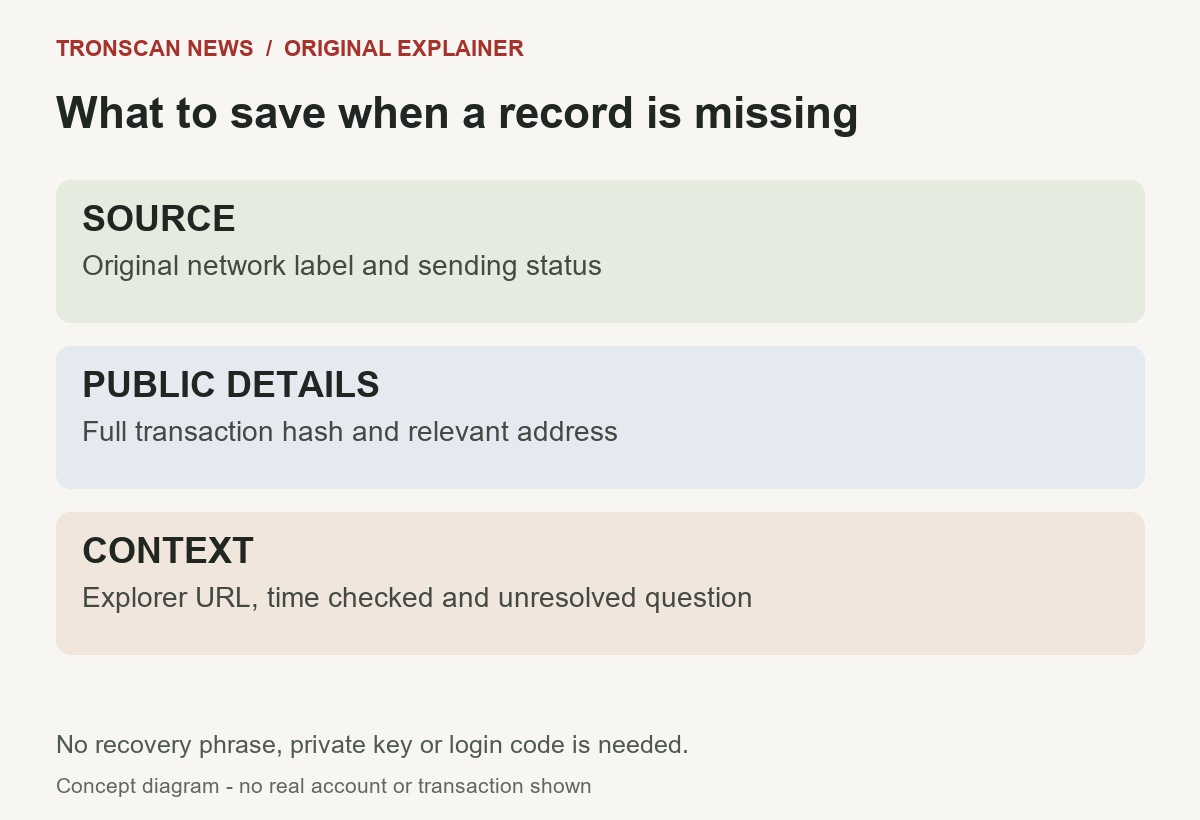
Prepare a short record with the source application, exact network label, public TxID or address, explorer URL and time checked. State what you expected and what you actually found. This is more useful than sending several images with no indication of which environment each one shows.
Use a precise unresolved question. For example, ask whether the sender broadcast a particular transaction on Nile, rather than saying only that the wallet is broken. If the service is an exchange, keep its internal order identifier labelled separately from the public chain identifier.
Do not paste a recovery phrase, private key, account password or one-time login code into the note. Public records can still expose linked activity, so share only the details needed through the relevant service’s official support channel.
Repeat the TRON mainnet vs testnet check consistently
When returning later, reopen the same source record and explorer URL before comparing results. Note whether a network setting, account selection or token filter changed in the meantime. Without those labels, a comparison over time can accidentally become a comparison between different environments.
Keep the original observation instead of overwriting it with a new amount. Add the later time and explain which variable changed. For example, a different explorer domain is a context change even if the public address string looks the same.
If the issue is resolved, write the narrow conclusion supported by the evidence: the transaction was found on the stated testnet, or the production token record matched the expected contract. Do not expand that into a claim that every wallet setting is correct or every linked service is safe.
A repeatable TRON mainnet vs testnet check finishes with the right network, the right public identifier and a clearly defined next question. It does not need a dramatic recovery promise or a new payment to make the record understandable.
TRON mainnet vs testnet: a lookup worksheet
Use a small worksheet when two people are investigating the same issue. Give each observation its own row rather than merging a test result with a production record. The worksheet should be readable without access to your wallet.
| Field | What to record |
|---|---|
| Question | Are you finding a transaction, identifying a token or checking a current holding? |
| Source network | The exact Mainnet, Shasta or Nile label from the original application. |
| Public identifier | The full TxID, account or token contract, labelled by its role. |
| Observed result | Found, not found or still unresolved, with the explorer URL and time. |
Before sharing the worksheet, check that its question matches its identifier. A current account holding cannot replace the receipt of one payment. A token contract identifies the asset being examined, while a recipient identifies the destination. Keeping those roles explicit prevents someone from repeating a technically correct search for the wrong object.
If another person supplies a screenshot, ask for the public explorer link and the network named in the original record. Do not request their login or signing credentials. When the screenshot and the linked page disagree, preserve both observation times and describe the difference instead of silently choosing whichever result fits the expected outcome.
For a resolved lookup, retain the worksheet as a record of the method rather than as a permanent claim about a balance. Holdings and service displays can change. The repeatable part is the network, identifier and evidence path, which lets you check again without relying on an old amount or an unlabeled screenshot.
One final worksheet check is whether another reader could reproduce the observation using only its public details. If the network field says only TRON, clarify whether that means production or a named testnet. If the identifier is shortened, preserve the complete value in the official support ticket. If the result says successful, specify whether that means the explorer found a transaction, execution completed or a receiving service credited its ledger. Those are separate milestones. A concise description of the exact milestone is more useful than a broad statement that everything worked or nothing arrived.
Frequently asked questions
1. What is the main TRON mainnet vs testnet difference?
Mainnet is the production network. Shasta and Nile are separate testing networks. Match the network in the source record to the explorer you use; a test-network record does not establish a Mainnet balance or payment.
2. Can I identify the network from an address starting with T?
No. A familiar address format is not enough to identify the environment used for a transaction. Preserve the source network label and compare it with the explorer domain before interpreting the result.
3. Can Shasta or Nile test tokens become a Mainnet exchange deposit?
Test tokens are for testing and have no financial value. A testnet balance does not establish a production deposit. Check the receiving platform’s own supported network and asset instructions rather than treating a matching ticker as compatibility.
4. Why can I find a transaction on Nile but not Shasta?
They are separate networks with separate records. Use the testnet named by the sender or application. A missing result on the other network does not by itself show that the original transaction failed.
5. Must I connect a wallet to check TRON mainnet vs testnet records?
No wallet connection to this website is required for public explorer lookup. Use the public address or TxID and official network references. Never supply a recovery phrase or private key merely to read a record.
Continue learning
Visit the Tronscan News homepage for independent TRON tutorials and verified updates. Our editorial standards explain source checks, AI assistance and corrections. This guide and its original diagrams were prepared with AI assistance and checked against the official references linked above.
Leave a Reply