TRON address poisoning is a transfer-history trap: a misleading address appears near familiar activity, and the user later copies it as the destination for a real payment. The practical defense is to obtain the receiving address from a trusted source and compare the complete destination before signing.
Quick answer: do not treat a recent transaction row as your address book. Open the recipient’s current receiving instructions, confirm the network and asset, and compare the full address with the final wallet confirmation. A familiar ending, a token ticker or a tiny transfer does not establish who controls the address.
This independent mobile guide was checked against the linked TronLink and TRONSCAN support references on October 24, 2026. Examples use descriptive labels rather than usable addresses. We have not tested a scam, accessed a private wallet or created a real transaction.
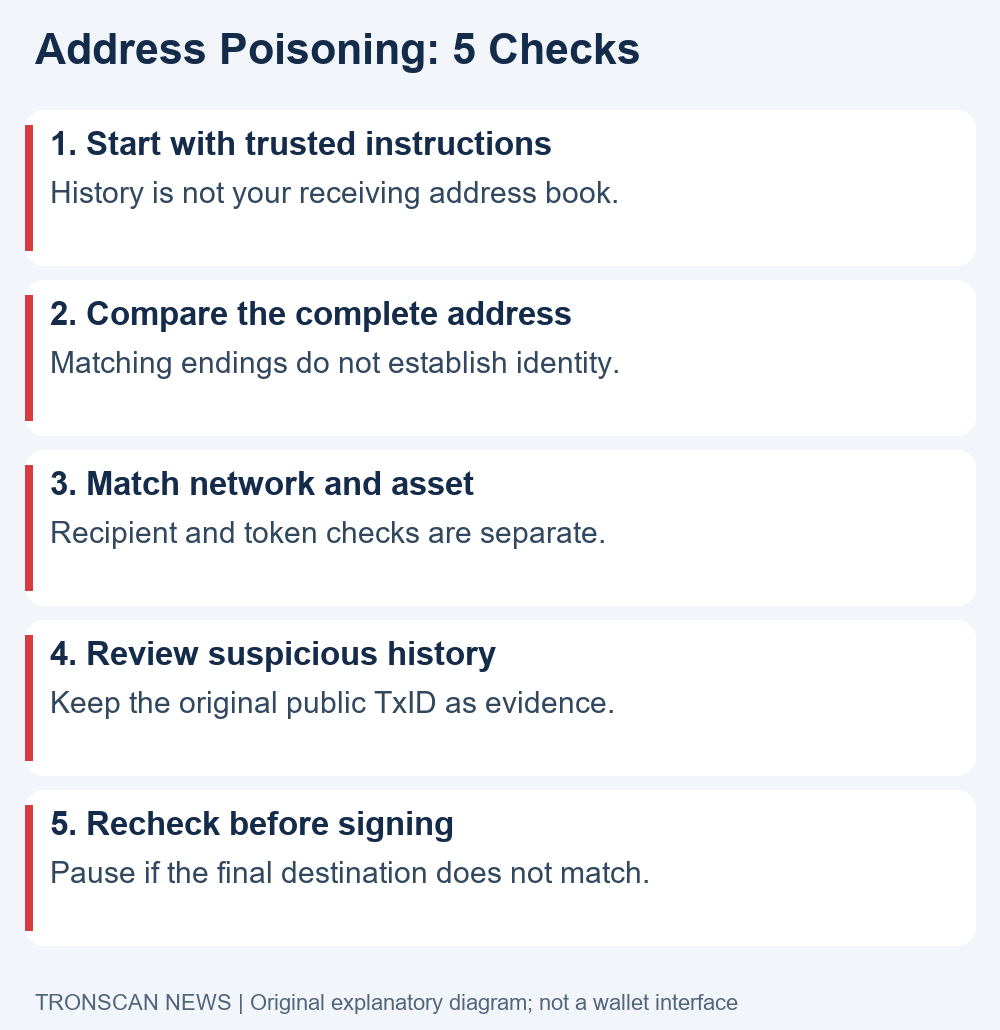
Table of Contents
How TRON address poisoning exploits transaction history
TronLink’s address-poisoning guidance describes attackers introducing small transfers involving lookalike addresses into a user’s history. The intended mistake happens later, when the user selects the wrong destination for a payment. The guide recommends checking addresses, using an address book and confirming recipient details through a secure channel.
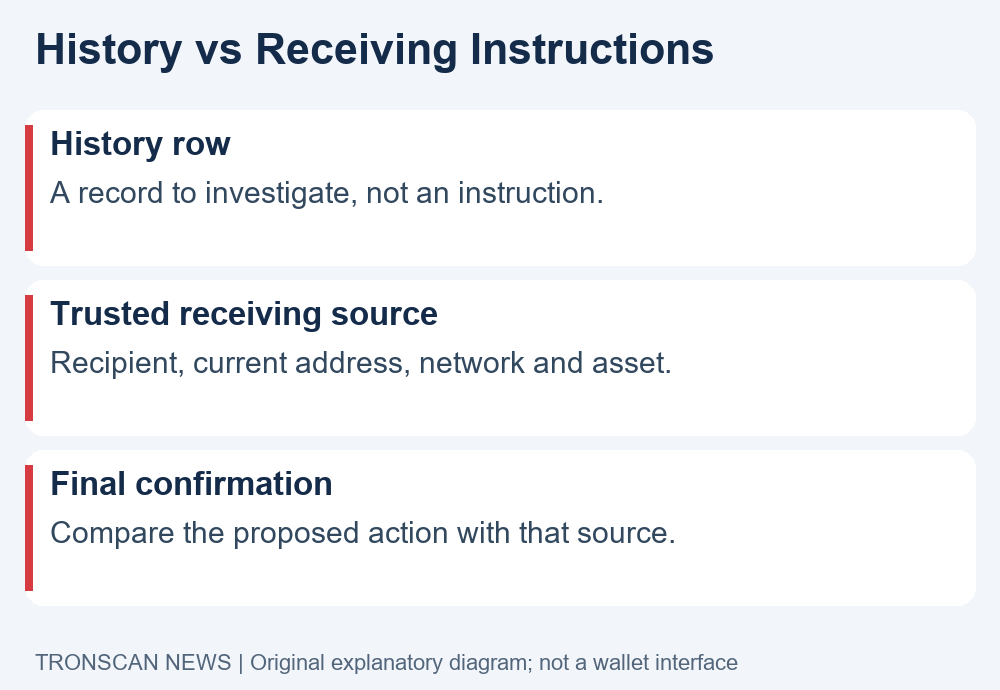
The useful distinction is between a historical event and a receiving instruction. History tells you something appeared in a record. A trusted receiving instruction tells you where a particular recipient currently wants a particular asset sent. Those sources serve different purposes even when their shortened address displays look alike.
On a phone, a narrow screen makes this distinction easy to miss. An interface may show a few characters at each end, while the middle is hidden. Your review should expand or otherwise reveal the complete address instead of treating a compact preview as an identity check.
1. Start with a trusted receiving source
The first TRON address poisoning check happens before you copy anything. Open the recipient’s normal receiving page or request the address through an established communication channel. For a platform deposit, use that platform’s current deposit instructions rather than an old transfer row or a search-engine snippet.
- Identify the intended recipient and purpose of the payment.
- Open the known service or established recipient conversation.
- Find its current asset and network instructions.
- Copy the complete receiving address from that source.
- Keep the source available while reviewing the wallet’s proposed destination.
TronLink’s transfer and receive instructions explain sharing a current account address or its QR code from the receiving interface. For our workflow, the important question is where the information came from. A QR image forwarded by an unknown account is not authenticated merely because a wallet can scan it.
For TRON address poisoning prevention, record the source as well as the destination. A short private note such as “recipient’s receiving page checked today” helps you distinguish a freshly verified destination from an address copied during an earlier investigation. The note is a recordkeeping aid, not proof that the recipient is trustworthy.
If the recipient says its address changed, pause and confirm through the existing channel you already know. Do not let an urgent message turn a new account, new link and new destination into a single unexamined decision.
2. Compare the complete address, not only its ending
The official similar-address scam explanation specifically warns about copying from history after checking only the final characters. Similarity is the lure. Seeing the same suffix is therefore a reason to expand the comparison, rather than a reason to stop checking.
For TRON address poisoning checks on a phone, place the trusted source and proposed recipient into a deliberate comparison sequence. Read the full source address, then reveal the full destination in the sending app. Compare every character in order. Beginning-and-ending checks can help you notice a mismatch quickly, but they do not replace the complete comparison.
Here is a hypothetical example without real addresses: your saved recipient is Address A, and a new history row contains Address B. Both compact previews end with the same five characters. That observation is insufficient to establish that B belongs to your recipient; return to the trusted source for A before deciding anything.
Do not “repair” a mismatch by manually replacing a few characters from memory. Discard the uncertain destination and obtain it again from the trusted receiving source. A fresh complete comparison is easier to audit than a mixture of copied text and remembered fragments.
When investigating TRON address poisoning, also distinguish the destination you intend to use now from an address shown in a screenshot. Screenshots can explain a concern, but a cropped image or shortened label may omit the very characters that distinguish the two addresses.
3. Verify the network and asset separately
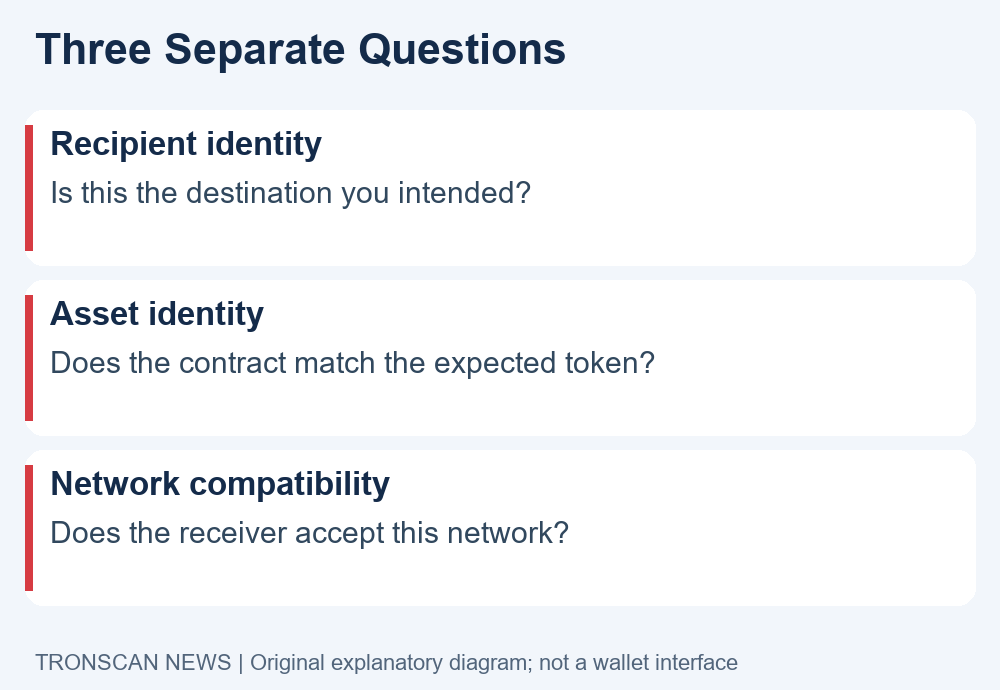
An address comparison answers only one part of the payment question. Confirm that the receiver accepts the selected network and the intended asset. A correct-looking recipient does not resolve an unsupported network or an unrelated token with a familiar name.
TronLink’s fake-token warning describes namesakes that use the same token name but a different contract address. Its advice is to compare contract information against official information. That warning is relevant when an unfamiliar token entry is used to make a history row appear persuasive.
For TRON address poisoning reviews involving USDT, keep the asset identity and recipient identity as separate checklist items. Our USDT TRC20 contract guide explains the contract comparison. Verifying a token does not certify its recipient, and recognizing a recipient does not verify a token.
Use an original record rather than a logo alone. The token label, receiving address and network should agree with your intended operation. If the app does not show enough information, pause and consult its normal support channel instead of assuming that every similarly named balance is interchangeable.
In a TRON address poisoning investigation, an unexpected token should not become an invitation to visit a website printed in its name. You can gather public evidence without connecting to a claim page, approving a spender or importing your wallet into an unfamiliar application.
4. Review unexpected activity without trusting it
A public history row can be a useful lead, but it should not become your next payment destination. Open the full transaction record through the known TRONSCAN explorer and compare its addresses, asset and amount with the activity you actually intended.
Our TRON TxID lookup guide explains how to preserve the complete transaction identifier. Keep the TxID attached to the correct observation. An address, a service order number and a transaction hash are different references and should remain separate in your notes.
For TRON address poisoning concerns, describe what you observed without overstating what it proves. “An unfamiliar small transfer appears in my history” is a specific observation. It does not, by itself, establish that someone has obtained your recovery phrase or that every asset has moved.
If you are also concerned about signing permissions, investigate that as a separate issue. The token approval review guide covers checking the token, spender and allowance. Do not approve a new contract as a supposed way to clean a misleading history entry.
Keep the original message or record available for a support review, but avoid repeatedly opening unsolicited links. The goal is to preserve evidence and choose an authenticated support route, not to interact with everything that appears in the suspicious activity.
For TRON address poisoning, an explorer warning can add useful context. The absence of a warning should not substitute for your own recipient verification. Your trusted source and full-address comparison still determine whether the proposed payment matches your intention.
5. Recheck the final destination before signing
The last TRON address poisoning check takes place in the sending app’s final confirmation. Compare the destination with the trusted receiving instructions again, alongside the network, asset and amount. If you switched apps or changed an input, repeat the comparison after that change.
An address-book entry can reduce repeated copying, but first verify the entry itself. Give it a label that describes the recipient and purpose, and review the underlying full address when the destination changes. A familiar nickname should help organize your review rather than conceal the destination.
A small test payment is not a substitute for identifying the intended recipient. If someone suggests one, first establish the correct address and receiving requirements. A successfully executed transfer only shows that an operation occurred; it does not prove that the person who supplied the address is the person you meant to pay.
For TRON address poisoning prevention, build a pause into urgent payments. If the recipient, address source or network remains unclear, leave the operation unsigned while you resolve the discrepancy. Do not use urgency or a familiar suffix as the deciding evidence.
Our workflow does not ask you to make a transfer. It asks you to establish a consistent chain from the trusted receiving instruction to the final proposed action. That chain should remain understandable even if another person later reviews your evidence.
What to preserve when reporting TRON address poisoning
The TRONSCAN scam-reporting guide lists reporting routes for tokens, contracts, account addresses and websites. It asks for supporting evidence and explains that an explorer cannot return funds to a victim. A report can inform risk labeling; it is not a transaction reversal request.
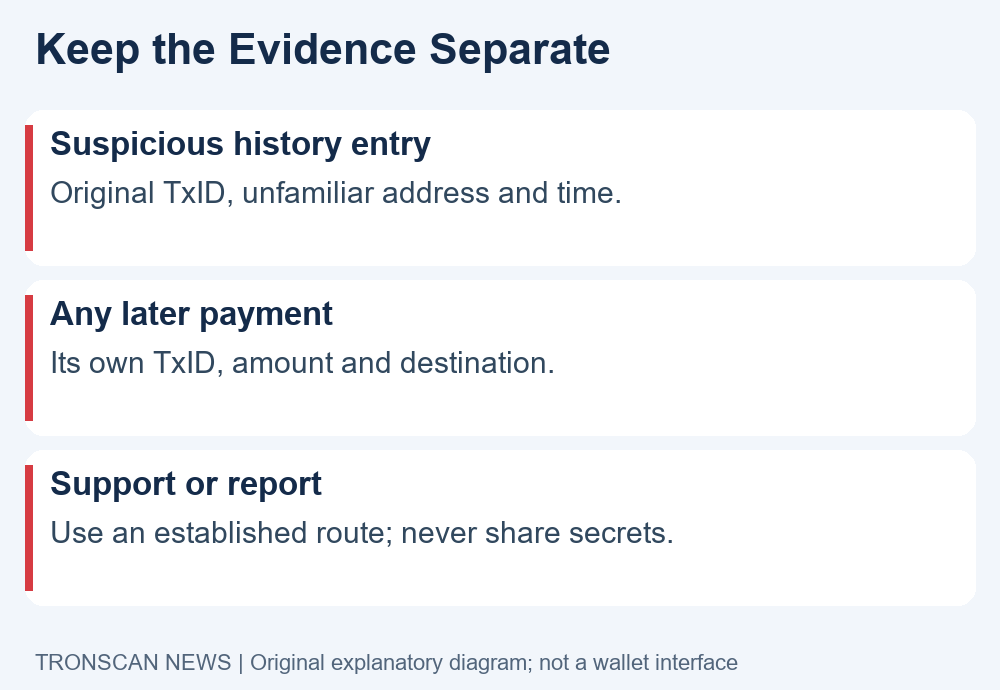
For TRON address poisoning, prepare a concise evidence note: the public TxID, unfamiliar address, observation time, token or contract involved and why the row caused concern. Keep the intended recipient’s verified details separate so a reviewer can understand which address is which.
If you have already sent a payment to the wrong address, preserve that payment’s own TxID as well. Do not mix the misleading history entry with the later outgoing payment. The two records answer different questions and may involve different amounts and timestamps.
Use the service’s established support or reporting route. Never send recovery words, private keys, passwords or verification codes as evidence. A person reviewing public addresses does not need the secrets that control your wallet.
Be specific about uncertainty. If you suspect TRON address poisoning but have not confirmed who controls an address, describe the suspicious pattern and provide the records. Avoid asserting an identity from a similar name or a copied profile image.
A mobile checklist you can reuse
Keep this worksheet in a private note before a payment. It is an original organizational aid, not a form to submit to this website. Mark any unverified field as unresolved and return to the appropriate source.
- Recipient: who you intend to pay and the established source of its instructions.
- Destination: the complete address from that source, compared with the final sending screen.
- Asset and network: the receiver’s current requirements and the actual choices in the sending app.
- Evidence: any suspicious history TxID kept separately from a new payment reference.
- Decision: proceed only when the proposed operation matches your verified intention, or pause to resolve the mismatch.
This approach makes TRON address poisoning harder to exploit because a recent history entry no longer supplies the recipient by default. It also creates a clearer account of what you checked, without pretending that any checklist can guarantee safety.
For more independent mobile explanations of public blockchain records, visit Tronscan News. We are not TRONSCAN, TronLink, TRON or Tether, and we do not provide wallet recovery or transaction reversal.
Frequently asked questions
What is TRON address poisoning?
It is a scam pattern that introduces misleading lookalike addresses into transaction history, hoping you later copy the wrong destination. Obtain receiving instructions from a trusted source and compare the full address before signing.
Is checking the last few characters enough?
No. Similar-address scams can exploit matching ending characters. Expand the address and compare the entire destination against the trusted receiving source, including the middle characters.
Does an unfamiliar small transfer prove my wallet was hacked?
That observation alone does not establish that your keys were stolen. Preserve the public record and separately investigate any unauthorized outgoing movement, suspicious signing request or permission concern.
Can TRONSCAN reverse a payment to a wrong address?
The explorer’s reporting guidance says it cannot return funds. Preserve evidence and contact the relevant service through its normal channel, without accepting promises of guaranteed recovery.
Should I connect my wallet to remove a suspicious entry?
Do not connect or sign through an unsolicited cleanup link. Reviewing public transaction evidence does not require exposing wallet secrets or approving an unfamiliar contract.
Editorial note: AI assisted with drafting and original explanatory diagrams. Linked official support references were checked on October 24, 2026. Examples are hypothetical and no wallet interface or transaction is fabricated. Material corrections should identify the affected claim and newer supporting evidence.
Leave a Reply