A TRON TxID is the transaction hash used to look up a particular blockchain transaction. It is different from your wallet address and a platform’s withdrawal order number. To find it on a phone, open the sending record, copy the complete hash and search it on the official TRONSCAN explorer.
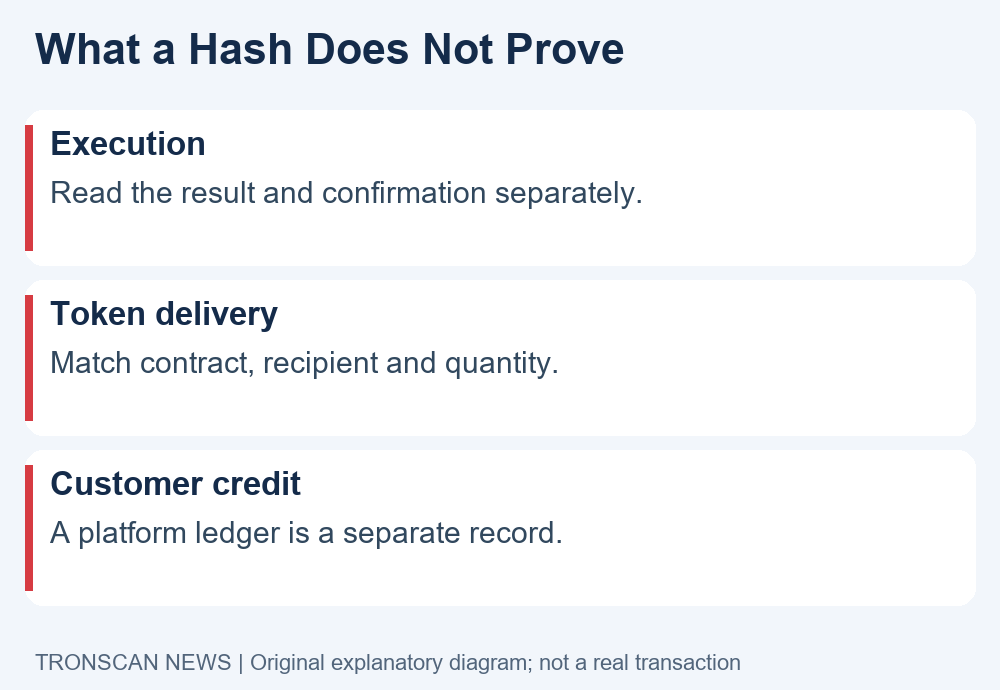
This independent guide explains how to identify the right reference and use it carefully. A hash helps you locate evidence; it does not, on its own, prove that the intended token reached the intended recipient or that an exchange credited a customer account.
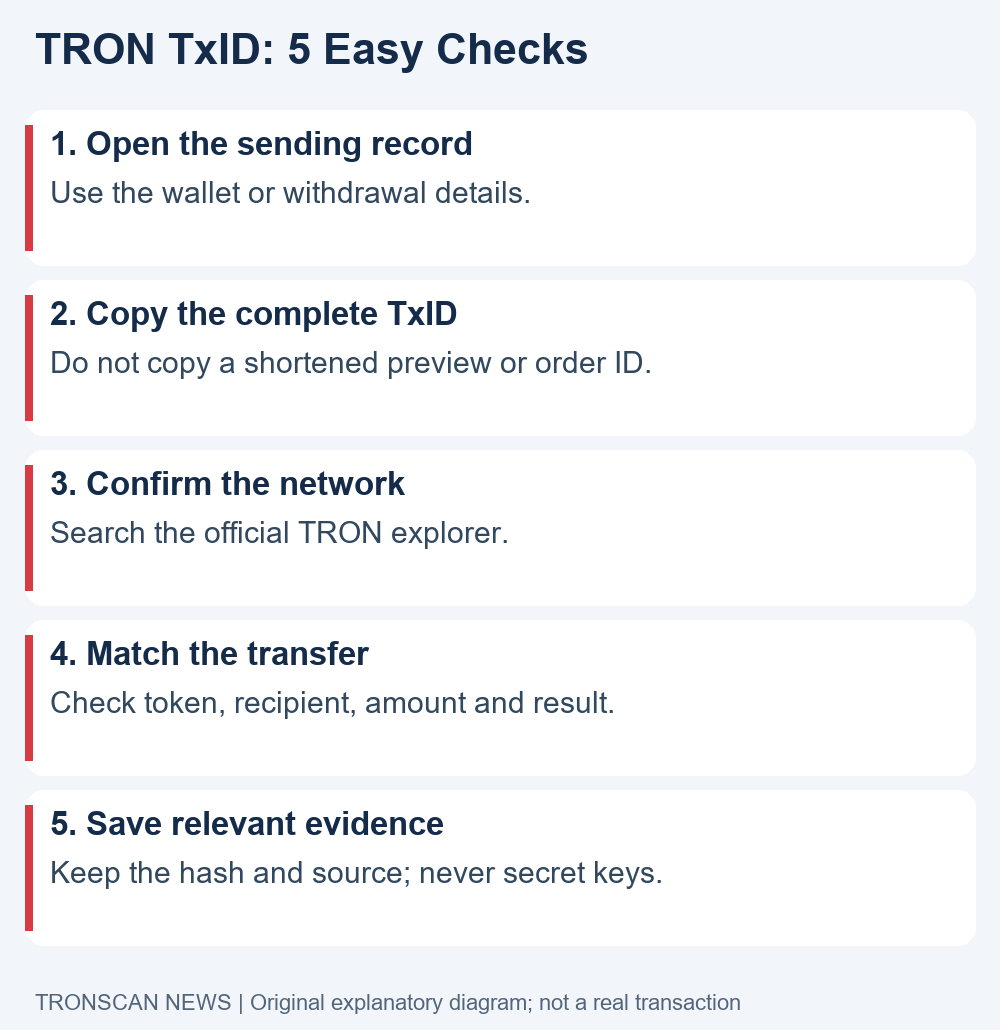
Table of Contents
TRON TxID: 5 easy checks on mobile
- Open the original sending record. Use the wallet activity entry or the sending platform’s withdrawal details for the specific payment you are investigating.
- Find the blockchain reference. Look for transaction hash, TxID or Txn Hash. Keep an internal order number separately, because it may refer only to a request inside the service.
- Copy the complete value. Use the copy control where available. Avoid manually transcribing a shortened label with an ellipsis from a small screen.
- Search the correct network. For a TRON mainnet payment, use the official TRONSCAN website and inspect the returned transaction. A different chain or test network answers a different question.
- Match the payment details. Check execution, confirmation, token contract, full recipient and quantity before treating the record as evidence for your payment.
Keep the source of the hash in your note. A reference copied from your own withdrawal history is different from one supplied in an unsolicited message. If someone sends a real transaction belonging to another payment, the explorer can accurately show that transaction while still telling you nothing about your missing funds.
What a TRON TxID identifies
Think of the hash as a lookup reference for a particular transaction, rather than a password or an account name. The official GetTransactionById reference describes it as a SHA-256 identifier derived from the transaction’s encoded raw data. Ordinary readers do not need to calculate it themselves.
The practical benefit is consistency: you can copy the same complete value from a sending record into a blockchain explorer and discuss that transaction with support. Preserve the network alongside it so another person knows which blockchain record you mean.
A hash can exist as part of a transaction-building workflow before a successful completed transfer has been established. The presence of a reference in an application is therefore a starting point for investigation, not the conclusion. Check the actual returned record and result.
When someone asks for your TRON TxID, ask which payment they are investigating if the context is unclear. You do not need to provide a private key, recovery phrase or a signature to let them read an ordinary public transaction.
If you already have a complete exported body and need to compare its serialized bytes with the identifier, follow the offline TxID recomputation procedure. Its tested Python example checks raw_data_hex consistency; it does not verify signatures, execution or finality.
TRON TxID versus wallet address and order ID
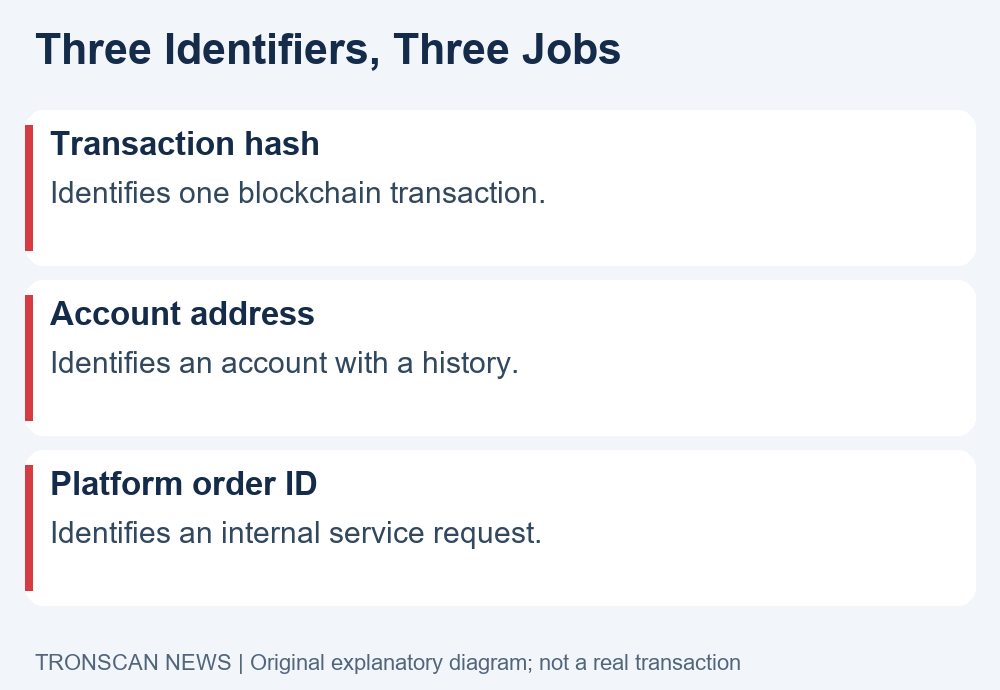
A wallet address identifies an account. Its explorer page can show a balance and a history involving many transactions. A transaction hash identifies a particular transaction record. Opening an address page is useful, but it does not automatically select the payment your support case concerns.
An internal order ID identifies a record inside a service. It may track withdrawal approval, processing or customer support. The service can use it even when a public blockchain explorer cannot. Do not discard that reference; label it correctly and ask for the blockchain hash when needed.
A token contract address has another role: it identifies the token contract being examined. It should not be substituted for the transaction hash or the recipient account. A page about the correct token still does not establish that a particular transfer happened.
For TRON TxID notes, use separate lines headed “Network,” “Transaction hash,” “Sender,” “Recipient,” “Token contract” and “Platform reference.” This simple structure prevents a long string from being copied into the wrong field during a support conversation.
Find a TRON TxID in a sending wallet
Open the account that actually sent the payment and locate the relevant activity entry. Match the approximate time, asset and amount before opening its details. If the application contains several accounts, check the account selector rather than assuming the currently displayed account is the sender.
The exact control names vary by wallet version. Use the transaction-details view and look for the hash or a link to a blockchain explorer. Avoid presenting one application’s button labels as universal instructions for every wallet.
If there is an explorer link, check its destination before relying on it. The official public explorer is tronscan.org. A search advertisement or a message containing a similar-looking domain is not equivalent to a trusted wallet’s documented explorer destination.
Copy the full reference into a local note if you need to switch between applications. Return to the sending entry afterward and compare the copied value. Mobile clipboard mistakes can silently replace a useful reference with text copied during an unrelated task.
Find a TRON TxID in exchange withdrawal history
Open the sending service’s official application or website, select withdrawal history and inspect the correct request. Record its internal status separately from any blockchain status. “Approved,” “processing” or a similar service label may describe work before a transfer is broadcast.
If no public hash is available, ask the sender whether the withdrawal has been broadcast and which transaction belongs to it. Include the service’s order reference in that request. Do not invent a blockchain hash from an order number or assume an empty field means the recipient lost the payment.
For TRON TxID investigations involving several withdrawals, keep one row per request. A service may present its own reference and a blockchain reference together. Preserve the relationship shown by the service instead of matching records only because their times are close.
Do not submit another withdrawal simply to generate a reference for the first. That creates another request with its own possible outcome. Resolve the original status using the sender’s evidence and official support before deciding whether another payment is appropriate.
Read the record after a TRON TxID search
A transaction page is more than a green status label. Check whether the record is for the intended network and operation, whether execution succeeded and whether the relevant confirmation state is available. A contract call can have a different result from the action you hoped it would perform.
The TRON confirmation documentation distinguishes broadcast acknowledgement, transaction inclusion, execution receipts and solidified state. This is why a sending application’s acknowledgement should not replace the completed on-chain evidence.
For token transfers, inspect the actual token movement and compare the full recipient and quantity. The contract called by a transaction and the recipient of a token movement are different fields with different meanings. Do not substitute one for the other because both look like addresses.
Our mobile transaction lookup guide covers the record-reading steps. Use it after locating the correct reference, especially when a transaction contains more detail than the simple payment summary shown by your wallet.
When a TRON TxID search returns no result
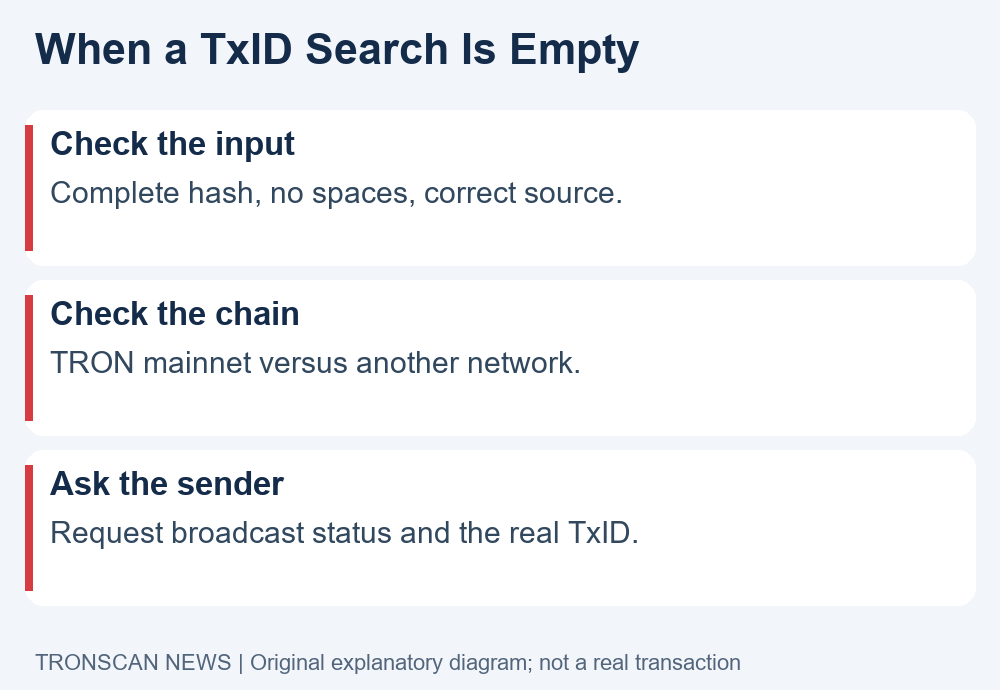
Start with the input. Copy the complete value again from the original record, remove accidental surrounding spaces and confirm that it is not a shortened preview. Do not repair missing characters by guessing; return to the source or ask the sender for the full reference.
Next check the network named in the sending record. A USDT transfer on another blockchain is not a TRON transaction just because its token ticker is the same. Likewise, a test-network record does not establish delivery of a mainnet payment.
An empty explorer result is an observation, not a complete diagnosis. There may be a wrong reference, a different network, an unbroadcast request or a data-availability issue. Record what you actually checked and contact the appropriate sending service when its broadcast status is unclear.
Keep investigating the original reference rather than collecting random hashes from search results. A visually similar transfer is not a substitute. You need evidence connecting the transaction to your sending record and intended destination.
A TRON TxID is not proof of USDT identity
Different tokens can use similar names or symbols. A real transaction involving a token labelled USDT still needs a contract check before it is treated as the issuer’s USDT. A familiar icon or a screenshot of a balance is insufficient evidence of token identity.
Use the issuer’s current supported-protocol reference and compare the complete contract address. Our USDT TRC20 contract guide explains that comparison and keeps the token contract separate from a deposit address.
After the token identity matches, compare the actual recipient and amount. A valid transaction for a different recipient does not satisfy your payment question. Neither does a correct contract paired with an unrelated historical transfer.
Keep these checks separate in your notes: locating a record, verifying its token, matching its destination and checking its result. Each answers one part of the investigation, and no single label answers them all.
Use a TRON TxID in a missing-deposit case
When the correct transfer executed but a platform account has not been credited, preserve the hash and compare the receiver’s current deposit instructions. Public on-chain evidence and a custodial customer ledger describe different stages of the same payment process.
Our USDT not received checklist helps identify whether the next question belongs to the sender, a wallet display or a receiving platform. It does not promise a fixed crediting time or recovery outcome.
For support, send a focused report through the official channel: network, full hash, asset, recipient, amount, timestamp with timezone and the specific status that remains unresolved. Include the internal withdrawal reference under its own label rather than calling it the blockchain hash.
Keep unrelated balances, identity documents and login codes out of an ordinary transaction note. If a service needs additional information, follow its official process and consider what is actually necessary. Publicly posting a full address history can disclose more financial activity than your question requires.
Save a TRON TxID without changing its meaning
Store the exact hash as text alongside the network and source link. Avoid spreadsheets or note tools that truncate long strings in exports. Before sharing a copied reference, compare it with the original entry and confirm that the receiving person can access the complete value.
Preserve timezone labels. A wallet may show local time while an explorer shows UTC, so two different displayed times can refer to the same event. Do not reject a record solely because the clock labels differ; compare the actual timestamp and other payment details.
If you save a screenshot, keep it as supporting context rather than replacing the hash with an image. Text is easier to copy into an explorer and reduces transcription errors. Redact unrelated account details before sharing the screenshot with the correct support destination.
Frequently asked questions
1. Is a TRON TxID the same as a transaction hash?
In this lookup context, yes: it is the transaction identifier used to find the blockchain record. Check the source and network, because a service may also display an unrelated internal order reference.
2. Can I find a payment using only a wallet address?
You can inspect the account history, but you must still match the correct transaction using its asset, recipient, quantity and timing. An address identifies an account with potentially many records, rather than selecting one payment automatically.
3. Does having a hash mean the transaction succeeded?
No. Open the record and inspect confirmation and execution, then match the relevant transfer details. A reference is not a substitute for the completed result or evidence of a platform’s customer credit.
4. Is it safe to share a transaction hash?
A public hash is not a secret signing credential, but it can reveal linked addresses and activity. Share relevant evidence with the intended recipient or official support and consider that privacy exposure before posting it publicly.
5. Do I need to connect my wallet to search?
No wallet connection or signature is needed for an ordinary public transaction lookup. Never provide a recovery phrase or private key to someone claiming those secrets are required to locate a transaction.
Continue your transaction check
Use a TRON TxID to locate the correct evidence, then read the result rather than stopping at the identifier. Visit the Tronscan News homepage for independent explainers. Our editorial standards describe source checks, AI assistance and corrections.
Leave a Reply