TRON USDT means USDt represented as a token on the TRON blockchain; it is separate from TRX, the network’s native asset. A USDT balance, a TRX balance and an account’s resources answer different questions. This guide connects those concepts so you can identify the asset, check receiving instructions and read a transfer record without guessing from a ticker.
This is an independent educational guide for ordinary mobile readers. It does not execute a transfer, quote a guaranteed fee or recommend buying either asset. Work through the account and payment evidence you already have before considering another operation.
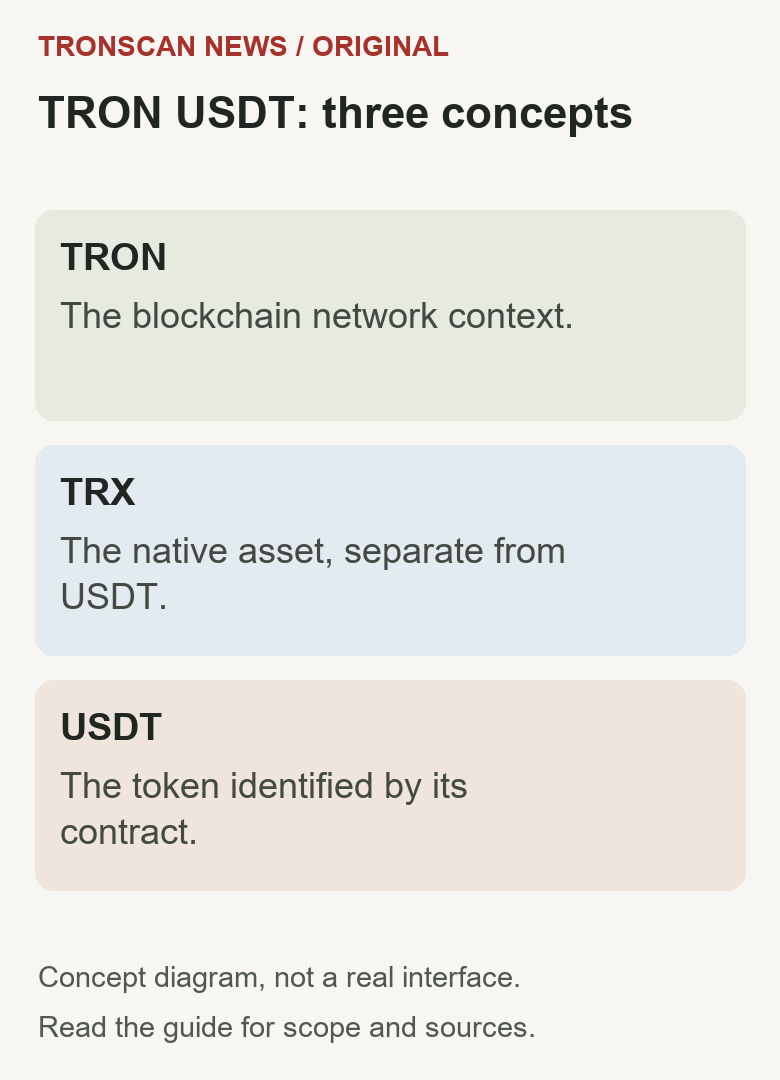
Table of Contents
What is TRON USDT? Read the name in three parts
USDT identifies the token, TRON identifies its blockchain context, and TRC20 describes the token standard used there. TRX remains a different asset. A wallet may show both balances under one account without making their units interchangeable.
The phrase “TRON USDT” does not mean that TRX has become USDT, that the explorer holds your funds, or that every service accepts the same deposit route. First identify the token and network; then read the receiving service’s instructions for that route.
A beginner’s worked question: in the clearly invented 100-USDT example below, the 100 describes token quantity. It does not describe the TRX balance, the available Energy, the fee of a future action, or an exchange deposit credit. The table below keeps those questions separate.
Definition review, 30 October 2026: Tether’s supported-protocol reference was rechecked for its TRON USDt entry. The earlier interface observations remain dated 25 October; this review does not claim a new transfer test.
TRON USDT quick reference: three concepts to separate
| Concept | What it identifies | What to check |
|---|---|---|
| TRON | The network context for the record | Sender and receiver support the intended network |
| TRX | The native asset, separate from a USDT quantity | Liquid balance, resources and any current operation quote |
| TRC20 USDT | The token on that network | Issuer-confirmed contract, quantity and recipient |
| Receiving-service credit | The service’s internal customer record | Its deposit conditions and actual credited status |
The purpose of this table is to stop one visible number from answering four different questions. An account can display token units while another field describes a resource or fiat estimate. Write the unit beside each value when comparing screens.
1. Identify TRON USDT by network and contract
Tether’s supported-protocol reference identifies TRC20 on TRON. Compare its USDt contract reference with TR7NHqjeKQxGTCi8q8ZY4pL8otSzgjLj6t. A symbol or logo alone is not sufficient to identify the token you intended to receive.
That contract identifies the asset, not your personal deposit destination. The recipient address must come from the intended wallet or receiving service. Copying a token contract from an article into a transfer destination confuses two different roles.
The English token page on TRONSCAN was checked read-only on 25 October 2026. It displayed TRC20, a Contract field matching the reference above, and Decimal 6. Its transfer table included Txn Hash, From, To and Amount (USDT). Live totals and values change, so they are not fixed instructions in this guide.
When someone supplies a screenshot of TRON USDT, ask for the underlying record context. A cropped token name does not show the complete contract, network or intended recipient. Preserve those missing fields as unknown until they can be verified.
2. Check TRON USDT receiving instructions before interpreting a payment
Obtain the receiving address and network from the actual receiving wallet or service. Compare the full destination, not a few visible characters. An old address in history or a similar-looking result in an explorer is not a substitute for current receiving instructions.
A service’s support for one asset does not automatically establish its support for every network on which that asset exists. Read its network-specific information and preserve the relevant date. Do not import an unrelated platform’s minimum or confirmation rule into your own investigation.
- Identify the intended asset and network in the receiving instructions.
- Compare the complete recipient with the intended account.
- Check the sender’s network choice against that requirement.
- Record any service-specific condition from that service’s own source.
- If the sources conflict or omit a field, resolve it before treating the route as verified.
This checklist does not certify that a transfer is safe or reversible. Its outcome is a clearer description of the intended route and any unresolved conditions. A public explorer cannot validate a private exchange customer’s account details on your behalf.
3. Read resources separately from the TRON USDT balance
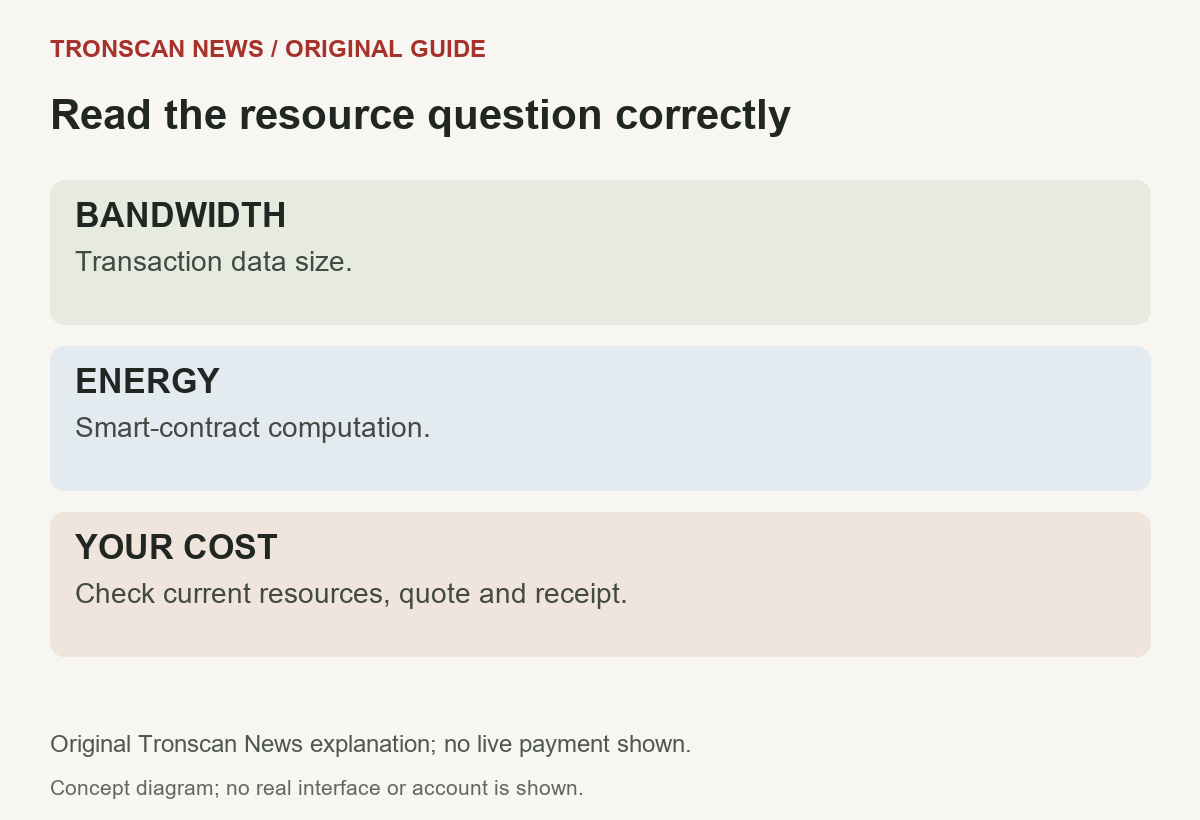
The official TRON resource model distinguishes Bandwidth for transaction data from Energy for smart-contract computation. Resource availability and charging rules affect an operation; the token amount alone is not a fee quote.
Do not assume that visible USDT means the account can complete every proposed action without another resource check. Conversely, do not infer a universal minimum TRX amount from one wallet screenshot. The operation, available resources and current network conditions need to be considered together.
A wallet estimate is a pre-operation observation. A completed transaction’s receipt describes recorded consumption and fees. Keep those observations separate when deciding whether a particular transfer behaved as expected.
This main TRON USDT guide connects the asset and resource questions without repeating every staking or resource-management procedure.
4. Compare TRON USDT service charges with the on-chain record
For exact gross-debit and net-recipient equations, a dated receipt and a locally tested worksheet, use our withdrawal-charge and network-fee reconciliation guide. Keep a service charge in USDT separate from a receipt fee in TRX.
An exchange withdrawal charge and the network’s recorded consumption may use different rules. If you compare them, preserve each source and unit. A difference is a question to investigate, not immediate proof that a fee was hidden or that the blockchain record is incorrect.
Write down the expected token amount separately from any quoted service charge. Then compare the actual token movement with the sender’s completed record. A fiat conversion adds another changing value and should not replace either token quantity or network fee.
When a tutorial claims a single fixed cost for all TRON USDT sends, ask what operation and conditions it describes. A generic promise cannot replace the current quote for your action or the final receipt. This guide deliberately does not publish an unsupported universal fee.
Do not make a new transfer merely to test a headline about low costs. Begin with an existing record you can inspect. A reproducible comparison of the same operation and units is more informative than unrelated screenshots from different services.
5. Use a receipt worksheet for an existing transfer
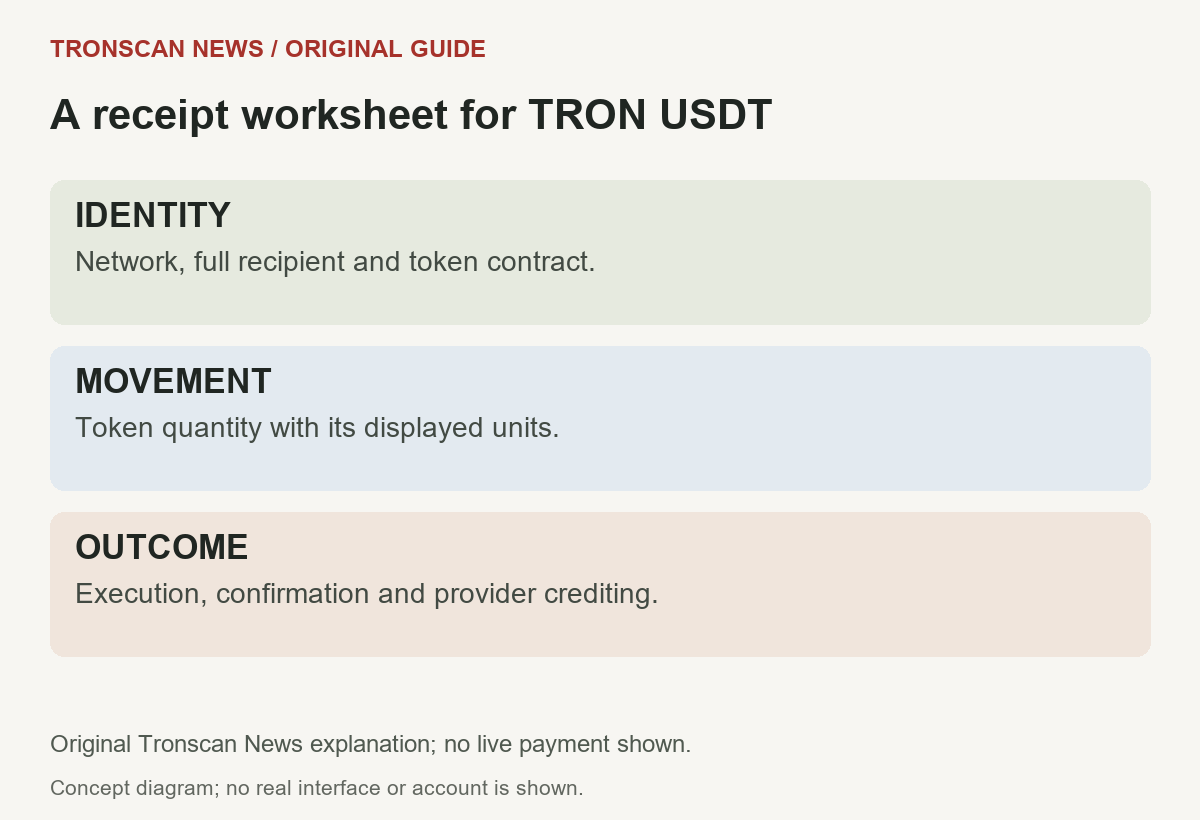
Our individual TRON transaction tutorial explains how to locate a payment. Use the following original worksheet to connect that record with the asset and receiving questions in this guide.
| Check | Observation to preserve | Next question |
|---|---|---|
| Identity | Full hash, network and source record | Is this the intended operation? |
| Asset | Contract and token quantity with units | Does it match the expected asset? |
| Recipient | Complete address in the relevant movement | Does it match the receiving instructions? |
| Execution / confirmation | Each reported state and observation time | What does the receiving service require? |
| Resources / fee | Actual receipt labels and units | Am I comparing a service charge instead? |
| Service credit | Actual deposit status in the receiving service | What additional evidence does support need? |
Complete only fields you can establish. If you have a service order number without a blockchain hash, say so. If the receipt is visible but service credit is missing, preserve both observations instead of turning one into a presumed failure of the other.
A synthetic TRON USDT account example
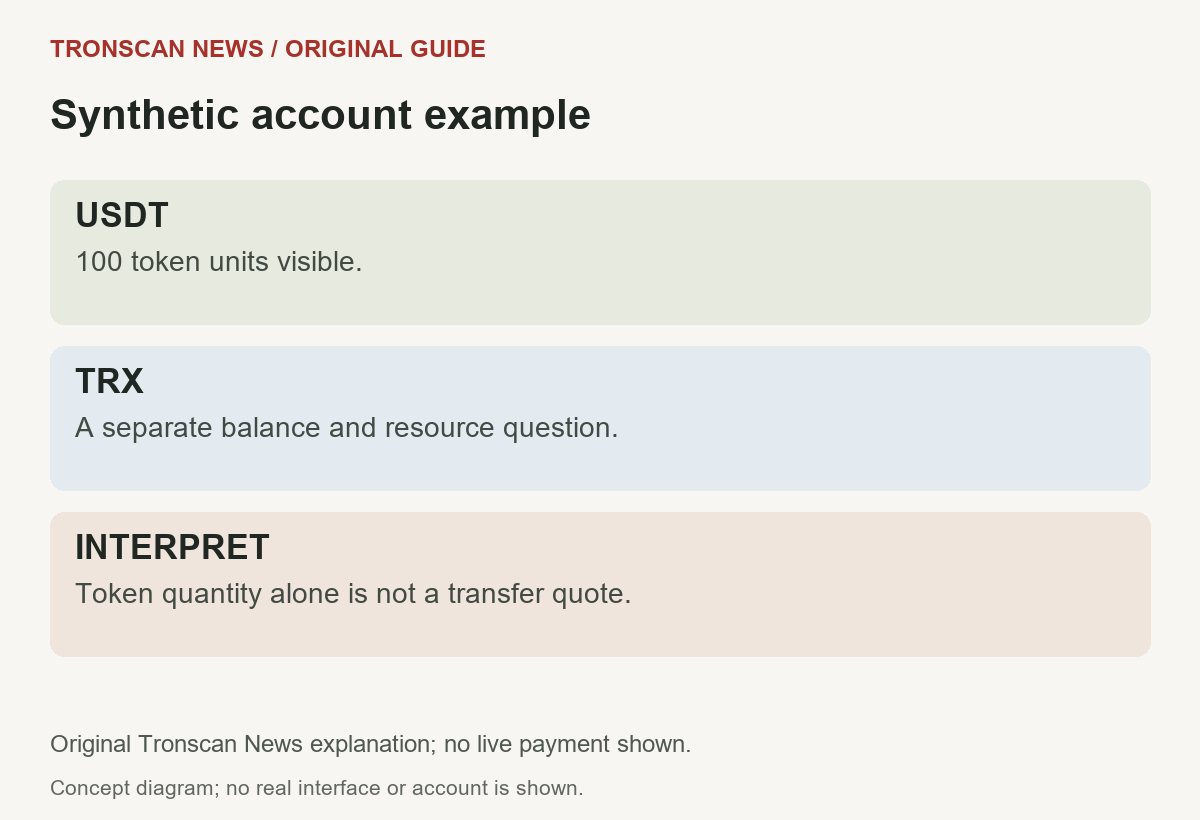
Invented example, not a live account: a wallet displays 100 USDT. The user asks whether that means a proposed transfer will have no additional cost. The token quantity does not answer that question.
First establish which account and network the wallet displays. Next distinguish token units from any TRX balance or resource display. Finally inspect the current quote for the proposed action and the applicable service conditions. A quote is still not a completed receipt.
If the user instead asks whether 25 USDT reached a service, the relevant evidence changes. Obtain the complete transaction hash, inspect the token movement and compare the intended recipient. Then check the service’s own crediting record.
The value of this example is the change in questions, not a recommended amount or transaction. It demonstrates why the same TRON USDT balance should not be used to infer transfer cost, recipient identity and deposit completion.
What to do when TRON USDT records do not match
- Wrong or uncertain network: return to the original sending and receiving records; do not choose a network from the ticker alone.
- Familiar symbol, different contract: preserve the contract discrepancy and stop treating the record as the intended token.
- No transaction found: check the complete identifier and whether it is a blockchain hash or a service reference.
- Receipt visible, credit missing: compare the receiving platform’s current conditions and contact its established support route.
- Unexpected cost: compare the same operation’s quote, completed receipt and separate service charge with their units intact.
The wider USDT explorer network-selection guide owns the cross-network lookup decision. Keep network selection there and the TRON asset/resource relationship here, so each guide has a clear purpose.
Never disclose a recovery phrase or private key to complete these reading checks. A public identifier can be enough to discuss a record, but it can also reveal account activity. Share only the evidence relevant to the support question.
A compact note to keep beside your phone
Use one note per operation: source, network, expected asset, recipient, hash if available, observation time and unresolved question. This small discipline helps prevent the correct hash from one payment being combined with an address from another.
When a screen truncates an address, expand the source record before comparison. If you copy a value, check what was copied and where it came from. A screenshot can support a conversation while still omitting the complete identifier needed to reproduce the result.
If a provider updates a deposit status later, preserve the earlier observation and its time. Do not silently rewrite the note as if the later state was visible from the beginning. Separating observation times makes a support discussion more precise.
TRON USDT cost comparison worksheet
To compare a quote with an existing receipt, keep three columns: the quoted action, the completed on-chain operation and the service charge. Use the same operation reference throughout. If one source is missing, preserve that gap instead of filling the column from a different payment.
| Source | Capture | Limit |
|---|---|---|
| Wallet estimate | Action, time, quoted units and scope | Not a completed receipt |
| Execution receipt | Hash, reported consumption and fee units | Not an exchange pricing policy |
| Service charge | Provider, asset, charged amount and policy | Not necessarily identical to network consumption |
Another invented example: a screenshot shows a 25-unit token movement while a separate withdrawal record displays a service charge. The useful comparison asks which amount was requested, which amount the sender says was deducted, and which movement the recipient actually received. It does not assume that one of those numbers is a network fee merely because it appears beside a transfer.
Save the relevant field labels with their values. If the wallet quote uses TRX and another screen uses dollars, establish the valuation time before comparing them. Do not silently round away a difference that you are trying to explain. If a quote changed before submission, preserve the original and later observations separately.
This worksheet supports an evidence-based TRON USDT question: what was quoted, what happened and what a provider charged. It does not predict the cost of a future operation or establish why a provider chose its price. For an unexplained charge, the next source is that provider’s own current policy and support record.
Frequently asked questions
1. Is TRON USDT the same asset as TRX?
No. This guide distinguishes the USDT token on TRON from the network’s native TRX asset. Compare asset labels, contracts where relevant and units instead of treating the two displayed balances as interchangeable.
2. Is the USDT token contract my receiving address?
No. It identifies the token on its network. Obtain the intended recipient from the actual wallet or service instructions and compare the full address separately. A contract copied from an asset reference is not a personal deposit instruction.
3. Does having USDT prove a transfer will be free?
No. Token quantity alone does not establish available resources or the current cost of a proposed operation. Inspect the relevant resources, wallet quote and service conditions; use a completed receipt to examine an operation that already happened.
4. Can an explorer confirm my exchange credit?
It helps inspect public on-chain records. The exchange maintains a separate customer ledger and deposit policy. Compare the network, asset and recipient, then check its own credited status through the established service channel.
5. What should I check first when a TRON USDT record looks wrong?
Start with the complete identifier and correct network. Then compare the contract, quantity and recipient. Record any missing evidence honestly before assigning a cause or assuming that another operation is needed.
Sources, testing and editorial scope
Reviewed on 25 October 2026 against the issuer protocol reference and TRON resource documentation linked above. The TRONSCAN token page was inspected read-only; no funds were sent and no wallet signing or provider crediting test is claimed.
The worksheets, synthetic example and four diagrams are original editorial explanations prepared with AI assistance and source checks. The Tronscan News homepage provides the broader guide collection. Tronscan News is independent and does not represent TRON, TRONSCAN or Tether.
Leave a Reply