TRON address formats can look different while representing the same address: wallets commonly display a Base58Check string beginning with T, while a TRON API may return a hexadecimal string beginning with 41. Compare them through a validated conversion, not by comparing their first or last characters. Neither representation proves the network, recipient identity or safety of a payment.
This guide to TRON address formats is for readers comparing an explorer account with a public address in an API response or support record. Success means establishing whether two complete strings encode the same address, while keeping the network and record type separate. It is a read-only task: no transfer, wallet connection or secret key is needed.
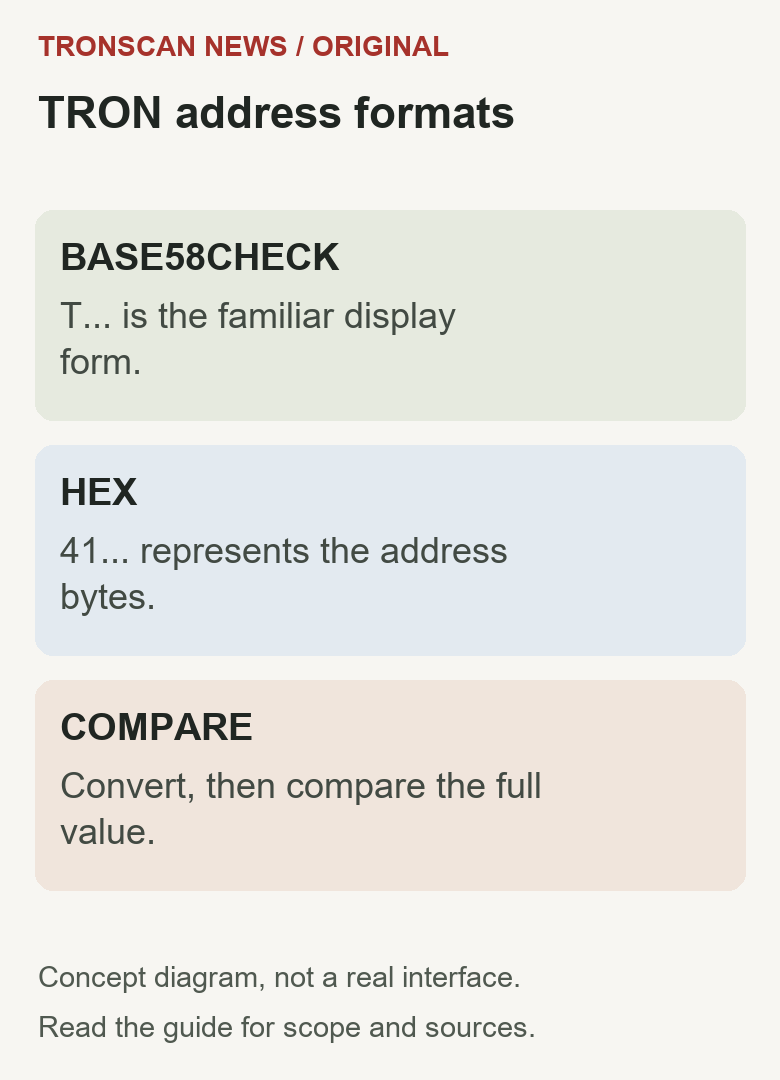
Table of Contents
TRON address formats: three rules to keep separate
First, identify the representation. Second, check the complete value using an appropriate address utility. Third, confirm what the address refers to in your investigation. Converting TRON address formats answers only the second question; it cannot settle the third.
The official TRON address encoding reference describes Base58Check and 21-byte hex forms, and explains that an API’s visible setting controls its expected address representation. Use the documentation for the particular endpoint rather than guessing from a nearby example.
| Representation | Recognition clue | Reader action |
|---|---|---|
| Base58Check display | Typically 34 characters starting with T; case matters | Preserve the full string from the trusted record. |
| TRON hex address | 42 hexadecimal characters including the leading 41 | Check the complete decoded address, not a suffix. |
| Other hex data | A hash, encoded parameter or another chain’s address can also look hexadecimal | Identify the field before attempting conversion. |
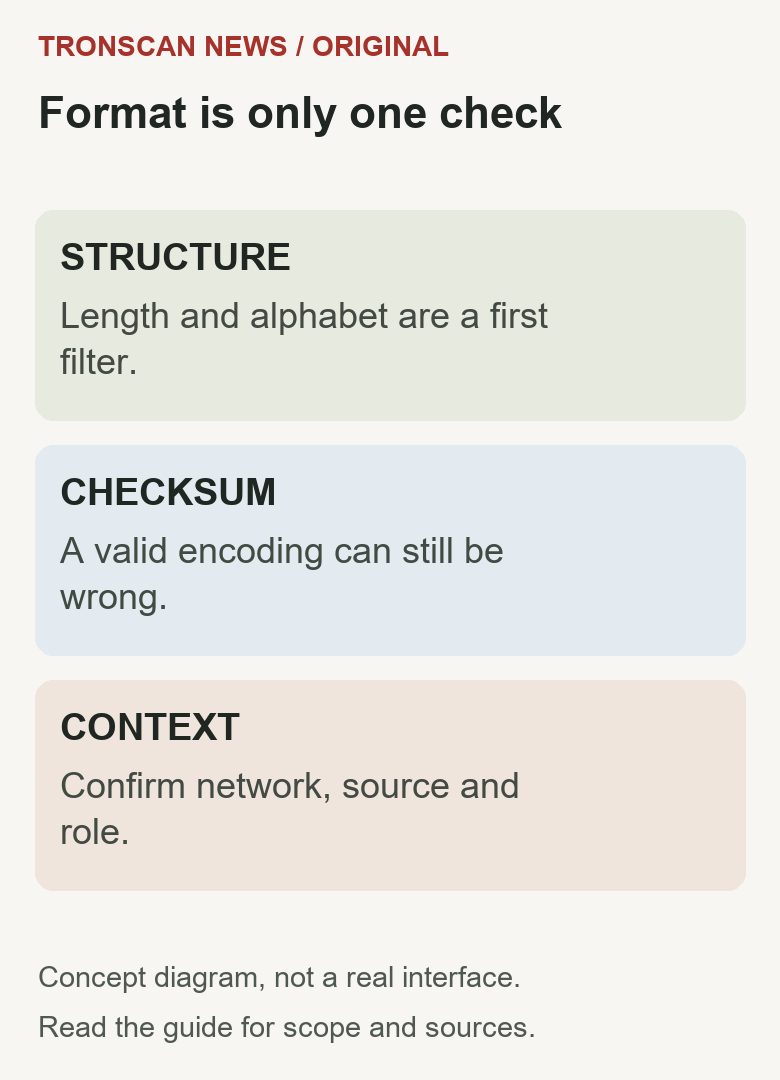
This TRON address formats table is a recognition aid, not a validator. Spaces, missing characters and transcription errors need checking. An input that looks plausible should still be treated as unresolved until its meaning and complete contents are established.
Rule 1: choose an address, not a different identifier
A transaction hash identifies a transaction. A token contract identifies a contract. An account address identifies an account. These can appear together on one screen without becoming interchangeable. Before comparing TRON address formats, write down the field label beside each string.
For example, an owner address in a record is a different role from the token contract called by that record. A recipient in a token-transfer event is another role to verify. Do not convert every string and then assume whichever one matches is the person who received the tokens.
Use our TRONSCAN guide to selecting the right record when deciding whether your task begins with an account, token or individual transaction. This page focuses on the representation comparison after that choice.
Keep the original sending or receiving instructions alongside your note. A copied row from an unfamiliar transaction is not a reliable source for a future payment destination. If the two strings came from different services, record which service supplied each one before trying to reconcile them.
Rule 2: compare TRON address formats through conversion
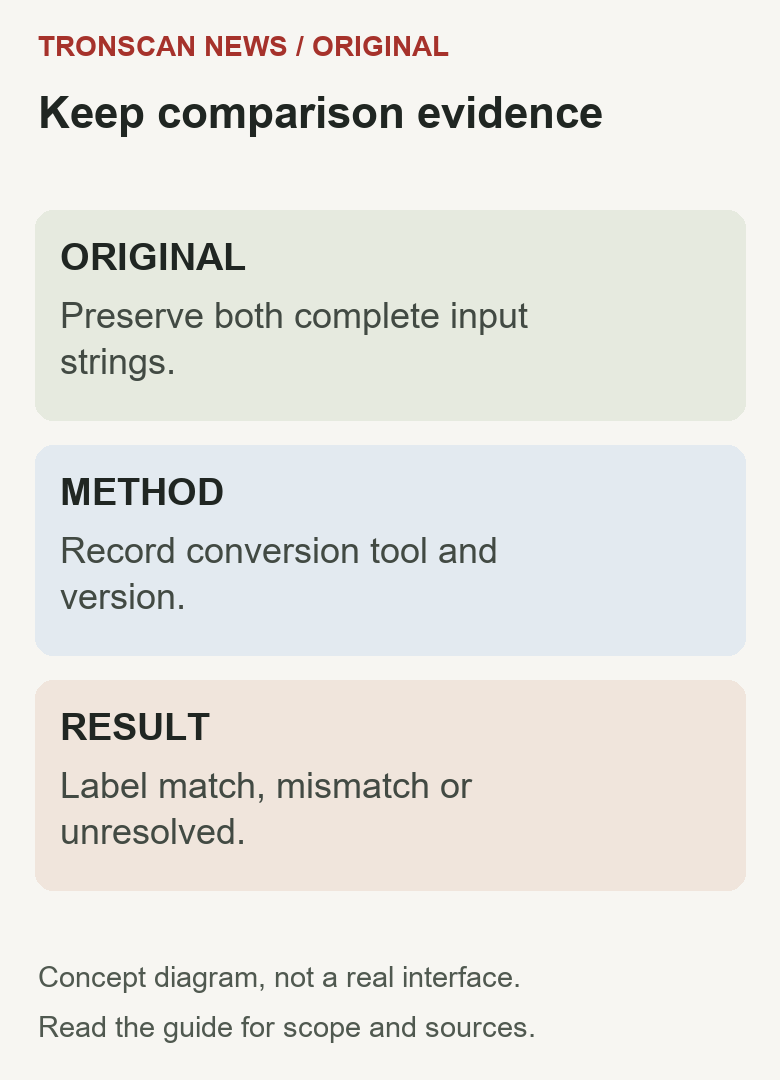
- Preserve both inputs. Copy each complete public string into a private note. Label its source and role; do not shorten it for the comparison.
- Identify the expected form. Read the field or endpoint documentation. Do not remove 41, add 0x or change case just to make an input accepted.
- Use an address-specific conversion method. Choose an official SDK utility in an environment you trust. A general text-to-hex encoder is a different operation.
- Compare the complete converted value. A matching address payload establishes representation equivalence. A mismatch needs investigation, not another payment.
- Keep the result narrow. Record match, mismatch or conversion failure. Continue to verify network, source and role separately.
The TronWeb address utility documentation provides address.toHex and address.fromHex. The page also distinguishes address conversion from generic data encoding. Developers should follow the utility documentation for their installed SDK version.
For ordinary phone users, there is no need to install a development tool simply to check a balance. Ask the service that supplied a hex address for its public display-form reference, or use its documented explorer link. Do not provide a recovery phrase to obtain a conversion.
A reproducible TRON address formats comparison
The following pair is a public example from the linked TronWeb documentation. It is included as a conversion fixture, not a payment destination, an account recommendation or an observed transfer. Never send assets to example addresses.
| Fixture field | Complete value |
|---|---|
| Base58Check example | TNPeeaaFB7K9cmo4uQpcU32zGK8G1NYqeL |
| Hex example | 418840E6C55B9ADA326D211D818C34A994AECED808 |
| Comparison result | The Base58Check payload decoded to the displayed hex value in our offline check. |
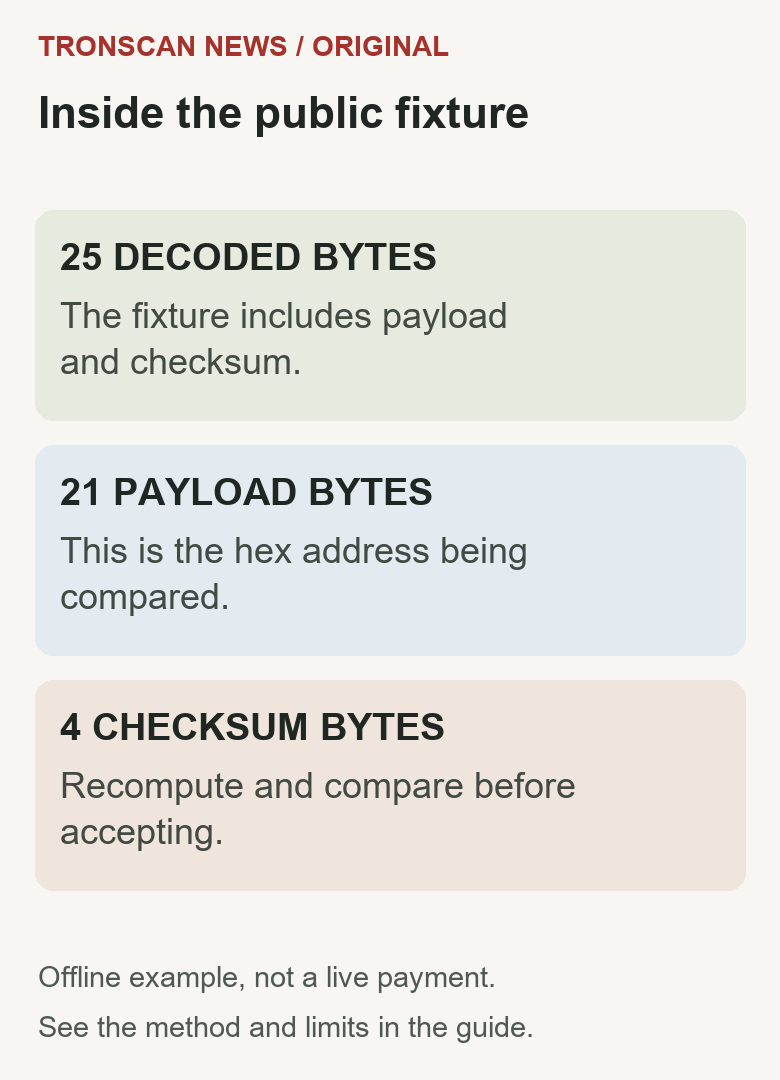
Our method, checked October 25, 2026: we independently decoded the public Base58 string, verified its four-byte double-SHA256 checksum and compared the resulting 21-byte payload with the documented hex example. We also changed the last character from L to M; that altered fixture failed the checksum check. No network request, wallet signing, account ownership check or payment was part of this test.
This deliberately small test demonstrates two outcomes: a known matching pair and one detected transcription error. It does not prove that every possible invalid input will be rejected by every application. It also does not test a wallet’s paste behavior or a particular exchange’s deposit form.
If your comparison produces a failure, retain the original input rather than silently repairing it. Ask the source to confirm the complete value. An application accepting a string is not evidence that the intended recipient supplied it.
Rule 3: TRON address formats do not select the network
The same representation rules are used across current TRON networks. A T-prefix or 41-prefix alone is not a mainnet/testnet selector. Keep the explorer domain, service network selection and original record in the evidence.
Use our TRON mainnet versus testnet guide to establish that separate context. Converting an address does not move funds between networks or make a testnet record a mainnet payment.
A useful TRON address formats comparison is precise: these two representations encode the same address, and this record was checked on the named network. That is stronger than saying that two screenshots look similar, but narrower than claiming that a deposit must be credited or the recipient is trustworthy.
TRON address formats comparison worksheet
Copy this worksheet into a note. It is an original investigation aid, not an automated validation tool or downloadable service. Fill it with public record details only.
| Evidence to retain | Question it resolves |
|---|---|
| Source A, full value, field label | What exactly was supplied, and in which role? |
| Source B, full value, field label | Are you comparing the intended records? |
| Network and explorer domain | Which chain context applies? |
| Conversion method and version | Can another reader reproduce the representation check? |
| Full output and comparison outcome | Was it a match, mismatch or failed conversion? |
| Remaining uncertainty and next contact | What still requires the source or service to explain? |
Record a date and timezone if you also inspect a balance. Format equivalence is a different observation from an account’s changing holdings. For the next record-classification step, use the account type evidence worksheet; matching representations do not determine whether the account record reports Contract or an omitted default.
When the comparison still does not resolve the issue
Matching representation, wrong role: the converted string might be the token contract instead of the recipient. Return to the original field labels and inspect the actual transfer record. Do not discard that distinction simply because the conversion succeeded.
Matching representation, different network: preserve both network names and ask the relevant service about the specific record. An address comparison cannot establish its deposit support or recovery policy.
Different payloads: stop the comparison and verify the source strings. Do not substitute a similar-looking address, edit a suffix or choose an address from an unsolicited helper. Keep the mismatch as the result until evidence changes it.
No conversion environment available: label the comparison unverified. Share the two relevant public references through the service’s official support route. Avoid posting unrelated account history in public comments.
Test TRON address formats with the public fixture
The TRON address formats worksheet is useful even without programming. The following optional Python example gives technical readers a reproducible check of the exact public fixture above. It uses only Python’s standard library, accepts no private key and makes no network calls. Save it as a local script in an environment you control. Running the unchanged example should print Corrupted fixture rejected; a failed assertion means the expected comparison was not established.
import hashlib
ALPHABET = "123456789ABCDEFGHJKLMNPQRSTUVWXYZabcdefghijkmnopqrstuvwxyz"
def decode_address(value):
    number = 0
    for char in value:
        number = number * 58 + ALPHABET.index(char)
    raw = number.to_bytes((number.bit_length()+7)//8, "big")
    raw = bytes(len(value)-len(value.lstrip("1"))) + raw
    payload, checksum = raw[:-4], raw[-4:]
    expected = hashlib.sha256(hashlib.sha256(payload).digest()).digest()[:4]
    if checksum != expected:
        raise ValueError("checksum mismatch")
    if len(payload) != 21 or payload[0] != 0x41:
        raise ValueError("unexpected payload")
    return payload.hex().upper()
assert decode_address("TNPeeaaFB7K9cmo4uQpcU32zGK8G1NYqeL") == "418840E6C55B9ADA326D211D818C34A994AECED808"
try:
    decode_address("TNPeeaaFB7K9cmo4uQpcU32zGK8G1NYqeM")
except ValueError:
    print("Corrupted fixture rejected")
else:
    raise AssertionError("Checksum failure was not rejected")
This small reference check is intentionally limited. It decodes a supplied Base58Check string, separates its payload and checksum, recomputes the checksum, checks the expected payload length and prefix, and returns the hexadecimal representation. It is not a general wallet library, production API validator or destination-approval system. Use a maintained SDK and appropriate integration tests for an actual application.
The changed-character fixture is a negative control: it makes the test demonstrate rejection as well as acceptance. Without that control, printing a plausible hex value would not show whether a checksum error had been noticed. Keep the unchanged fixture and altered fixture separate in your notes so that a deliberately invalid example is never copied as a real destination.
If you adapt the script, retain the original test first. Record your Python version, any edits and the actual output before entering another public address. A different exception may indicate an unsupported character or malformed input rather than the specific checksum failure shown here. Preserve that distinction when reporting the result instead of describing every rejected input as the same problem.
Do not add recovery phrases, private keys, wallet passwords or exchange credentials to this script. They have no role in comparing these public representations. Local execution avoids sending an address to a conversion website, but it does not make an untrusted computer suitable for sensitive wallet operations. This example does not interact with a wallet at all.
For a support case, the useful attachment is the narrow result: the two original public strings, the documented role of each, the conversion method and the exact outcome. It is unnecessary to attach a complete wallet history. If the payloads match but a service still reports a missing deposit, move to that service’s network and crediting investigation; rerunning the same encoding check cannot resolve its internal ledger.
Worked control: two valid addresses can still differ
The previous corrupted-character test shows that an error can be detected. A second question matters just as much: what if both inputs are valid? To test that distinction, we constructed a synthetic address payload consisting of the prefix byte 41 followed by twenty bytes whose value is 11 in hexadecimal. We calculated its checksum, encoded it, decoded it again and compared its payload with the official fixture. This is a deliberately constructed public example, not a generated wallet or a live account test.
| Control | Observed local result | What follows |
|---|---|---|
| Official fixture versus its documented hex value | Checksum verified; complete payload matched | The two representations in that pair are equivalent. |
| Synthetic Base58 versus its own hex value | Checksum verified; complete payload matched | The synthetic pair is also internally consistent. |
| Official fixture versus synthetic fixture | Both decoded successfully; payloads differed | Successful validation alone does not establish that two addresses match. |
The synthetic Base58 value is TBXSw8fM4jpQkGc6zZjsVABFpVN7UvXPdV. Its hex representation is 411111111111111111111111111111111111111111. Do not use either example as a payment destination. We did not query whether an account exists at that address, identify an owner, or establish any transaction history.
Run this optional control after the earlier decode_address definition. The expected final line is Both valid, different payloads. The test makes a comparison assertion as well as a validation assertion; these are separate checks. It uses the same locally defined alphabet and standard-library hashing method, and does not contact an explorer.
# Run after the decode_address definition above.
import hashlib
def encode_fixture(payload):
    digest = hashlib.sha256(hashlib.sha256(payload).digest()).digest()
    raw = payload + digest[:4]
    number = int.from_bytes(raw, "big")
    result = ""
    while number:
        number, remainder = divmod(number, 58)
        result = ALPHABET[remainder] + result
    leading_zeroes = len(raw) - len(raw.lstrip(bytes([0])))
    return "1" * leading_zeroes + result
synthetic_hex = "41" + "11" * 20
synthetic = encode_fixture(bytes.fromhex(synthetic_hex))
assert decode_address(synthetic) == synthetic_hex.upper()
original = "TNPeeaaFB7K9cmo4uQpcU32zGK8G1NYqeL"
assert decode_address(synthetic) != decode_address(original)
print(synthetic)
print("Both valid, different payloads")
For a real investigation, apply the distinction to the original trusted sources. Suppose one service gives you an account address and another record gives you a different address in hex. Validating each input only answers whether each is an acceptable encoding. Convert and compare the complete payloads before deciding that they identify the same account. If they differ, preserve the difference and ask which record each service intended you to inspect.
It is also possible to compare the wrong two roles perfectly. For instance, a contract’s two representations can match each other without proving that the contract is the recipient you meant to check. Keep the field labels from the worksheet beside the conversion result. The test cannot supply missing context that was never included in the inputs.
This control is useful when checking a conversion tool or reviewing a support explanation. Ask for the comparison outcome rather than accepting a statement that an address is valid. Repeating a validation step does not repair a wrong source value, and a green validation message is not evidence of ownership, account activity or a service’s deposit policy.
Frequently asked questions
1. Are TRON address formats two different wallets?
Not necessarily. Base58Check and hex can represent the same address. A successful complete conversion comparison establishes that equivalence; it does not identify the wallet application, its owner or the account’s current holdings.
2. Can I lowercase a Base58Check address?
No. Preserve its exact case and complete contents. If a source changes the value or truncates it, request the original reference instead of guessing which characters were intended.
3. Does 41 prove that an address is on mainnet?
No. The prefix alone does not distinguish the current TRON networks. Confirm the network using the original service selection and correct explorer context.
4. Can converting an address reverse a wrong transfer?
No. Conversion changes a representation, not a blockchain record or destination. Preserve the original transaction evidence and contact the relevant service about its actual options.
5. Does a valid checksum prove the recipient is safe?
No. A valid encoding can belong to an unintended or untrusted destination. Confirm the full address through the original trusted source and keep identity questions separate from encoding checks.
Scope and editorial notes
Tronscan News is an independent educational publication. This article’s original comparison worksheet and offline fixture test were prepared with AI assistance and editorial source checks on October 25, 2026. The test covers public address encoding only; it does not validate a live account, a wallet interface or a deposit.
For related guides, visit the Tronscan News homepage. Source-checking and correction procedures appear on the site’s About & Standards page in the navigation. When reporting an error, identify the section and public reference; never send secret credentials.
Leave a Reply