TRC10 vs TRC20 is a difference between two token standards on TRON, not two separate blockchains. TRC10 assets are handled at the protocol level and identified by a token ID. TRC20 tokens use smart contracts; the full contract address identifies the token. TRX is the network’s native asset and belongs in a separate category.
This guide helps you classify a record you already have. The success condition is a short evidence note containing the network, standard, token identifier and intended account, with unresolved fields clearly marked. You do not need to connect a wallet, sign a message or send funds to make this comparison.
Table of Contents
TRC10 vs TRC20: six differences that matter when reading a record
The official TRON token standards overview separates protocol-level TRC10 assets from TVM-based fungible TRC20 tokens. Use that distinction to choose the right evidence, rather than treating a familiar ticker as an identity check.
| Question | TRC10 | TRC20 |
|---|---|---|
| Where is the token implemented? | TRON protocol level | A smart contract running in the TRON Virtual Machine |
| What identifies the token? | The token ID, together with the network | The full token contract address, together with the network |
| What does an ordinary direct transfer use? | TransferAssetContract | A call to the token contract’s transfer function |
| How is the basic balance queried? | Account token holdings keyed by token ID | The contract’s balanceOf function for an account |
| What resource distinction matters? | A direct protocol transfer differs from contract execution | Smart-contract execution uses Energy as well as transaction Bandwidth |
| What must a receiving service support? | The specific asset and its deposit route | The specific contract asset and its deposit route |
This TRC10 vs TRC20 comparison is a record-reading aid, not a claim that one standard is safer, cheaper in every situation or accepted by every exchange. The TRC10 documentation describes token-ID-based transfers and account holdings; the TRC20 documentation describes contract-based fungible tokens. A TRC10 asset can also participate in smart-contract interactions, so “TRC10” should not be read as a promise that every operation involving it avoids computation.
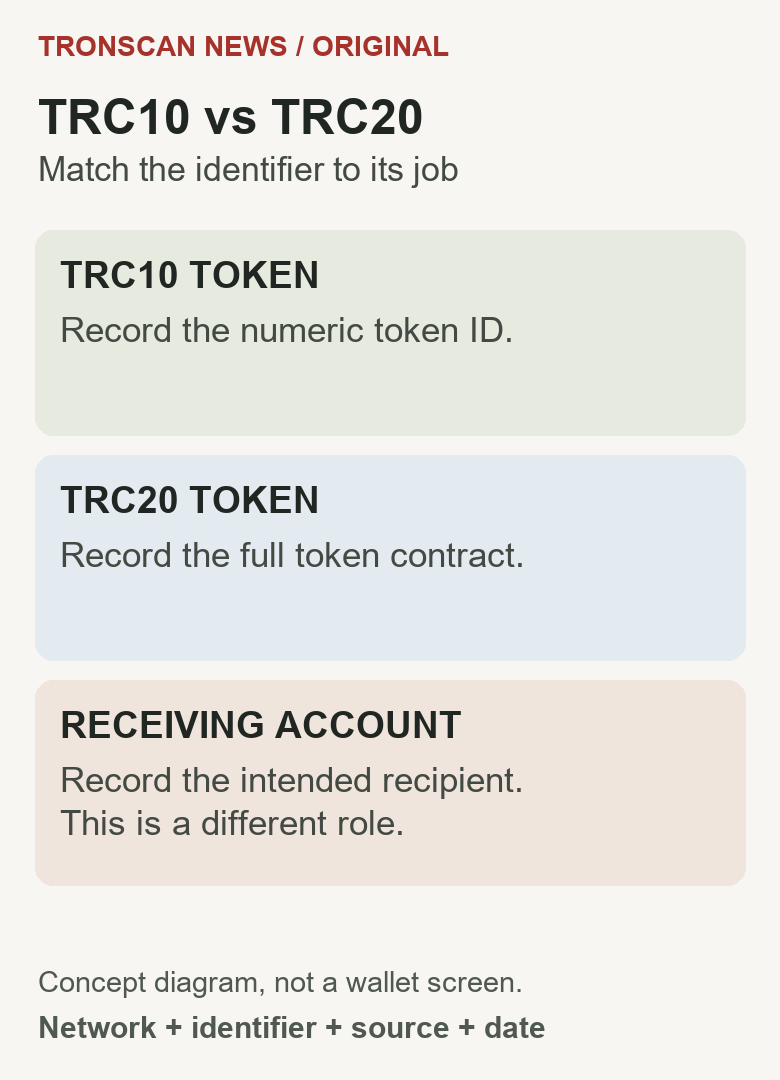
Identify TRC10 vs TRC20 without confusing three different identifiers
A token identifier answers “which asset?” An account address answers “whose account?” A transaction hash answers “which recorded operation?” Write these labels next to the strings before comparing them. Two long strings can look similar while serving entirely different purposes.
For TRC10, preserve the complete token ID rather than substituting its display name. The official GetAssetIssueById reference queries a token by its ID. For TRC20, preserve the complete contract address. An account’s address format alone does not tell you which token standard a balance uses.
The USDT TRC20 page on the official TRONSCAN explorer was checked read-only on 26 October 2026. It displayed TRC20, a Contract field and Decimal 6. This observation establishes what that page displayed; it is not a test transfer or an audit. For a paired legacy-and-newer asset check, use the BTT and BTTOLD record comparison, including the separately verified precision scales.
For a concrete TRC10 vs TRC20 field comparison, the BitTorrent Old TRC10 record showed a numeric Token ID, while the USDT TRC20 record showed a Contract address. Both displayed Decimal 6 during this check. This is a field comparison only: it does not recommend the legacy token, establish a current migration route or imply that every token has the same precision.
A contract field is not your personal deposit destination. Obtain the intended recipient from your actual wallet or receiving service. Never replace that recipient with a token identifier simply because the identifier was copied from a legitimate explorer page.
TRC10 vs TRC20: a read-only identification workflow
- Record the network. Preserve the network named in the original sending or receiving record. Keep Mainnet and test environments separate.
- Find the token’s own record. Follow the asset context from your existing record or a verified issuer reference. A search result that only repeats the token name is insufficient.
- Record the displayed standard. Note TRC10 or TRC20 when shown. If absent, leave it unknown while checking the corresponding protocol or issuer source.
- Copy the correct identifier. Use the token ID for a TRC10 asset or the full contract for a TRC20 token. Record the source URL and check date beside it.
- Separate the account and operation. Keep the intended recipient and transaction hash in their own fields. Do not compare a token contract with an account address as if they were interchangeable.
- Resolve inconsistencies before drawing a conclusion. A mismatched network, identifier or unsupported receiving route remains an open issue. Do not use a second payment as a diagnostic test.
For broader navigation and record selection, start with the TRONSCAN beginner’s guide. This article focuses on selecting the right identifier for a standard, rather than repeating every account or transaction lookup.
An original TRC10 vs TRC20 evidence worksheet
Copy this TRC10 vs TRC20 worksheet into a note. Complete it from the underlying records, not from memory. “Unknown” is a useful outcome when a source does not provide enough information. It prevents a missing fact from silently becoming an assumption.
| Field to preserve | Your evidence | What it does not establish |
|---|---|---|
| Network and environment | [Network name; Mainnet or test environment] | That the receiving service supports the route |
| Token standard | [TRC10 / TRC20 / unknown] | Issuer authenticity or token value |
| Token identifier | [Complete token ID or full contract] | Your receiving account |
| Account being examined | [Complete public address] | Who controls that account |
| Operation reference | [Transaction hash, if relevant] | Private exchange credit |
| Source and check date | [Record URL; issuer source; date] | A guarantee that future rules remain unchanged |
| Unresolved condition | [Missing field, mismatch or unsupported route] | Permission to proceed while guessing |
The worksheet’s method is deliberate: classify the object, preserve its identifier, then compare only equivalent fields. It is an original editorial aid assembled from the documented identifier roles. It does not validate a token automatically, and it is presented here as copyable text rather than as a downloadable file.
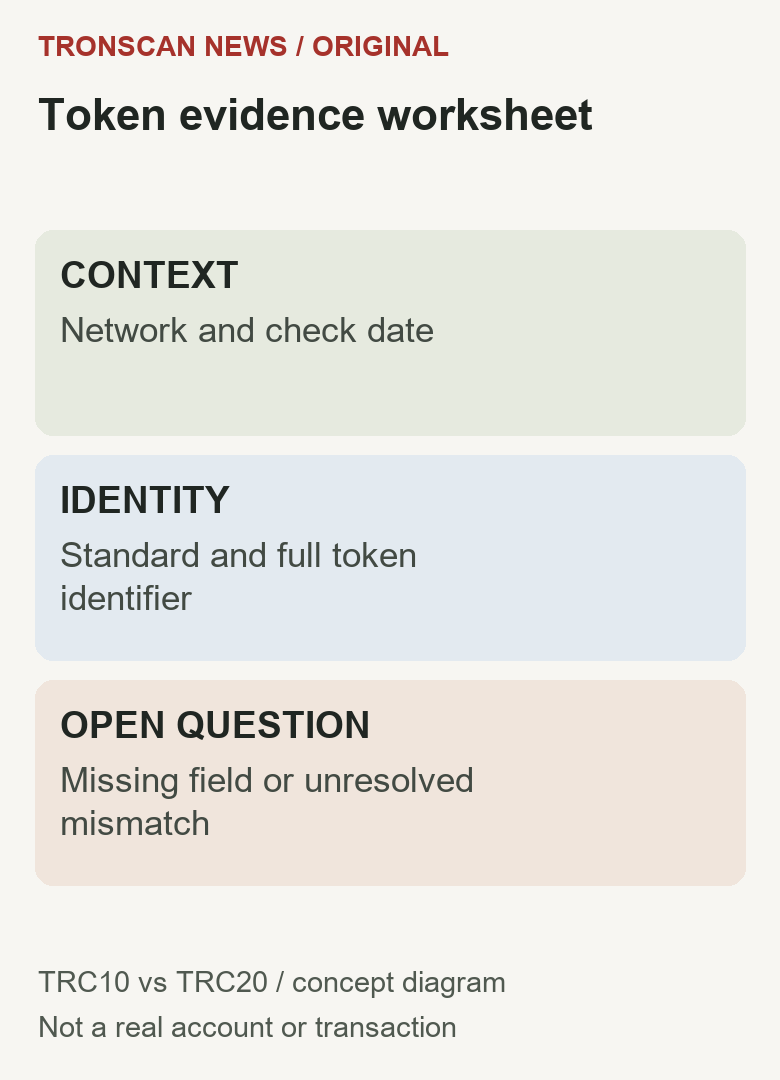
TRC10 vs TRC20 examples: interpreting incomplete evidence
Case A — the same display name, different identifiers. Two hypothetical listings both say “Example Token,” but their token identifiers differ. Record them as separate candidates. The matching name does not justify combining balances or accepting one as a replacement for the other.
Case B — a T-prefixed address with no token context. A hypothetical screenshot shows an address and a quantity but hides the asset details. That address might identify an account or a contract. The correct result is “standard unknown,” followed by a request for the full record context.
Case C — a recognized standard, an unsupported deposit. A hypothetical receiving service lists one asset route, while the sender’s record describes another. Recognizing TRC20 or TRC10 does not resolve that mismatch. Check the receiving service’s own current instructions and preserve the unresolved condition.
These examples contain no real transactions, balances or claimed customer outcomes. Their purpose is to show how the worksheet behaves when evidence is incomplete, including when it should stop short of a definitive answer.
TRC10 vs TRC20 resources, decimals and authenticity
A standard label is not a fixed fee quote. The official resource model distinguishes transaction Bandwidth from smart-contract Energy. Read an actual operation’s receipt or current estimate in context; do not apply an old “times cheaper” comparison to every present-day transfer.
Likewise, a raw integer is not necessarily a human-readable token quantity. Preserve the unit and the relevant precision or decimals before comparing a wallet display with an API result. The Decimal 6 observed on the USDT page is a property of that token, not a rule for every TRC20 token.
The TRON USDT guide separates USDT, TRX and resource balances. TRC10 vs TRC20 explains the token standard; neither a standard label nor verified source code alone establishes that an issuer is trustworthy or that an exchange has credited a deposit.
How to compare two records without changing their meaning
Suppose you are comparing an explorer result with an export from a service. Start by making two copies of the worksheet, one for each source. Do not overwrite one source’s identifier with the other source’s value merely to make the notes agree. Preserve the original label, the complete value and the source separately.
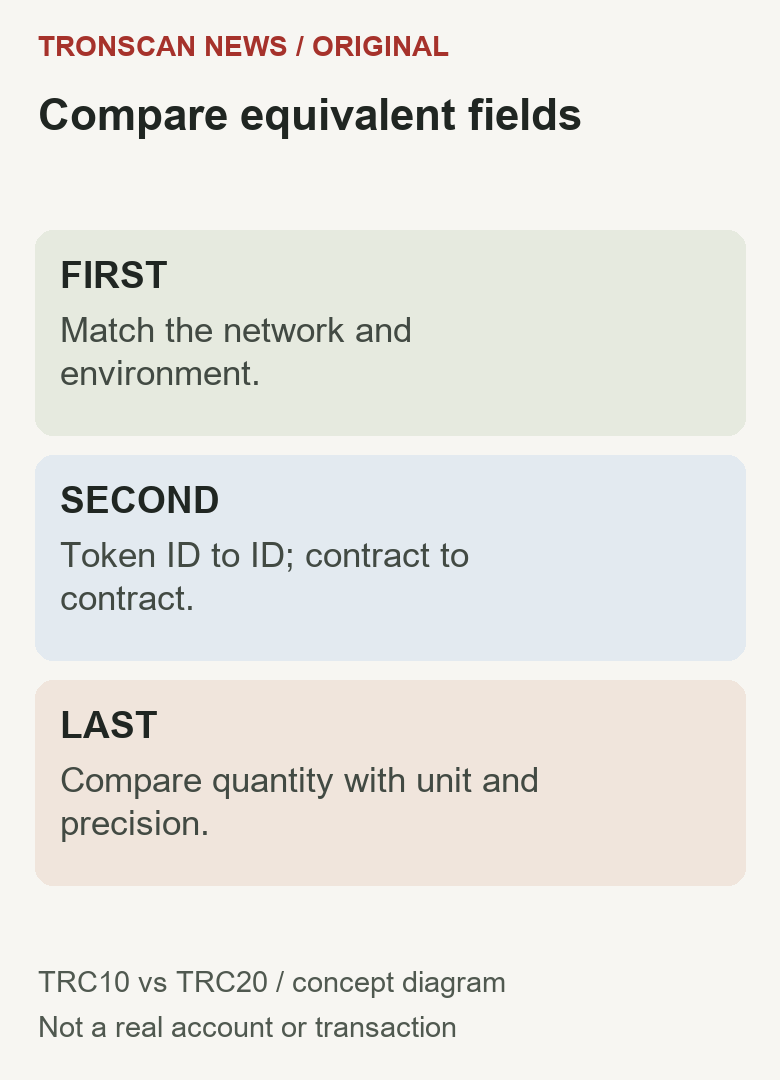
Make the comparison in this order:
- Environment first. If one record is from Mainnet and the other is from a test environment, stop the asset comparison. Resolve that context mismatch before comparing quantities.
- Object second. A token page and an account page answer different questions. Determine whether each source describes an asset, an account or an operation.
- Identifier third. Compare a token ID with a token ID, or a contract with a contract, on the same network. Keep a receiving address in the account field.
- Quantity last. Preserve whether each number is raw or already formatted, its unit and its precision. A display difference alone does not prove a missing transfer.
For example, a hypothetical service export might include only a symbol and a quantity, while an explorer page includes a contract. Those sources are not yet sufficient to establish an asset match. Add “issuer or contract context missing from export” to the unresolved-condition row. Ask the service for the missing context through its own support channel rather than filling in the contract from a similarly named search result.
Another hypothetical pair could show a token ID on one side and an account address on the other. That is a role mismatch, not proof that either string is malformed. Revisit the original pages and locate the asset and account fields independently. Keep the mistaken comparison in your notes if it explains why an earlier conclusion was unreliable.
Keep an evidence note that another reader can reproduce
A useful note should let another reader retrace the public checks without accessing your wallet. Include the date, the complete public record URL, the network context, the displayed standard and the identifier. A screenshot can supplement that note, but a crop that hides the network or identifier should not replace it.
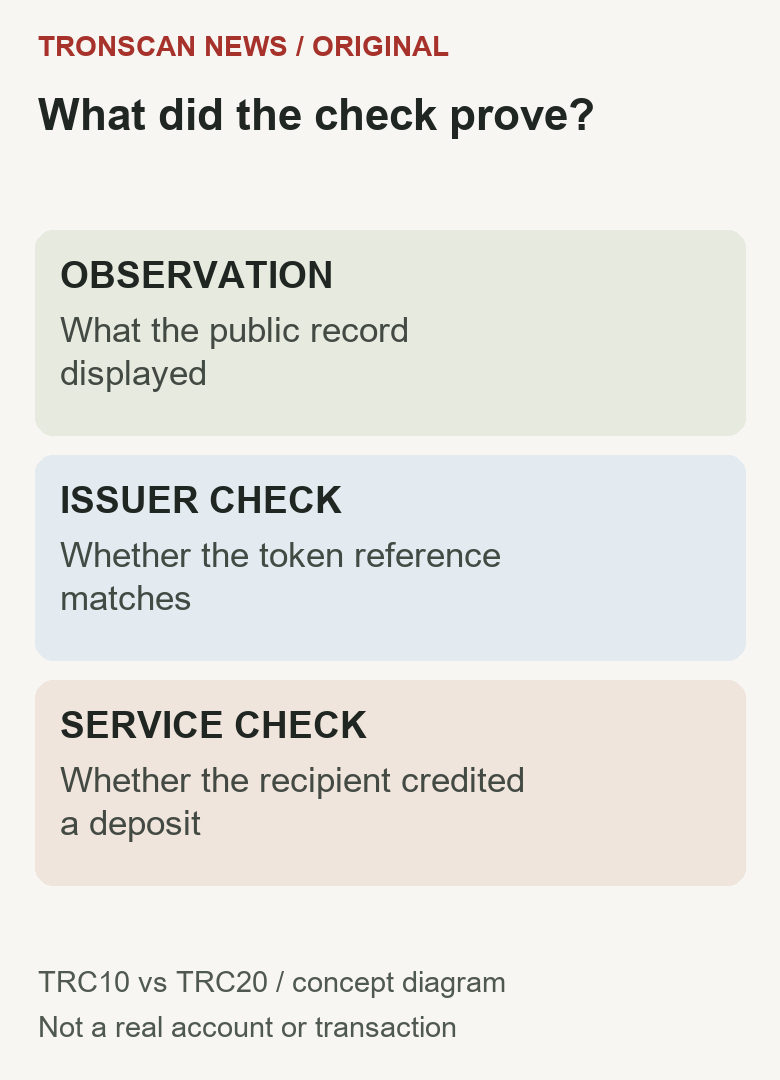
Write observations and conclusions on separate lines. “The page displayed a Contract field” is an observation. “This is the issuer’s intended token” requires a separate issuer-reference comparison. “The receiving exchange credited my account” requires evidence from that service. Keeping those statements separate prevents the token-standard check from appearing to certify things it never tested.
Before sharing a TRC10 vs TRC20 evidence note, remove private account references, support-ticket details and personal information that the recipient does not need. Public blockchain addresses can still reveal financial activity when associated with an individual. Never attach wallet secrets or sign a message to make a public token-standard comparison more convincing.
Frequently asked questions
1. Are TRC10 and TRC20 different networks?
No. They are token standards on TRON. Network selection and token-standard identification are related but separate checks; a test environment must also be distinguished from Mainnet.
2. Is TRX a TRC20 token?
No. TRX is TRON’s native asset. A TRX balance should be kept separate from holdings of protocol tokens and smart-contract tokens.
3. Which identifiers matter in a TRC10 vs TRC20 check?
Not by its appearance alone. Determine the address’s role and examine the token record. For identification, preserve the network and the appropriate token ID or contract address.
4. Does a TRC20 label prove that a token is genuine USDT?
No. It describes a standard. Verify the full token contract against the issuer’s own network-specific reference rather than relying on the symbol, logo or standard label.
5. Does identifying the standard confirm that a deposit will be credited?
No. The receiving service must support the exact asset and route, and its internal crediting process is separate from the public record. Keep those service-specific conditions in your evidence note.
Sources, testing and editorial scope
Checked 26 October 2026. Tronscan News is an independent educational publication, unaffiliated with TRON, TRONSCAN or Tether. This article and its original diagram were prepared with AI assistance. Technical descriptions were checked against the official documentation linked beside them.
Testing covered read-only observation of the USDT TRC20 page and the BitTorrent Old TRC10 page. The latter initially showed a security verification screen and later loaded normally without interaction or bypass. Its Basic Info table displayed Token ID 1002000 and Decimal 6. No transfer controls were tested. No wallet was connected and no transaction was signed or broadcast. The comparison and worksheet use documented protocol roles, with hypothetical cases explicitly labelled.
For a correction, use an available comment form with the disputed claim and a reliable source; never include secrets or private account details. Find our editorial standards and other guides through the Tronscan News homepage.
Leave a Reply