TRON internal transactions are records produced inside contract execution, linked to a parent transaction. They are not a second set of separately signed sends. Start with the parent hash, identify the asset and read the execution outcome before counting an internal record as a completed movement.
This guide separates native-asset execution records from TRC20 token events and an exchange’s private account ledger. It includes an original classification worksheet and a read-only Mainnet interface check. The worked numbers are synthetic and do not describe a reader’s account.
Table of Contents
TRON internal transactions: choose the evidence you need
The official internal-transactions reference places these records within a parent transaction’s receipt. It distinguishes native TRX/TRC10 movements from TRC20 movement recorded through token events. One parent can have multiple internal records or none.
| Your question | Evidence to start with | Do not substitute |
|---|---|---|
| Was the signed operation executed? | Parent transaction and receipt result | An isolated child-record label |
| Did a contract move native TRX? | Internal record, outcome and asset units | A TRC20 ticker |
| Did a TRC20 token move? | Matching token contract and Transfer event | An internal-transaction count |
| Did an exchange credit a customer? | Platform deposit record and requirements | Any public count alone |
This decision table is an editorial worksheet, not an explorer screenshot. It keeps four different questions apart so that evidence supporting one answer is not silently promoted into an answer to all four.
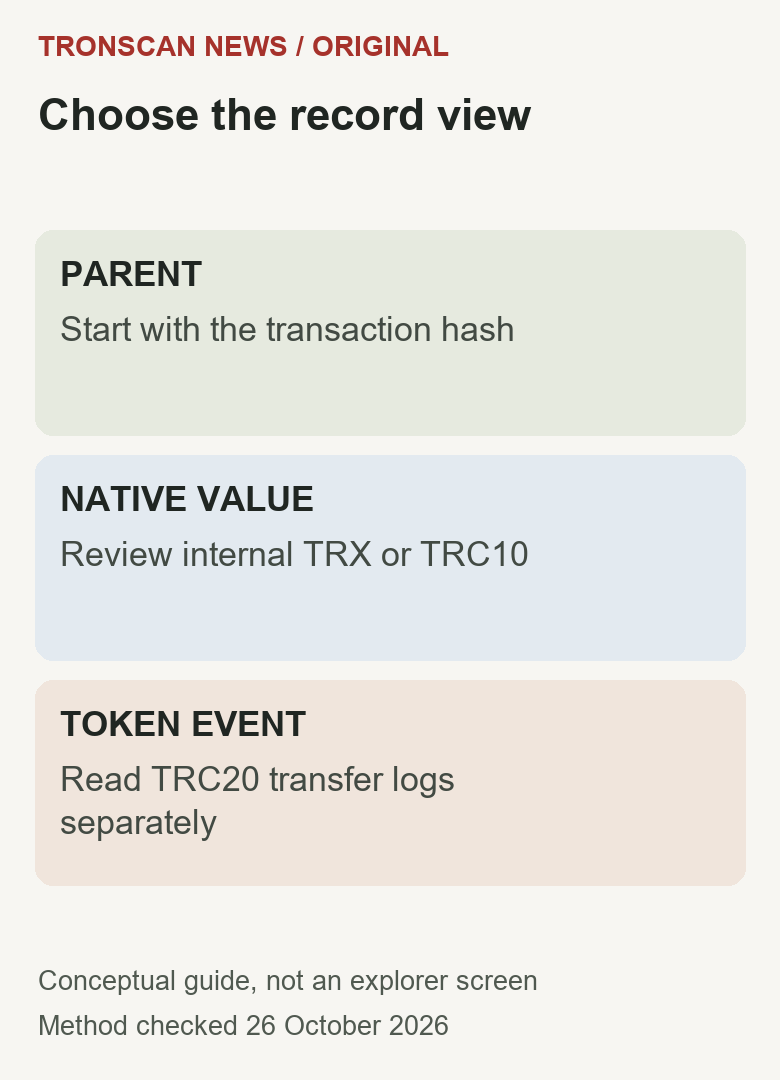
A checked empty TRON internal transactions view
On 26 October 2026, we opened Mainnet block 87433272’s Internal Transactions view through the visible tab next to Transactions and Transfers. The page displayed “A total of 0 internal transactions.” Its overview separately showed 389 Transactions, 328 Transfers and 0 internal transactions from 0 parent transactions.
That is a deliberately scoped observation. An empty internal-record view does not turn the other two counts into zero. It also does not mean a named person’s payment failed. The page identifies one block, one network and one category checked at a particular time.
We did not inspect a nonempty internal record in this example, submit a transaction, connect a wallet or test every account interface. The field explanations below come from the linked official references. They are not presented as screenshots or tested button names from a different page.
Six read-only checks for TRON internal transactions
- Preserve the network and original source. Keep the Mainnet or testnet context, complete URL and observation date with your note.
- Keep the parent transaction hash. A child-record identifier does not replace the hash needed to locate the original signed operation.
- Identify the record category. Separate internal execution records from token events and ordinary transaction-list entries.
- Check the asset and unit. Preserve the token identifier or native-asset unit exactly. Do not convert an amount from a ticker alone.
- Check rejection and parent execution. A recorded attempted movement is not sufficient evidence that the state change took effect.
- State the remaining question. Contract execution, token movement and private-platform credit require different follow-up records.
For the general explorer routes, use our TRONSCAN guide. This article focuses on interpreting internal records rather than repeating the complete account-history workflow.
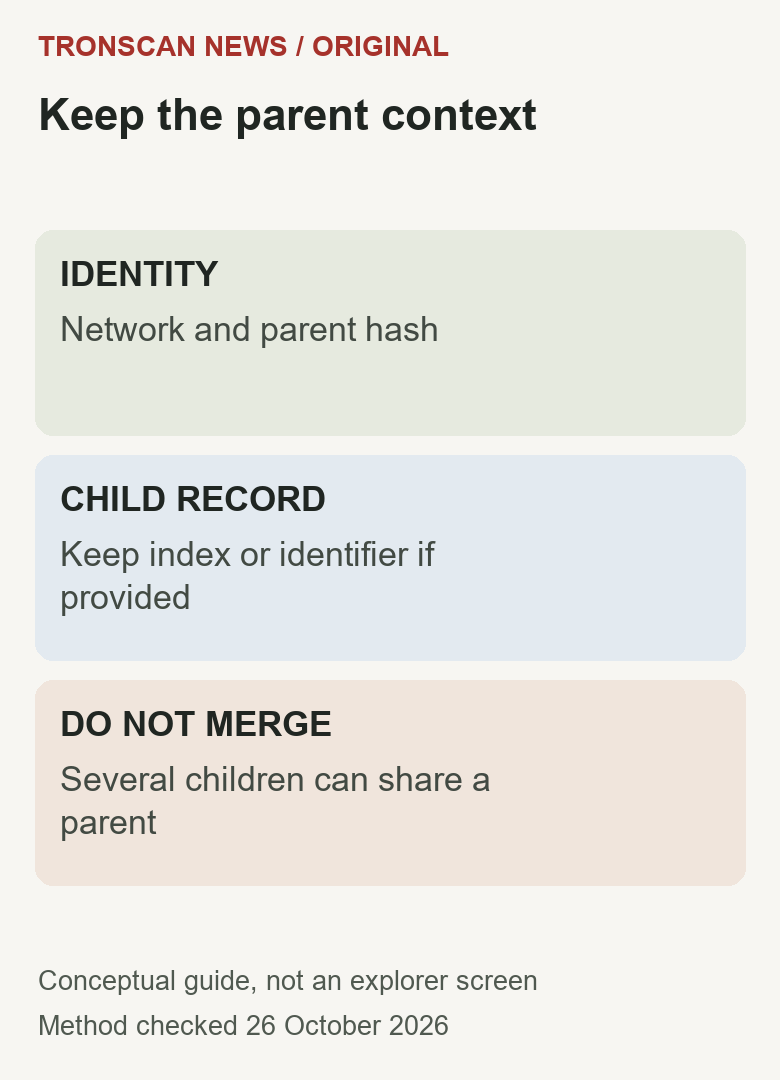
TRON internal transactions fields: a compact reading key
The official TRONSCAN internal-record API documentation describes fields including parent identifiers, call type, rejection and value information. API names need not be identical to labels in an explorer interface, and native-node receipts can use a different field shape.
| Concept | What to record | Interpretation boundary |
|---|---|---|
| Parent reference | Complete parent transaction hash | Do not count each child as another signed transaction |
| Caller and recipient | Full addresses and their record roles | A contract caller is not automatically a named customer |
| Call type | Original type or note label | A label alone does not establish payment purpose |
| Rejected | Explicit boolean or displayed status | Preserve unknown values rather than treating them as false |
| Value | Integer, asset identifier and unit scale | Do not read every value as TRX or USD |
Copy a field’s original spelling beside your interpretation. If one service calls an object an internal transfer and another calls it an internal transaction, compare the parent, index, addresses, asset and outcome before deciding they are different events.
A synthetic TRON internal transactions classification exercise
Consider three illustrative rows under one hypothetical parent. Row A has an explicit successful parent result, a nonrejected child record and 1,000,000 sun of native value. Row B is marked rejected and carries 2,000,000 sun. Row C has a value but no verified rejection or parent-result evidence.
Our worksheet assigns A to “movement evidence to reconcile,” B to “rejected attempt—exclude from effective-movement totals,” and C to “unresolved—do not count yet.” It does not add all three values simply because they appear in a list. None of these rows is a live transaction or a claim about a real deposit.
The useful output is not just a total. Keep an inclusion reason next to every included or excluded record. If someone later provides the missing parent result for C, you can revise that one classification without rewriting the provenance of A and B.
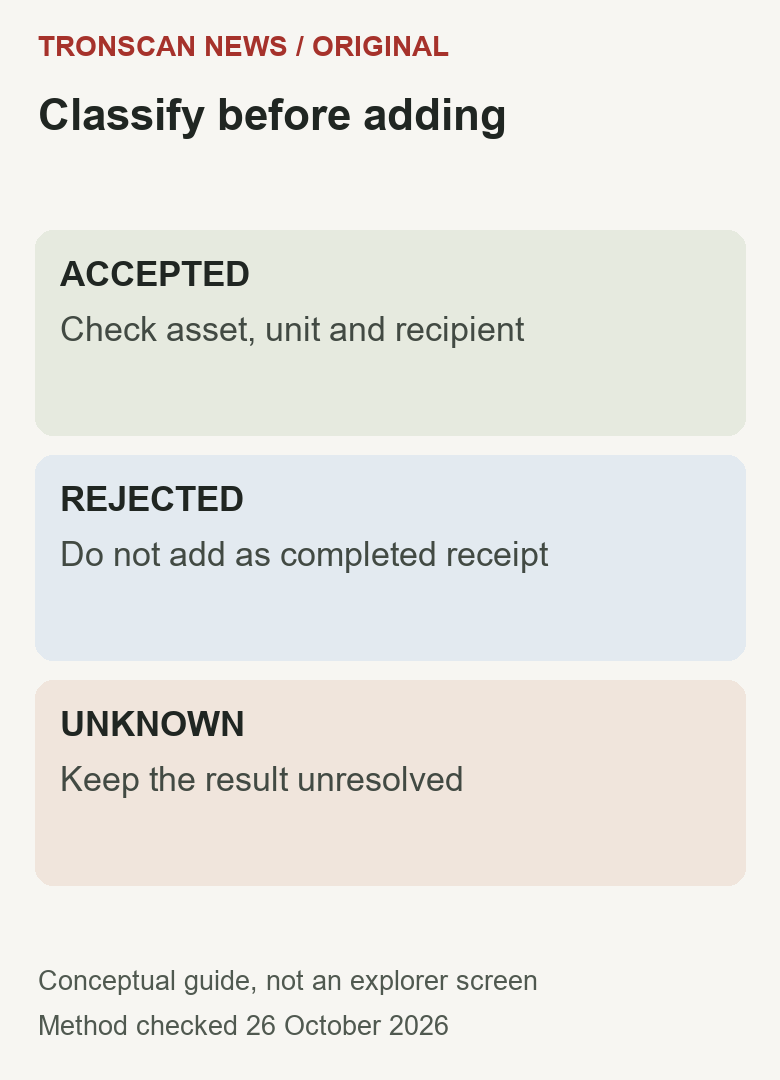
Do not double-count TRON internal transactions
A parent operation, an internal record and a token-event entry can be different representations of related execution context. A review should first define what is being counted: signed operations, child calls, native-asset movements or token events. A single column called “transactions” hides that choice.
For a small manual review, preserve a source type and record index with the parent hash. Do not deduplicate solely by parent hash if your task concerns multiple child records. Conversely, do not call ten child rows ten separately signed payments. Your counting rule must follow the question you intended to answer.
For TRC20 movement, the official event-log reference explains the separate log structure. A matching event name is only one part of interpreting a log; keep the emitting contract and event data with it. A contract can emit familiar event names, so a label does not establish issuer identity.
When TRON internal transactions are missing
An empty list can reflect the chosen scope, filter or service’s available history. The native-node documentation also notes that internal-record retention depends on configuration. Therefore, an absent API array is not enough to prove that no contract-internal activity occurred anywhere.
Do not switch networks until a row appears and then call that a match. Preserve the original environment and explain which service was queried. If your question concerns one known operation, return to the complete parent hash and its receipt rather than treating a block-wide empty list as a substitute.
Our TRON transaction history guide covers scope, filtering and pagination. For an individual operation’s execution outcome, use the TRON transaction checking guide. Keep those follow-ups separate from any private customer-account balance.
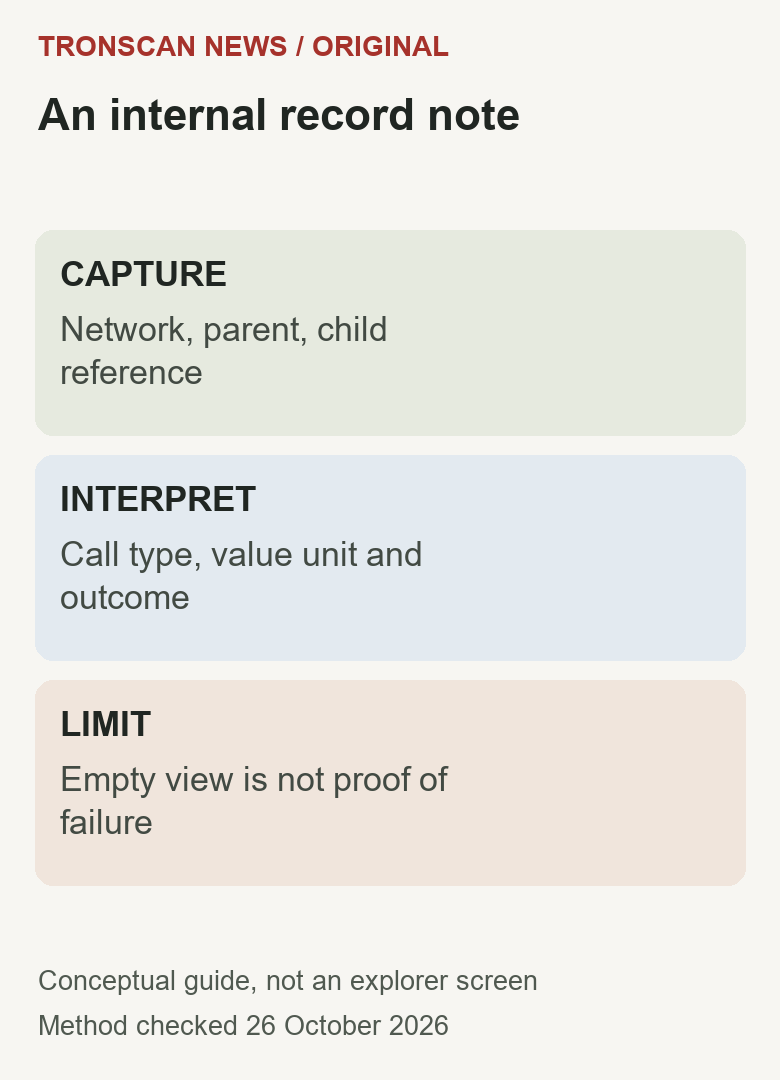
TRON internal transactions FAQ
1. Are internal records separately signed transactions?
No. They arise within the execution context of a parent operation. Preserve the parent reference instead of presenting each child record as an independent signed send.
2. Is every USDT transfer an internal transaction?
No. The official native internal-record concept is distinct from TRC20 event-based token movement. Inspect the correct token contract and event evidence for a USDT movement.
3. Should rejected internal records be added to received amounts?
No. A rejected attempt is not effective-movement evidence. Keep it in a separate diagnostic category, together with the parent execution result.
4. Does an empty internal list prove my transfer failed?
No. It answers a scoped category query. Check the known parent transaction, asset-specific movement and any receiving platform’s requirements separately.
5. Does internal mean a private exchange transfer?
No. Here it refers to contract execution records. A platform’s internal customer ledger is a different system and may not correspond to a separate public chain record.
Reconcile TRON internal transactions without double counting
A parent receipt and an internal row describe related evidence at different levels. If you copy both into a spreadsheet, do not automatically treat them as two independent payments. First decide what your worksheet measures: submitted transactions, execution calls or asset movements. Those are different counting units. Write the chosen unit above the table so another reader can reproduce the count.
For TRON internal transactions, preserve a child identifier or position when one is supplied. Two rows sharing one parent hash are not necessarily duplicates. Conversely, seeing the same row through two explorer views does not establish two movements. A defensible reconciliation keeps the source URL and retrieval date, then compares the complete available identifiers before merging observations.
A synthetic unit and outcome exercise
Suppose a hypothetical parent contains an accepted native-TRX record of 1000000 sun, a rejected record of 2000000 sun and another row whose outcome is missing. The first amount corresponds to 1 TRX because a TRX contains 1000000 sun. The second is a rejected attempted movement and is not added as a completed receipt. The third remains unresolved. This exercise does not establish the parent fee, a wallet balance change or an exchange credit.
If the copied value is already displayed in TRX, do not divide it by a million again. Record the unit alongside the number. A token amount also needs its own token identifier and scale; applying the TRX conversion to a TRC10 token entry would confuse assets. The classification method for TRON internal transactions starts with identity and units before arithmetic.
What a second reviewer should be able to repeat
Give the reviewer the same network, parent hash, record category and original source. Ask them to identify which observations are accepted, rejected or unknown, and which number is raw rather than formatted. A screenshot can help preserve presentation, but it does not replace the public reference or the scope of the original observation. Save a text note when a service temporarily cannot load the record.
Finish the review of TRON internal transactions with a narrow conclusion: which execution record was observed and how it was classified. If the remaining issue is a missing exchange deposit, carry the parent hash and asset-specific evidence to the receiving service. Do not label the private credit as completed solely because an explorer shows contract activity.
TRON internal transactions: sources and testing scope
Checked 26 October 2026 by Tronscan News with AI-assisted drafting and official-source review. The Mainnet empty-list observation was read-only; the three-row classification was a local synthetic exercise. No funds, signatures or wallet connection were involved. This is an independent publication, not an official explorer service. More guides and editorial standards are available through Tronscan News.
Leave a Reply