TRON event logs are structured records emitted during smart-contract execution. Read the emitting contract, event definition, indexed fields and data together. A familiar event name alone does not identify an issuer, prove an exchange deposit or explain the whole transaction.
This is a read-only interpretation guide. Its original worksheet decodes one integer from an official documentation example and separates that calculation from claims about a live transfer. No wallet connection, signature or transaction is needed for the exercise.
Table of Contents
Where event logs fit in a transaction
The official TRON event reference describes logs within transaction information. The basic pieces are the emitting address, topics and data. An ABI supplies the event’s field types and layout. This article explains a conventional, nonanonymous TRC20 Transfer event; do not apply that layout blindly to every contract event.
| Piece | Question it answers | Still needed |
|---|---|---|
| Emitting contract | Which contract produced this log? | Network and independently checked token identity |
| Topics | Which event and indexed values? | Matching ABI and event declaration |
| Data | Which nonindexed values? | Types, units and formatting scale |
| Parent receipt | Which execution contains the log? | Outcome and confirmation context |
The table is an original reading order. It stops a decoded number from becoming a payment conclusion before the record’s identity and execution context have been checked.
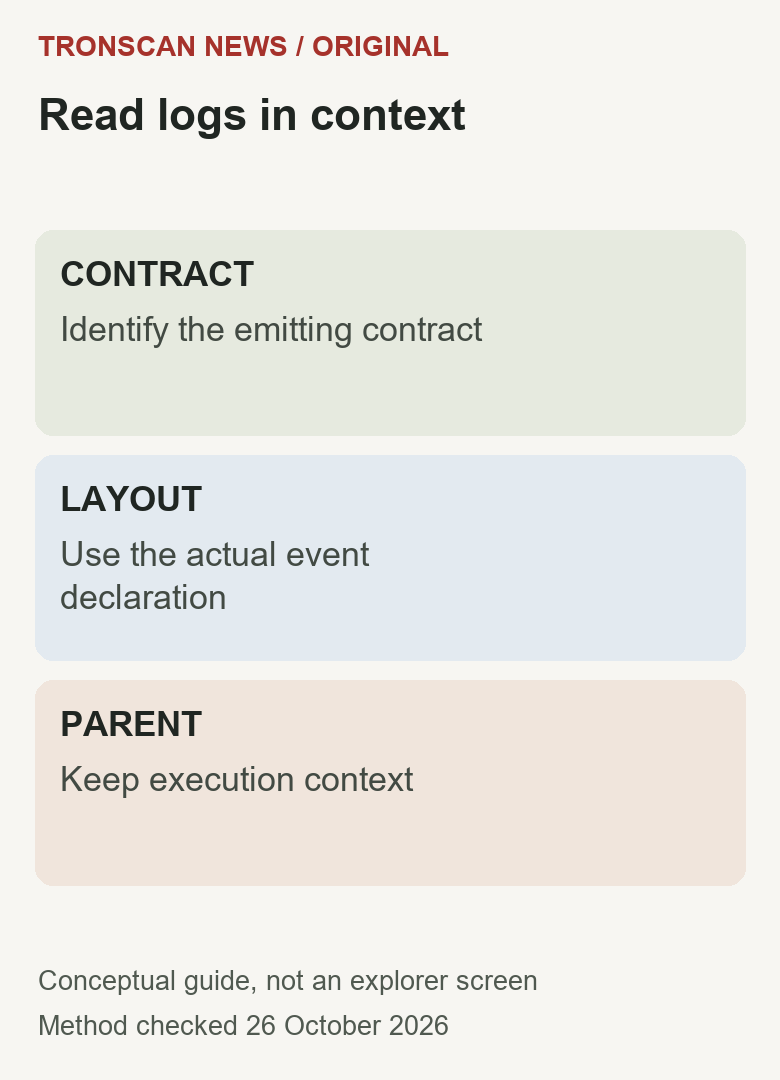
Six essential checks for TRON event logs
- Preserve the network and complete transaction hash. A hash copied without its environment is an incomplete reference.
- Identify the emitting contract. Use a trusted issuer reference for token identity, rather than the displayed ticker alone.
- Find the actual event declaration. Keep its name, argument types and indexed markers. Similar names can describe different layouts.
- Match topics and data to that declaration. Do not treat every topic as an address or every data word as a token amount.
- Decode integers without losing precision. Keep the raw hexadecimal value and its decimal integer before applying a token scale.
- Rejoin the parent context. Record the log position, receipt outcome and the narrow conclusion supported by this evidence.
Our TRONSCAN guide provides the broader explorer routes. This page deals with the interpretation of event logs after you have located a relevant contract execution.
A checked documentation example, not a new transfer
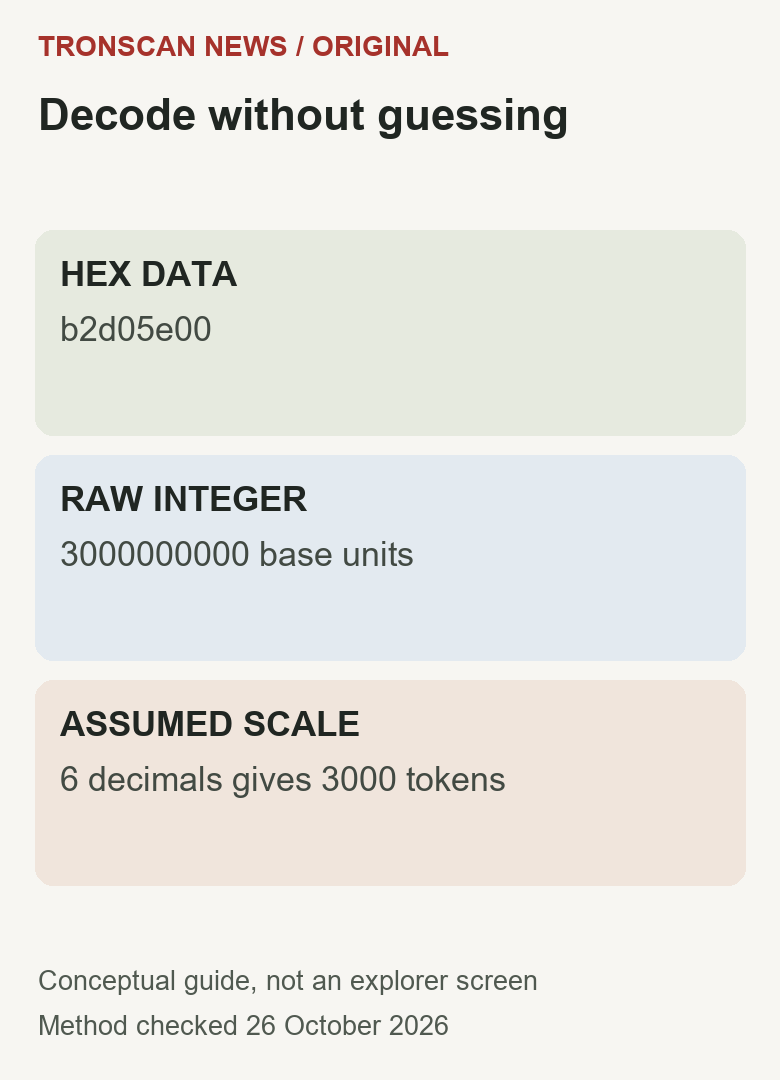
The official event reference includes a Transfer example whose data word ends in b2d05e00. We checked the hexadecimal-to-integer conversion locally on 26 October 2026: 0xb2d05e00 = 3000000000. This proves an arithmetic conversion, not the date, current state or purpose of a live transaction.
Leading zero padding does not change that integer. If, and only if, the relevant token’s independently verified decimal scale is six, the formatted quantity is 3000 tokens. The six-decimal assumption is stated explicitly here; it is not inferred from the event name or from the number of hexadecimal characters.
| Input or assumption | Operation | Result |
|---|---|---|
| Hexadecimal b2d05e00 | Convert base 16 to an integer | 3000000000 raw units |
| Assumed decimals = 6 | Divide by 1000000 | 3000 token units |
| Assumed decimals = 18 | Divide the same integer by 10^18 | 0.000000003 token units |
This contrast is the worksheet’s useful result: identical raw event data can produce very different formatted quantities when the scale changes. Do not choose the assumption that makes a deposit look correct. Establish the token identity and scale first, then calculate.
Event logs topics: typed fields, not wallet names
For the conventional Transfer declaration with indexed sender and recipient, the signature topic identifies the event layout, while the following indexed topics carry the sender and recipient values. The nonindexed unsigned integer is in data. This description follows the cited TRON example; an event with a different declaration needs its own mapping.
A long padded word can look unfamiliar beside a short explorer label. Keep the original value rather than trimming arbitrary characters until it resembles an address. Address representation and ABI padding are different concerns. When converting representations, preserve the exact bytes and use a documented conversion method.
A displayed sender in event logs also has a particular role within that event. It is not automatically the transaction’s signer, a named customer or the person operating an exchange account. The worksheet should call it the event sender rather than silently changing the field to owner.
Transfer and Approval event logs answer different questions
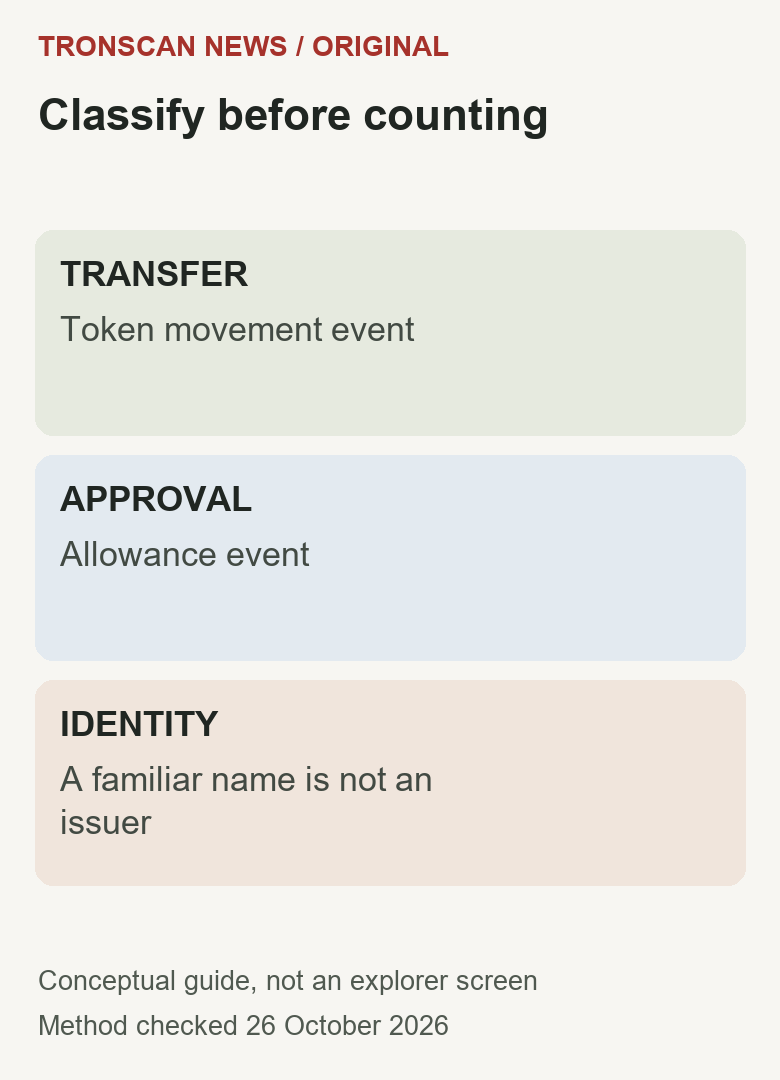
The TRC20 interface reference defines Transfer and Approval as separate events. Approval concerns allowance; it should not be counted as a token payment merely because its data contains an amount and two addresses.
Consider a synthetic review containing one Transfer and one Approval under the same parent hash. An analyst counting token-movement events would not add both values as received tokens. The first task is classification. Only after classification should the analyst consider amounts, direction and the receiving address.
Another contract can emit a familiar event signature. That does not make it the issuer’s token contract. Verify the emitting contract on the correct network before interpreting an apparent USDT event. A symbol, logo or recognizable event name is descriptive information, not sufficient contract identity.
Do not double-count event logs and transfer summaries
An explorer may offer a decoded transfer summary alongside raw event logs. Those views can describe the same movement. If your worksheet includes both, label their source type and compare the transaction hash, emitting contract and log position before adding amounts.
Deduplicating only by transaction hash has the opposite problem: one execution can contain several distinct logs. Preserve a log index or equivalent position when the source supplies one. If the position is unavailable, write that limitation instead of inventing an identifier or claiming a complete event count.
Internal native-asset records are a separate category. Do not replace an event count with an internal-record count or assume that an empty internal list rules out TRC20 events. When the initiating account differs from a token event’s sender, our checked transaction-sender and token-sender example separates the caller, called contract and movement endpoints.
A reproducible event-log evidence note
Use the following original checklist for a small manual investigation. Its success criterion is a repeatable interpretation of one specified record, not a promise that every transfer or contract has been audited.
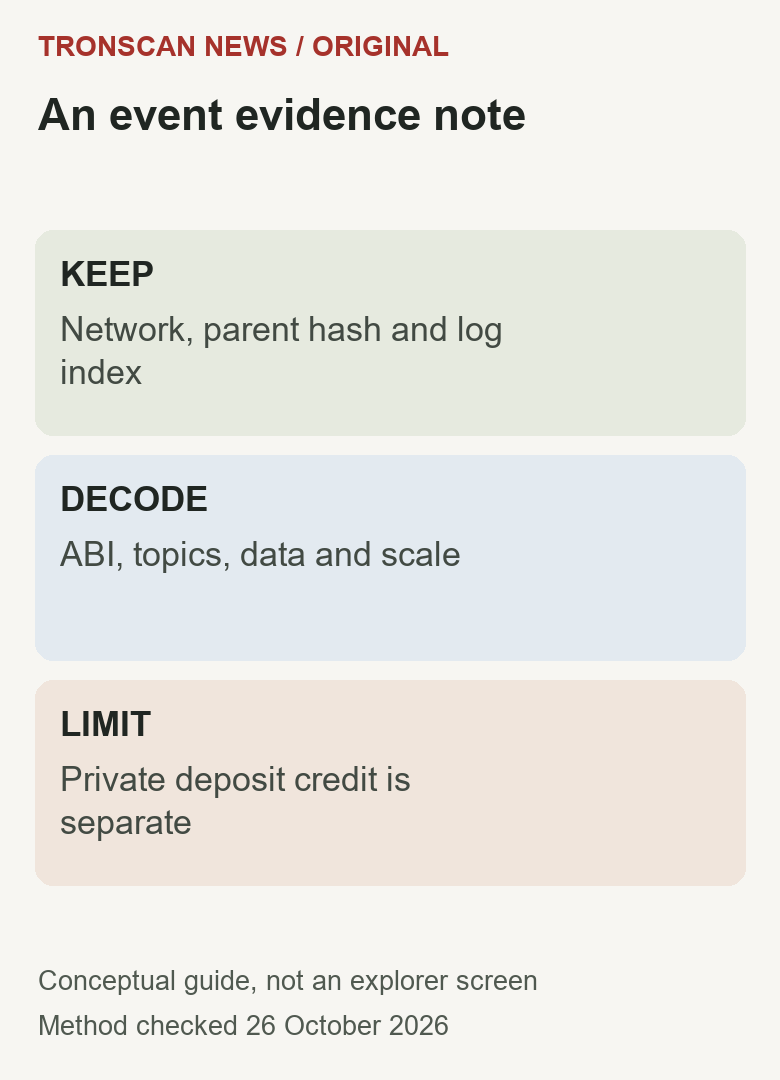
- Record the public source URL, network, parent hash and date of observation.
- Copy the complete emitting contract and log position without shortening them in the retained evidence.
- Record the event declaration and the source of its ABI.
- Keep the raw topics and data next to the decoded field names.
- For an amount, keep the raw integer, decimal scale and formatted result as separate columns.
- State the receipt outcome and any unresolved identity, confirmation or private-credit question.
For event logs copied from documentation, mark the source as a documentation example. For a hypothetical exercise, mark the values as synthetic. Neither should be presented as a freshly observed network transfer. A screenshot preserves presentation, but its date and the underlying public reference still matter.
When event logs are missing or cannot be decoded
A failed lookup, empty response and absent field are different observations. Keep the source’s actual message. Do not change an unavailable response into a numerical zero, and do not guess the ABI from a token name when the event declaration is unknown.
If raw data exists but decoding does not, verify the emitting contract and event definition before interpreting bytes. If the page will not load, retain the complete parent reference and the time of the failure. A later successful retrieval can resolve that availability gap without rewriting the original observation.
If one parent transaction contains several assets, classify the events before adding quantities. The worked swap route and net-transfer comparison reconciles seven movements with twenty differently typed logs. It separates input constraints, intermediate pool rows and the final recipient’s token delta. A USD estimate is another calculation and is not encoded in an ordinary Transfer amount.
Event logs FAQ
1. Does a Transfer event identify the official token?
No. Check the emitting contract and network against a trusted issuer reference. The event name or signature alone does not establish issuer identity.
2. Is an Approval event a completed payment?
No. It concerns allowance. Keep it separate from token-movement records when reviewing a receipt.
3. Can I decode an amount without connecting a wallet?
Yes. Reading public evidence and converting a known integer are read-only tasks. The arithmetic exercise here uses no signature or account access.
4. Do all event logs use the same topic layout?
No. Use the event declaration and ABI. The conventional Transfer example in this guide is not a universal decoder for other events.
5. Does a decoded log prove an exchange credited me?
No. Preserve the parent execution and token evidence, then check the receiving platform’s separate deposit record and requirements.
Review event logs with a second person
To check whether your interpretation is reproducible, give another reader the retained raw record and event declaration before showing them your conclusion. They should be able to locate the same fields and obtain the same integer. If they need an unstated assumption about decimals or address roles, add that assumption to the worksheet rather than hiding it in a formatted total.
For event logs, separate a decoding disagreement from an identity disagreement. Two readers might calculate the same amount but disagree about whether the emitting contract is the intended token. Correct arithmetic does not settle that identity question. Keep both findings so the next step addresses the actual uncertainty.
Sources and checking scope
Checked 26 October 2026 by Tronscan News with AI-assisted drafting and primary-source review. The integer conversions and synthetic comparison table were tested locally. We did not submit a transaction, verify a reader’s receipt or test every current explorer control. The original diagrams illustrate a method rather than a real interface. More independent guides and editorial standards are available from Tronscan News.
Leave a Reply