The TRON transaction sender is the account that initiates an operation. A USDT token sender is the From address in a particular token movement. They can be different addresses. Read the field’s role before deciding who sent tokens to whom. The transaction’s top-level destination can also be the contract being called rather than the final token recipient.
This beginner guide answers one practical question: which address should you compare with an expected USDT sender or recipient when several addresses appear under one hash? It covers one observed TRON Mainnet contract execution. It does not identify the people behind the addresses, assess the transaction’s purpose, or certify an exchange deposit.
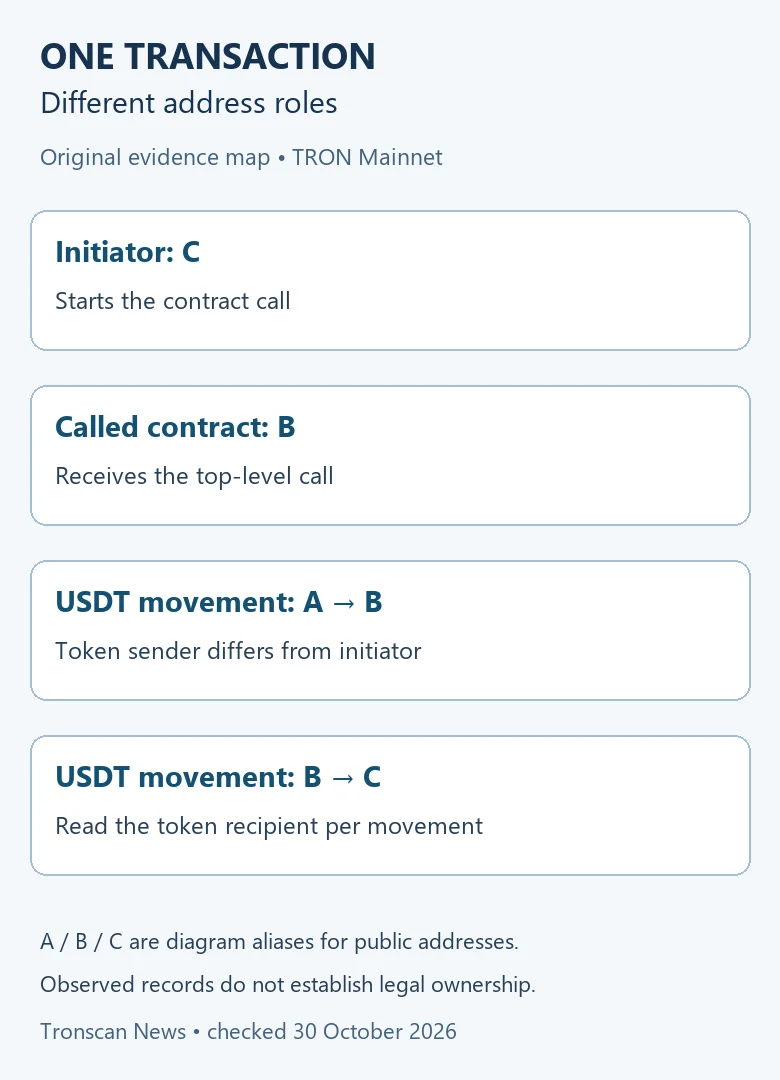
Table of Contents
TRON transaction sender: three roles to separate
An ordinary transfer can make several address fields look interchangeable. A contract execution makes that shortcut unreliable. Begin with our TRONSCAN record-selection guide if you have not yet located the correct transaction. Once the hash and network match, use the role worksheet here.
| Role | Question it answers | Compare it with |
|---|---|---|
| TRON transaction sender (initiator) | Which account initiated this operation? | The TRON transaction sender field |
| Called contract | Which contract receives the top-level call? | The destination and contract-call context |
| Token movement sender and recipient | Which addresses are endpoints of this particular token movement? | The From and To fields in that movement |
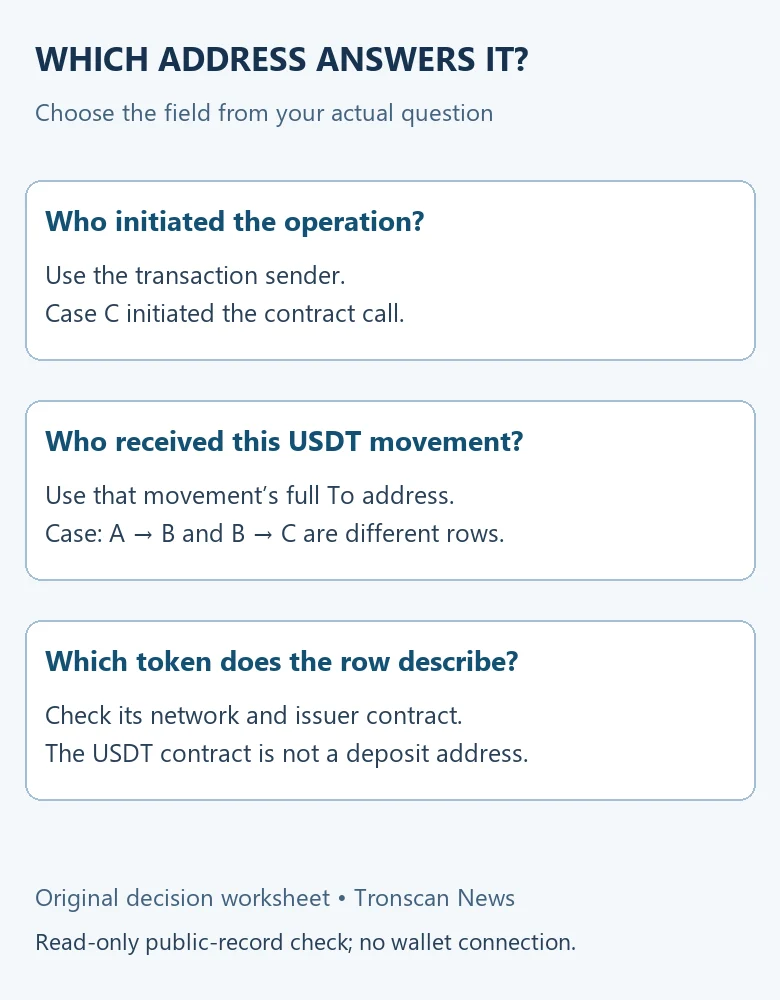
The official TRONSCAN transaction-detail reference distinguishes the TRON transaction sender, destination and token-transfer list. Keep those scopes separate. A field label copied without its surrounding section can turn a correct address into the wrong answer.
For example, if your task is to locate the recipient of one USDT movement, copying the TRON transaction sender does not complete that task. If your task is to identify the TRON transaction sender, copying a token’s From field may answer a different question. Write the question beside the address before sharing it.
TRON transaction sender in a checked Mainnet example
On 30 October 2026 we read the public record for transaction 27913f3126272aac449ef9e2bd2fb6a64581d6bbd6286787a16a4b0ec1996ddd, in block 87550752. Its block timestamp is 02:00:27 UTC. The following values are observed public data, not an invented payment or a transaction we submitted.
Open the same transaction on TRONSCAN to compare the record. Live confirmation information can change after collection. The first saved explorer response had confirmed=false while its execution field said SUCCESS; those are separate observations. The saved node receipt also reported SUCCESS. A later browser check displayed CONFIRMED and 133 confirming blocks; we retained that later observation separately. Confirmation counts continue changing.
| Alias | Complete public address | Observed role in this case |
|---|---|---|
| A | TVjuTE3V5bMVdpfNhid8kD2v35T2k1u1Br | Sender in the first USDT movement |
| B | TQqgNg13s2DjvXhW1ky4v6TsR8wZGvb7Y4 | Top-level called contract; recipient in one USDT movement and sender in another |
| C | TLdfXrbVcqfksQdDpTWtsuvYV9FFvme7Yn | TRON transaction sender; recipient in the second USDT movement |
The TRON transaction sender in this case is C, which initiated the operation, but the first observed USDT movement ran from A to B. The second ran from B to C. Calling every sender field “the wallet that paid me” would hide that distinction. These observations do not establish legal ownership, account relationships or an economic explanation for the operation.
The TRON transaction sender appeared as Owner Address in the checked English web view. Overview also showed Contract Address and Token Transfers. All Transfers contained three displayed movements: one in TRX and two in USDT. Use the asset label and the token contract rather than treating the displayed count of three as three USDT payments. Our worksheet selects the two USDT movements only.
The two USDT movements in one receipt
We matched the token contract against Tether’s supported-protocol reference. The contract is TR7NHqjeKQxGTCi8q8ZY4pL8otSzgjLj6t. Our TRON USDT introduction explains why this token, the TRON network and native TRX are different concepts.
| Receipt log-array position | USDT direction | Raw quantity | Quantity at six decimals |
|---|---|---|---|
| 1 | A → B | 7816997892 | 7816.997892 USDT |
| 2 | B → C | 7816997892 | 7816.997892 USDT |
Positions 1 and 2 are zero-based positions in the returned node receipt’s log array. They are not invented transaction identifiers. The receipt contained three logs in total; two matched this token’s conventional Transfer layout. We did not treat the remaining log as another USDT payment or decode its different event here.
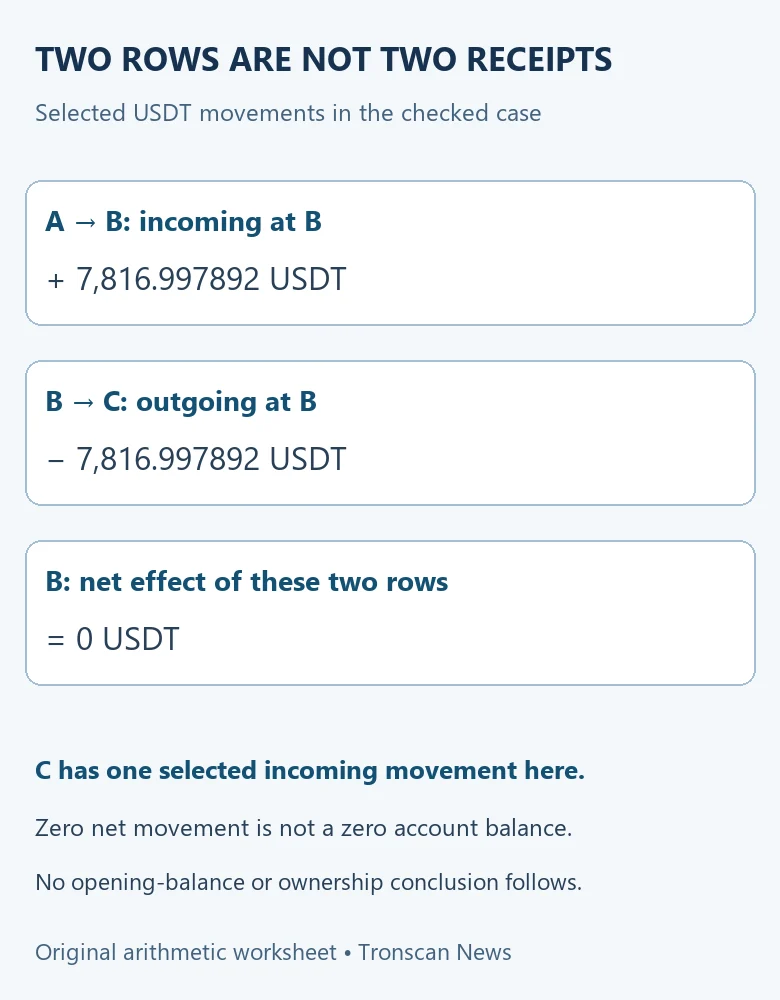
The arithmetic at B is an incoming quantity and an equal outgoing quantity: the net effect of these two included USDT movements is zero. That is a statement about this pair of rows. It does not say B’s total balance was zero, that there were no other assets or movements, or that another address had no opening balance.
Adding the two quantities produces a movement-volume total, not the amount C received. For C’s observed incoming token movement, the relevant quantity in this table is 7816.997892 USDT once. Do not turn two transfer rows into two incoming payments to C simply because they share a parent hash.
Five steps to identify the right address on a phone
- Preserve the parent reference. Copy the complete transaction hash from the original sending record and verify the network. A service order number is a separate reference.
- Name the top-level roles. Record the TRON transaction sender and the called destination with their section labels. Do not relabel them as token endpoints yet.
- Locate the intended token movement. Match the issuer’s token contract and read that row’s complete From, To and quantity. Expand shortened addresses before comparing them.
- Repeat for every relevant movement. Keep one worksheet row per distinct movement. When raw log positions are unavailable in your view, retain the full row details and mark the limitation.
- Write a bounded result. State which movement matches the expected recipient and what remains unresolved, including confirmation or receiving-service credit.
Success means another reader can find the same parent record and understand why you selected a particular token row. It does not require a wallet connection, signature, private key or a new transfer. If a page asks you to authorize an operation, that is a different workflow from the reading exercise here.
An original address-role worksheet
Use a separate note for each transaction. The following worksheet is designed for comparing two screens whose sender or recipient fields seem to disagree. It asks you to preserve the role as well as the value, rather than replacing one address until the displays look consistent.
| Write down | Case-specific example | Question still open |
|---|---|---|
| Parent hash and network | The linked Mainnet transaction | Is it the same operation as the sending record? |
| TRON transaction sender | C | Is this field relevant to the token question? |
| Called destination | B | Am I reading a contract call rather than a token recipient? |
| One token movement | A → B, or B → C | Which complete recipient matches my evidence? |
| Record position and units | Log-array position, contract and exact USDT quantity | Could two views be describing the same movement? |
| Outcome and time checked | Execution result plus separate confirmation observation | Does a receiving service show its own credit? |
The worksheet does not need a theory about who controls A, B or C. Avoid adding names from a label, a chat message or a similar-looking address unless you have a source appropriate to that separate claim. Matching public values is different from establishing identity.
When the addresses still do not match
Only a cropped screenshot is available. Ask for the underlying public record and the name of the field being compared. A shortened sender label may omit both the full address and whether it belongs to a transaction summary or a token movement.
You see the same amount twice. Compare endpoints and record positions before deduplicating. In the checked example the equal quantities have different sender-recipient pairs. Deduplicating the entire hash would lose one movement; counting both as incoming to C would add an unrelated row to C’s receipt.
You need a later path. This guide stops at the roles inside one execution. Use the multi-record USDT tracing method for a bounded review of later movements. A later numerical match still does not prove ownership or identify particular fungible units.
The receiving platform has not credited a deposit. Preserve the matching token movement and consult that platform’s current instructions through its official route. Neither the TRON transaction sender field nor a successful token record gives an explorer access to the platform’s private customer ledger.
How the example was checked
We saved an anonymous read-only TRONSCAN transfer-list response, the transaction-detail response and a public node receipt. The TRON receipt reference provides the execution-record context. We compared the parent hash, block, token emitter, conventional Transfer fields, exact quantities and derived Base58 addresses.
Fourteen local assertions passed, including agreement between the node’s two selected token logs and the explorer’s two decoded transfer rows, the different TRON transaction sender and first token sender, the amount conversion, and zero net quantity at B for this pair. These checks validate the retained field comparison and arithmetic; they do not audit consensus, signatures, contract safety or the completeness of any address history.
Frequently asked questions
1. Is the TRON transaction sender always the USDT sender?
No. Read the TRON transaction sender field separately from each token movement’s From field. The observed example has a different initiator and first USDT sender.
2. Is the transaction’s To address always my deposit recipient?
No. In a contract execution it can identify the called contract. Match the recipient in the relevant token movement with your actual receiving instructions.
3. Do two USDT transfer rows mean two payments to me?
Only rows whose full recipient matches your intended address support that incoming-movement observation. Other rows under the same hash can have different endpoints.
4. Can this address-role check identify the owner?
No. The TRON transaction sender label describes a role in a public execution. It does not establish the legal owner, customer identity, intent or relationship between the addresses.
5. Must I connect a wallet to compare these records?
No. This check uses public references and saved read-only responses. Do not provide a recovery phrase or private key to resolve a field-label question.
Sources, date and editorial scope
Prepared by the Tronscan News editorial team with AI assistance and primary-source checks on 30 October 2026. The diagram and role worksheet are original; the linked transaction is an observed public example, not a payment we made or a recommended contract interaction. Current explorer layout and confirmation status may differ from the saved collection.
Visit the Tronscan News homepage for our independent English guides. We are not the TRONSCAN operator, TRON or Tether. Use About & Standards for the editorial and correction policy, identifying the specific claim and supporting source without sharing private credentials.
Leave a Reply