To trace USDT through more than one transfer on TRON, record the starting token movement, inspect the receiver’s later outgoing movements, and verify every proposed connection separately. A chain of addresses can show a possible route. It does not identify a person, prove ownership, or establish that particular fungible units came from the original sender.
This guide helps you trace USDT when you already have a public transaction hash and need to organize several related records. It covers TRON Mainnet USDT token movements, not a cross-chain bridge investigation, wallet recovery or a prediction about where funds will go. The successful result is a reproducible path worksheet with unresolved steps clearly marked.
First identify the asset from Tether’s official supported-protocols reference. The issuer links the TRON USDT contract. A ticker or logo alone is insufficient. Keep the network and contract alongside each movement rather than silently carrying them over from the first row.
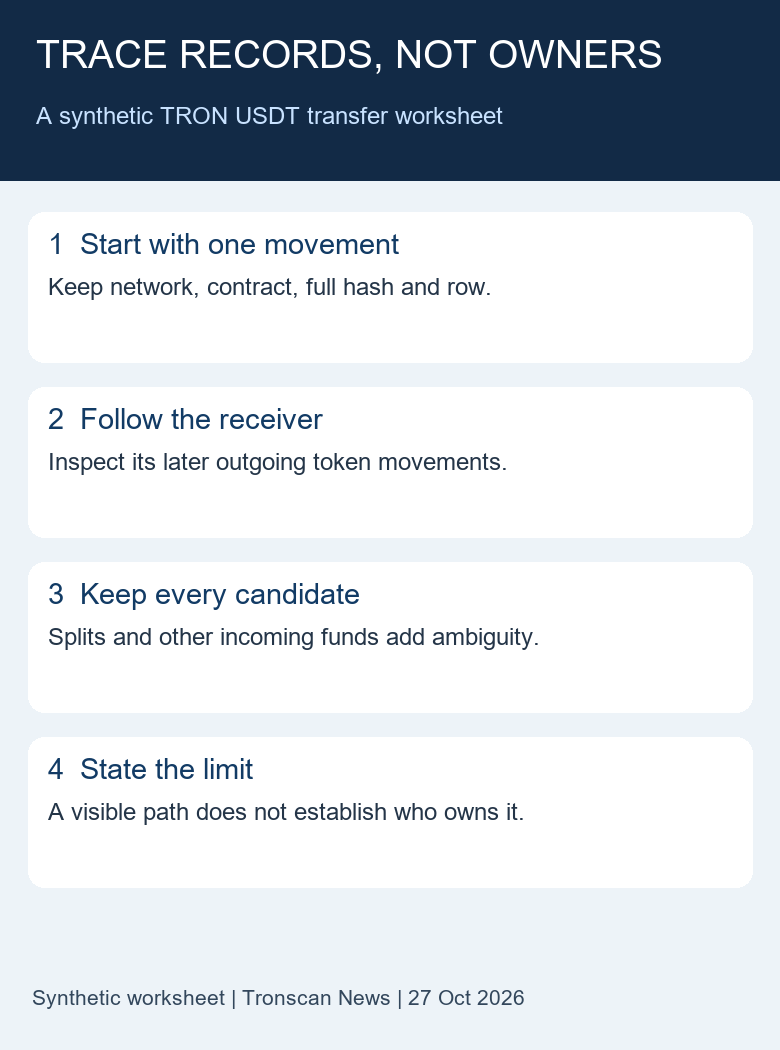
Table of Contents
Define why you want to trace USDT before opening more pages
Write a narrow question such as “Which later outgoing movements from the receiver fall inside my review window?” This is answerable from a specified set of public records. “Who stole these funds?” adds identity, legal responsibility and intent that an explorer alone cannot establish. Keeping the question narrow prevents a long diagram from looking more conclusive than its sources.
Set a start and end time, a timezone and a maximum number of hops. A hop is one proposed address-to-address movement in your worksheet, not a guarantee that the next address is controlled by a different person. A two-hop review is a manageable initial scope. If it ends at an unresolved service account, retain that boundary instead of extending the path until a familiar label appears.
Also decide whether you are reviewing a token movement or an entire transaction. One transaction can contain several movements. An account’s general transaction list is not a substitute for a filtered token-transfer list. The TRON transaction history guide explains how to keep those record types and filter scope separate.
6 steps to trace USDT through multiple records
- Anchor the starting movement. Use the original complete hash. Verify the network, token contract, sender, recipient and amount in the relevant transfer row. Where one hash contains several rows, preserve the row identity or the full movement details. Do not choose a row only because its amount matches a message.
- Record the receiver as the next account to inspect. Copy the full receiving address from that movement. Avoid abbreviated names or only the first and last characters. A token contract and the token recipient have different roles; following the contract address instead of the receiver changes the question.
- Review outgoing movements in the stated window. Select the same token contract and network. Retain all plausible later rows, including splits. An empty filtered result is a statement about the view you checked, not proof that no outgoing movement exists outside that view.
- Check each candidate in its own transaction record. Compare full addresses, quantities, timestamps and execution information. Exclude an approval-only record from a movement path. Keep a pending or reverted candidate separate from a completed token movement rather than treating them as equivalent.
- Account for other funds and incomplete coverage. Inspect whether the intermediary already held tokens or received another transfer. Do not infer that one incoming amount funded a later outgoing amount merely because the numbers fit. Note missing pages, unknown opening balances and gaps in the time window.
- Write a bounded conclusion. Distinguish observed movements, possible continuity and unknown ownership. Save references for every edge in the diagram. Stop when the next step requires private exchange records, unsupported chain attribution or evidence that is unavailable.
Trace USDT with an evidence table
The official TRONSCAN transfer-list reference distinguishes transfer records, address and contract filters, raw quantities, time and execution-related fields. This article uses those distinctions to design a manual worksheet. It does not claim a live authenticated API test or that every current mobile screen uses the same field labels.
| Worksheet column | What to preserve | Why it matters |
|---|---|---|
| Network and asset | TRON Mainnet and exact token contract | A symbol repeated on another chain is not the same record. |
| Movement reference | Complete hash plus row or log identity where available | One hash can contain multiple movements. |
| Endpoints | Full sender and receiver | A shortened match can join unrelated addresses. |
| Quantity | Raw amount, decimals and displayed token units | USD estimates and rounded values are different measurements. |
| Order and status | Block/time, timezone and execution result | A later-looking row may be a timezone or sorting mistake. |
| Coverage | Window, filters, pages reviewed and collection time | A partial list cannot support an exhaustive conclusion. |
| Inference | Observed, candidate or unresolved | An address path should not masquerade as identity evidence. |
A synthetic ledger: why matching amounts are not enough
The following exercise is invented for this article. A, B, C, D, E and F are labels, not usable addresses. R1 through R8 are row labels, not transaction hashes. Every row belongs to the same hypothetical date and timezone. The example deliberately includes another funding source, a self-transfer and two rows that must be excluded.
| Row/time | Movement | Token units | Treatment |
|---|---|---|---|
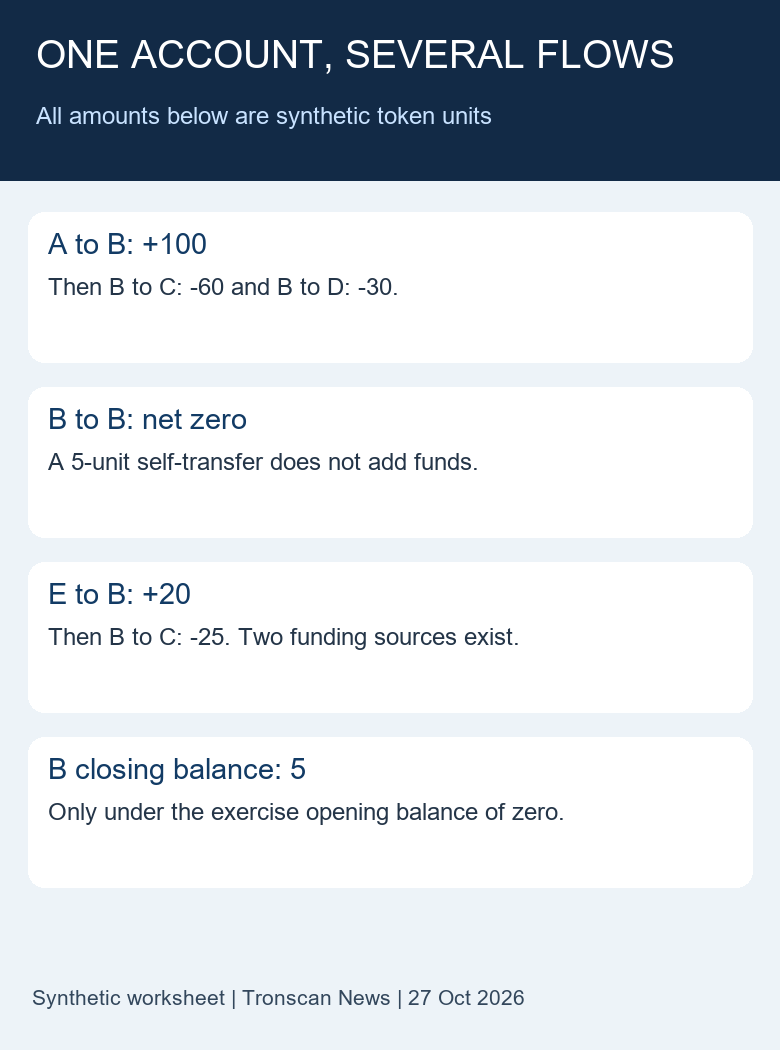
| R1 / 10:00 | A → B | 100 | Include: starting USDT movement. |
| R2 / 10:01 | B → C | 60 | Include: first outgoing candidate. |
| R3 / 10:02 | B → D | 30 | Include: a second branch. |
| R4 / 10:03 | B → B | 5 | Include once; net change at B is zero. |
| R5 / 10:04 | E → B | 20 | Include: another funding source. |
| R6 / 10:05 | B → C | 25 | Include: later outgoing candidate. |
| R7 / 10:06 | B → F | 999 | Exclude: different token contract. |
| R8 / 10:07 | B → F | 999 | Do not count as completed: unresolved execution. |
For this arithmetic exercise only, assume B started at zero. Its included movements give 100 − 60 − 30 + 0 + 20 − 25 = 5. The two included B-to-C movements total 85 token units. Both statements are bookkeeping results under explicit assumptions. Neither statement assigns a particular part of C’s receipts to A rather than E.
We tested these eight local rows with Python Decimal arithmetic on 27 October 2026. Four assertions checked the closing balance, zero net effect of the self-transfer, exclusion of the wrong-asset and unresolved rows, and the combined B-to-C amount. These tests verify the worksheet’s arithmetic. They do not validate a live address, a fraud model or the completeness of an explorer’s history.
Trace USDT splits as separate branches
In the example, B sends to both C and D. Draw two edges with their own references. Do not combine them into a single outgoing transfer or discard the smaller branch because the larger one looks more interesting. The graph should retain the structure of the observed records, even when that structure makes your original theory less convenient.
If a single transaction contains several relevant movements, give each one its own worksheet row. Repeating its hash in several rows is not automatically a duplicate. Conversely, displaying the same movement in an account history and a transaction detail page does not create two transfers. Deduplicate the underlying movement, not merely the page URL or the whole transaction hash.
When no reliable row or log identifier is available, document that limitation. A combination of hash, contract, sender, receiver and amount helps explain what you copied, but identical movements can still occur within one transaction. Do not present a locally invented row label as an on-chain identifier.
Trace USDT with other incoming funds in view
B’s additional receipt from E prevents a simple story that every later payment must come from A. An unknown opening balance adds another possible source. Even if your review finds only one incoming row, incomplete pagination or an overly narrow time window can hide earlier balances. Write “no other incoming movement observed within this scope,” not “no other funds existed.”
USDT is fungible within the same token contract. A numerical match by itself does not attach a unique serial number to the units you are following. A formal allocation model would introduce assumptions beyond this manual guide. Do not silently adopt first-in-first-out, proportional allocation or a fixed percentage and then describe the output as a directly observed fact.
When you trace USDT, a useful note keeps observation and interpretation in separate sentences. For example: “R2 shows B sending 60 to C after R1. R5 shows a later additional receipt at B. This worksheet does not determine the economic source of each later unit.” That note is less dramatic than a certainty claim, but another reader can reproduce and assess it.
Trace USDT in a consistent time and amount format
Use one timezone throughout the table and retain the original source timestamp. Do not compare a local wallet time directly with a UTC explorer time without converting. If several movements share a block or timestamp, the displayed time alone may not establish their exact execution order. Keep row or log positions when provided and mark unresolved ordering honestly.
Preserve token quantities rather than rounded dollar values. Two amounts displayed as the same USD estimate can represent different token amounts. A raw quantity also needs its token-decimal interpretation. The TRC20 decimal-reading guide explains how to keep large integer amounts exact without floating-point rounding.
Do not subtract TRX network fees from a USDT quantity just to force a match between two movements. They are different assets. An intermediary may send a different USDT amount for unrelated reasons. If a platform reports a withdrawal charge, preserve its denomination and description separately; your trace should not infer the charge from a convenient difference alone.
Where to stop when you trace USDT
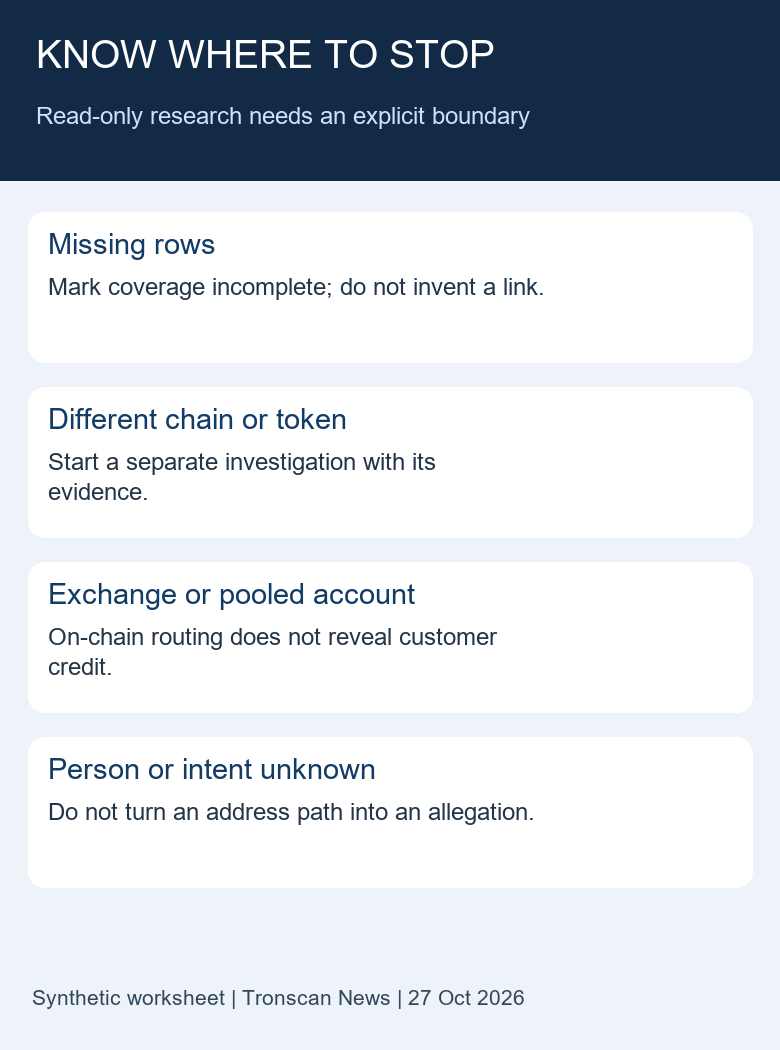
A pooled service account is a boundary, not an automatic invitation to select its next withdrawal as your continuation. The address may handle many customers and unrelated operations. A public label can help orient a reader, but it does not map a specific deposit to a private customer ledger or a later payment.
If the next step moves to another network, open a separate chain section. Record the source and destination evidence needed to establish that bridge operation. The fact that two transactions have similar amounts is not enough. This article does not supply a tested bridge-correlation method, so an unsupported cross-chain link stays unresolved.
If the goal is to establish that an exchange credited your own account, use the exchange’s verified transaction history or official support process. Public blockchain records answer a different question. Keep account identifiers and private support attachments out of a public diagram unless you have a clear reason and appropriate authorization to share them.
Trace USDT through failures: record uncertainty instead of guessing
No starting record appears. Recheck the network and original hash. A failed search, rate limit or service outage is not evidence of an absent transfer. Return to the TRONSCAN record-selection guide before extending an unanchored path.
The address has too many results. Narrow the token and time window while retaining a note of what was excluded. Stop at a manageable scope rather than claiming that one visible page is complete. If the service limits accessible history, record the limit and collection date.
A candidate is not a successful movement. Keep it in a separate unresolved or excluded section with the reason. Do not let a matching recipient override contradictory execution information. The transaction body and its post-execution receipt are distinct, as the TRON receipt reference explains.
Two researchers disagree. Compare the starting movement, contract, timezone, coverage and inclusion rules before comparing conclusions. They may have examined different rows or windows. Correct the worksheet at the specific edge where the evidence diverges; do not choose whichever graph has more arrows.
Trace USDT and write a bounded conclusion
Begin with the scope: network, asset contract, period and hop limit. List the included movement references. Then describe a result such as “two later outgoing candidates from the receiver were observed.” Follow it with the limitations: unknown opening balance, additional incoming funds, missing pages or unresolved execution.
Use explicit stopping language: “No further link established within the reviewed evidence.” This does not claim that funds cannot move again or that an address belongs to an identified person. Avoid turning a diagram into an accusation, a recovery promise or a payment instruction. Keep the evidence version and collection date so later corrections do not silently overwrite the earlier reasoning.
A second-reader audit before sharing a path
Ask another reader to rebuild one proposed edge from the references, without showing them your conclusion first. They should be able to identify the same network, token contract, full endpoints and movement. If they cannot, the worksheet needs a clearer reference or an explicit uncertainty note. Agreement with your drawing alone is not an independent reconstruction.
For the synthetic example, have the reviewer explain why R4 changes movement volume but not B’s net token balance, and why R7 and R8 do not enter the completed-USDT total. Then ask whether R6 can be assigned wholly to A. The appropriate answer is that this ledger does not establish that attribution. This exercise checks reasoning as well as arithmetic.
Keep an evidence version when correcting a row. Suppose you copied 25 as 2.5 in R6. Correct the quantity, recompute the local balance, and identify every conclusion affected by that change. Preserve a brief correction note with the date and reference. Do not leave the old total next to the new row or quietly redraw only the final arrow.
Before sharing, remove private service identifiers and account screenshots that the recipient does not need. Public addresses and transaction hashes can themselves reveal financial activity. An internal review copy and a public educational diagram may need different levels of detail. In a public example, use clearly labelled synthetic identifiers as we do here, rather than partly obscured real data presented as proof.
Finish the audit by naming what was not checked: additional pages, earlier balances, another network or service records. The review is reproducible only when those limits travel with the graph.
Before combining observations from two sources, use the field-by-field TRON record-comparison worksheet to check whether they describe the same movement.
Frequently asked questions
1. Can I trace USDT without connecting a wallet?
A review of public transfer records uses public addresses and transaction hashes. This worksheet requires no wallet connection, signature or secret.
2. Does an outgoing amount matching my deposit prove it is my money?
No. Other incoming funds, prior balances and fungibility prevent that conclusion from amount matching alone. Preserve the candidate link and its assumptions separately.
3. Should I follow the USDT contract as the recipient?
Follow the receiving address in the relevant token movement. The token contract identifies the asset and is not interchangeable with that recipient.
4. Does a self-transfer add a new source of funds?
In the synthetic ledger, the same-account transfer has zero net token-balance effect. Record it once and distinguish movement volume from net balance change.
5. Can this guide identify the owner of a destination?
No. It organizes public movement evidence. Ownership, intent and private exchange credit require additional evidence beyond the path shown here.
Sources, method and editorial scope
Prepared by the Tronscan News editorial team with AI assistance and source review on 27 October 2026. The original diagrams and eight-row worksheet are synthetic. We tested four local arithmetic assertions; we did not trace a real person’s funds, connect a wallet, sign a transaction or test every current explorer interaction.
The Tronscan News homepage links our independent educational guides. We are not affiliated with TRONSCAN, TRON or Tether. Corrections can be raised through About & Standards with the specific claim and supporting source. Do not submit recovery phrases or other secrets.
Leave a Reply