Compare TRON records by matching their network, transaction identity, movement and units before judging a numerical difference. Two screenshots can look similar while describing different transactions. Two views of the same transaction can also display different layers, such as a submitted call, execution receipt or individual token movement.
This guide provides an original side-by-side worksheet and eight explicitly synthetic comparison cases. We tested the cases locally, including two additional checks for zero values and decimal normalization. We did not operate a wallet or claim that synthetic labels are real hashes.
The success standard is a bounded conclusion: the checked fields match, a specific field differs, or required evidence is missing. A match does not establish the beneficial owner of an address, approve a signing request or prove that an exchange credited an account.
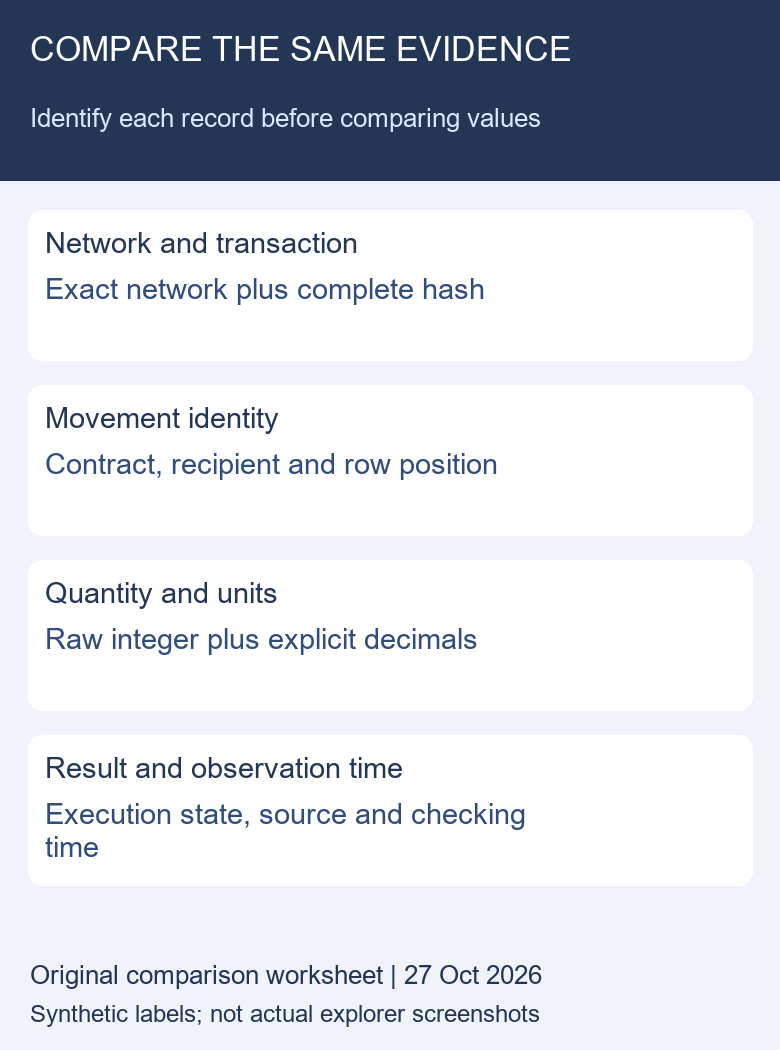
Table of Contents
Define the question for the two TRON records
Start by deciding whether you are comparing two views of one transaction or two different transactions. These are different tasks. The first asks whether the sources describe the same underlying evidence consistently. The second asks what changed between two separately identified records.
Write the question above the worksheet. For example, “Do these two exports describe the same token movement?” is narrower than “Are these wallets the same?” A transaction comparison cannot answer every ownership or custody question that might arise from the record.
Our TRON transaction-identifier guide helps distinguish the complete transaction hash from an address or token contract. Do not begin the comparison with a shortened screenshot label if the full identifier is available from the source.
Distinguish a transaction body from its receipt
The TRON execution-receipt reference distinguishes the post-execution receipt from the submitted transaction body. The body describes the proposed operation and related parameters. The receipt supplies execution information after the transaction is on-chain and executed.
That distinction prevents a common comparison error. One source can show what an operation requested, while another shows what execution actually reported. A parameter in a call body is not interchangeable with an executed token movement or a private service’s customer-credit record.
The official TRONSCAN transaction-detail reference is another source for checking which fields a response provides. Preserve field names and source context. Do not rename every amount-like field “USDT received” simply because that is the outcome you hoped to verify.
This article does not claim that every current explorer screen presents the same labels. We compare evidence fields and explicit units. When an interface changes, identify the corresponding documented record before assuming that an old button sequence or screenshot remains applicable.
A field-by-field worksheet for TRON records
| Field group | Record A | Record B | Meaning of a difference |
|---|---|---|---|
| Network | Full network selection | Full network selection | Different scope; stop a same-record claim |
| Transaction | Complete hash | Complete hash | Different transaction identity |
| Record layer | Body, receipt or movement | Body, receipt or movement | Different evidence questions may apply |
| Movement | Contract, recipient, source row position | Contract, recipient, source row position | Another asset, recipient or movement |
| Quantity | Raw integer and explicit decimals | Raw integer and explicit decimals | Normalize comparable units before deciding |
| Execution | Actual result field | Actual result field | Investigate state and collection context |
| Observation | Source URL and checking time | Source URL and checking time | Possible freshness or presentation difference |
The blank columns are intended for the reader’s own public evidence. Do not put private keys, recovery phrases, passwords or service authentication codes into a transaction worksheet. Those values are outside the public-record comparison task.
A reproducible order for comparing TRON records
- Record both sources. Preserve their URLs, retrieval times and the question being answered. A copied image without the source context is a weak starting point.
- Match the network first. A familiar asset symbol or similar-looking identifier does not replace an explicit network selection.
- Match the complete transaction hash. If it differs, label the task as a comparison of different transactions. Do not continue calling them duplicate views of one event.
- Select the same record layer. Compare body with body, receipt with receipt and movement with the corresponding movement wherever possible.
- Identify the asset and row. Preserve the full token contract, recipient and source-specific movement position. One transaction can require more than one movement-level observation.
- Normalize documented units. Keep raw integers and decimals together. Do not use a rounded USD estimate as the token quantity.
- Compare execution and freshness. Retain the actual result value and checking time. Missing evidence remains unresolved rather than becoming a presumed success.
- Write the narrow conclusion. List the matched fields, the remaining differences and the next evidence required. Keep ownership and private service credit separate.
Eight synthetic cases and their tested results
All labels in this fixture are synthetic. The baseline uses a synthetic mainnet label, synthetic transaction A, synthetic contract A, recipient B and movement position zero. Its quantity is 1,250,000 raw units with six decimals, equal to 1.25 formatted units. The example is arithmetic and record selection, not an actual transfer.
| Case | Changed observation | Checker result |
|---|---|---|
| 1 | All checked fields match | same checked fields |
| 2 | Same text hash, another network | different network |
| 3 | Another transaction | different hash |
| 4 | Another token contract | different contract |
| 5 | Another recipient | different recipient |
| 6 | Another movement position | different position |
| 7 | Different execution value | different execution |
| 8 | Missing amount, not a zero | unresolved |
Each TRON records fixture case changes one baseline field or removes one required value. We checked the expected result against the local function’s output. This makes it possible to see what the checker actually distinguishes instead of treating a generic “verified” label as a complete explanation.
Interpret the synthetic TRON records cases carefully
Case one: matching fields. The two TRON records agree on the selected baseline fields. The output says “same checked fields,” deliberately avoiding a broader identity or security claim. A field that the worksheet does not inspect can still differ.
Case two: another network. The text used for the synthetic hash remains the same, but the network label changes. The checker stops at that difference. A hash string without network context is not sufficient evidence for this comparison method.
Case three: another transaction. The complete synthetic transaction identifier differs. The reader may still compare the two operations, but must not describe them as two displays of the same transaction. Equal amounts and similar times would not repair the identity mismatch.
Case four: another contract. The displayed asset name could remain similar, yet a different complete contract changes the asset scope. The comparison should preserve this difference rather than merging rows solely by symbol.
Case five: another recipient. A changed recipient means that the selected movement does not describe the same destination. Do not infer that the difference is harmless because the shortened prefixes look familiar. Compare the complete source values.
Case six: another movement position. The same transaction can contain multiple relevant records. A position identifier helps select the intended source row. It must be interpreted according to the source; different APIs’ row numbers are not automatically equivalent.
Case seven: another execution value. The result fields disagree. The checker reports the field difference but does not decide which source is correct. Compare the record layer, freshness and documented confirmation context before resolving that disagreement.
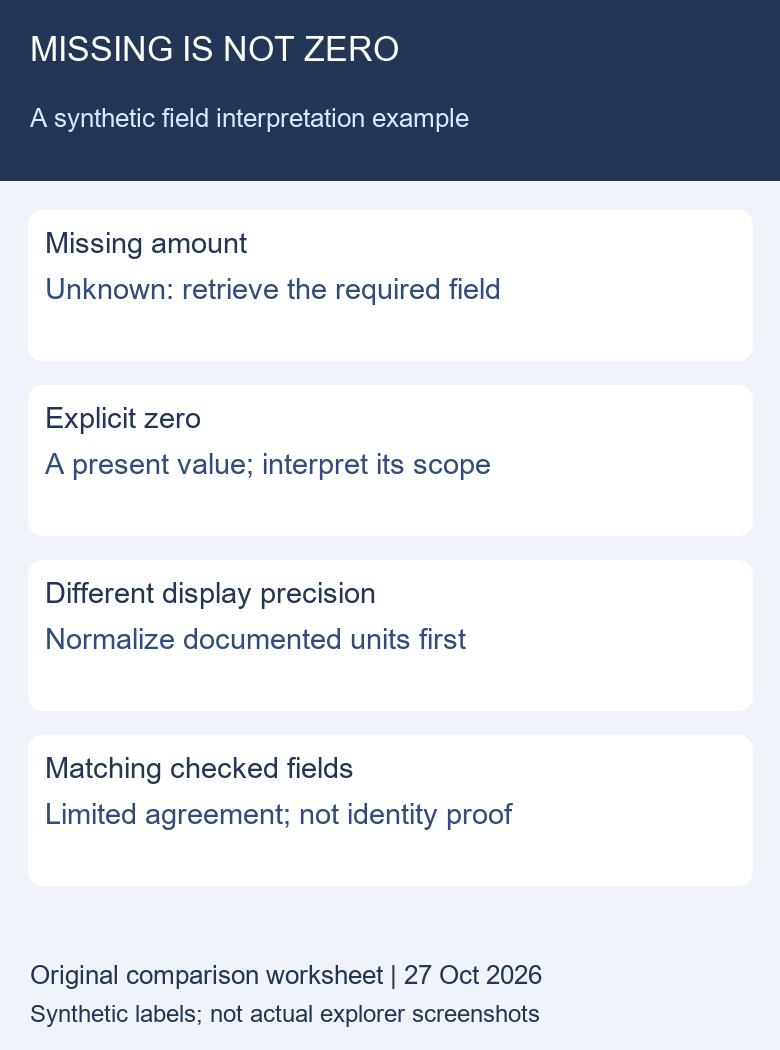
Case eight: missing quantity. One required raw amount is absent. The result is unresolved. The code does not replace it with zero or infer it from a nearby USD label. Retrieving the missing evidence is the next step.
A small offline comparison function
The following Python example compares already prepared dictionaries. We tested its eight fixture cases and two extra assertions locally on 27 October 2026. It does not fetch records, decode token events, authenticate a source or connect a wallet.
from decimal import Decimal

def compare_records(a, b):
    required = ["network", "hash", "contract", "recipient",
                "position", "raw", "decimals", "execution"]
    if any(a.get(k) is None or b.get(k) is None for k in required):
        return "unresolved"
    identity = ["network", "hash", "contract", "recipient",
                "position", "execution"]
    for key in identity:
        if a[key] != b[key]:
            return "different " + key
    first = Decimal(a["raw"]) / Decimal(10) ** a["decimals"]
    second = Decimal(b["raw"]) / Decimal(10) ** b["decimals"]
    if first != second:
        return "different quantity"
    return "same checked fields"
The two additional assertions matter. Two explicit zero raw amounts remain present values and can match. A raw amount of 1,250,000 with six decimals and a raw amount of 125 with two decimals both format as 1.25. That arithmetic match does not authorize changing a real token’s decimal convention; actual metadata must establish which conversion applies.
The TRON records comparison function returns the first checked difference. It is a simple teaching example, not a complete diff engine. If several fields differ, the output does not claim that the first difference is the only one. A manual worksheet should retain every relevant discrepancy.
It also assumes that the input dictionaries already describe comparable movement-level observations. It cannot turn a transaction-body parameter into a receipt or decode a token event automatically. Mislabeling the input layer can produce an apparently neat comparison that answers the wrong question.
Run an explicitly synthetic example end to end
To try the function, place the following dictionaries and print statements after its definition in a local Python file. Every identifier beginning with “synthetic” is an authored placeholder. None is a valid transaction link, and the example must not be used as evidence that a real payment occurred.
a = {"network": "synthetic-mainnet", "hash": "synthetic-tx-A",
     "contract": "synthetic-contract-A", "recipient": "synthetic-address-B",
     "position": 0, "raw": "1250000", "decimals": 6,
     "execution": "synthetic-success"}
b = dict(a)
print(compare_records(a, b))
b["recipient"] = "synthetic-address-C"
print(compare_records(a, b))
b = dict(a)
b["raw"] = None
print(compare_records(a, b))
The three expected outputs, in order, are “same checked fields,” “different recipient” and “unresolved.” Run the file locally with Python. This requires only the standard decimal module and prepared data; no explorer account, API credential or wallet connection is involved.
The first call compares an independent copy of the baseline dictionary. The second changes only the recipient in that copy. The third resets the copy before removing the amount. Resetting matters: otherwise the recipient difference from the earlier step would remain in the input and obscure the intended missing-field example.
Our tests of TRON records used the same first-difference rule shown in the function. In a review note, state that rule explicitly. An output naming a recipient difference does not certify the quantity, execution value or remaining fields; it reports where this ordered check stopped.
If a reader adapts the code for actual source data, the preparation step becomes part of the evidence. Document how the network was selected, which movement was extracted, where decimals came from and whether any representation was converted. A clean comparison result cannot repair an undocumented or incorrect extraction.
Keep the raw source records alongside the prepared dictionaries. If an adapter accidentally maps an execution field into an amount column, inspecting the original data is the way to find that mistake. Retaining only the final “same checked fields” message would hide the input error and make the result difficult to review.
Preserve missing values and address formats
When reviewing TRON records, distinguish a field that is not present, one that is explicitly null, one that is a present zero and one that contains a value you have not interpreted. These states should not collapse into the same spreadsheet cell.
The example checks for missing or null required values. It intentionally accepts zero as present. It does not validate every possible input type, so malformed strings or inappropriate decimal values require additional handling in a production program.
Likewise, do not lowercase every address to make a comparison pass. Address encodings have their own rules. If one source uses a different representation, use a documented, validated conversion and preserve the original values. The simple function above performs no address conversion.
Our exact token-decimal worksheet helps with raw-to-formatted quantities. A display that rounds 1.250000 to 1.25 can still describe the same quantity. A USD estimate with a changing valuation basis is a different measurement.
When matching TRON records still leaves a question open
Matching public fields cannot prove a customer’s private exchange credit. A service can apply its own account mapping and crediting process after an on-chain event. Preserve the public evidence, then use the verified service channel for the private part of the question.
Matching transaction fields also does not prove who controls the addresses. A public recipient and a person or organization are different levels of attribution. Do not promote an account label, a screenshot or an assertion by another party into ownership proof.
If you want to follow later movements, our multi-transfer tracing worksheet addresses that separate task. Comparing records establishes which observations you are looking at; tracing examines a possible sequence and its attribution limits.
The official confirmation-semantics reference is useful when records concern different confirmation stages. Keep the stage each source actually reports. A displayed timestamp alone does not establish that two sources observed the same stage at the same time.
Write a reviewable conclusion and preserve evidence
A useful conclusion names the question, source times and matched identity fields, then lists the differences. For example: “The selected network and complete transaction identifier match, but the movement position differs; the two selected rows cannot yet be treated as one transfer.” This sentence is an explicitly hypothetical reporting example.
Save the public identifiers and relevant field values with their source links. Preserve a before-and-after note if a later retrieval changes a value. A record copied without its checking time is harder to interpret when a source updates.
Do not repeatedly refresh until one source happens to resemble another, then discard the disagreement. If an observation changed, retain both and explain the sequence. If the source was unavailable, label that gap instead of treating the absent record as a failed or reversed transfer.
The method succeeds when the conclusion remains proportional to the evidence. A narrow unresolved result can be more useful than a broad confident statement: it identifies the exact missing field and the next read-only check required to move forward.
For selecting the underlying public record before applying this comparison, use the complete TRONSCAN guide. A transaction body, receipt and token movement remain separate record choices.
For aggregate TRON records rather than two identified receipts, use the transaction-counter scope and timing audit to check whether totals, category counts and reported shares can be compared.
Frequently asked questions
Are matching amounts enough to match two TRON records?
No. Check the network, complete transaction identifier, token contract and intended movement. Amounts alone do not establish record identity.
Why can a body and receipt show different information?
They describe different layers: the submitted operation and its post-execution evidence. Compare corresponding fields before calling the difference an error.
Should an unavailable amount be treated as zero?
No. Preserve the missing state and obtain the required record. An explicit zero is a separate observation.
Does the example verify real transactions automatically?
No. It compares prepared dictionaries and was tested with synthetic labels. It does not retrieve, authenticate or decode real blockchain evidence.
Does agreement prove who owns an address?
No. The checked public fields do not independently establish beneficial ownership, control or a service customer’s identity.
Editorial note: Tronscan News prepared this independent guide with AI assistance, original worksheets and local synthetic tests on 27 October 2026. No real wallet action or current interface sequence was tested. Official references support the record-layer distinctions; the comparison worksheet is our authored method. Corrections information is available through the site navigation.
Explore related guides through the Tronscan News home page.
Leave a Reply