The seven selected TRON transaction counters in our saved response do not form a mutually exclusive partition of its overview total. Their sum is 20,150,720,999, exceeding the response’s txCount of 15,970,969,775 by 4,179,751,224. Treating those seven rows as slices of one complete pie would therefore be unsupported.
This original scope audit uses the official public response collected on 27 October 2026 at 05:31:29 UTC. We preserve the fields, calculate the sum locally and distinguish that finding from an explanation of the source’s internal counting rules. We do not claim that a mismatch alone proves a provider error.
The same response contains two different update timestamps and a selected USDT row whose reported proportion differs from a recomputation using the response’s current overview denominator. These are reasons to retain scope and timing, not to silently force every number into agreement.
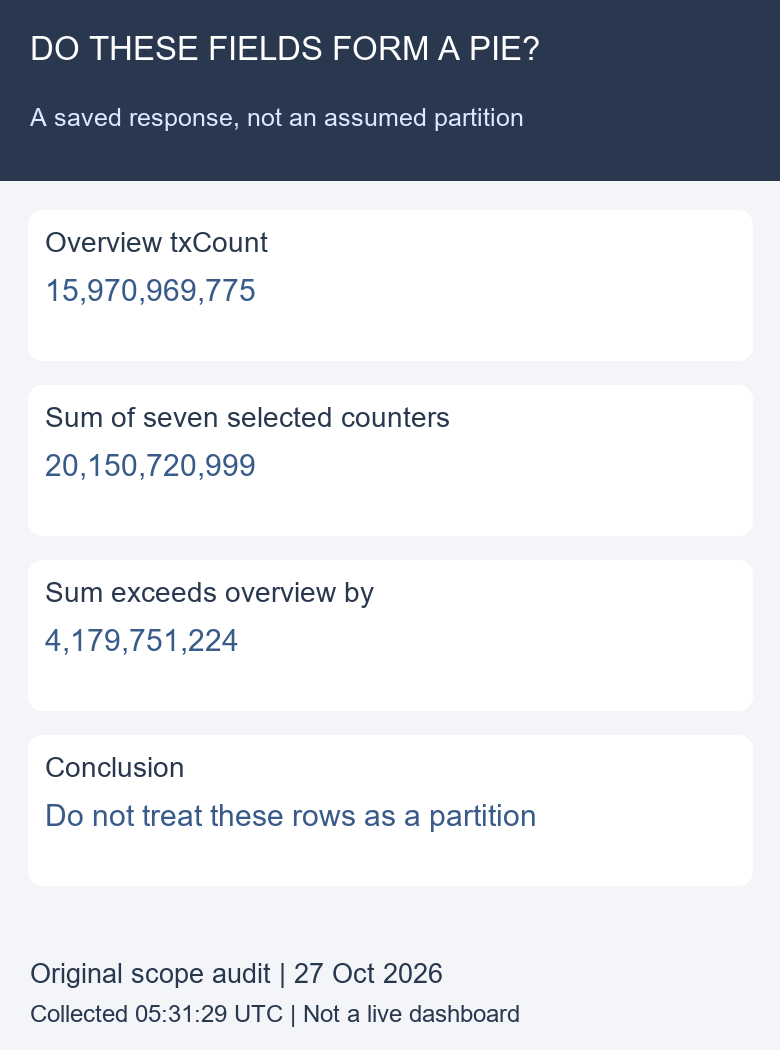
Table of Contents
Transaction counters answer a different question from one receipt
The official transaction-statistics reference describes network-level count and summary fields. A statistical counter is not a particular transaction hash, a movement row or an account’s private service record.
The TRON execution-receipt reference concerns the post-execution evidence for a selected transaction. It supports a different task from this aggregate audit. A public receipt cannot by itself define the entire statistical population behind a counter.
Use the TRONSCAN guide to selecting the correct public record when you need to locate an account, transaction or token page. This article starts after the statistical response has been selected and asks how its fields may legitimately be combined.
Seven selected transaction counters in the saved response
| Source field | Reported count |
|---|---|
trxTransferCount |
6,260,177,908 |
trc10TransferCount |
1,461,572,620 |
trc20Count |
4,174,105,808 |
triggerCount |
5,443,115,193 |
freezeBalanceCount |
33,496,818 |
votesCount |
18,079,660 |
othersCount |
2,760,172,992 |
The seven integers sum to 20,150,720,999. This is our sum of explicitly listed fields. It is not a newly discovered network transaction total. We retain the separate overview count, 15,970,969,775, alongside it.
Other response fields also exist, including NFT-related counts and amount-like values. We did not add them to this selected sum. Adding more nonnegative fields would not repair the fact that the selected sum already exceeds the overview count.
Why these rows cannot be published as one pie
For an exclusive partition of the same population, selected nonnegative category counts cannot add to more than that population’s total. This basic arithmetic condition fails for the chosen transaction counters in this response. That is the specific condition we tested.
It does not identify which fields overlap, whether every field shares a reporting horizon or how each field is refreshed. Those questions need appropriate source definitions and implementation evidence. We have not independently reconstructed the provider’s classification pipeline.
A blockchain operation can have different descriptive layers, such as an outer operation and associated token movements. However, that general distinction is not proof of the exact algorithm used for every statistical field here. We therefore do not assign the entire excess to a particular pair of fields.
The useful reporting choice is to show the selected counters with their own names and retain the failed partition condition. A chart that labels them as seven exclusive slices would add an unsupported interpretation to otherwise genuine source values.
Preserve both update fields and the collection time
The response’s lastUpdateSeconds converts to 27 October 2026 at 05:05:05 UTC. Its millisecond updateTime converts to 27 October at 00:00:00 UTC. We collected the response at 05:31:29 UTC.
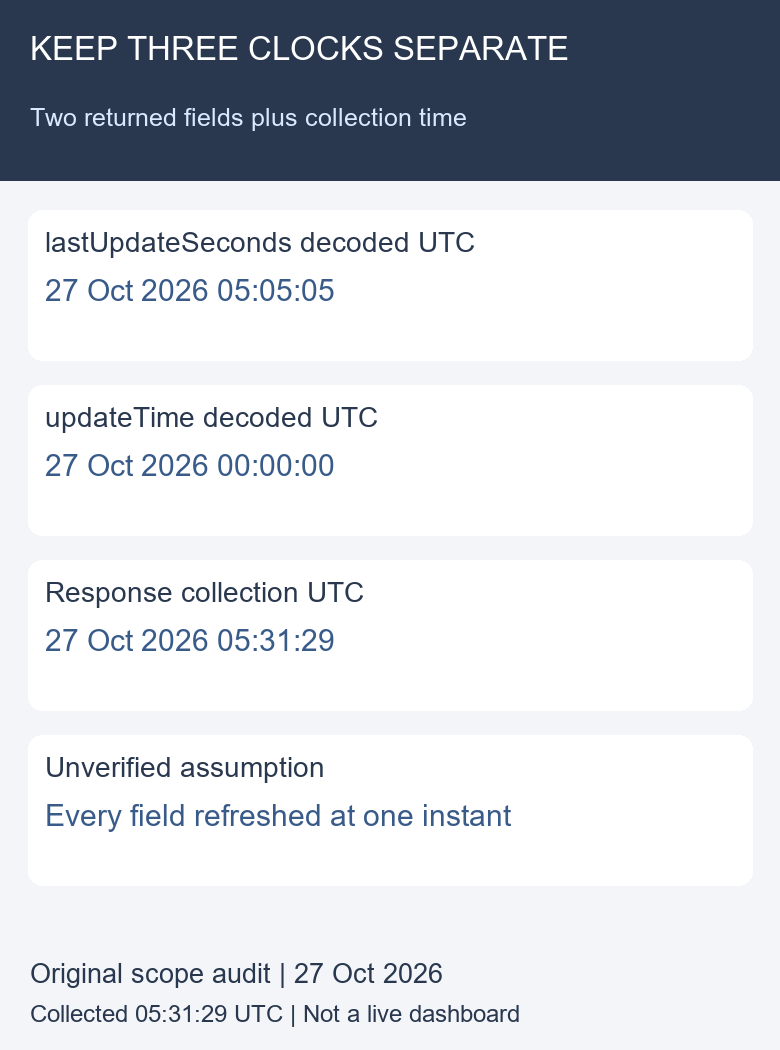
For transaction counters, these three times have different roles. Collection time records when we obtained the response. Returned metadata describes source update information. Neither automatically certifies that every counter was computed from a synchronized observation at that instant.
Do not treat the two timestamp units as interchangeable. The seconds field is decoded directly; the millisecond field is divided by one thousand before a Unix-time conversion. Both conversions use UTC so that an unstated local timezone does not shift the labels.
The source also reports lastDayTxCount as 11,825,114. We preserve that field’s name and documented context. We do not divide the cumulative overview count by it to invent a growth rate or assume that all other fields use its daily scope.
Audit the selected USDT row without inventing a denominator
The selected row is identified by the complete contract TR7NHqjeKQxGTCi8q8ZY4pL8otSzgjLj6t. Its returned count is 3,704,824,688 and its reported proportion is 23.22531152981712.
Dividing that count by the same response’s overview txCount and multiplying by one hundred gives approximately 23.197243124205%. This is our explicitly named denominator calculation. It differs from the stored proportion by approximately 0.028068 percentage points.
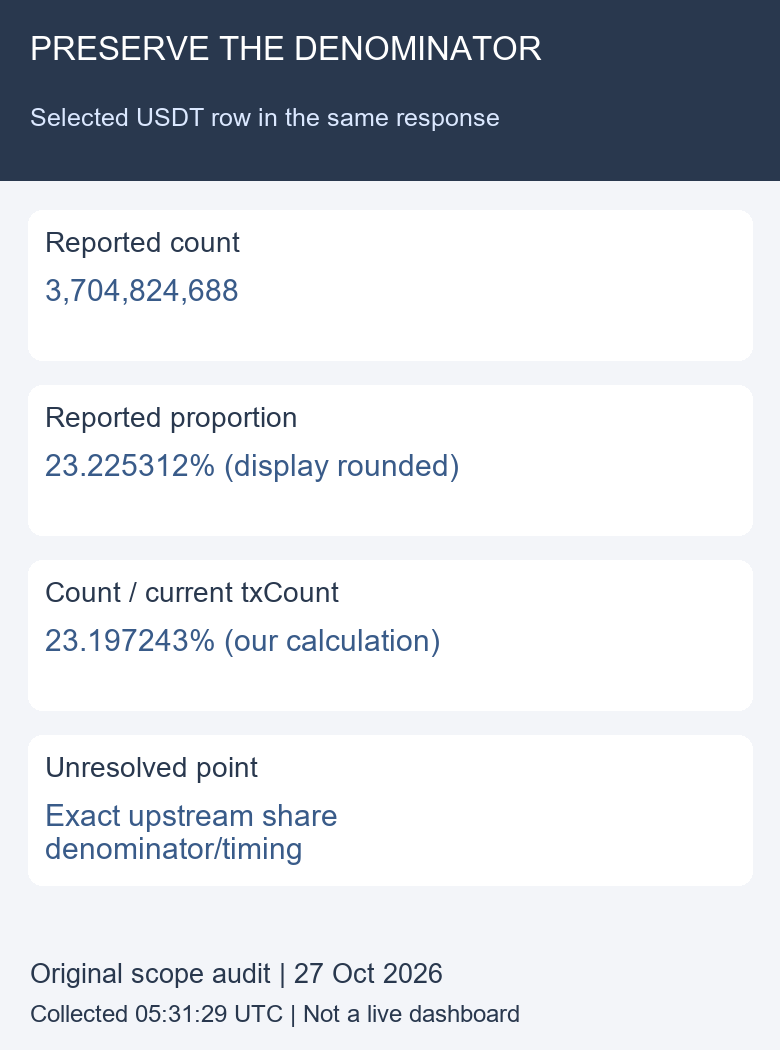
The difference is visible when more decimal places are shown. At a coarse one-decimal display, both values appear as 23.2%. A rounded chart can therefore conceal a scope or timing question that remains relevant to a precise reconciliation.
We have not established the exact denominator or refresh timing used to generate the stored proportion. The correct conclusion is limited: it does not equal this specific recomputation from the retained count and overview total. Do not silently relabel the stored value as our calculated share.
A zero amount does not erase a nonzero count
The same selected row contains amount: 0.0 alongside its nonzero count. Those are separate fields. The amount value cannot be substituted for the count or used to assert that no relevant activity was recorded.
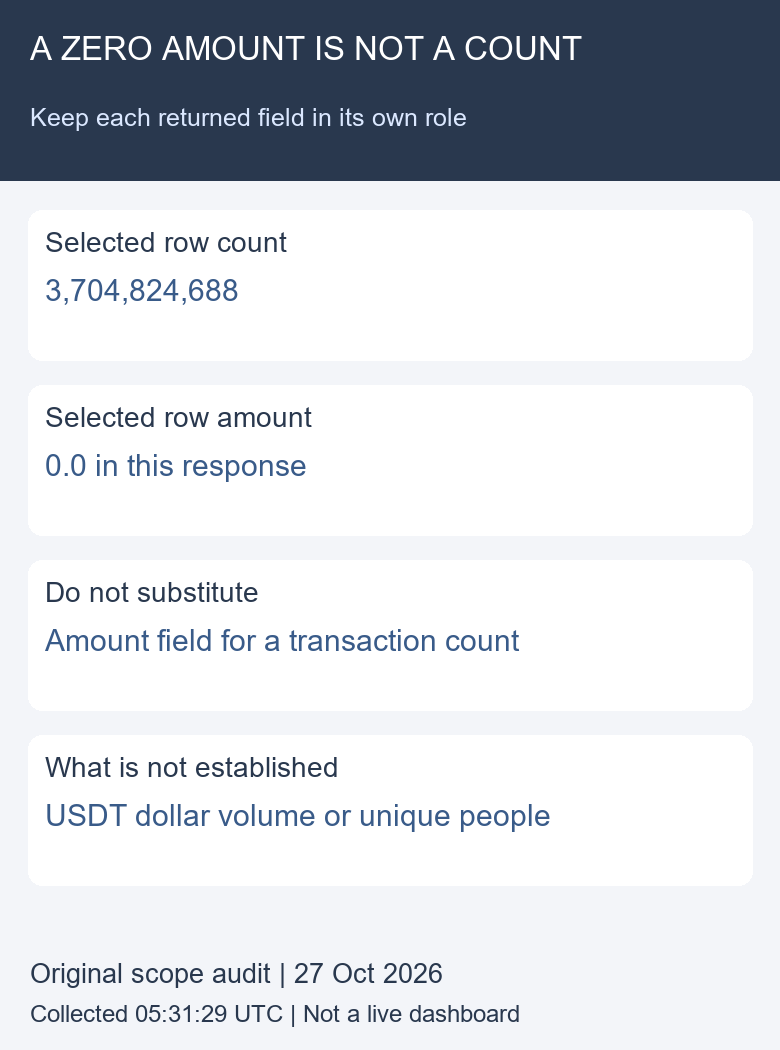
This audit deliberately excludes monetary interpretation of the amount-like fields. Their unit and operation scope must be established for the particular question before conversion. A token label does not automatically make every amount a USDT quantity or USD valuation.
The dated USDT transfer-activity analysis uses another endpoint’s defined USD-amount series. Its thirty-date transfer amounts are not interchangeable with a cumulative transaction counter or the amount field discussed here.
Reproduce the transaction counters audit
- Save the complete response. Preserve collection time, source metadata and the field names. A screenshot of a summary tile is insufficient for the comparisons below.
- Select the count fields explicitly. We list seven fields and do not pretend that they exhaust all response fields or form exclusive categories.
- Check types and signs. The selected values are nonnegative integers. An absent value should not be replaced with zero.
- Compare the selected sum with the overview. Record the excess without altering the source values. Treat the partition condition as a question, not an assumption.
- Decode clocks with their own units. Retain seconds-based and millisecond-based source metadata separately from collection time.
- Name the share denominator. Filter the complete USDT contract, then state exactly which overview value is used in a recomputation.
- Keep the unresolved issues. A correct local calculation is not a reconstruction of upstream counting rules or a proof of unique users.
The following standard-library Python example reads the saved response. We ran it locally on 27 October 2026 and checked the printed outputs against this report. It performs no API call, wallet connection or signing operation.
import json
from pathlib import Path
from decimal import Decimal, getcontext
from datetime import datetime, timezone
getcontext().prec = 45
data = json.loads(Path("network-transactions-publication-source.json").read_text())
fields = ["trxTransferCount", "trc10TransferCount", "trc20Count",
          "triggerCount", "freezeBalanceCount", "votesCount", "othersCount"]
assert all(isinstance(data[k], int) and data[k] >= 0 for k in fields)
selected_sum = sum(data[k] for k in fields)
print("overview", data["txCount"])
print("selected sum", selected_sum)
print("excess", selected_sum - data["txCount"])
print("partition check", selected_sum <= data["txCount"])
target = "TR7NHqjeKQxGTCi8q8ZY4pL8otSzgjLj6t"
matches = [r for r in data["trc20Top10"] if r["address"] == target]
assert len(matches) == 1
row = matches[0]
print("USDT reported count", row["count"])
print("reported proportion", row["proportion"])
print("recomputed proportion", Decimal(row["count"]) /
      Decimal(data["txCount"]) * 100)
print("seconds clock", datetime.fromtimestamp(
      data["lastUpdateSeconds"], timezone.utc).isoformat())
print("milliseconds clock", datetime.fromtimestamp(
      data["updateTime"] / 1000, timezone.utc).isoformat())
Read the test outputs without overstating them
The input-type checks pass for the seven selected fields, and exactly one matching USDT row is present in the selected top-list response. The sum and timestamp conversions reproduce the retained values. These are local selection and arithmetic checks.
The printed partition condition is false. That outcome is part of the finding and must not be described as a successful exclusive-classification check. The stored USDT proportion also remains different from the specifically recomputed ratio.
These findings do not establish an internal software defect, a network failure or misleading intent by the provider. A snapshot audit can show that a proposed interpretation is unsupported without determining the reason. We did not obtain a provider-internal explanation.
Keep count, share, rate and person distinct
A count is not automatically a rate. Deriving transactions per second requires an appropriate count of operations over an explicitly matched time interval. A cumulative overview and an unrelated timestamp do not provide that interval by themselves.
A share is a ratio with a denominator. Its numerical precision does not establish which population was used. Preserve the stored share and the underlying count, then identify the denominator before comparing it with another view.
A person is another entity entirely. These transaction counters do not independently identify unique individuals, customers or beneficial owners. Repeated operations can contribute more than once, and a network counter cannot supply private service attribution.
For two individually identified records, our field-by-field comparison worksheet provides a different method. Aggregated counters need the additional population, horizon and denominator checks discussed here.
Compare another snapshot without hiding changes
When revisiting transaction counters, retain the same field selection, source endpoint and calculation code when comparing a later response. Save its own collection and source update times. Do not overwrite this snapshot while keeping its old checking date.
If only some fields change, report exactly which ones changed. That observation can guide further investigation, but it does not by itself establish a refresh schedule or an explanation of the unchanged fields.
If a field is absent or the response structure changes, stop the affected calculation. Keep an unavailable observation separate from a zero count. Removing a failing check until a preferred result appears would undermine reproducibility.
The practical success standard is a reviewable interpretation: genuine source values, explicit arithmetic and an honest list of unverified assumptions. A polished pie chart would not improve the evidence if the categories have not been established as an exclusive partition.
A manual check of the transaction counters
You can reproduce the core finding with an ordinary calculator before running the script. Begin with the TRX transfer, TRC10 transfer and TRC20 fields shown in the table. Their sum is 11,895,856,336. This is a subtotal of three selected fields, not a newly established population of distinct transactions.
Add the returned trigger count of 5,443,115,193. The subtotal becomes 17,338,971,529. At this point it already exceeds the overview of 15,970,969,775 by 1,368,001,754. Adding the remaining nonnegative fields cannot make this an exclusive breakdown of that overview.
The remaining freeze, votes and others fields add to 2,811,749,470. Together the seven fields produce 20,150,720,999. Subtracting the overview gives 4,179,751,224. Keep the subtraction labeled as the excess of the selected sum over the overview; do not rename it duplicate transactions or extra network activity.
This distinction matters when charting transaction counters. A pie chart normally implies mutually exclusive slices of one population. Converting these transaction counters into percentages that total 100 would hide the failed assumption. A table with the original field names, values and an interpretation note is more faithful to the available evidence.
Make a denominator and timing worksheet
For each proposed comparison of transaction counters, write down five items: population, horizon, unit, denominator and refresh time. The selected fields provide integer counts, but that alone does not establish a shared population or refresh boundary. Leave an unknown worksheet cell explicitly unknown instead of completing it from an adjacent field’s name.
For example, the response’s lastDayTxCount is 11,825,114. Its presence does not authorize dividing every cumulative-looking field by that number. A denominator must answer the same question as the numerator. A token row’s count, an overview count and a last-day count are not interchangeable merely because they are returned together.
Likewise, collection at 05:31:29 UTC is our observation time. The native seconds timestamp resolves to 05:05:05 UTC, while the milliseconds timestamp resolves to midnight UTC. These three times describe different recorded facts. We preserve each one and do not use the latest clock to relabel every counter as current to that instant.
Report a small share difference honestly
The stored USDT proportion is approximately 23.2253115, while the specified count divided by txCount and multiplied by 100 yields approximately 23.1972431 percent. Subtracting the two produces about 0.0280684 percentage points. Percentage points express the direct difference between percentages; they are not the same as a relative percentage increase.
Rounding both values to one decimal place gives 23.2. That convenient display hides the difference, so a checking worksheet should retain more precision even if a reader-facing summary uses fewer digits. Conversely, retaining many decimal places cannot establish the source’s exact denominator. Numerical precision and semantic certainty are separate properties.
If another reader obtains a different snapshot, ask for its collection time, the original count, the overview and both native timestamps. Repeating the same calculation on those retained inputs can confirm that reader’s arithmetic. It cannot prove that two responses should have identical values or explain an undocumented refresh process.
A concise publication note for this snapshot
A responsible summary can state that seven named transaction counters sum to more than the returned overview, with both values and the collection date shown. It should also state that the audit has not established an exclusive classification, a shared horizon or one synchronized refresh instant. This gives readers a useful result without supplying a speculative explanation.
For the USDT row, keep the reported count, stored proportion and explicitly recomputed ratio in separate columns. Leave the amount field outside any volume calculation. Before reusing the finding in a later report, obtain a new response and rerun the same selection and arithmetic, retaining the old snapshot as dated evidence rather than silently updating its values.
Frequently asked questions
Can the seven transaction counters be added as a network total?
Not on the interpretation tested here. Their selected sum exceeds the response’s overview count, so they cannot be treated as an exclusive partition of that same total.
Does that finding prove an API bug?
No. The audit does not independently establish the source’s classification, horizon or refresh implementation. It limits the interpretation that can be supported.
Which update timestamp should replace the other?
Neither. Preserve both returned fields with their units and retain collection time separately. We did not verify one universal refresh time for every counter.
Why is the stored USDT share different from the recomputation?
The report identifies the difference but does not establish the stored share’s exact denominator or refresh rule. We keep both values rather than inventing a cause.
Does a zero amount mean zero transactions?
No. A separate nonzero count remains present in the selected row. This report makes no monetary-volume inference from the amount field.
Editorial note: Tronscan News prepared this independent audit with AI assistance, original diagrams and local calculations on 27 October 2026. No private account, real wallet action or provider-internal counting system was tested. Corrections information is available through the site navigation.
Find the main topic guides at the Tronscan News home page.
Leave a Reply