The saved TRON Energy data attributes 180,515,748,252 Energy units to the USDT contract, approximately 92.779120% of the response’s overview total. The contract’s reported source components add exactly to that total. A particularly important unit distinction is that the field named trx represents Energy covered through TRX burning in this endpoint, not a quantity of TRX tokens.
This is a dated snapshot analysis and field-reconciliation guide. We collected the default response on 27 October 2026 at 04:45 UTC. Its own update timestamp is 26 October 2026 at 00:48:46 UTC. Those are different times. We do not describe the values as live readings or certify that they cover a complete 26 October calendar day.
A second documented request specifying 26 October’s millisecond timestamp returned the same update time and totals. That confirms the observed response for that request; it does not independently establish the upstream reporting boundary or finalization policy.
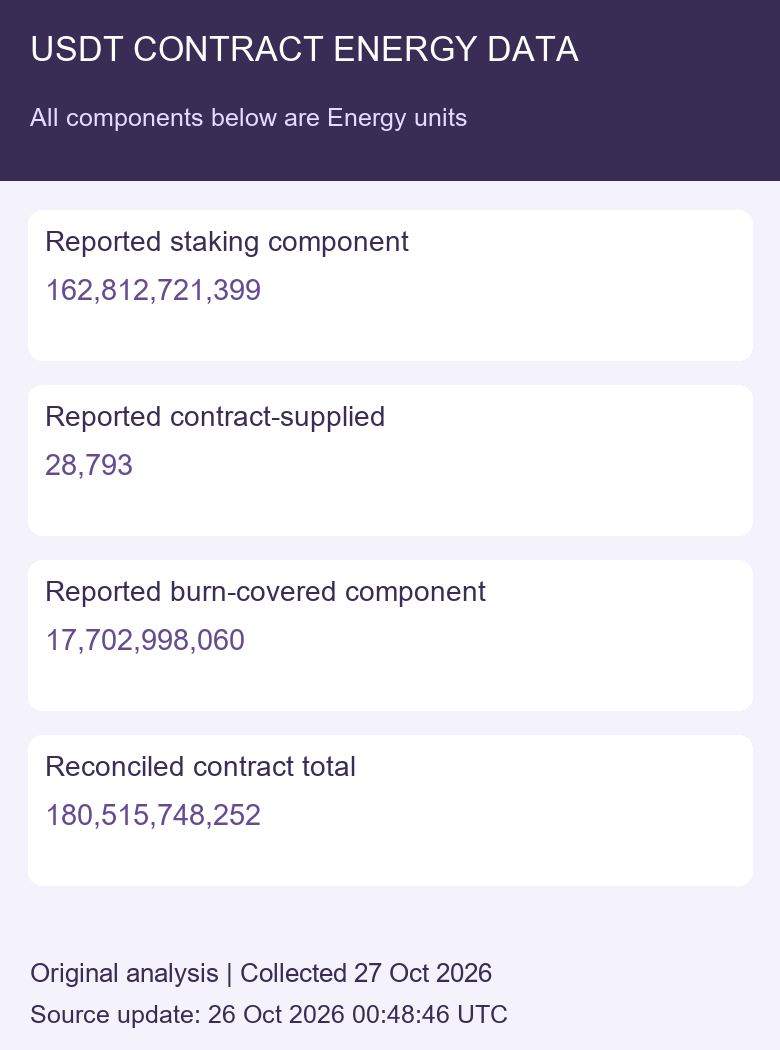
Table of Contents
Energy data is not a transfer-fee quotation
The source aggregates contract resource consumption. A reader planning one USDT transfer needs different evidence about the proposed operation, available resources and applicable network conditions. Do not divide an aggregate by a guessed number of transfers and present the result as the fee every reader will pay.
Our TRON Energy guide for an individual transfer addresses that separate task. This review focuses on reconciling a contract-ranking snapshot and interpreting its denominators, units and coverage.
The official contract Energy statistics reference defines the endpoint fields. We retained the complete USDT contract address, the overview total, the component values and the source update timestamp before calculating anything.
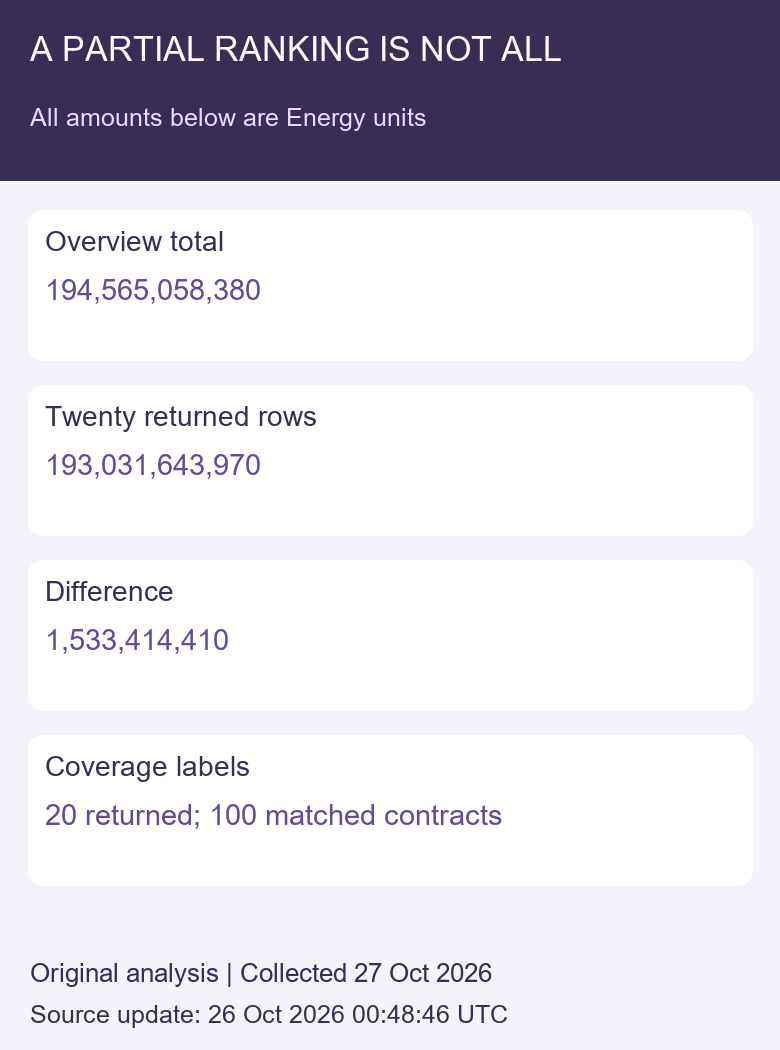
The request returned twenty rows while reporting one hundred matched contracts. Twenty is the requested result limit, not a statement that only twenty contracts exist or that the selected rows represent the complete matched list. This coverage distinction matters when reconciling row sums.
USDT contract Energy data components
| Source field | Energy units | Share of this contract’s total |
|---|---|---|
| energy | 162,812,721,399 | 90.193085% |
| contract_supplied | 28,793 | 0.000016% |
| trx | 17,702,998,060 | 9.806900% |
| total_energy | 180,515,748,252 | 100% |
The raw integer components reconcile without a remainder: 162,812,721,399 plus 28,793 plus 17,702,998,060 equals 180,515,748,252. We calculated percentages from those integers and rounded the display only after division.
The tiny contract-supplied component is still a present, nonzero value. Rounding its percentage to a short label can conceal it. A report should not replace a small value with “none” merely because a chart label rounds to zero at the chosen precision.
These components explain how the source partitions the contract’s reported consumption. They do not identify who ultimately paid a particular bill, establish a resource-rental agreement or describe the economic purpose of individual contract calls.
Why the field named trx must retain its unit
Reading trx: 17702998060 as 17.7 billion TRX would change the measurement entirely. In this Energy data endpoint, the documented meaning is Energy paid through burning TRX. Keep the Energy unit attached to the field when moving it into a spreadsheet or chart.
Do not apply a generic “divide every TRON number by one million” rule. Different fields have different units. A transaction fee reported in sun, an amount of TRX and an aggregate Energy component require their own documented interpretation.
Converting Energy consumption into a TRX cost would require an appropriate price or parameter and a clearly defined scope. This report does not perform that conversion. It therefore makes no claim that the burn-covered Energy component equals a stated token fee.
The TRON USDT asset-and-resource guide provides the wider context for token quantities, TRX resources and receipts. Confirm the asset and record being interpreted before using an aggregate table. Neither an account balance nor a configured limit should be substituted for this contract resource series.
Use the right denominator for each percentage
The 92.779120% figure divides USDT contract Energy, 180,515,748,252, by the overview total, 194,565,058,380. It answers a cross-contract share question within the returned source snapshot.
The 90.193085% staking component divides 162,812,721,399 by the USDT contract total instead. It answers a source-composition question within that contract. These percentages have different denominators, so they must not be combined as if they were neighboring slices of one pie.
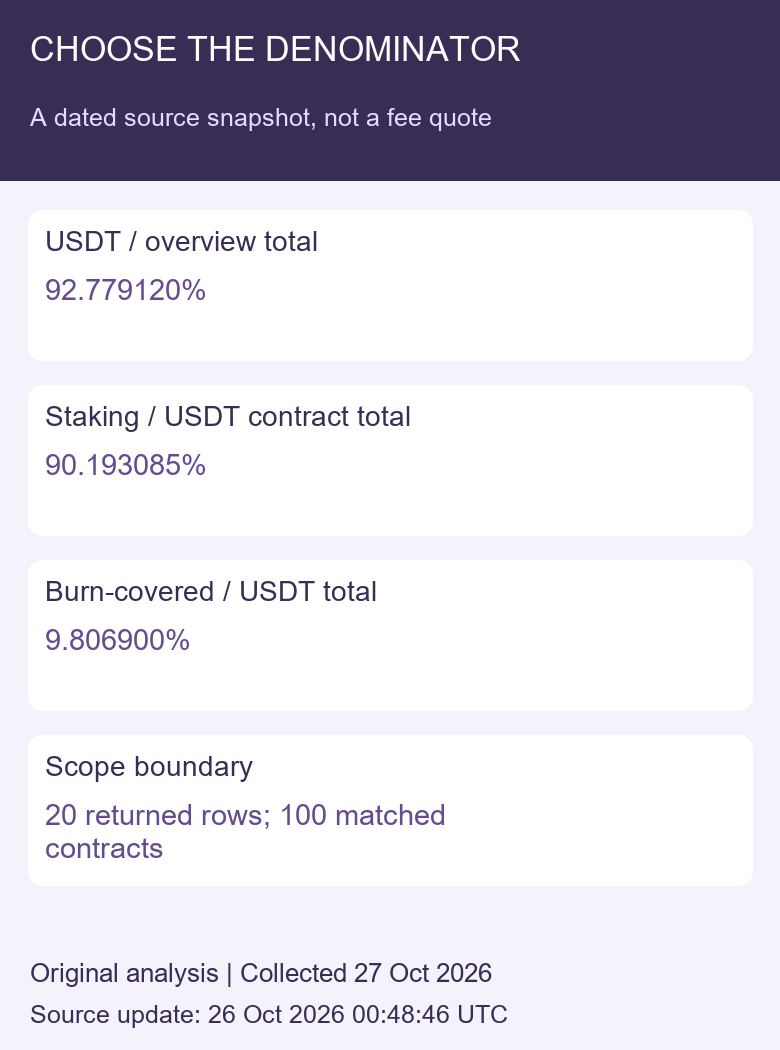
The response also contains a rounded share value of 0.93 for the USDT row. Displaying that ratio as approximately 93% is compatible with the more precise ratio calculated from the saved integers. A rounded source share and a six-decimal calculated percentage need not have identical printed digits.
Keep the original share field alongside your recomputation. If a future response produces a material disagreement, preserve the discrepancy and inspect its timing and denominator. Do not silently overwrite the source field with the calculated result.
A further denominator trap arises when combining source fractions across contracts. An arithmetic average of twenty staking percentages would give a tiny contract the same weight as the USDT contract. To describe the returned subset, a weighted fraction would require summing the relevant Energy components and dividing by the subset’s summed Energy total. To describe every matched contract, the unreturned rows would also be needed. This Energy data review reports the USDT component fraction only; it does not promote an average of visible rows into a network-wide source distribution.
The twenty returned contract rows
The following table retains the names and complete contract addresses from the selected response. Names are source labels, not an endorsement or an ownership conclusion. Percentages are our own calculation against the same overview total used above.
| Source name and contract | Energy units | Share of overview |
|---|---|---|
TetherTokenTR7NHqjeKQxGTCi8q8ZY4pL8otSzgjLj6t |
180,515,748,252 | 92.779120% |
UpgradableProxyTFFAMQLZybALaLb4uxHA9RBE7pxhUAjF3U |
6,357,926,127 | 3.267764% |
UniversalRouterTQqgNg13s2DjvXhW1ky4v6TsR8wZGvb7Y4 |
2,338,082,646 | 1.201697% |
BridgersTJ4KeiGTvTX4wRUgLARiwr8rGLaurmVkdZ |
975,047,078 | 0.501142% |
SunSwapProxyTTRr81XJt6zESpJw2zHgJNAsxcsyT5MVYv |
775,713,021 | 0.398691% |
BatchSenderTC1snEEDSpgyW9gvTwVqeHzzmvZ8TN1h4u |
350,896,864 | 0.180349% |
SmartExchangeRouterTGnC7LMji8hBpyvZt1TTEJhVpAZ5HFyJ3r |
335,028,753 | 0.172194% |
UniswapV2Router02TNJVzGqKBWkJxJB5XYSqGAwUTV15U24pPq |
329,144,675 | 0.169169% |
FactoryTFo9zaFLsHKroQXGMyXNyCuENyFWiEXz3h |
203,803,296 | 0.104748% |
MarketProxyTU2MJ5Veik1LRAgjeSzEdvmDYx7mefJZvd |
152,973,146 | 0.078623% |
SimplifiedBatchSenderTDe5aJyJmtJdon9nNRbX1itnftt6LQLUwU |
125,472,271 | 0.064489% |
DiamondTKwNfJYb2iyouByKpNdxQ6tryXK8KhTPT9 |
102,266,242 | 0.052561% |
UsddPsmTBXW4hS5KYjjbJXDpnrPf4zhkLwrpUjbyz |
88,732,101 | 0.045605% |
TXtEs6t2oUWQsNos7m68gbHdE9Q5n6x2oN |
74,982,623 | 0.038539% |
TrxManagerTY6zhEurUSg9dgLMwBXkqhVVAQwZX4mqEG |
62,003,416 | 0.031868% |
ProxyGatewayTWoGH5DrqhMSaUBz1RYxHuu7rEPG1AZgyi |
61,820,356 | 0.031774% |
NoneTT1j2adMBb6bF2K8C2LX1QkkmSXHjiaAfw |
54,375,104 | 0.027947% |
TransparentUpgradeableProxyTT3kgJohTQJNKDUWwTxtRDMHNNWNvNG3i4 |
48,367,830 | 0.024859% |
TJMaGM5Ci1P4CVSfYUGQxzpxsMVykcakHy |
41,433,695 | 0.021296% |
SmartExchangeRouterTCFNp179Lg46D16zKoumd4Poa2WFFdtqYj |
37,826,474 | 0.019442% |
The twenty Energy data row totals sum to 193,031,643,970 Energy units. That is below the overview total of 194,565,058,380 by 1,533,414,410. The response reports more matched contracts than returned rows, so we do not label the partial row sum as the complete overview total.
Our component check succeeded for every one of the twenty returned rows. This tests the arithmetic partition within those rows. It does not verify all one hundred matched contracts, and it does not independently audit the upstream collection process.
For the USDT row, the complete contract is TR7NHqjeKQxGTCi8q8ZY4pL8otSzgjLj6t. The issuer’s network and contract reference is useful for checking the selected asset. A familiar symbol on another row would not replace an exact contract match.
Keep trigger and caller counters separate
The same response reports 2,411,880 total trigger transactions and a caller counter of 784,250 in its overview. Those are source-reported counters, not quantities of Energy. We retain their field context rather than adding them to the component totals.
In particular, the trigger counter is not identified here as the number of USDT token transfers behind the selected contract row. Dividing USDT contract Energy by that overview counter would mix scopes. The resulting quotient should not be presented as an individual USDT transfer’s typical resource requirement.
The caller counter also does not independently establish a number of unique people. An address-level or source-defined caller measure and a person are different entities. A customer, exchange or application can interact through arrangements that this aggregate response does not resolve.
When a reader wants an average, the first task is therefore to identify an appropriate population: which operations, which contract, which reporting interval and which resource components are included? A convenient denominator in a nearby field is not automatically the right denominator. Preserve an unresolved average rather than inventing a per-transfer result from mismatched counters.
This is another reason to keep the complete Energy data response in the evidence folder. A cropped ranking row can hide the overview scope and update time. The row may remain useful for a limited component reconciliation while being insufficient for a broader claim about cost, users or individual operations.
Reproduce the Energy data reconciliation
- Save the response and request. Retain the endpoint, requested result limit, collection time and any explicit day parameter. Do not keep only the graph.
- Read the source’s update time. Convert the seconds timestamp with an explicit timezone. Preserve it separately from your collection time.
- Select the exact contract. Require one match for the complete USDT contract. Stop if it is absent or duplicated.
- Reconcile each returned row. Add staking, contract-supplied and burn-covered Energy. Compare the exact integer sum with that row’s total.
- Name each denominator. Use the overview total for a cross-contract share and the selected contract total for a within-contract source share.
- Check coverage. Record twenty returned rows and one hundred matched contracts. Keep the partial row sum distinct from the overview total.
- Publish a dated conclusion. State the actual source update and calculation limits. Do not convert this evidence into a live fee quotation or an unverified calendar-day claim.
The following standard-library Python example reads the saved energy-contracts.json file. We ran it locally against the retained response on 27 October 2026. It does not make a network request or use a wallet.
import json
from pathlib import Path
from decimal import Decimal, getcontext
from datetime import datetime, timezone
getcontext().prec = 45
data = json.loads(Path("energy-contracts.json").read_text(encoding="utf-8"))
rows = data["data"]
target = "TR7NHqjeKQxGTCi8q8ZY4pL8otSzgjLj6t"
matches = [row for row in rows if row["contract_address"] == target]
assert len(matches) == 1
for row in rows:
    components = row["energy"] + row["contract_supplied"] + row["trx"]
    assert components == row["total_energy"]
usdt = matches[0]
print("source update UTC", datetime.fromtimestamp(
    data["lastUpdateSeconds"], timezone.utc).isoformat())
print("returned rows", len(rows), "matched contracts", data["total"])
print("USDT share of overview", Decimal(usdt["total_energy"]) /
      Decimal(data["totalEnergy"]) * 100)
for field in ["energy", "contract_supplied", "trx"]:
    print(field, "Energy units", usdt[field], "share within USDT",
          Decimal(usdt[field]) / Decimal(usdt["total_energy"]) * 100)
print("returned-row energy", sum(row["total_energy"] for row in rows))
Compare the two observed request contexts
We retained a separate request note for the explicit-day check. The first collection used the endpoint’s default period with a result limit of twenty. The second specified day=1792972800000, corresponding to 26 October 2026 at 00:00 UTC, and the same result limit. This is an observation about those two requests, not a general claim about every possible day parameter.
| Request | Collection UTC | Returned source update UTC |
|---|---|---|
| Default statistics period, limit20 | 27 October 04:45 | 26 October 00:48:46 |
| Explicit day1792972800000, limit20 | 27 October 05:25:28 | 26 October 00:48:46 |
Both observations returned the same overview Energy total and USDT component values used in this article. That supports the limited statement that the selected numeric fields were consistent across these two saved responses. It does not establish that the values were independently recomputed between collections.
The requests also come from the same provider. Two matching responses from that source are not two independent measurements of the network. A separate reconstruction or independently maintained source would involve another method and its own scope checks. We did not perform such a reconstruction here.
Keep the time ordering explicit when explaining the result. The source update precedes both collection times. We therefore attach the source update to the snapshot and keep collection times in the method note. Replacing the earlier update with the later collection time would make the Energy data appear fresher than the actual returned metadata supports.
For a later reader, the practical next step is to retain the same request context and examine the newly returned update field. Do not assume a calendar-day boundary merely because a requested timestamp has a date. The reporting-period convention must be established from appropriate source evidence before making a complete-day or day-over-day claim.
Handle discrepancies and unavailable observations
If the component sum does not match a contract total in a later response, preserve that row and its checking time. Do not change one component to force equality. Check whether the source fields, units or reporting scope changed before explaining the difference.
If the contract is missing from a limited result list, that does not establish zero consumption. It may be outside the selected result set. The missing row should be reported as unavailable in that response unless another source supplies the required evidence.
If the returned update time is older than expected, do not relabel it with the collection date. A successful HTTP response proves that a response was obtained; it does not prove that every statistical field was freshly updated at that moment.
A change in the percentage alone also needs context. A contract’s share can change when its own total changes, when the overview denominator changes, or both. Retain the numerator and denominator rather than reporting only a moving percentage.
For two separate observations, the record-comparison worksheet helps preserve the same identity, units and scope. A ranking row in one snapshot and a receipt for one transaction answer different questions and should not be treated as equivalent records.
What this dated analysis adds
This Energy data review contributes an exact component reconciliation, a full returned-row table, recomputed shares and an offline check. Those are original calculations from a saved public response. The method is more informative than repeating a rounded percentage without identifying its denominator.
The result remains limited. We did not independently reconstruct contract execution, establish every caller’s identity or inspect a reader’s available resources. The source’s reporting period and finalization behavior were not independently certified. All of those questions require evidence beyond the arithmetic checked here.
A useful next review would preserve another explicitly dated snapshot and compare the same contract, fields and denominators. It should not infer a trend from a single observation or reuse today’s checking date for an older response.
Frequently asked questions
Does trx mean TRX tokens in this Energy data response?
No. The documented field describes Energy covered through TRX burning. Treating the integer as a TRX quantity would change its unit incorrectly.
Why does the USDT row show 0.93 instead of 92.779120%?
The source ratio is rounded. Our percentage is recomputed from the retained Energy integers with the overview total as denominator.
Did all twenty returned rows reconcile?
Yes. Their three reported Energy-source components add to their row totals. That local arithmetic check does not independently validate every matched contract or the source pipeline.
Is this a complete 26 October calendar-day report?
We do not certify that boundary. The source update is 26 October at 00:48:46 UTC; collection occurred on 27 October. Both times are retained and the values are described as a dated snapshot.
Can this table predict the fee for my next USDT transfer?
No. An aggregate contract resource snapshot does not establish an individual operation’s resource requirement, available coverage or final fee.
Editorial note: Tronscan News prepared this independent review with AI assistance, original diagrams and local integer/decimal checks on 27 October 2026. No signing, resource purchase or live wallet action was performed. Corrections and editorial information are available through the site navigation.
Find the main guides and dated analyses at the Tronscan News home page.
Leave a Reply