java-tron merged a sync timeout change into its release_v4.8.3 source branch on October 26, 2026. The change concerns peer requests inside a node. It does not set a wallet transaction’s expiration or promise that a transfer will confirm within ten seconds. This review explains the source event and supplies a tested offline timeline model for reading request-age evidence.
The audience is a reader investigating node synchronization or interpreting a provider’s technical explanation. We did not upgrade a node, induce a peer failure or verify deployment at a public explorer. The Tronscan News homepage collects our independent guides and source-based updates.
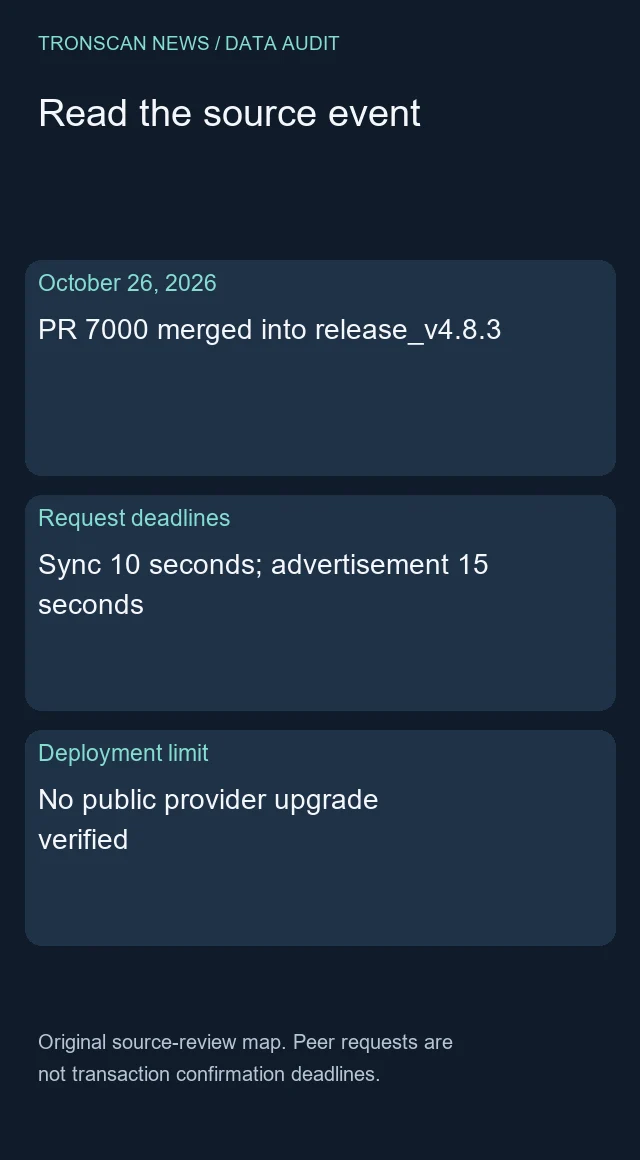
Table of Contents
1. Identify the October 26 source event
The official merged pull request 7000 records merge time 2026-10-26 09:23:54 UTC and target branch release_v4.8.3. Its scope includes chain-summary request deadlines, sync completion state and peer-request limits. A branch merge is the event reported here; this is not an announcement that every node or TRONSCAN has installed the change.
The reviewed merge commit is 632e64796f4dd4315dcddca892e561c8d42c9273. We retained the pull-request metadata, changed-file patch and two source files at that commit. This pinned reference avoids interpreting a later branch revision as if it were the code reviewed on October 29.
The existing released-version review covers the site’s earlier java-tron release coverage. A source-branch name, merged change and published software release are different evidence. For this article, installation status at individual public providers remains unverified.
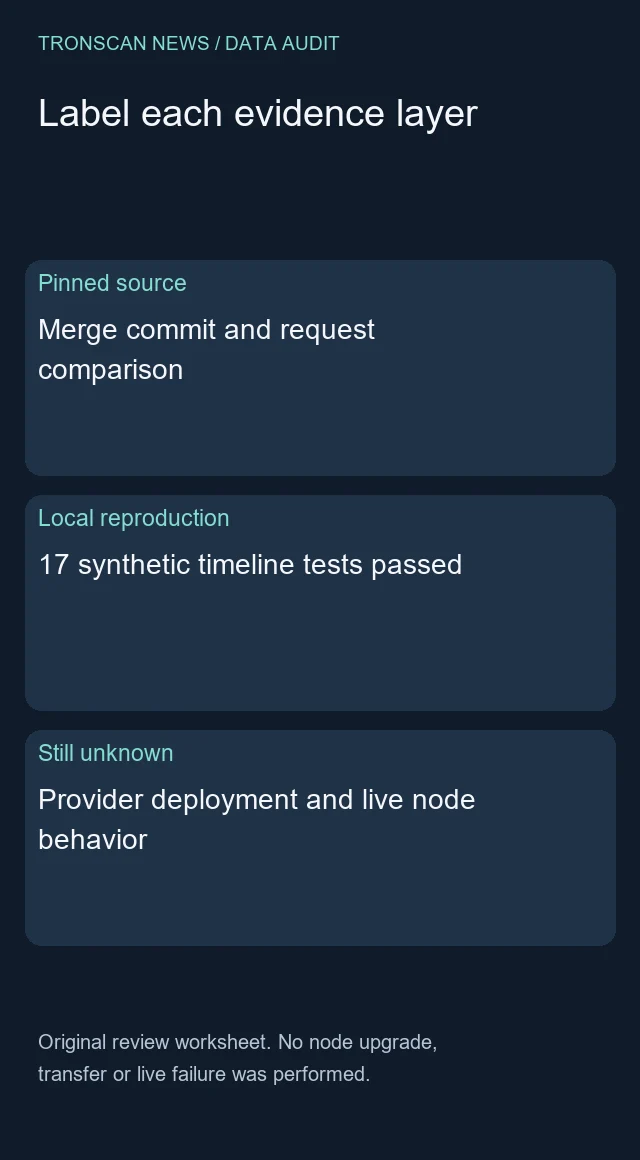
| Evidence layer | What was verified | What it does not establish |
|---|---|---|
| Pull-request event | Merged October 26 into release_v4.8.3 | Public provider deployment |
| Pinned source | Request-age comparison and constants | Which binary a remote node runs |
| Our local program | 17 synthetic timeline tests | Full java-tron behavior under live traffic |
| User transfer | Not measured by this review | A fixed confirmation deadline |
2. Separate the request classes and their units
At the reviewed commit, Parameter.java sets SYNC_TIME_OUT to 10000 milliseconds and ADV_TIME_OUT to 15000 milliseconds. The retained patch shows previous values of 5000 and 20000 milliseconds respectively. These are source constants for different peer-request categories, not a quoted network transfer fee or on-chain governance parameter.
| Request category in this review | Previous source value | Reviewed source value | Unit |
|---|---|---|---|
| Chain-summary / requested sync block | 5000 | 10000 | Milliseconds |
| Advertisement inventory request | 20000 | 15000 | Milliseconds |
Do not copy the ten-second value into a support message about a delayed exchange deposit. A peer request is a communication between nodes. A transaction receipt, a solidified record and an exchange’s internal credit are different objects. The state-view comparison guide helps distinguish the latest head from a solidified observation.
Likewise, a wallet’s request to a hosted API may have its own client or gateway timeout. This article does not infer that setting from a java-tron peer constant. Record which layer produced an error before deciding whether the reviewed code is relevant to the investigation.
3. Use the original request timestamp
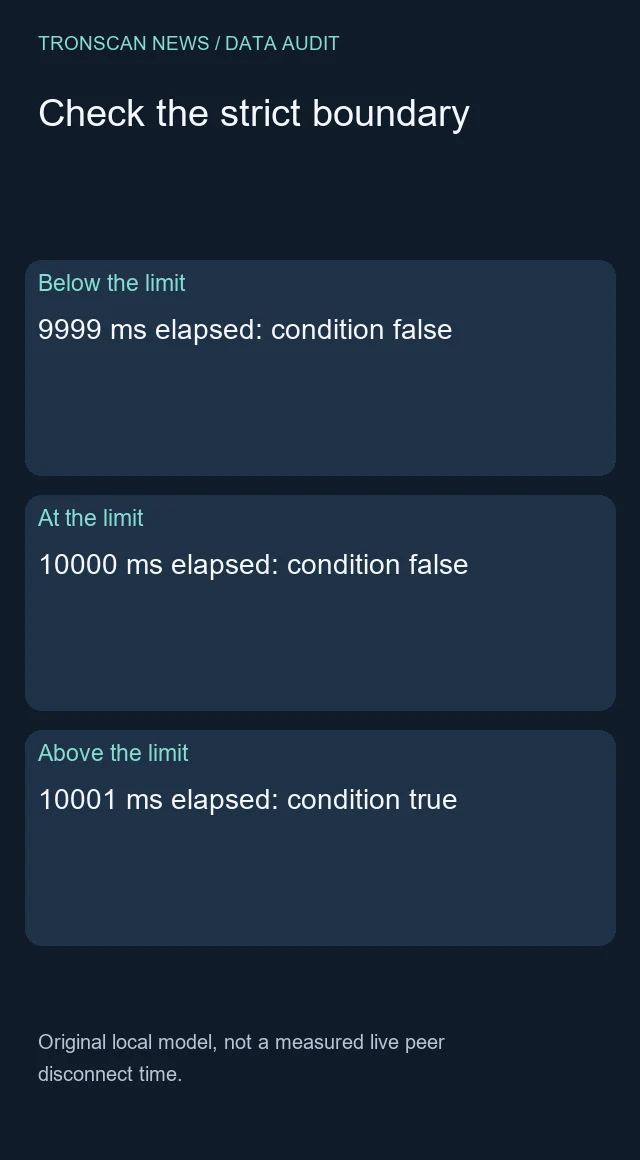
The pinned PeerStatusCheck source checks an outstanding summary request’s stored timestamp against the observation time minus the sync limit. The comparison is strict: the request timestamp must be earlier than that boundary. Other checks can also select a disconnect, so this branch alone does not describe the entire peer lifecycle.
Our illustrative model writes the same boundary as elapsed_ms > limit_ms. At exactly 10000 elapsed milliseconds, that particular condition is false. At 10001, it is true. This is arithmetic at an observation instant. It does not predict the exact wall-clock millisecond when a scheduled node check will execute or when a remote peer will notice a disconnection.
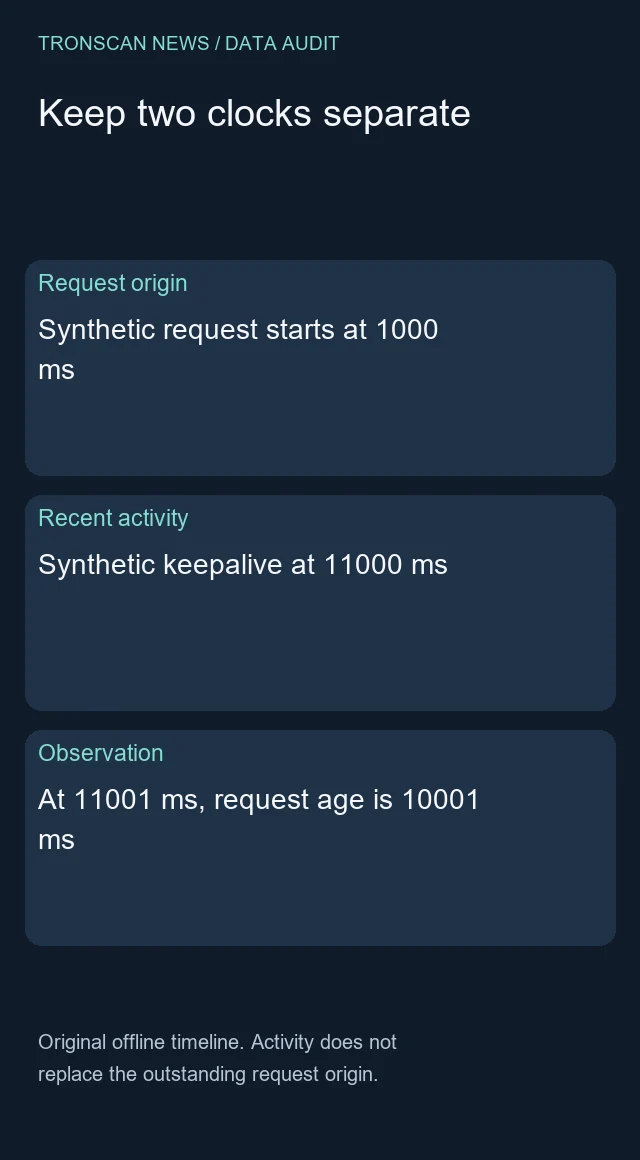
Consider a synthetic summary request beginning at relative time 1000. At observation time 7000, it is six seconds old and has not crossed the reviewed ten-second limit. At 11000 it is exactly ten seconds old. At 11001 it has crossed the strict boundary. All times in this example are invented offsets, not recorded Mainnet log times.
A keepalive at 11000 does not replace the request’s origin in our model. At observation 11001, the outstanding request is still 10001 milliseconds old. The distinction is between evidence that a connection communicated recently and evidence that a particular outstanding request received the response needed to complete it.
| Synthetic case | Request time | Observation | Elapsed | Selected condition |
|---|---|---|---|---|
| Six-second summary | 1000 | 7000 | 6000 | false |
| Exact summary boundary | 1000 | 11000 | 10000 | false |
| Past summary boundary | 1000 | 11001 | 10001 | true |
| Past boundary, recent activity | 1000 | 11001 | 10001 | true |
| Advertisement boundary crossed | 1000 | 16001 | 15001 | true |
4. Reproduce the offline sync timeout model
Save the following code as deadline_model.py. It accepts a local JSON list of cases and prints one result for each. The three accepted request labels are local names for the selected comparisons: summary, sync_block and advertisement. They are not a new node API or a command for changing peer settings.
For a single reproducible fixture, save [{"kind":"summary","requested_ms":1000,"observed_ms":11001,"activity_ms":11000}] as local-cases.json. Run python deadline_model.py local-cases.json. The output’s deadline_condition should be true, with elapsed_ms 10001 and limit_ms 10000. The recent activity value does not reset the request.
import json
import sys

LIMITS_MS = {'summary': 10000, 'sync_block': 10000, 'advertisement': 15000}


def integer(value, name):
    if type(value) is not int or not 0 <= value <= 9223372036854775807:
        raise ValueError(name + ' must be a nonnegative int64 integer')
    return value


def inspect_deadline(kind, requested_ms, observed_ms, activity_ms=None):
    if kind not in LIMITS_MS:
        raise ValueError('unsupported request kind')
    observed_ms = integer(observed_ms, 'observed_ms')
    if activity_ms is not None:
        activity_ms = integer(activity_ms, 'activity_ms')
        if activity_ms > observed_ms:
            raise ValueError('activity cannot be after observation')
    if requested_ms is None:
        return {'kind': kind, 'outstanding': False, 'elapsed_ms': None,
                'deadline_condition': False, 'activity_resets_request': False}
    requested_ms = integer(requested_ms, 'requested_ms')
    if requested_ms > observed_ms:
        raise ValueError('request cannot be after observation')
    elapsed = observed_ms - requested_ms
    limit = LIMITS_MS[kind]
    return {'kind': kind, 'outstanding': True, 'elapsed_ms': elapsed,
            'limit_ms': limit, 'deadline_condition': elapsed > limit,
            'activity_resets_request': False,
            'scope': 'Offline branch illustration, not full node state or actual disconnect timing'}


if __name__ == '__main__':
    if len(sys.argv) != 2:
        raise SystemExit('Usage: deadline_model.py local-cases.json')
    with open(sys.argv[1], encoding='utf-8') as source:
        cases = json.load(source)
    print(json.dumps([inspect_deadline(**case) for case in cases], indent=2))
The program uses nonnegative integer offsets and rejects Boolean values, future request times and future activity times. Those rules are local input-quality safeguards. They are not a claim that the production node uses the same validation routine or a monotonic clock. This small model does not implement the surrounding Java scheduler, peer state or network channel.
A null request timestamp means no outstanding request in this model. It is not an epoch-zero request. A newly issued request has its own origin. Keeping those cases separate avoids calculating an enormous age for an operation that already completed or applying an old request’s deadline to a later one.
To retain a reproducible output file, run python deadline_model.py local-cases.json > local-results.json. Keep both files together. Name a later set of cases separately so a corrected input does not silently replace the original evidence used in a support note.
5. Check the 17 local test cases
We tested each of the three categories just below, exactly at and just above its limit, producing nine boundary cases. Additional cases cover recent keepalive activity, a cleared request, a new request and five invalid-input paths. All 17 tests passed locally against the displayed functions. We did not run the upstream Java test suite or a live multi-node experiment.
| Test group | Cases | Expected behavior |
|---|---|---|
| Three categories × three boundaries | 9 | Only strictly above limit is true |
| Keepalive after old request | 1 | Original age retained |
| Cleared request | 1 | No outstanding request |
| New request | 1 | New origin used |
| Negative / Boolean / future times / unknown category | 5 | Rejected |
The “true” result means only that the selected arithmetic condition holds for the supplied offsets. It does not establish that the peer was actually disconnected or identify why a production node chose a reason code. Other conditions and prior state can affect the full code path.
To check the boundary manually, subtract the stored request time from the observation time before comparing with the category’s limit. Do not subtract the latest activity timestamp instead. In the keepalive fixture, doing so would produce one millisecond and conceal the old unanswered request. That contrast is the purpose of the test, not evidence of a live network fault.
6. Read completion and remaining-work evidence separately
The merged change also addresses the remaining-block count on a validated completion path. A remaining-work display and an outstanding-request timestamp describe different state. A response can complete one request while a later request begins, and a node can have separate upload and download responsibilities.
Our model does not simulate block availability, response validation or the completion-state transition. Its null-request case illustrates only the absence of an outstanding timestamp. It must not be presented as a test of the upstream remainNum correction. The retained upstream patch is the evidence for that source change; the Python output is evidence for our limited arithmetic examples.
When an operator reports “sync complete,” preserve what the statement refers to. It could describe a particular download exchange, an interface counter or a node’s current head relationship. Ask for the dated source, version and relevant state fields before treating the words as a universal assertion about all peers.
A successful response containing locally known blocks does not, by itself, prove that a larger synchronization goal made new progress. The upstream discussion identifies further work around repeated exchanges without new downloads. We therefore do not describe the merged request deadline as a complete solution to every no-progress scenario.
7. Build a version-aware troubleshooting note
For a real investigation, record the node software version or commit if the operator can provide it, the observed request category, the stored request origin, the observation time and the exact log message. If the version is unknown, mark the applicability unknown. A publicly reachable endpoint does not reveal which source revision produced its response.
Keep connection activity and request completion on separate lines. A ping or keepalive demonstrates a different event from the requested summary arriving. Likewise, a later request should receive a new identifier in the note, even when it involves the same peer. Reusing one row for several requests destroys the chronology needed to understand a deadline.
Remove private access tokens and unrelated account information from a shared note. Public node troubleshooting does not require a wallet recovery phrase. The read-only evidence-preservation guide provides a method for retaining original responses and distinguishing later copies.
Do not restart a transfer merely because a provider mentions synchronization. First inspect the original transaction through the appropriate network and preserve its actual status. This source review contains no evidence that any particular transfer disappeared, failed or needs replacement. A node maintenance explanation and a customer payment outcome must be supported separately.
8. Verify what changed before calling the review complete
Use a four-column review note: source fact, local reproduction, production observation and unresolved question. For this article, the source fact is the October 26 merge and pinned comparisons. The local reproduction consists of 17 synthetic tests. Production deployment and live peer disconnect timing remain unresolved because we did not operate or instrument a node.
Keep the original values with their units. The reviewed sync constant is 10000 milliseconds, which is ten seconds. That conversion does not make it ten blocks or ten confirmations. The advertisement value belongs in another row. Combining them into one generic timeout obscures which request was actually being measured.
If a later release includes this commit, that adds release evidence. If a provider states a deployed version, that adds provider evidence. Neither should be retroactively implied by today’s source review. Save the new statement and date as an additional observation, then reassess applicability against the version actually documented.
If a local fixture differs from the expected output, check that the file uses integer milliseconds and one of the three supported labels. Record the exception or unexpected fields instead of editing the expected result. A reproducible disagreement is useful evidence; a model adjusted to match a preferred explanation is not.
The practical success criterion is a reader who can distinguish recent connection traffic from an old outstanding request, reproduce the strict boundary and state the deployment limit. That is enough to make the source event useful without claiming a live outage, a guaranteed transfer time or a repair we did not perform.
9. Keep log timestamps and collection timestamps distinct
A real support note should retain the original timestamp string and its stated timezone, alongside the time at which the log excerpt was collected. The collection time cannot replace the event time. If an operator sends an older excerpt during today’s investigation, label it as an older observation rather than describing its request as currently outstanding.
Keep measurements from the same clock domain together. Our local fixtures use one synthetic relative timeline throughout. They do not subtract a browser’s local clock from a remote node’s stored request timestamp. Combining clocks without checking their relationship can produce a plausible duration that measures clock difference instead of request age.
| Worksheet field | Record to retain | Question it answers |
|---|---|---|
| Source version | Actual binary version or commit, if known | Is this source comparison applicable? |
| Request identity | Category and one outstanding request | Which deadline is being discussed? |
| Origin and observation | Unmodified times, units and timezone | Can the elapsed interval be reproduced? |
| Other activity | Separate keepalive or progress event | Was activity confused with completion? |
| Observed outcome | Exact dated log evidence | Was a disconnect actually recorded? |
For an excerpt that lacks the request origin, mark the age calculation unavailable. A timeout message may be useful evidence, but it does not let this model reconstruct every earlier timestamp. Likewise, an isolated request timestamp without an observation time cannot establish that the branch condition held when the node checked it.
If several peer records are involved, keep their request identities separate before summarizing. A completed request on one connection does not supply the missing response for another connection. The model accepts one case at a time specifically to make that boundary visible. Its output should accompany the original case values rather than replace them in a shared report.
Frequently asked questions
Does this sync timeout change transaction expiration?
No. The reviewed source concerns node peer requests. A transaction’s own expiration field is a separate mechanism.
Does a keepalive reset the modeled request age?
No. The model keeps the original outstanding request timestamp. Recent connection activity is recorded separately.
Is exactly ten seconds already past the sync boundary?
Not for the selected strict comparison. The modeled condition becomes true only when elapsed time is greater than 10000 milliseconds.
Has every public TRON node deployed this change?
That was not verified. A merge into release_v4.8.3 is source evidence, not a universal deployment statement.
Did these tests disconnect a real peer?
No. All 17 tests use local synthetic offsets. We did not run a node upgrade, network experiment or upstream Java test suite.
Checked October 29, 2026 by the Tronscan News editorial team. AI assisted preparation; source metadata and pinned files were retained, and the original offline model passed 17 local tests. Independent publication, not official TRONSCAN support. Send corrections through this page’s comments with the affected source reference and public evidence; exclude credentials.
Leave a Reply