FASE Foundation is the Financial Access and Systemic Empowerment Foundation, a Swiss nonprofit initiative announced by Tether on 28 October 2026. Its stated remit includes financial safety, inclusion and access to essential services. For a USDT user, the practical first step is to distinguish the organization’s announcement from a working service, an eligibility decision or a reported result.
This FASE Foundation news review was checked on 30 October 2026. We inspected Tether’s release and FASE Foundation’s public homepage. The review does not establish program availability in your country, verify a particular aid recipient or certify an offer sent through a private message.
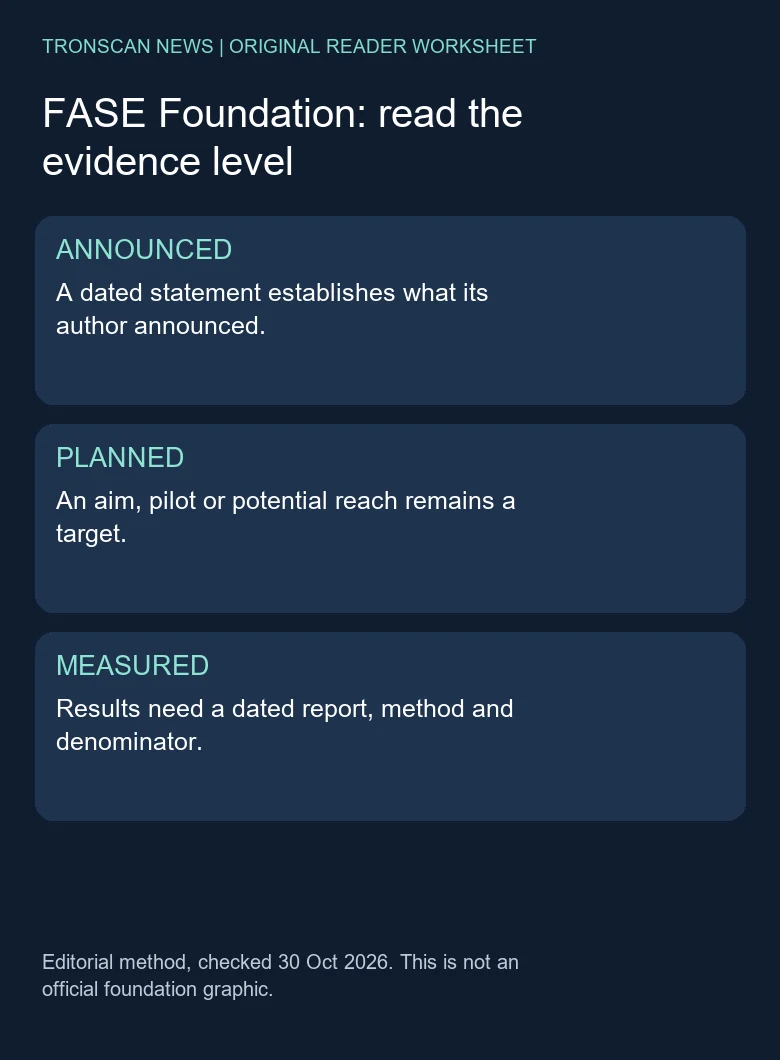
Table of Contents
What the FASE Foundation announcement says
The 28 October Tether announcement describes a multi-stakeholder foundation. Its initial initiatives include youth scam-prevention work with Goodwall, a stablecoin humanitarian-aid pilot with Prosper Global, and support connected with trafficking survivors. It describes UNODC’s contribution as technical advice. These are attributed statements from the release.
The linked FASE Foundation website presents four areas: financial safety; financial freedom and inclusion; access to resources; and responsible AI and robotics. It also displays founding partners. A logo or an organization’s inclusion in that list does not, by itself, describe the responsibility it has for a particular program.
The FASE Foundation announcement uses prospective language for reach and pilot activity. We have not verified completed outcomes. This distinction matters whenever a headline compresses a plan into a short phrase such as “helping millions.” A potential audience and an independently measured audience answer different questions.
FASE Foundation: a claim-status table for readers
The following is our editorial reading aid. It separates facts attributed to the inspected pages from conclusions those pages do not establish. It is not a legal or operational assessment of the organization.
| Item to check | Evidence inspected | Safe interpretation | Still needed for a stronger claim |
|---|---|---|---|
| Launch | Dated Tether release | Tether announced the foundation on 28 October | A separate legal-registry check before making a legal-status assurance |
| Focus areas | Foundation homepage | These are the site’s stated priorities | Program-level documentation for a specific activity |
| Prospective reach | Announcement wording | A target or potential scale, not completed delivery | Dated outcome figures with a counting method |
| Partner identity | Named group and homepage logos | A relationship is presented by the source | Confirmation of the relevant party’s actual role in the proposed action |
| A message offering assistance | Neither inspected page authenticates your private message | The sender and action require separate verification | An independently located official channel describing that exact offer |
Reading the FASE Foundation reach figures accurately
Two scale figures in Tether’s release need careful attribution. The Goodwall youth alliance aims to reach up to 10 million young people. The initial humanitarian-aid pilot with Prosper Global could reach up to 1 million people. These figures describe different initiatives and prospective reach. Neither is a verified completion total in this review.
| Figure in the release | Associated initiative | How to preserve its meaning |
|---|---|---|
| Up to 10 million | Youth digital education and scam prevention | Keep “aims” and “up to”; do not label it payments delivered |
| Up to 1 million | Initial stablecoin humanitarian-aid pilot | Keep “could” and the pilot scope; do not label it completed aid distribution |
Do not add these into an “11 million beneficiaries helped” total. The source does not establish completed delivery, and this review has not established that the audiences are distinct. Addition would create a claim stronger than either input supports. The same caution applies if a later article converts an upper bound into a guaranteed minimum.
For a practical comparison, save the exact wording alongside the number. A change from “could reach” to “reached” is substantive. Before repeating the latter, look for an outcome report that identifies the program period and explains how people were counted. A fundraising target, an audience estimate and delivered assistance should occupy separate rows in your notes.
Keep three dates in your FASE Foundation notes
The event date, the date you inspected a page and the period covered by a result are separate fields. In this review, 28 October 2026 is the announcement date and 30 October is our source-check date. No completed-outcome reporting period was verified. This prevents a current review from making a two-day-old announcement look like a fresh launch.
If a page later changes, keep the earlier observation and label the new one with its own check date. A modified webpage can help explain an update, but it does not retroactively change what you observed. For a disputed figure, retain its surrounding sentence, attribution and reporting period rather than a number detached from context.
How to check a FASE Foundation link in three steps
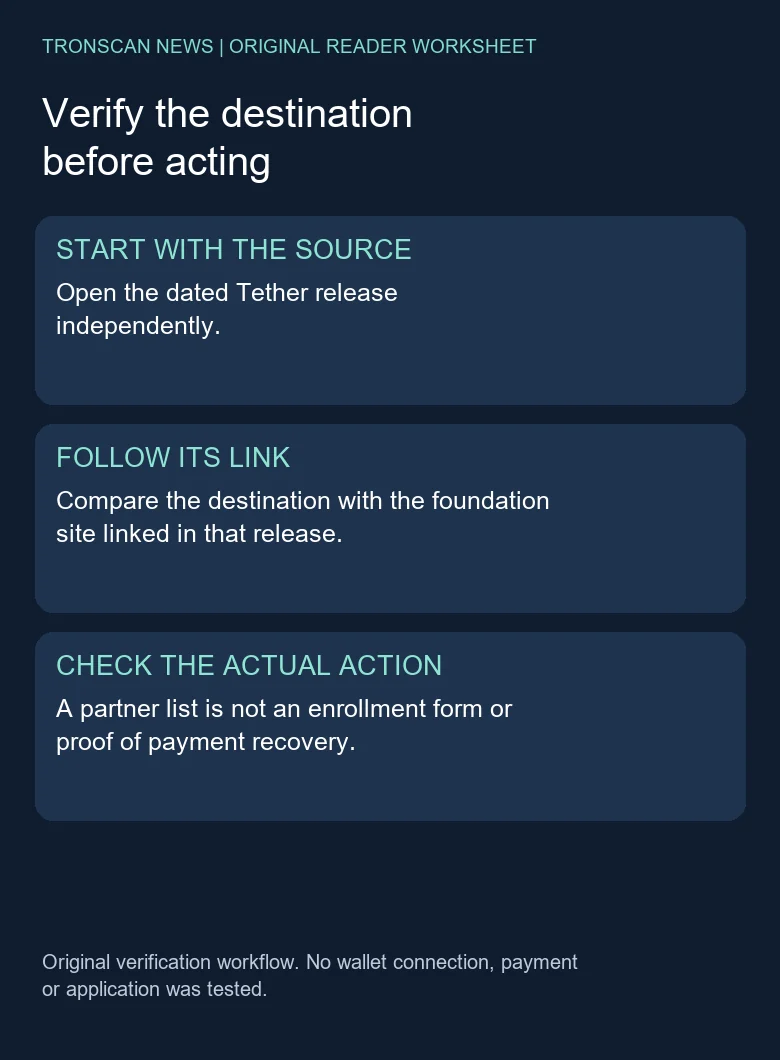
- Start independently. Open the dated release using the source link above rather than beginning with a forwarded screenshot. Check its date, publisher and full title.
- Compare the destination. Follow the foundation link inside that release. Compare the complete hostname with the address you were given; a similar display name is insufficient.
- Verify the proposed action. Find a page that actually describes the offer, application or contact route you are considering. If the specific action is not documented, leave its availability unverified.
Success here means identifying a source-backed destination and understanding what its public pages say. It does not mean qualifying for assistance. Our explorer-link verification checklist explains the related distinction between link text and the destination a browser opens.
What this announcement changes for a USDT reader
The useful news is the announced initiative and its stated priorities. This review found no basis for treating that news as a change to the transaction you are checking. An organization’s announcement is not evidence that your specific payment was confirmed, credited, reversed or refunded.
Keep the asset, network and service separate. Our TRON USDT guide explains those concepts for TRC20 records. If a payment has not arrived, use the actual transfer record and the receiving service’s documented process; the USDT not received troubleshooting guide provides that next step.
Likewise, a third-party message cannot inherit authenticity simply by mentioning a foundation, a partner or a UN body. The relevant question is narrower: does an independently located official source describe this exact action and destination? Record the answer before deciding whether the message relates to the announcement at all.
A reusable FASE Foundation follow-up worksheet
Copy these five fields into your own notes when a later program update appears. This is our prospective verification method, not a claim that any missing information is absent from every possible source.
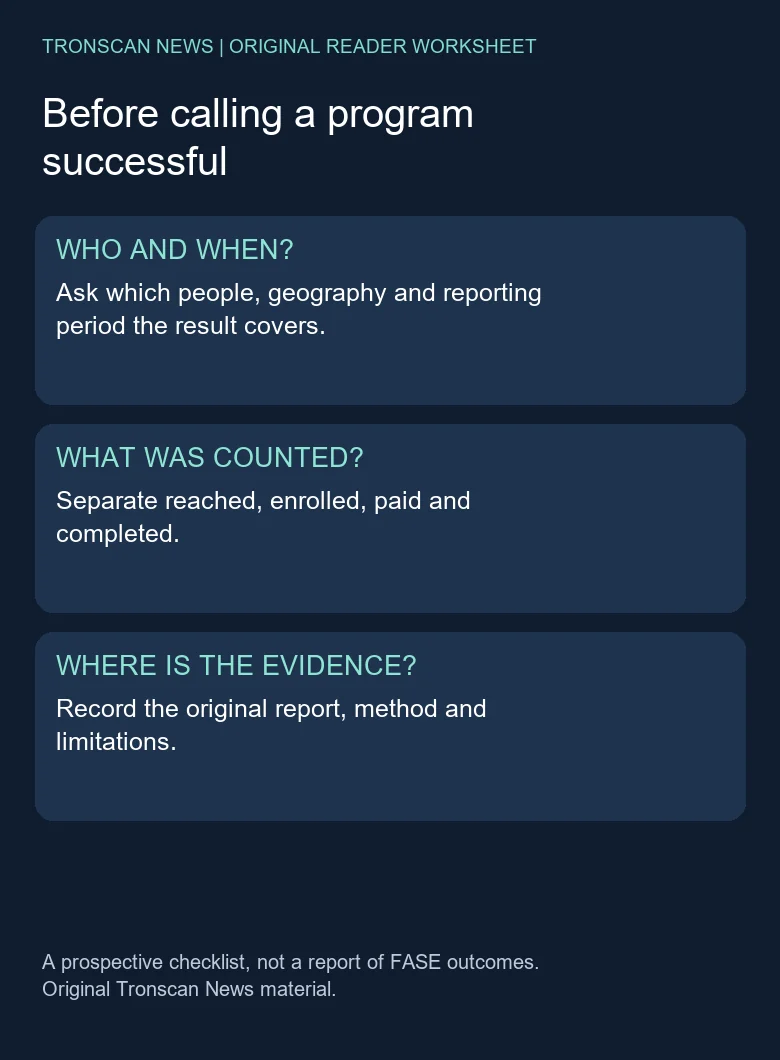
- Claim: copy the single outcome being asserted, keeping words such as “aims,” “could” and “pilot.”
- Source and date: record the original page and its publication or reporting date.
- Scope: note the program, geography and time window the claim covers.
- Measure: identify whether the number counts an audience, enrolled participants, delivered assistance or another defined unit.
- Limit: state what you cannot conclude from that source. Leave an unknown field unknown rather than substituting zero.
For example, a hypothetical future report might state “500 participants completed a course.” That would not, without more evidence, mean 500 people received payments or recovered losses. This is a synthetic example explaining measurement categories; it is not FASE data.
What would justify an update? A dated program page identifying eligibility and a functioning access route would support a more specific availability statement. A results report defining participants and the measurement period would support an outcome statement. A changed headline alone would support neither. We would preserve this launch review and add the new evidence with its own date, rather than publish another page for the same announcement.
Five frequently asked questions
1. What does FASE Foundation stand for?
Financial Access and Systemic Empowerment, as named in the dated Tether announcement and the foundation’s public site.
2. Was FASE Foundation announced on 30 October?
No. The source release is dated 28 October 2026. We checked it for this review on 30 October; the review date does not change the event date.
3. Does FASE Foundation’s announcement prove aid is available to me?
No. Eligibility and availability require documentation for the specific program and location. We did not test an enrollment or payment process.
4. Does a listed FASE Foundation partner authenticate a private offer?
No. The specific sender, destination and proposed action need their own verification. A copied logo or name is not enough.
5. Did this review verify completed FASE Foundation outcomes?
No. It verifies the inspected announcement and homepage as sources for their stated plans and priorities. It does not verify beneficiary totals, recovery results or completed aid delivery.
Sources, method and corrections
Tronscan News is an independent publication. Our editorial team checked the two primary pages linked above on 30 October 2026 and created the evidence table, worksheets and illustrations for this article. AI assisted drafting and diagram preparation; the article distinguishes source statements from our verification method. We did not perform a registry audit or interact with an application, wallet or payment flow. Use the editorial and correction information available from the Tronscan News homepage if a cited page changes or a correction is needed.
Leave a Reply