USDT blacklist status is a boolean recorded for a specified address in the token contract. It is separate from the contract’s global paused flag and from the amount returned by balanceOf. Reading all three as one “wallet status” can produce the wrong conclusion.
This beginner guide shows how to read those fields on TRON Mainnet through TRONSCAN. The goal is a dated, reproducible status record. It is not a diagnosis of every failed transfer or a way to identify the people behind an address. We use the public USDT token contract itself as the example query address, rather than label a customer wallet.
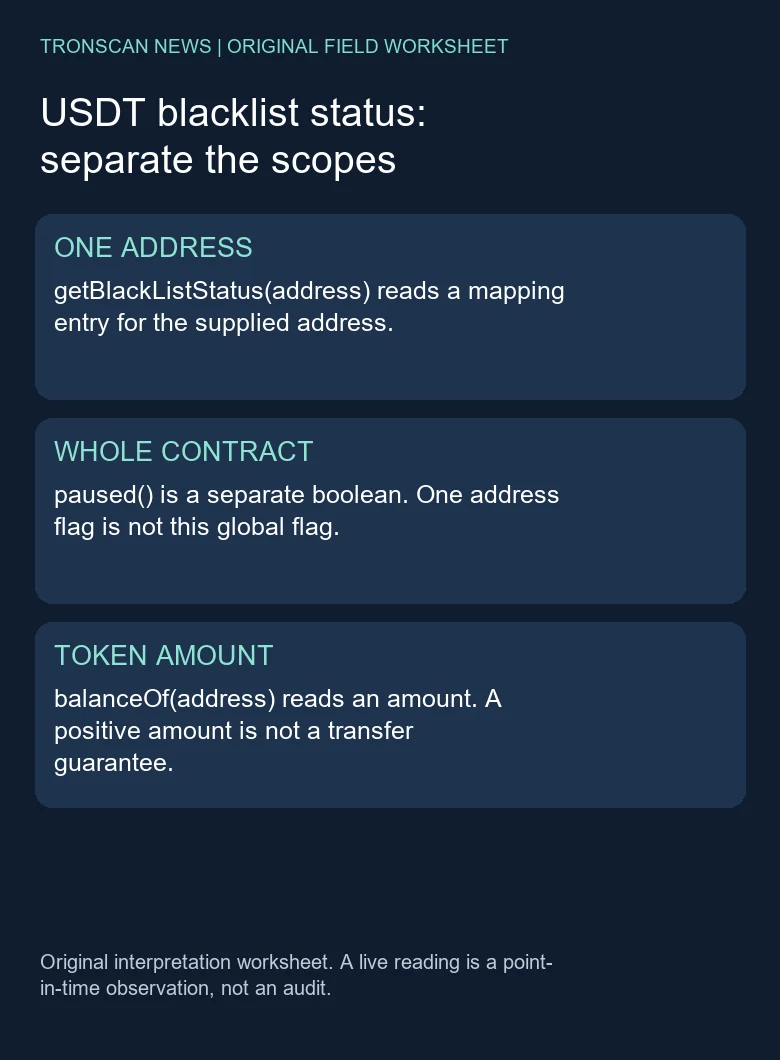
Table of Contents
USDT blacklist status: choose the right contract first
Start with Tether’s supported-protocols page. Under TRC20 via Tron, its USD₮ link identifies TR7NHqjeKQxGTCi8q8ZY4pL8otSzgjLj6t. Open that token page, then follow its Contract link. A token name or logo alone is not the same identification check.
Keep the network in your notes. This walkthrough concerns the named TRON Mainnet contract. It does not describe another token using the USDT symbol, a test network, or every deployment of a stablecoin on other chains. Our TRON USDT introduction explains the asset, network and token-standard distinction.
The explorer’s contract page provides Code, Read Contract and Write Contract sections. We used Read Contract. No wallet connection, signature or token transfer was required for the checks reported here. Merely reading a displayed function name is different from receiving a result for a supplied address.
Three fields that answer different questions
| Field | Input | What its result describes | What it does not establish |
|---|---|---|---|
| getBlackListStatus | One address | The boolean blacklist entry for that address | The identity of its controller or the reason for the entry |
| paused | No address argument | A separate contract-level boolean | Every condition that could affect an individual transfer |
| balanceOf | One address | A raw integer token amount | A guarantee that a future operation will succeed |
To cross-check USDT blacklist status, the read panel also exposes isBlackListed. In the displayed BlackList source, getBlackListStatus returns the corresponding mapping entry. In our test we queried both for the same address. That is a consistency check within one contract and explorer, not verification by two independent data providers.
Tether’s published token terms, showing a last-update date of 26 February 2026 when checked, describe circumstances in which it may freeze tokens. That policy statement does not supply the reason for a particular address flag. This guide makes no legal-status or wrongdoing inference from the sample.
How to read USDT blacklist status on TRONSCAN
- Verify the contract and network. Follow the issuer’s TRON token link and compare the complete contract address above. Confirm that the explorer is on Mainnet.
- Open Contract, then Read Contract. Find
getBlackListStatus. Search by method name if the function list is long; numbering can change. - Enter the complete query address. The tested input was labeled
_maker_address. For the example below, the query address equals the token contract itself. For your own observation, record exactly which public address you entered. - Choose Call and inspect the returned value. Save both the boolean and the surrounding function name. An empty output is not a result of false.
- Read paused separately. It takes no address input. Record its result without substituting it for the address-specific result.
- Read balanceOf if amount is relevant. Enter the same address in its
who_addressfield. Preserve the raw integer and verify decimals before formatting it.
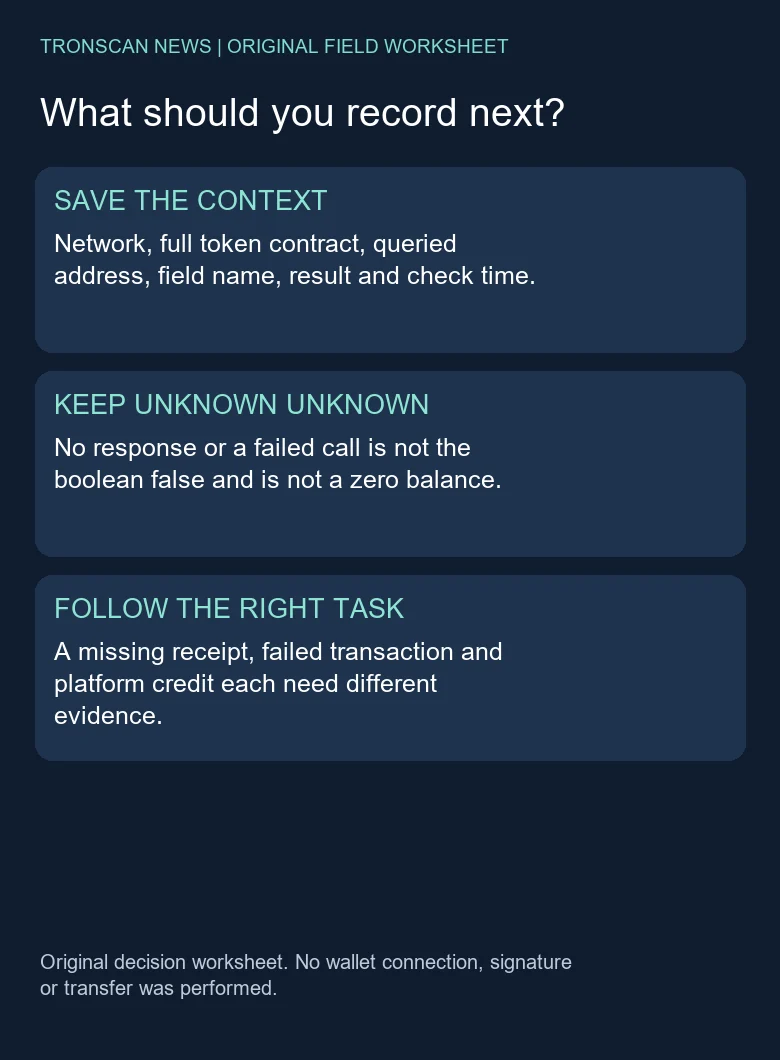
The success criterion for a USDT blacklist status check is a record with the network, token contract, queried address, field and returned value attached to each other. Copying “true” without those identifiers is insufficient. A saved result also needs a check date; a current-state view should not be presented as historical state at an earlier block.
A checked USDT blacklist status example
On 30 October 2026 we used the official TRONSCAN USDT contract page and entered TR7NHqjeKQxGTCi8q8ZY4pL8otSzgjLj6t as the query address. The same string therefore has two roles here: it selects the token contract and identifies the address whose mapping or balance is being read.
| Read function | Observed output | Scope of the observation |
|---|---|---|
| getBlackListStatus(address) | true, bool | The supplied token-contract address |
| isBlackListed(address) | true, bool | The same supplied address |
| paused() | false, bool | The separate global flag |
| balanceOf(address) | 9774157135308, uint256 | The same supplied address’s raw amount |
Using the token’s six decimals, that raw balance formats as 9,774,157.135308 USDT. The arithmetic is integer division by 10 to the sixth power, retaining six fractional places. It is not a dollar valuation, proof of ownership, an available-to-withdraw amount or an amount we transferred.
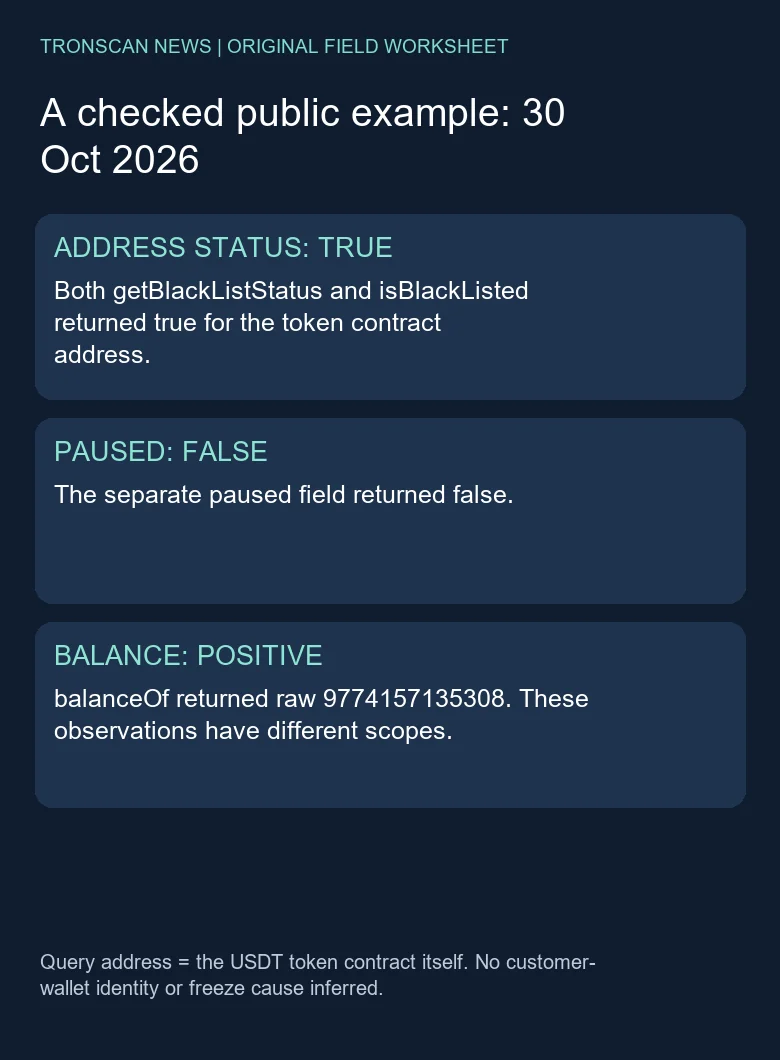
This checked USDT blacklist status illustrates why the scopes matter. The address-specific true output does not make paused true. The positive balance does not erase the address flag. Neither comparison tells us why the mapping was set, who can control the address, or which other conditions a proposed transaction would encounter.
We did not submit a transfer to test enforcement. The reads were sequential and were not pinned to a single block. Treat the values as a saved example of the interface and field meanings, not a promise about the contract’s present state when you read this article.
Compare two booleans without inventing a transfer result
This four-case reading aid describes possible combinations. Only the true/false combination was observed in our sample. The other rows are hypothetical interpretations, not additional live tests.
| Address entry | paused | What the pair says |
|---|---|---|
| true | false | Address entry is set; the separate global flag is not set. This is the observed pair. |
| false | false | Neither of these two flags is set; other execution conditions remain untested. |
| true | true | Both flags are set; preserve both scopes. |
| false | true | The address entry is not set while the global flag is set. |
None of these rows replaces a transaction receipt. If the question concerns an actual attempt, its execution outcome and relevant contract conditions must be examined separately. The matrix is a reading aid for two values, not a transfer simulator.
USDT blacklist status is not a complete transfer diagnosis
A contract result, a wallet message and an exchange’s internal account status belong to different evidence layers. Begin with the error or record actually available. Do not infer a blacklist entry merely because a wallet shows a balance while an attempted action fails.
If you have a failed on-chain transaction, retain its hash and actual result. The TRON transaction-error guide covers that next task. If your difficulty is interpreting the explorer’s balance categories, use the TRON balance-reading guide instead of changing the meaning of the blacklist field.
A false USDT blacklist status also has a narrow meaning. It does not validate a recipient, prove control of a wallet, authenticate an investment offer or guarantee that an exchange will credit a deposit. Keep the answer tied to the exact question the function accepts.
A USDT blacklist status observation sheet
Record the following USDT blacklist status fields together. This original worksheet is designed to make a support discussion or later comparison reproducible without claiming more than the read operation proves.
- Identity: network and complete token contract address.
- Subject: complete queried address, kept separate from the token contract field even if both happen to match.
- Method: function name, visible input label and returned type.
- Result: exact boolean or raw amount, with formatted amount in a separate field.
- Time and limit: check date, whether a block was pinned, and any failed or unavailable reads.
Our optional USDT blacklist status node comparison returned HTTP 429, so we stopped that attempt and obtained no independent node result. The article’s sample comes from the saved explorer UI. A rate-limit response is neither false nor zero. We have not converted that unavailable comparison into an additional successful test.
Five frequently asked questions
1. What does USDT blacklist status true mean here?
It is the returned mapping value for the supplied address in the identified contract. It does not explain why the entry was set or identify a person.
2. Is USDT blacklist status the same as paused?
No. One takes an address input and the other is a separate global flag. Our example returned true for the selected address and false for paused.
3. Does a positive USDT balance prove it can be transferred?
No. A balance is an amount, not a complete execution test. We did not submit a transfer from the example address.
4. Did checking USDT blacklist status require connecting a wallet?
Not in the tested TRONSCAN Read Contract workflow. We entered a public address and used Call, without a wallet connection or signature.
5. Does a missing USDT blacklist status result mean false?
No. Record a failed call, blank output or rate limit as unavailable until a valid result is obtained. Do not substitute a boolean or balance.
Method, sources and corrections
The independent Tronscan News editorial team checked the linked issuer pages and public explorer on 30 October 2026. The field tables and diagrams are original. AI assisted drafting and diagram preparation. This was a limited read-only interface check, not a security audit, an identity investigation or an unfreezing service. Find our editorial and correction information from the Tronscan News homepage.
Leave a Reply