Peso USDT networks must be checked as an asset-and-network pair. Peso’s public support table lists USD₮ on TRON, while its USDC row does not. On Base, the same table lists USDC and does not list USD₮. A platform’s support for a network is therefore an incomplete answer until the asset matches too.
This Peso USDT networks review uses public documentation checked on 30 October 2026. It is not an account-opening recommendation or a report of a deposit we made. We followed the issuer’s company link to Peso’s site and help center, then compared its network and deposit guides. We did not install the app, submit identity documents or test a payment.
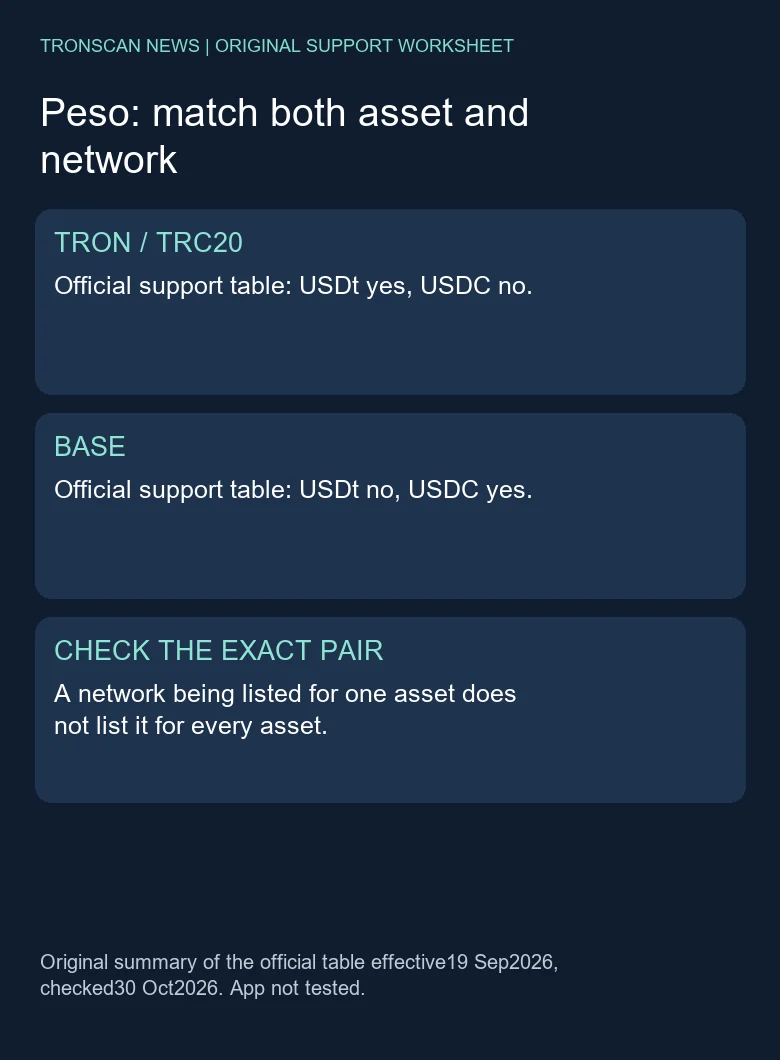
Table of Contents
Peso USDT networks: the source and its scope
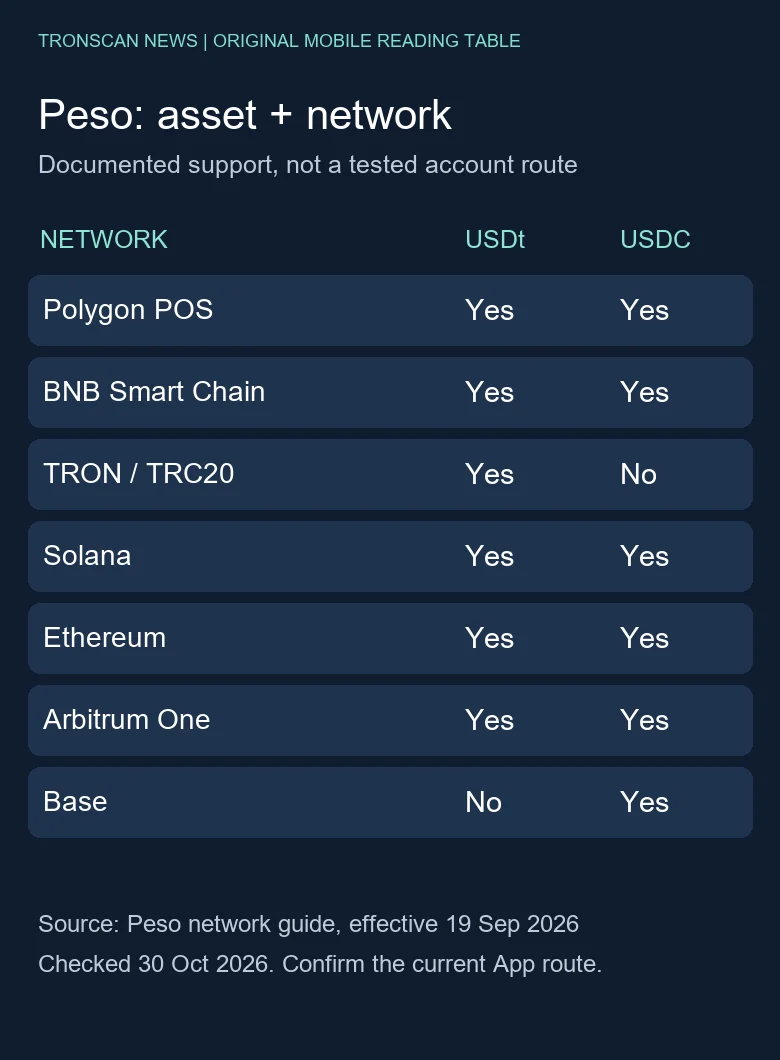
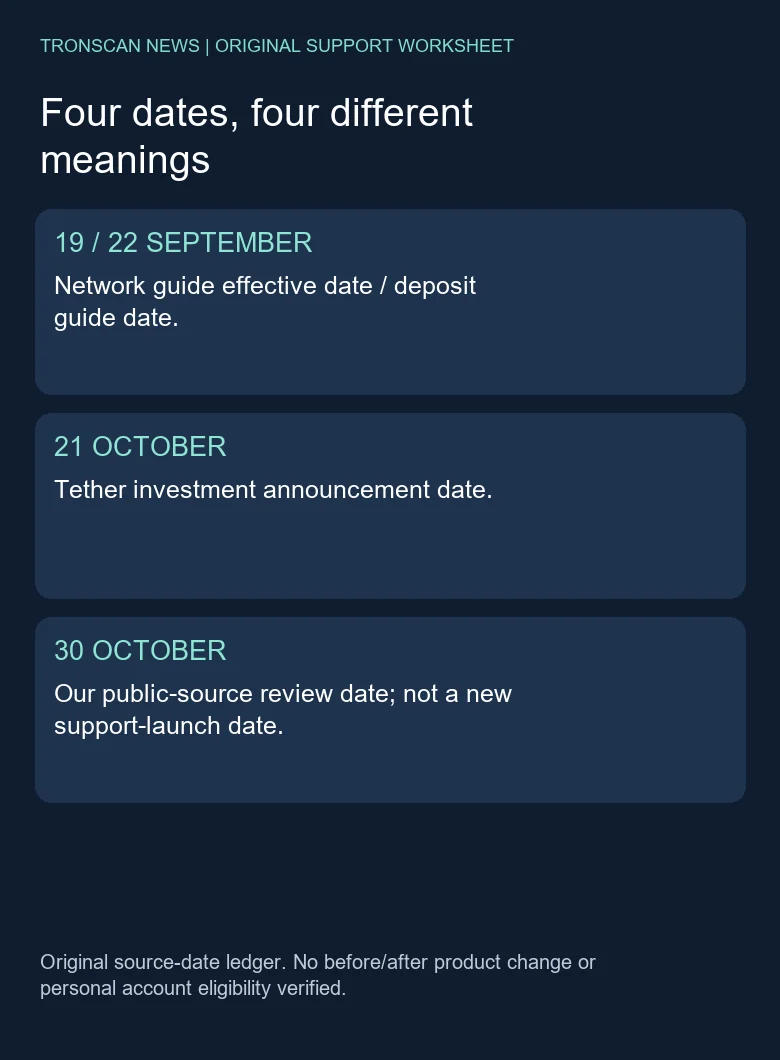
The official Peso USD₮ and USDC network guide states that it applies to crypto deposits and sends and is effective from 19 September 2026. Its visible relative update label does not provide an exact new modification date. We keep the explicit effective date separate from our review date.
| Network named by Peso | USD₮ listed | USDC listed |
|---|---|---|
| Polygon POS | Yes | Yes |
| BNB Smart Chain | Yes | Yes |
| TRON / TRC20 | Yes | No |
| Solana | Yes | Yes |
| Ethereum | Yes | Yes |
| Arbitrum One | Yes | Yes |
| Base | No | Yes |
“Listed” means listed in that provider document. It does not mean that we verified every asset’s token contract on every chain or confirmed availability for every customer. A “No” in this table describes Peso’s documented support row; it is not a statement about whether some unrelated token can exist on that blockchain.
Use the USDT explorer network-selection guide for the separate task of choosing the appropriate explorer after identifying the actual network. The Peso USDT networks table, a token contract and an explorer each answer different questions.
Why Peso appears in USD₮ news
In its 21 October 2026 announcement, Tether said it led Peso’s pre-seed round. The release described planned expansion of local on- and off-ramps across Bolivia, Brazil, Colombia and Argentina. That is an attributed investment announcement, not a new TRON protocol announcement or proof that a particular user can access a service.
The announcement date does not replace the dates in the operating documents. Likewise, a later review of those documents should not turn an existing support table into a claim that network support launched today. Our task here is narrower: identify what the currently inspected public pages say and preserve the limits of that evidence.
A tested public-source workflow for Peso USDT networks
- Identify the company through a primary source. The Tether release links to Peso’s public website. We followed that link rather than selecting a similarly named app or an advertisement.
- Open the linked help center. Follow its network-support guide and retain the page title, scope and explicit effective date.
- Select the asset row before interpreting the network. For a TRON question, inspect USD₮ and USDC separately. Do not turn a single check mark into support for both assets.
- Read the provider’s deposit instructions. Compare them with the support table. Separate documented steps from actions you have personally tested.
- Record unresolved account-specific questions. If you cannot inspect the relevant account’s current deposit screen, leave that route and its quote unverified.
The success standard for a Peso USDT networks review is a reproducible support record, not a completed transfer. We verified the source-navigation path and the public asset rows. We did not verify an authenticated deposit address, account eligibility, a live exchange rate or an actual credit.
What the deposit guide says, and what remains untested
The official deposit guide dated 22 September 2026 applies to a verified Peso account. It describes choosing the asset and network in the app before copying the generated address. It says the screen displays the fee, minimum and estimated crediting time alongside that address.
Those Peso USDT networks instructions are documented product steps, not our own App test. We have not opened a verified account or observed that screen. A public article cannot provide a personal deposit address or guarantee that an option appears for a specific reader. When applying a provider’s instructions, the actual asset, network and destination shown for that account must agree.
This distinction also explains why a logo or an identical-looking address format is insufficient. A saved address from a different asset or network selection is not evidence that it is the currently documented route for the operation you intend. Keep the asset, network and provider context attached to the address.
A short reading key for the Spanish support pages
Our Peso USDT networks review uses the following English reading key. These terms identify concepts in the public help text; they do not certify the appearance or location of a button in an authenticated account.
| Spanish term | Meaning in this review | Keep it separate from |
|---|---|---|
| Moneda | Selected asset or currency | The network used to move it |
| Red | Blockchain network | A token ticker or the name of an exchange |
| Dirección | Destination address | The full asset-and-network support decision |
| Comisión | The charge described by the provider | An automatically universal blockchain fee |
| Mínimo | A stated minimum for a scoped operation | A promise that every larger operation will be accepted |
| Acreditación | Crediting to the provider account | The mere existence of a public transaction hash |
For example, a reader may find the correct network name while overlooking that the adjacent asset is USDC. The support matrix still needs both coordinates. Similarly, finding a transfer hash does not answer whether the receiving platform has completed its own crediting process. The reading key is meant to preserve those distinctions when moving between the Spanish originals and this English explanation.
Two synthetic Peso USDT networks cases
Case A: USD₮ on TRON. A hypothetical reader has USD₮ on TRON and is evaluating a provider’s deposit route. The support table lists that asset-and-network pair. The next unresolved evidence is the verified account’s actual deposit selection, address and current quote. The public table alone does not complete a transfer.
Case B: USDC on TRON. A hypothetical reader substitutes USDC because both assets are called stablecoins. Peso’s inspected table does not list that pair. The fact that USD₮ appears under TRON does not resolve the mismatch. This is a different asset question, not merely a different spelling of USD₮.
These are invented decision examples, not customer cases. Neither example involves an actual payment, an account balance or a recovery result. Their purpose is to show exactly where a public support check ends and an account-specific question begins.
Keep Peso USDT networks separate from fee evidence
The network guide also describes provider charges. A provider’s deposit or withdrawal tariff is not automatically the blockchain’s transaction fee. Our exchange withdrawal fees versus network fees guide explains that scope distinction.
When comparing costs across Peso USDT networks, record three items separately: the sending service’s quote, any on-chain receipt, and the receiving service’s credited amount or charge. Preserve the asset and direction for each. Do not subtract two unrelated screenshots and label the difference a universal TRON fee.
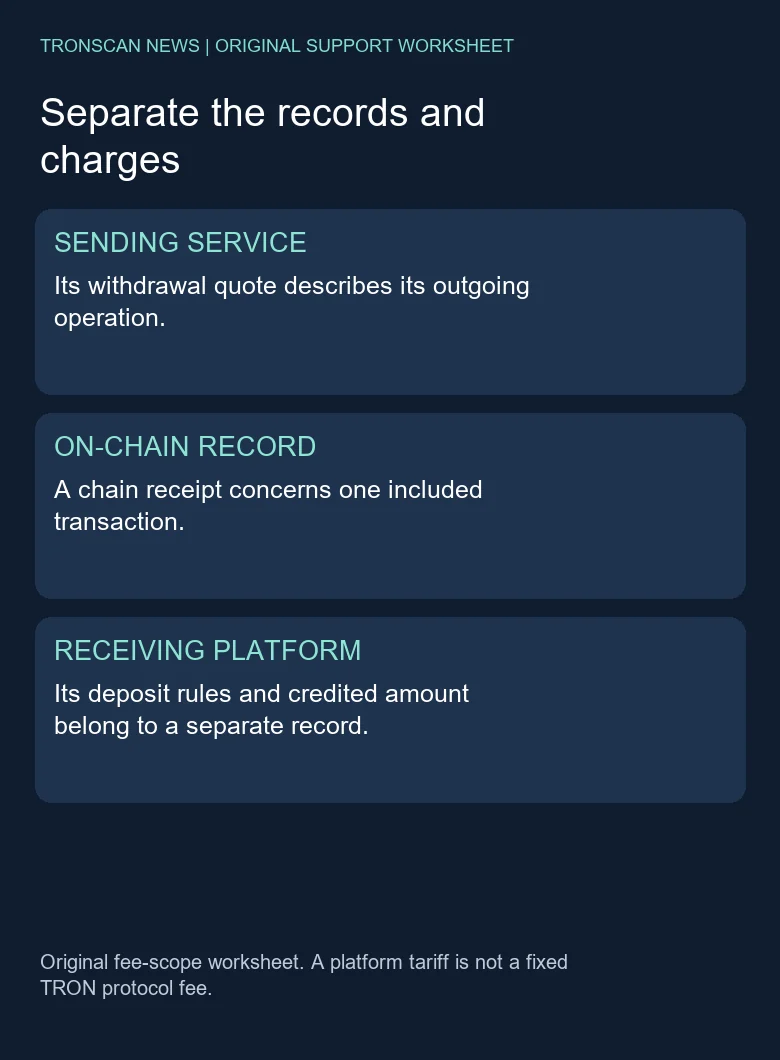
If an on-chain record exists but a platform credit is missing, the next task is to reconcile those records. The USDT deposit troubleshooting guide helps organize the hash, network and receiving-service reference. A public transfer record does not expose every step inside a provider’s ledger.
Five frequently asked questions
1. Do Peso USDT networks include TRON in the inspected guide?
Yes. The support table effective 19 September 2026 lists USD₮ on TRON / TRC20. We have not tested an account-specific deposit or withdrawal.
2. Do Peso USDT networks imply USDC on TRON is supported?
No. The inspected table marks USD₮ yes and USDC no for TRON. Always preserve the asset-and-network pair.
3. Do Peso USDT networks include Base in that table?
No. Base is listed for USDC, not USD₮, in the cited provider document. This is a provider-support statement, not a universal claim about tokens on Base.
4. Do Peso USDT networks determine whether my account is eligible?
No. An investment announcement is separate from account verification and access to a particular feature. We did not test eligibility or open an account.
5. Were these Peso USDT networks newly launched on 30 October?
That is not established here. The cited support table has a September effective date. Thirty October is our review date, not a verified support-change date.
Sources, method and corrections
The independent Tronscan News editorial team reviewed the linked primary pages on 30 October 2026. We translated relevant Spanish support statements into English and created the comparison table, decision cases and diagrams. AI assisted drafting and diagram preparation. This source review does not establish current App behavior or completed transfers. Find our editorial and correction information from the Tronscan News homepage.
Leave a Reply