A TRC721 token ID identifies one NFT within a particular contract. It is not a token amount, a price or a TRX balance. On TRONSCAN, an NFT’s ID can appear beside a transfer count and a native-coin amount. Keep the labels attached to the numbers.
This TRC721 token ID guide uses a public TRON Mainnet record to show the difference. The transaction occurred on 5 December 2022 at 16:09:00 UTC; we checked its explorer and API representations on 30 October 2026. It is a historical teaching example, not news of a new mint, a purchase we made or an endorsement of the collection.
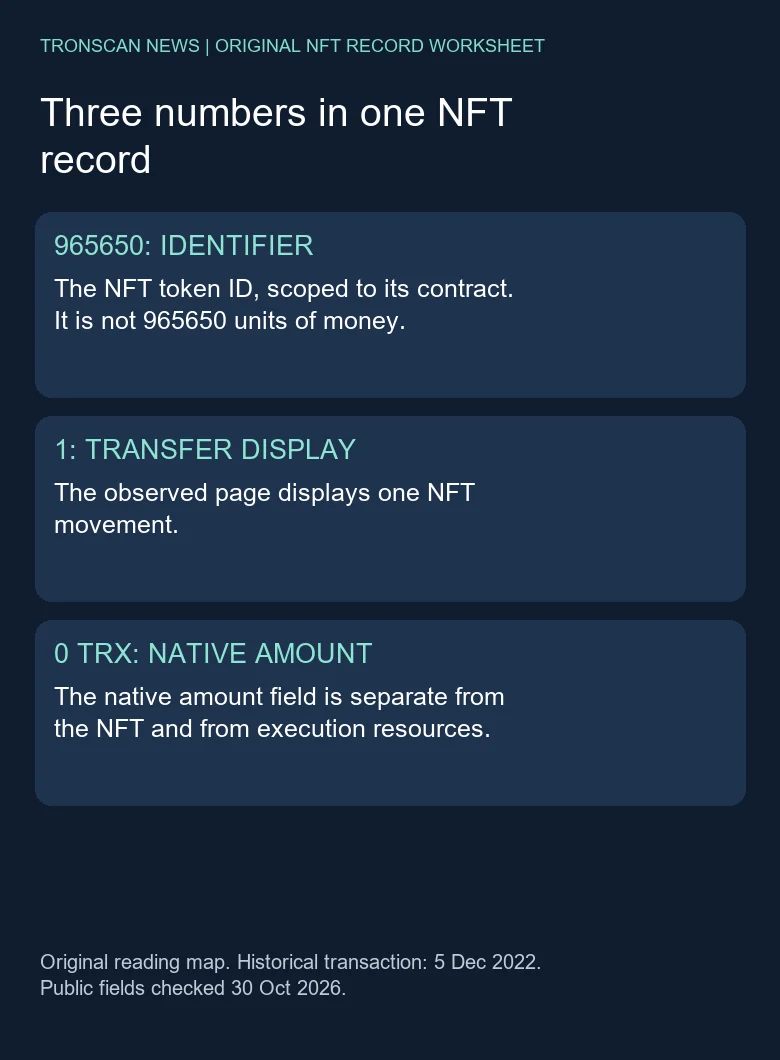
Table of Contents
TRC721 token ID: identify the item before reading amounts
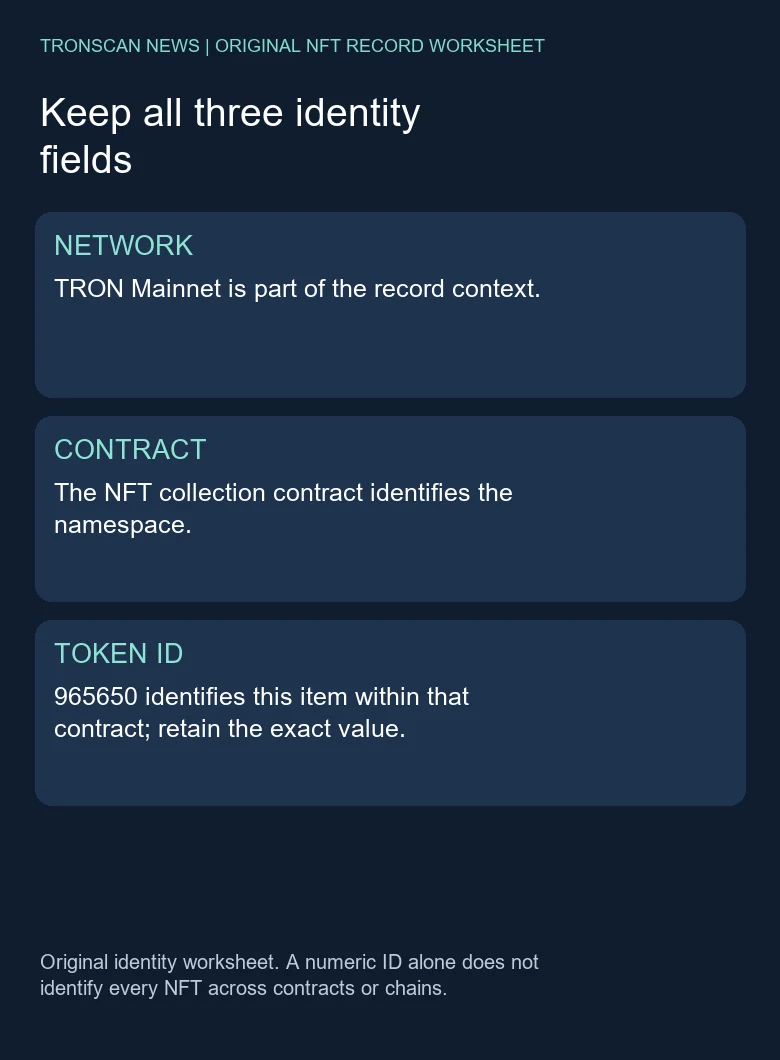
The official TRON TRC-721 standard reference describes TRON’s non-fungible-token interface. For a TRC721 token ID lookup, keep the network, collection contract and item ID together. A familiar collection symbol or a numeric ID without its contract is incomplete context.
| Identity field | Checked value | Purpose |
|---|---|---|
| Network | TRON Mainnet | Which chain contains the record |
| Contract | THjYwnDDN6aYxrzKb88CSMTEYjBuHpoYxS | The NFT collection’s contract namespace |
| TRC721 token ID | 965650 | The specific item inside that namespace |
A hypothetical second collection could use the same numeric ID. That would not make its item the NFT in our example. The contract is part of the TRC721 token ID lookup. Similarly, an Ethereum record should not be substituted for a TRON record because an interface or token-standard name looks related.
If you are still deciding which record category to open, begin with our TRONSCAN record-selection guide. This article continues at the point where the asset is identified as TRC721 and the task is to read one NFT’s record.
A checked TRC721 token ID example
Open the historical transaction on TRONSCAN. Its full hash is 6e857404b7b3b8fed973442e0e2f58c3179e04893deb7a341873fa4160d5e27f. The record is in block 46556208. Our saved view reported Successful and CONFIRMED.
The page’s token-transfer section displayed one DVKNFT movement and the item link #965650. A separate Amount field showed 0 TRX. These are different fields. Zero in the native-coin amount field does not erase the displayed NFT movement or establish that no execution resources were consumed.
| Visible number | Field context | Correct reading | Incorrect substitution |
|---|---|---|---|
| 965650 | NFT item link | The TRC721 token ID | 965650 USDT or a price |
| 1 | Displayed NFT movement | One NFT in the observed transfer display | The item ID or a dollar value |
| 0 TRX | Native Amount | Native amount in that field | A universal zero-fee or no-activity statement |
We did not buy, transfer or value the NFT. The collection name and symbol are identifiers displayed by the explorer. They are not a review of the project, an assessment of the token’s metadata or proof of the identity of its holders.
How to follow the TRC721 token ID link
- Verify the network and hash. Open the exact transaction above and compare its block and UTC timestamp with the saved example.
- Find the token movement. In Token Transfers, read the collection link and the adjacent item ID. Keep them separate from any native Amount field.
- Open the item link. In this tested record, selecting
#965650opened the item-specific page whose Overview showed Token ID 965650. - Compare its contract. The Basic Info section showed the same collection contract address. An ID match without a contract match would not complete the check.
- Read the transfer row with its date. The tested item page displayed one indexed transfer with the same hash and block. Preserve the full identifiers rather than relying only on an age label.
The checked item-specific transfer page provides a reproducible destination. Our TRC721 token ID check requires an exact network-contract-ID match across the transaction and item view. We did not test a current-owner function or certify that the indexed list is a complete ownership audit.
TRC721 token ID history is not a current-owner certificate
A transfer row concerns an event in a historical record. Its recipient is the recipient in that row. It should not automatically be relabeled “the present owner” without a current-state check and the appropriate scope. The same caution applies to a single screenshot shared long after its collection date.
Retain the item filter and time window when reading history: a collection-wide list answers a broader question. For current permissions after identifying the item, use the NFT approval scope worksheet to distinguish an item-specific approved address from an owner/operator flag. Neither query reconstructs historical state.
A useful record therefore contains both an event timestamp and an observation date. The first states when the recorded event occurred; the second states when you inspected the explorer. Changing the observation date does not turn an old event into a newly occurring transfer.
API field names: two different meanings of token ID
The official item-transfer API reference requires both a contract and a tokenId parameter. We made one anonymous read request for the documented example pair. It returned HTTP 200 and one record in token_transfers; we saved the response.
| Full field path | Value in the saved response | Meaning here |
|---|---|---|
| token_transfers[0].token_id | 965650 | The NFT item identifier |
| token_transfers[0].contract_address | THjYwnDDN6aYxrzKb88CSMTEYjBuHpoYxS | The collection contract |
| token_transfers[0].tokenInfo.tokenId | THjYwnDDN6aYxrzKb88CSMTEYjBuHpoYxS | Contract identifier in the metadata object |
| token_transfers[0].tokenInfo.tokenType | trc721 | The returned token type |
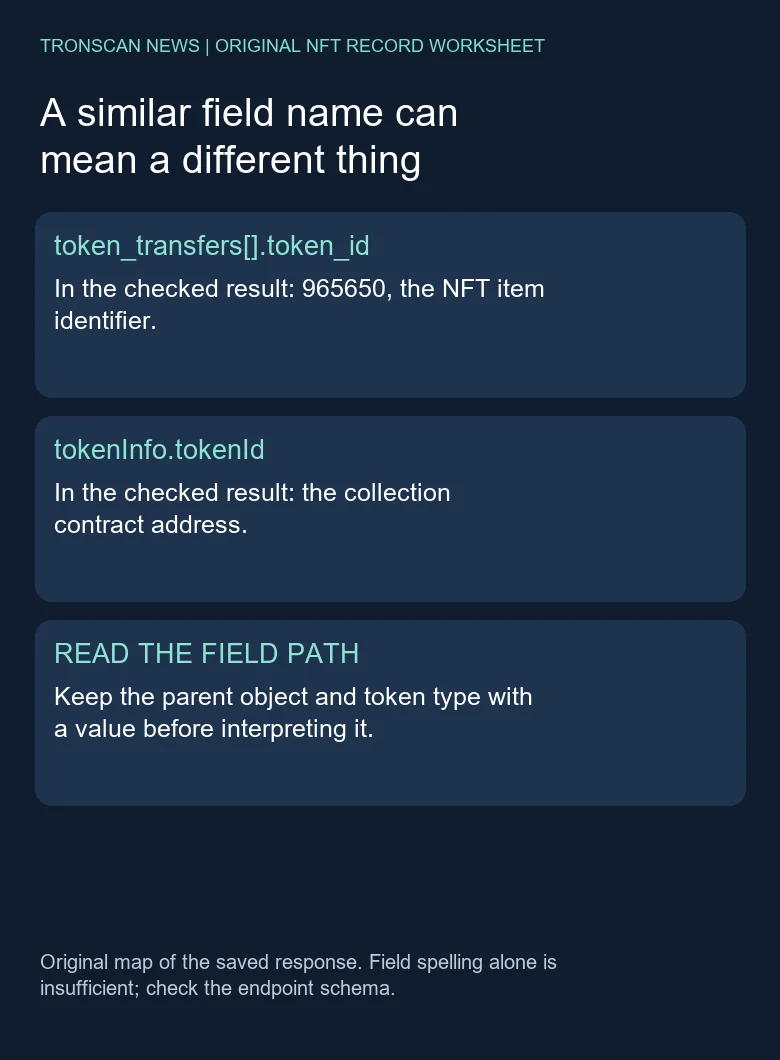
This is why copying a value named tokenId without its parent object can fail. In the checked response, one path contains the NFT item ID and another contains its contract address. Do not apply fungible-token decimal scaling to the identifier or treat a numeric string as a token balance.
A multi-token standard such as TRC1155 can track a per-address quantity for a particular ID. Do not apply a unique-item ownership assumption to that different token standard.
TRC721 token ID versus other token identifiers
The word “token” is not enough to determine what an identifier names. The official token-standards overview separates protocol-level TRC10 assets, fungible TRC20 contracts and non-fungible TRC721 items. This is a conceptual comparison, not three additional live tests.
| Context | Identity to preserve | Question to ask before reading a number |
|---|---|---|
| TRC10 asset | The protocol-level token identifier | Which asset is this field naming? |
| TRC20 fungible token | The token contract and the relevant amount field | Is this an identifier or an amount with decimals? |
| TRC721 NFT | The collection contract plus the individual item ID | Which item within which collection does this value identify? |
For a practical reading habit, first write down the record type, then the complete field path, then the value. In our NFT example, this prevents a collection contract from being mistaken for an item ID and prevents the item ID from being mistaken for a fungible balance. Preserve the endpoint or page section as part of a copied record so another reader can check the interpretation.
Common failed TRC721 token ID checks
No item found: recheck the network, complete contract and item ID together. A missing indexed result does not, by itself, prove that every chain or provider lacks the item.
The number looks enormous: inspect its label. An identifier is not made into a USDT amount by adding a currency sign or dividing by six decimals.
The NFT image is missing: keep the record identifiers. This article does not verify the availability or contents of an external metadata file. For a separate dated tokenURI test and an external-access failure branch, use our NFT metadata reading checks. A thumbnail and a transaction record are separate pieces of evidence.
The historical recipient is being called the owner: retain the event wording and date. Do not upgrade an old recipient field into a current ownership claim.
A concise citation should preserve the TRON Mainnet network, complete collection contract, item ID 965650, full transaction hash, event time and inspection date together. This makes a later check reproducible without presenting the observation as a price appraisal or a current-owner certificate.
Five frequently asked questions
1. Is a TRC721 token ID a balance?
No. It identifies an item within a contract. The example’s ID 965650 is not an amount of USDT or TRX.
2. Is a TRC721 token ID sufficient without its contract?
No. Keep the network and collection contract with the item ID. A matching number in another namespace is not the same identification check.
3. Does 0 TRX mean that no NFT moved?
No. The checked page displayed an NFT movement separately from a native Amount field of 0 TRX. It also does not establish zero execution cost.
4. Does this TRC721 token ID example identify the current owner?
No. We checked a historical transaction, an item-filtered transfer view and their indexed API representation, not a current-owner function.
5. Did we test a newly minted NFT on 30 October?
No. The event occurred on 5 December 2022. Thirty October 2026 is the source-check date for this tutorial.
Method, limits and corrections
The independent Tronscan News editorial team compared the live API response with the transaction and item views on 30 October 2026. Ten record checks matched, including the hash, block, UTC time, contract, ID and type. These are representations from the same explorer provider, not independent-node consensus verification. AI assisted drafting and original diagrams. No wallet connection, signature, NFT purchase or transfer was performed. Find our editorial and correction information from the Tronscan News homepage.
Leave a Reply