NFT approval on a TRC721 contract can apply to one token ID or to an owner–operator relationship covering that owner’s NFTs in the same contract. Read getApproved(tokenId) and isApprovedForAll(owner,operator) as separate questions. A zero address from the first query does not answer the second.
This guide checks those scopes without connecting a wallet or changing permission. On 31 October 2026 we made four public read calls: one current-owner lookup, one item-approval lookup, one specified operator lookup and one deliberately different ID input. The worksheet below preserves each input with its actual result and its limits.
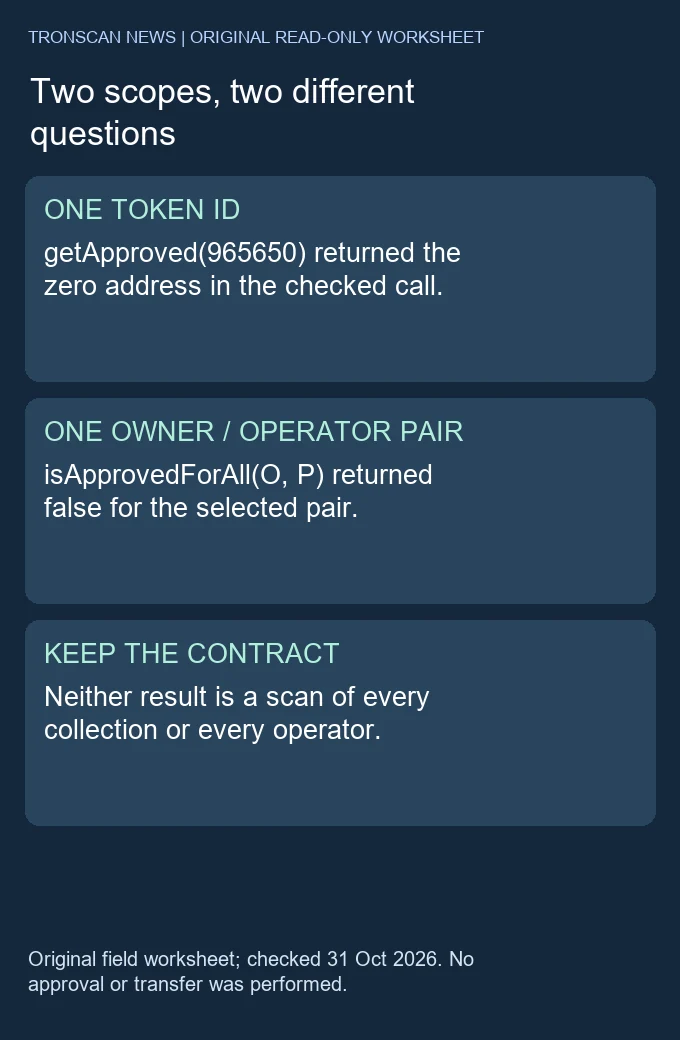
Table of Contents
Choose the NFT approval question first
The official TRC721 interface reference distinguishes a token-specific approved address from an operator flag for an owner. The operator scope belongs to that collection contract. It does not automatically extend to every NFT contract on TRON, every wallet asset or native TRX.
| Question | Read input | Return type | Scope retained |
|---|---|---|---|
| Who currently holds this item? | ownerOf(tokenId) | address | One contract and item ID |
| Who has item-specific NFT approval? | getApproved(tokenId) | address | One contract and item ID |
| Is this operator approved for this owner? | isApprovedForAll(owner,operator) | bool | One contract and ordered address pair |
Our TRC721 token-ID guide explains how the contract and item ID identify an NFT. Begin there if the record type is uncertain. The approval task starts after that identity is established; a collection logo or a familiar operator name is not an adequate substitute for a complete address.
The standard overview lists approve and setApprovalForAll as permission-changing methods. They are different from the read methods used here. Merely choosing Read Contract and querying a public state value did not grant or remove permission in this test.
Our dated NFT approval test inputs
We selected a previously documented Mainnet NFT rather than a wallet supplied by a reader. The contract page displayed Devikins and DVKNFT, with address THjYwnDDN6aYxrzKb88CSMTEYjBuHpoYxS. Its Code view explicitly said Contract code not verified. The explorer exposed an ABI and callable read fields, but that is not a source-code verification or safety audit.
Open the checked Mainnet contract, select Read Contract and keep the complete contract address visible. We used token ID 965650. Our ownerOf call returned the public address labelled O in this original input sheet. O is a worksheet label, not a claimed real-world identity.
| Label | Complete value | Selection method |
|---|---|---|
| Contract C | THjYwnDDN6aYxrzKb88CSMTEYjBuHpoYxS | Existing TRC721 example |
| Token ID | 965650 | Same item used for ownerOf and getApproved |
| Owner O | TNLjmMrKwAxPXabtgdLGdF1DG17kQKHZg2 | Actual ownerOf return in this check |
| Candidate operator P | TRQ2EpdqBTAQ6MjWecPh8gDDUwaPYaiXaa | Public address shown as deployer on this contract page |
P was deliberately chosen as a reproducible public input, not because we established that it was an active marketplace or suspected operator. A deployment label does not grant NFT approval. This test asks about exactly O and P, and makes no inference about other possible operators.
Read the actual NFT approval results
- Confirm Mainnet, C and token ID 965650.
- In Read Contract, open ownerOf, enter that ID and select Call. Record the returned address as O.
- Open getApproved, enter the same ID and select Call. Preserve the returned address with the ID.
- Open isApprovedForAll. Enter O in owner_address and P in operator_address, in that order, then select Call.
- Save the contract, inputs, return types and observation date together. Stop before any permission-changing method.
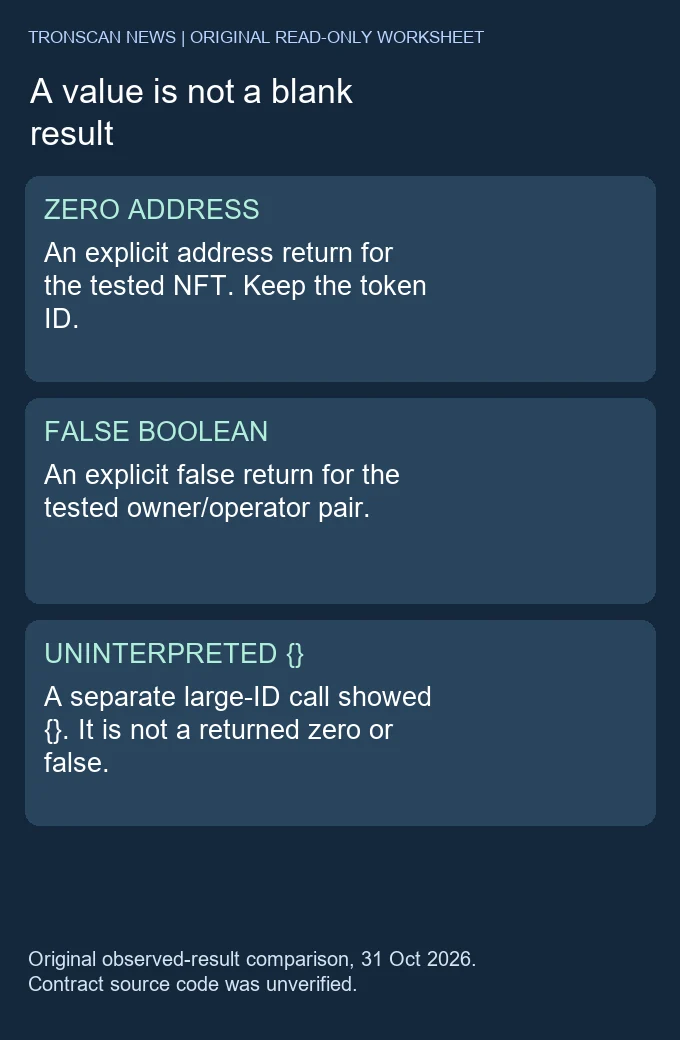
The item-specific query returned T9yD14Nj9j7xAB4dbGeiX9h8unkKHxuWwb, the zero address in TRON Base58 form. The operator query returned false with type bool. The first result is an address; the second is a boolean. Do not rewrite either one as a token balance, approval amount or transfer receipt.
| Actual call | Observed return | Supported reading |
|---|---|---|
| ownerOf(965650) | O, address | Current holder returned by the tested contract |
| getApproved(965650) | Zero address, address | No item-specific approved address returned for this ID |
| isApprovedForAll(O,P) | false, bool | This specified owner/operator pair was not approved in the observation |
These sequential NFT approval observations were not pinned to one shared block. They do not establish the historical approval state when the NFT previously moved. We did not enumerate all operators, prove who controls O or P, inspect private wallet activity, or test whether a transfer would succeed.
Why zero and false do not mean all-clear
An NFT approval conclusion must carry its scope. The following decision table is synthetic: it describes possible combinations under the standard, not extra live test results. A named address Q is only a placeholder for an item-specific approved address.
| Item query | Chosen operator query | Bounded interpretation |
|---|---|---|
| Zero address | false | Neither tested grant appears; other operators remain untested |
| Zero address | true | Item-specific address is empty, but the chosen operator flag is enabled |
| Address Q | false | Item-specific grant exists; chosen operator flag is not enabled |
| Address Q | true | Both scopes show a grant; the addresses need not be the same |
Clearing one scope and checking another are different tasks. This reading exercise does not revoke anything. A broad claim such as “this wallet has no NFT approval anywhere” would require evidence beyond a single item and one selected pair, and is not supported by our observations.
Keep unsuccessful NFT approval reads unresolved
For a separate input-boundary check, we entered the largest uint256 value, 115792089237316195423570985008687907853269984665640564039457584007913129639935, into getApproved. The interface displayed {}. It did not return an address or a typed boolean that we could interpret.
We retained that display as unresolved. We did not turn it into a zero address, a false flag, proof of an existing item or a complete revert diagnosis. If a reader gets a blank or failed response, check the network, contract, exact ID, method and input format before assigning a meaning. A response that cannot be interpreted should remain unknown.
For NFT approval comparisons, also preserve the owner/operator order. A question about O granting authority to P is not a question about P granting authority to O. Reusing the wrong owner from an older transfer record changes the question even when the collection and candidate operator remain unchanged.
Keep current state separate from approval events
The standard defines Approval for a token-specific change and ApprovalForAll for an owner/operator flag. These event names describe a recorded change at a transaction’s time. The read methods above ask about state when queried. An old event containing true is not, by itself, proof that the same operator remains enabled now.
For a later historical investigation, retain the event’s emitting contract, parent transaction outcome, owner, approved address or operator, token ID where applicable, and block time. ApprovalForAll carries a boolean instead of a token ID. Mixing those two layouts can make a collection-level flag look like an individual item’s grant. We did not inspect a real approval-event transaction in this exercise, so no event history is presented as tested evidence.
A reusable NFT approval note can be kept in four lines: identity, question, observation and boundary. Identity records Mainnet plus C and the relevant ID or ordered pair. Question names the exact read method. Observation contains the typed returned value and date, including an unresolved display when appropriate. Boundary states what was not checked, such as other operators, other collections or historical state. Keep the complete addresses in the note; shortening them for display should not replace the underlying comparison values.
Use the right permission model next
A TRC20 allowance is a different quantity-based model. Our TRON USDT allowance guide addresses that task; do not apply its amount interpretation to a TRC721 operator boolean. Conversely, the absence of a numeric NFT approval amount does not make an enabled operator flag irrelevant.
The TRONSCAN beginner guide provides the general record-selection route. For the current task, success means recording the exact NFT approval scope and a usable typed result, or explicitly marking the read unresolved. It does not mean approving an operator, connecting a wallet or certifying an asset as safe.
Five frequently asked questions
1. Does a zero NFT approval address rule out every operator?
No. getApproved concerns the item-specific address. The operator question requires a separate owner/operator input pair.
2. Does “for all” include every NFT collection?
No. The query is made against one collection contract. Preserve that contract in the record.
3. Was the tested deployer approved for the tested owner?
The specified isApprovedForAll call returned false on 31 October 2026. We did not enumerate other operators.
4. Does an empty-object display mean false?
No. Our separate large-ID query displayed {} without an interpretable permission return, so it remains unresolved.
5. Did these NFT approval checks revoke or grant permission?
No. We used public read calls only, with no wallet connection, approval, transfer or signature.
Sources, method and corrections
The independent Tronscan News editorial team checked the official TRC721 references and four explorer read calls on 31 October 2026. Original materials include the input sheet, typed-result matrix, clearly synthetic scope table and two dedicated diagrams. AI assisted drafting and diagrams. The single-provider, sequential observations and unverified contract source are limits, not an asset endorsement. Editorial standards and correction information are available from the Tronscan News homepage.
Leave a Reply