TRC1155 is TRON’s multi-token standard: one contract can track balances for multiple token IDs, and each ID has its own quantity per address. An ID such as 9 is an identifier, not nine tokens. Unlike a typical unique-item ownership lookup, the same ID can have units held by more than one address.
This beginner guide reads one historical TransferSingle event and tests four public, read-only contract calls on 31 October 2026. The result is a contract–ID–address worksheet that keeps historical movement, current balance and batch ordering separate. We did not mint, send, burn, approve, connect a wallet or claim anything.
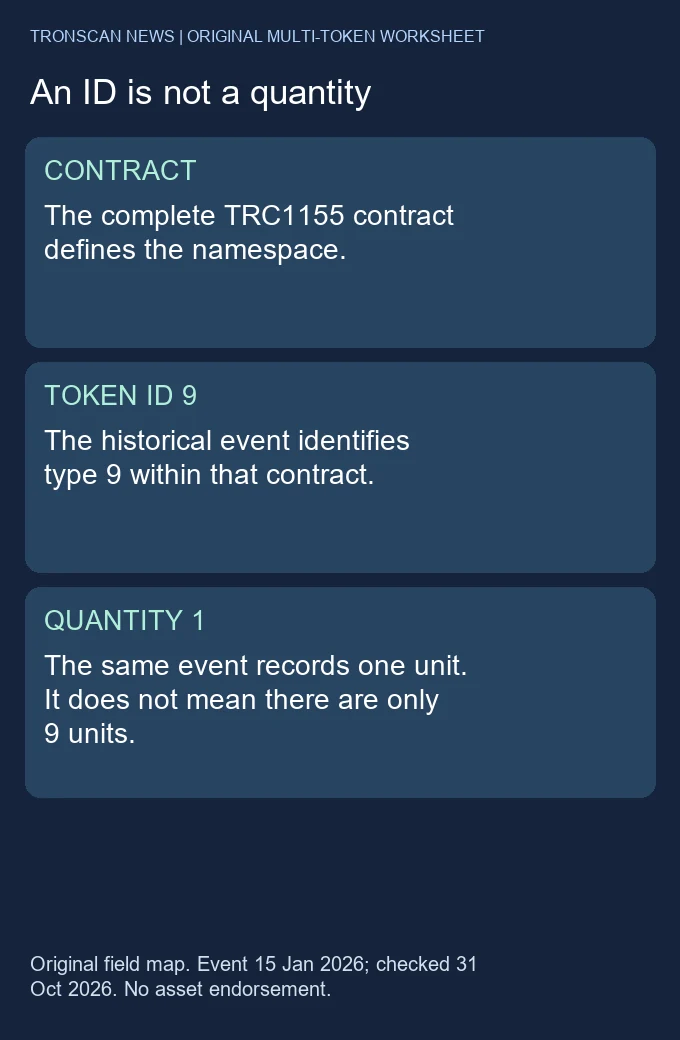
Table of Contents
What changes when you read a TRC1155 record?
The official TRC1155 interface reference defines balanceOf(address,id), its batch counterpart and the TransferSingle and TransferBatch event layouts. The event’s operator, source, recipient, identifier and quantity answer different questions.
The OpenZeppelin TRON multi-token explanation contrasts a per-ID balance with TRC721’s ownership/count model. Do not apply a TRC20 decimal scale or a TRC721 uniqueness assumption merely because the explorer calls the asset a token or NFT.
| Reading task | Required identity | Number means |
|---|---|---|
| TRC20 balance | Network, token contract, account | A fungible-asset quantity with its defined scale |
| TRC721 item | Network, contract, item ID | One item identifier; account balance counts items |
| TRC1155 balance | Network, contract, account and ID | Quantity of that ID held by that account |
Our TRC721 token-ID example explains unique-item records. Use the worksheet below when one token ID can have a separate quantity at each address.
A historical TRC1155 example: ID 9 and quantity 1
The inspected Mainnet contract was TRDrsvacd1bzmAnXvXeXBSp8dJdbK1txuY. The public token page displayed an unknown reputation and used the contract address as its token label; the contract page displayed TOPNFT. These are observations for identifying the record, not an endorsement of the issuer, artwork, marketplace or asset value.
The selected transaction was 33af6147bd0a2e0ec875a96cab2882b8c947e2533b7d8e829a2f5a764eb130fe. Its public transaction detail showed a successful, confirmed record at block 79,284,720, with block time 2026-01-15 22:58:12 UTC. The event happened in January; our October 31 check does not turn it into a newly occurring mint.
The displayed method was mint(address account,uint256 id,uint256 amount,bytes data), with ID 9 and amount 1. Minting methods are implementation-specific; the name is not a universal TRC1155 interface or a permission to invoke it. We inspected only the already completed record.
| Observed field | Value | Reading boundary |
|---|---|---|
| Emitting contract | TRDrsvacd1bzmAnXvXeXBSp8dJdbK1txuY | Namespace for this ID |
| Event/log position | TransferSingle /0 | One event under this hash |
| ID | 9 | Identifier, not amount or price |
| Quantity | 1 | One unit of ID 9 in this event |
| Source | Zero address | Mint-style event source, not a funded sender |
| Recipient A | TQH2gPq3p3FNXFi4QCwv3YThaSUwAhn58V | Public receiving address, not an identified person |
The event’s operator was TA3Yfdzbbr1U3gtJQkByu8b7GshLtYnCfv, also displayed as the initiator of this call. The zero source, operator and recipient were three different address roles. A mint-style event does not mean that the zero address signed a funded transfer.
Check the TRC1155 event’s two data words
We read the transaction body and receipt through public Mainnet provider endpoints and saved their complete responses. Both returned usable HTTP 200 data and SUCCESS execution labels. The receipt contained one log, whose emitting address matched the called contract after accounting for address representation.
The first topic identified TransferSingle. The next three topics held operator, source and recipient. Its data was 64 bytes: two 32-byte words. Our exact integer conversion returned 9 from the first word and 1 from the second. This is an identifier-and-quantity pair; treating the second word as a token decimal scale would answer a different question.
Preserve the emitting address, event definition and parent outcome. Use the TRC1155 declaration for this layout. For a contrasting case where NFT is a fungible token symbol, the APENFT amount-reading example reconciles a TRC20 Transfer value with its decimal scale. A familiar NFT label does not establish that the record has a token ID.
Read a current TRC1155 balance without a wallet
We opened this contract’s Contract tab, selected Read Contract and expanded balanceOf. The interface requested account_address and id_uint256. We entered a complete public address and ID 9, then selected Call. The current read returned 1 as uint256 for A.
Repeating the read for B, TNaCoB4UpUx2MLjGCRYmoTScM15c6oawVN, and the same ID 9 also returned 1. The token-transfer list had independently shown a separate historical mint-style row for B under the same ID. We do not infer real-world ownership or a shared operator from those two addresses.
- Confirm the network and complete TRC1155 contract.
- Select Read Contract, not a transfer or mint action.
- Choose balanceOf and provide the exact account and token ID.
- Record the returned integer, return type and observation time.
- Keep that current observation separate from the historical transfer’s time.
A returned 1 for both accounts demonstrates why this record should not be described as one unique ID with one exclusive owner. It does not establish the ID’s complete supply, all holders, a continuous history of balances or permission to transfer any unit.
Keep TRC1155 batch-query pairs in order
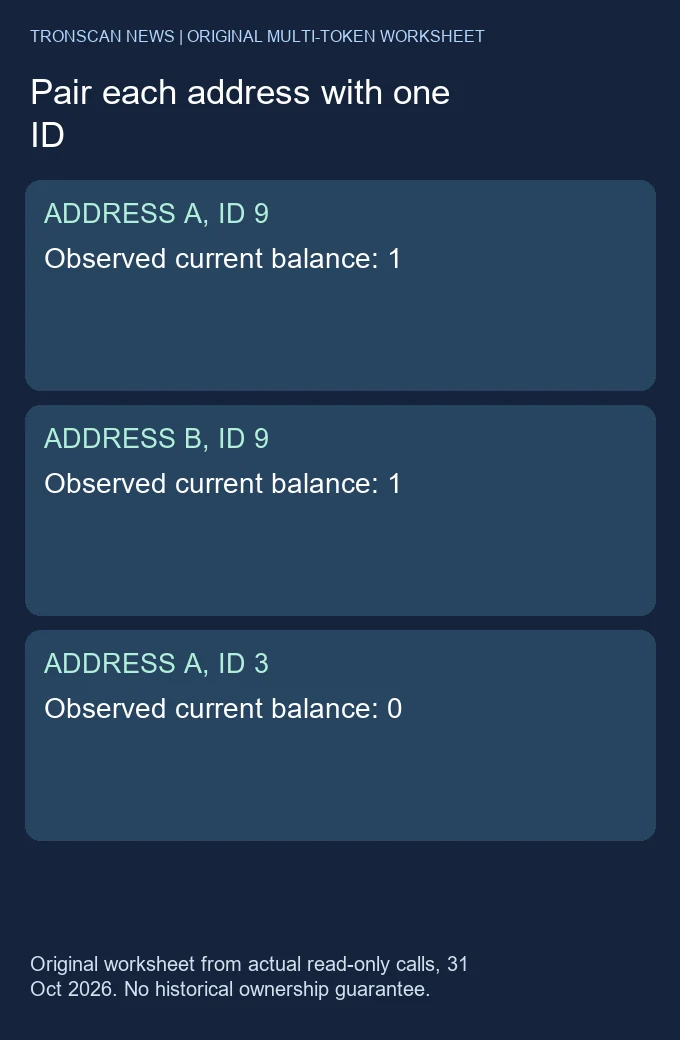
For a repeatable check, copy the complete addresses from the field matrix and the B paragraph above; A and B are worksheet labels, not valid address inputs. Preserve the contract URL, the input arrays and the returned array together. A screenshot of balances alone loses which address and ID produced each value, making later comparison unreliable.
We tested balanceOfBatch with accounts [A,B] and ids [9,9]. The returned uint256 array was [1,1]. We then tested accounts [A,A] with ids [9,3]; it returned [1,0]. Repeating an account is valid when the second query asks about a different ID.
| Batch call | Position | Exact question | Actual return |
|---|---|---|---|
| First | 0 | A, ID 9 | 1 |
| First | 1 | B, ID 9 | 1 |
| Second | 0 | A, ID 9 | 1 |
| Second | 1 | A, ID 3 | 0 |
The arrays are zipped by position. They are not a request for every account combined with every ID. Sorting one array without applying the same permutation to the other changes the questions. Preserve the original input order beside the output rather than retaining only the list of balances.
The zero for A/ID 3 was an explicit returned value in the tested call. A failed request, blank page or absent field should not be rewritten as zero. Our reads were sequential and not pinned to a shared block; they are dated observations, not an independent-node or historical-state audit.
TransferBatch is not the same as balanceOfBatch
TRC1155 uses a batch event to represent multiple ID/quantity pairs in one movement operation. balanceOfBatch reads current balances for account/ID pairs. The similarity in the names does not make a balance query a transfer, and it does not mean we performed a batch transfer.
Explicitly synthetic exercise: a TransferBatch might contain ids [3,9] and values [2,1]. A reading worksheet would map ID 3 to quantity 2 and ID 9 to quantity 1 in that array order. This example is invented for interpretation practice; the actual historical receipt inspected here contained TransferSingle, not TransferBatch.
Do not sum 2 and 1 and label the result three different NFTs. They are three reported units across two identifiers in the assumed example, with no claim about uniqueness, supply, price or ownership. Keep each pair intact until its contract and semantics are established.
Stop at the limits of the TRC1155 evidence
The general TRONSCAN guide remains the entry point for address, block and transaction searches. This worksheet narrows the task to a multi-token ID and its per-address quantity. A metadata image or collection label is not a substitute for those identity fields.
We did not request metadata URLs, test receiver hooks, approve an operator or audit contract safety. We also did not determine whether an unsolicited token represents a useful or trustworthy asset. Reading the public record does not require visiting a token’s promotional link or connecting a wallet.
If another interface disagrees, compare network, complete contract, account, ID and observation time first. A current balance and a January event can differ without either being fabricated. Establish the intended time scope before investigating an apparent mismatch.
Five frequently asked questions
1. Is TRC1155 ID 9 a quantity of nine?
No. In the checked event 9 was the identifier and 1 was the separate quantity.
2. Can two addresses hold the same TRC1155 ID?
Yes. Our current reads returned 1 for ID 9 at both A and B under the same contract.
3. Does a TRC1155 balance query transfer anything?
No. The tested balanceOf and balanceOfBatch calls were public read operations with no wallet connection.
4. Did we test a real TransferBatch transaction?
No. The real receipt contained TransferSingle. The batch-transfer array example is explicitly synthetic.
5. Does the historical event prove the current balance?
No. We queried current values separately on 31 October 2026 and do not claim continuous ownership since January.
Sources, method and corrections
The independent Tronscan News editorial team compared official standard references, explorer event fields, raw body/receipt data and four actual read-only calls on 31 October 2026. The original material includes the field matrix, raw-word check, paired-input tables and two dedicated diagrams. AI assisted drafting and diagram preparation. No funded or permission-changing action occurred. Editorial standards and corrections are accessible from the Tronscan News homepage.
Leave a Reply