APENFT is the name returned by the checked TRON token contract whose symbol is NFT. This contract represents a fungible TRC20 token, not an individual NFT collectible. The letters NFT beside its amount are a ticker. They do not turn that amount into a count of artworks or an item identifier.
On 31 October 2026 the explorer’s token page displayed AINFT (NFT), while the actual name() read returned APENFT. We kept both observations with the complete contract. This beginner guide reconciles one real transfer across the method input, event data and displayed token quantity, without connecting a wallet.
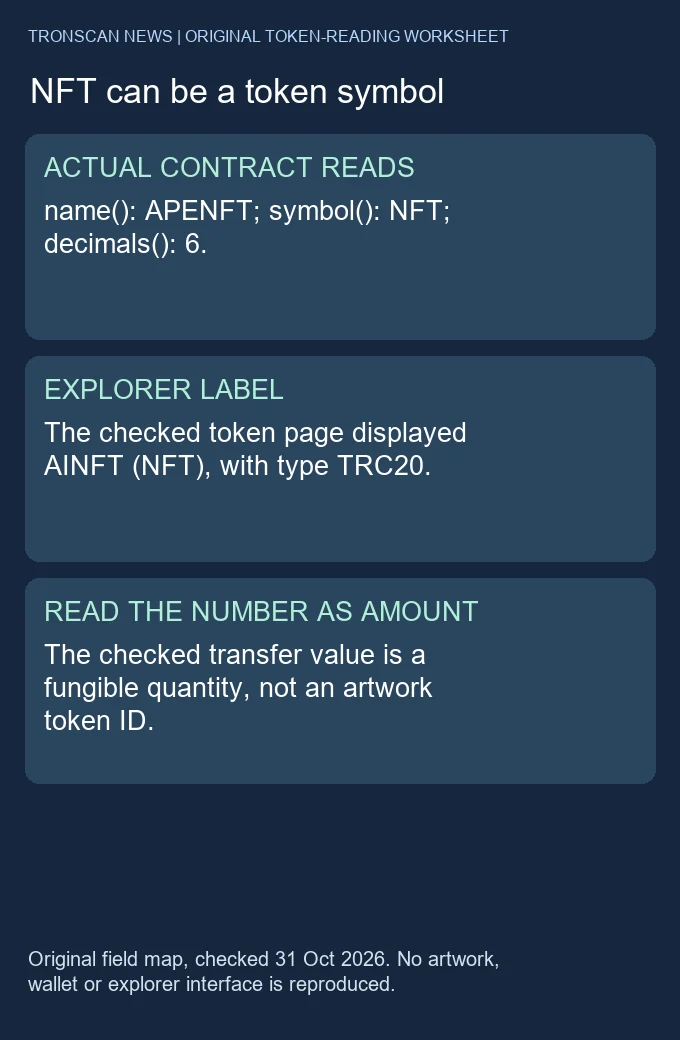
Table of Contents
Identify APENFT by its complete contract
The complete Mainnet contract used here is TFczxzPhnThNSqr5by8tvxsdCFRRz6cPNq. APENFT documentation lists this address beside the token symbol NFT. We use that listing to cross-check identity; it does not prove an asset’s value or make every similarly named contract authentic.
The explorer displayed type TRC20 and six decimals on the token page. In Read Contract we independently selected the exposed name, symbol and decimals fields. “Independently” here means a separate interface check, not an independent blockchain node: the explorer supplied all three read results.
| Observed field | Actual value | What it identifies |
|---|---|---|
| Complete contract | TFczxzPhnThNSqr5by8tvxsdCFRRz6cPNq | The selected TRON asset contract |
| Explorer token label | AINFT (NFT) | Display metadata on the checked page |
| name(), string | APENFT | Returned contract metadata |
| symbol(), string | NFT | A ticker, not a token standard |
| decimals(), uint8 | 6 | Six decimal places in an amount |
We do not infer a rebranding date or a new contract migration from the label difference. A site-managed name and an on-chain metadata string can be different. Preserve which field came from which source instead of silently changing the read result to match the page heading.
Choose an APENFT amount record, not a collectible ID
The official TRC20 interface reference describes fungible balances and transfer values. Its metadata fields include a symbol and decimal scale. Those fields answer a different question from a non-fungible contract’s item-specific ownership lookup.
Our TRC721 item-identification guide follows one collectible using its contract and token ID. Our TRC1155 ID-and-quantity worksheet handles quantities attached to individual IDs. Use those workflows when the actual record type calls for them, rather than selecting them because a fungible token’s symbol happens to be NFT.
| Record being read | Identity needed | Meaning of the number |
|---|---|---|
| Checked APENFT TRC20 transfer | Network, token contract, hash, source and destination | Scaled fungible token quantity |
| TRC721 collectible | Network, collection contract and item ID | One item identifier |
| TRC1155 balance | Network, contract, account and ID | Quantity of that particular ID |
A very large APENFT quantity is therefore not proof that the recipient received billions of individual collectibles. Neither the ticker nor the number provides an artwork title, token URI, item ID, creator attribution or an ownership certificate for a specific image.
One actual APENFT transfer and its dated fields
We selected transaction d973a5f708be211fb2afaf81d9be6ad8d3f7430b1b843427a2586fb810391be7 from the token transfer list. Its public transaction detail showed Successful and CONFIRMED at block 87,584,617, with block time 2026-10-31 06:14:30 UTC.
| Checked field | Value |
|---|---|
| Source | TRtpQEsHRGFaYKv9cgGm7QeY9WPLr8xxGf |
| Destination | TMbn85X3J98Fxo6kSbDQfkuzja27WFF3Ap |
| Called and emitting contract | TFczxzPhnThNSqr5by8tvxsdCFRRz6cPNq |
| Method | transfer(address _to, uint256 _value) |
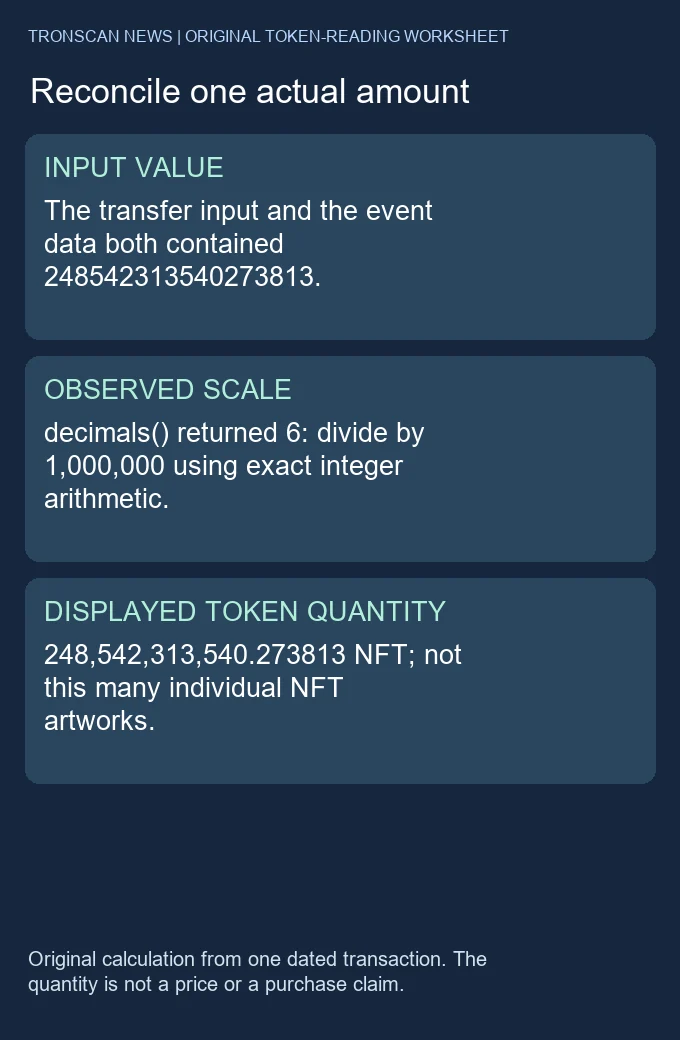
| Raw _value | 248542313540273813 |
| Displayed quantity | 248,542,313,540.273813 NFT |
| Native Amount displayed | 0 TRX |
The source and destination are public addresses, not identified people. The record does not tell us that an artwork was bought, that the addresses belong to different people, or why the transfer occurred. We do not turn the explorer’s dollar estimate into a realized payment or a market-value claim.
Reconcile the APENFT input and event amount
We retrieved the public transaction body and receipt through read-only Mainnet provider endpoints and saved their responses. Both returned usable HTTP 200 data and SUCCESS execution results. The method input began with selector a9059cbb and contained a recipient word followed by the raw quantity word.
The receipt contained one Transfer event. Its emitting address matched the called APENFT contract after accounting for address representation. The source and destination topics matched the transaction’s source and recipient input. The event data was one 32-byte word whose exact integer value matched _value: 248542313540273813.
Using the observed six-decimal scale, exact division gave a whole part of 248542313540 and a remainder of 273813. Keeping all six fractional digits produced 248542313540.273813, matching the explorer’s formatted amount. No floating-point rounding was needed.
Five APENFT reading checks you can repeat
- Confirm Mainnet and copy the complete token contract.
- Record the token type and inspect name, symbol and decimals in Read Contract.
- Open the specific transaction and check its result, block time and called contract.
- Compare the transfer’s recipient and raw _value with the matching emitting event.
- Apply that contract’s decimal scale, preserve the original integer and label the output as a token quantity.
Success means that identity, direction and quantity reconcile for the selected record. It does not require buying APENFT, connecting a wallet, granting approval, opening promotional metadata or performing a new transfer. Our check is a reading exercise, with no signature or funded action.
The native Amount of 0 TRX is a different field from the APENFT quantity. It does not erase the token movement, and it does not establish that the transaction used no resources or paid no fee. We did not use that native amount as the denominator for the token calculation.
Do not identify an asset from Transfer alone
An event name is only part of a record. Keep the emitting contract, declared layout and argument meaning with it. In our actual event the data word was a fungible amount. Calling it a collectible ID merely because the symbol says NFT would discard the checked token type and scale.
The raw event signature alone should not be treated as a full token-type certificate. This example establishes its interpretation by combining the selected contract, its exposed fields, the transfer method input and the matching event data. We did not audit every method or prove general compliance from one receipt.
The source-code page displayed a perfect-match verification label during this review. That is useful context for matching published source to a contract, but it is not an endorsement, a guarantee of future behavior or a promise that any receiving service will credit the asset.
Handle a missing or mismatched field explicitly
If a token page cannot provide a decimal value, leave the human-readable amount unresolved. A familiar ticker is not permission to assume the precision used by another contract. If an event’s emitting address differs from the selected token, first determine which asset emitted it instead of applying APENFT’s scale to every number in the transaction.
If the parent transaction cannot be retrieved, retain that gap rather than presenting the saved input as a completed transfer. If the input and event disagree, preserve both raw integers and investigate their exact contract and field correspondence. This example matched; it is not a claim that every token implementation emits or accounts for values in the same way.
A failed request is also different from a token quantity of zero. Keep an explicit returned zero, a missing value and an unreadable response as separate states in the worksheet. That distinction makes later checks reproducible without inventing a value for a field the provider did not supply.
Keep an APENFT comparison note with its limits
For later comparison, save the full contract and transaction hash, the checked block and UTC time, the method’s raw value, the decimal count and the formatted output. Preserve the source of each label. A screenshot that retains only “NFT” and a number loses the information needed to distinguish a fungible amount from an item record.
We used one selected transfer and three current metadata reads. The receipt and explorer are representations supplied through public providers, not an independent-node audit. Current balances, other transfers, historical metadata changes and the recipient’s purpose were not established.
The TRONSCAN beginner guide remains the general search route. Once a result is open, choose the next reading method from its actual network, contract and token type, then retain uncertainty when a field cannot be verified.
Five frequently asked questions
1. Is APENFT’s NFT symbol an individual NFT collectible?
No. The checked contract is a fungible TRC20 token whose symbol() returned NFT.
2. Why did the page say AINFT while name() said APENFT?
Those are different observed metadata fields. We preserve both and do not infer a rebranding date.
3. Is the transfer’s long raw integer a token ID?
No. The checked method and event use it as a fungible quantity, scaled by six decimals.
4. Did 0 TRX mean no APENFT moved?
No. The explorer displayed a separate token movement that matched the checked input and event value.
5. Does this APENFT record prove an artwork sale?
No. We verified the token record and arithmetic, not the parties’ identities, purpose or a collectible purchase.
Sources, method and corrections
The independent Tronscan News editorial team checked the public token page, three read-only metadata fields, one transaction and its event on 31 October 2026. Original materials include the identity and comparison matrices, input/event equality checks, exact integer calculation and two diagrams. AI assisted drafting and diagrams. No wallet, approval, claim or transfer was performed. Editorial standards and corrections are available from the Tronscan News homepage.
Leave a Reply