The SUN token is a TRC20 asset associated with the SUN platform; it is different from sun, the smallest denomination of native TRX. There is also a legacy SUNOLD contract. When reading a balance or transfer, identify the complete contract before choosing a unit scale or interpreting the word SUN.
Our 31 October 2026 comparison found a practical trap: the explorer labelled the two token pages SUN and SUNOLD, but both contracts returned SUN from symbol(). Both also returned the same name and decimal count. A ticker-only check therefore failed to distinguish these two actual records.
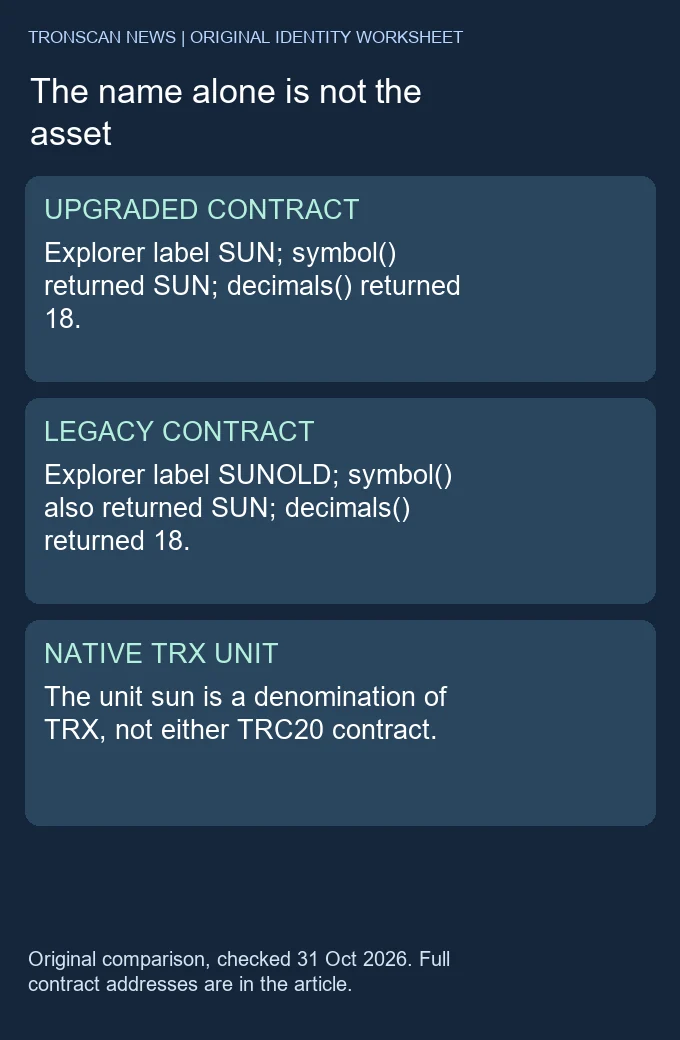
Table of Contents
Match the SUN token to a complete contract
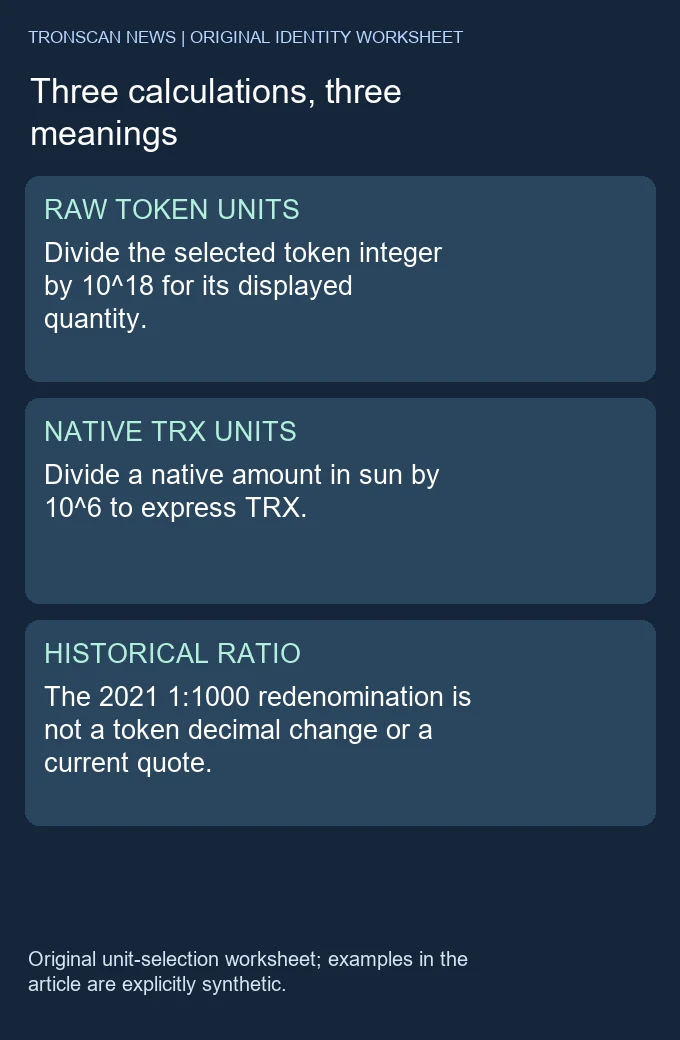
The SUN team’s 2021 redenomination notice identifies the old and upgraded contracts below. It describes the upgraded asset as a platform governance token and a 1:1000 redenomination starting 26 May 2021, Singapore time. That is historical context, not an announcement of a new October 2026 migration.
| Record | Complete Mainnet contract | Explorer label checked |
|---|---|---|
| Upgraded SUN token | TSSMHYeV2uE9qYH95DqyoCuNCzEL1NvU3S | SUN (SUN) |
| Legacy token | TKkeiboTkxXKJpbmVFbv4a8ov5rAfRDMf9 | SUNOLD (SUNOLD) |
| Native TRX amount in sun | No TRC20 contract is selected for this denomination | A native-coin amount or fee field |
The words “old” and “upgraded” identify the relationship documented by the issuer. They do not establish whether any particular exchange accepts a deposit today. We did not test a migration interface, exchange crediting, governance participation or a funded transfer.
The current and legacy SUN token contract addresses have different complete values. Preserve the full strings in any comparison note, even when a phone interface shortens them visually. A match in a logo, symbol, name or number of decimals does not repair a contract mismatch.
Eight actual SUN token field reads
We opened both token pages, followed each contract link, selected Read Contract and expanded name, symbol, decimals and totalSupply. The upgraded SUN contract and the legacy contract each displayed a perfect-match source-verification label. That label is not a security audit or a guarantee of market value.
| Method and return type | Upgraded contract | Legacy contract |
|---|---|---|
| name(), string | SUN TOKEN | SUN TOKEN |
| symbol(), string | SUN | SUN |
| decimals(), uint8 | 18 | 18 |
| totalSupply(), uint256 | 19900730000000000000000000000 | 19900730000000000000000000 |
These are eight sequential SUN token read observations, four against each contract. We retained the page address and each method result. The token-page legacy label was SUNOLD, while the actual legacy symbol() read was SUN. We report both fields with their sources rather than silently replacing the on-chain return with the browser’s display label.
This discrepancy does not, by itself, establish that either interface is broken. A curated asset label and a contract metadata string are different fields. The record-selection decision should use the complete contract, with labels as supporting context.
Read the SUN token supply integers correctly
We used integer arithmetic to divide each actual totalSupply return by the observed scale of 10^18. The upgraded-contract result was 19,900,730,000 token units; the legacy-contract result was 19,900,730. Both divisions had zero remainder. The first raw integer was exactly 1,000 times the second.
That cross-contract arithmetic is a comparison of the observed totalSupply values. It is not a measurement of one address’s balance, circulating supply, liquidity or an amount available to withdraw. It also does not prove that a user can exchange an arbitrary balance at a particular price or redeem it through an available service.
Both SUN token contracts used eighteen decimals in our check. The difference between the two supply values was therefore not caused by changing a decimal count from one contract to the other. Keep the asset identity, raw integer and scale together before comparing human-readable quantities.
Our TRC20 decimal-reading guide explains that general raw-to-display operation. Here the original comparison adds the two complete contracts and their actual metadata collision, which an isolated decimal lookup would miss.
Keep the native unit sun separate
The official TRON network overview defines 1 TRX as 1,000,000 sun. A native transaction value or fee expressed in sun belongs to that coin denomination. It does not refer to either of the TRC20 contracts in the identity table.
Explicitly synthetic comparison: a native amount of 1,000,000 sun represents 1 TRX. A raw integer of 1,000,000 in an eighteen-decimal SUN token field represents 0.000000000001 token units. These are deliberately invented inputs for unit practice, not a live transfer or a trading conversion.
Spelling and capitalization alone are not sufficient safeguards. A field can use SUN in capital letters for a native denomination, while a token symbol can also be SUN. Read the surrounding field definition and whether a specific token contract has been selected.
Five practical SUN token identity checks
- Decide whether the number comes from a native TRX field or a token-specific record.
- For a token record, confirm Mainnet and copy its complete contract address.
- Match that address to the intended upgraded or legacy asset; do not stop at symbol().
- Read decimals on that exact contract, then preserve the raw number with its scale.
- Record the observation date and keep current service acceptance or conversion availability as a separate question.
A successful reading ends with an identified asset and a correctly labelled quantity. It does not require a wallet connection, a token approval or a purchase. If the interface offers such actions, they are additional workflows beyond this read-only example.
If a transfer page and a wallet disagree, first compare the contract and the time scope. An old-token record and an upgraded-token balance can both display SUN while representing different contracts. A current wallet amount and a historical transfer amount also answer different questions.
Separate a token from the SUN platform’s contracts
The SUN token contract is not interchangeable with every contract used by the SUN platform. A router address and a token address have different roles. Finding a familiar platform name beside a transaction does not establish which asset moved or which contract emitted the token event.
The TRON swap-record walkthrough shows why the called router, intermediary assets and final account delta must be read separately. Use the specific token’s emitting contract to attribute a movement, rather than assuming all calls involving a platform are SUN token transfers.
The TRONSCAN beginner guide remains the general search entry point. The narrower worksheet here resolves an identity-and-unit ambiguity before a balance, supply or transaction interpretation is attempted.
A compact record-classification worksheet
Write down four fields before doing arithmetic: source field, asset identity, raw integer and intended output unit. For a native fee, the source field identifies a native-coin amount and the output unit is TRX. For a SUN token supply, the source is totalSupply on one named contract, and the output unit belongs to that contract. These two rows should not share a token identity merely because their labels contain the same three letters.
In our exact supply calculation, integer division produced a whole-number quotient and a zero remainder. That result is specific to the checked supply integers. A wallet balance or a transfer can have a nonzero remainder, so preserve fractional precision rather than assuming all token quantities are whole numbers. Do not use binary floating-point rounding to decide whether two long raw integers are equal.
If the original field is already a human-readable token quantity, dividing it by the decimal scale again would be a second conversion. Preserve whether the source is raw or displayed in the comparison note.
Keep the historical ratio within its evidence
The old announcement supplies historical contract context. Our current read results supply a dated metadata and supply comparison. Neither is proof that an old swapping page, exchange route or support policy is available now. We did not open a wallet or test a conversion.
For an unresolved deposit-support question, retain the exact contract and transaction hash alongside the receiving service’s stated asset. Do not change a contract label in a receipt to make it match a service. A numerical multiplier cannot establish that a different token contract was actually delivered or credited.
Five frequently asked questions
1. Is the SUN token the same as sun used in TRX fees?
No. The former is a contract-based TRC20 asset; the latter is a denomination of native TRX.
2. Did the legacy symbol() return SUNOLD?
No. Our actual read returned SUN, while its explorer token page used the SUNOLD label.
3. Did the two contracts use different decimals?
No. Both actual decimals() reads returned 18 on 31 October 2026.
4. Does the supply ratio prove a wallet’s redeemable amount?
No. We compared totalSupply values, not personal balances or current conversion availability.
5. Was a new SUN token migration tested today?
No. The cited redenomination notice is from 2021. This article reports read-only identity checks in 2026.
Sources, method and corrections
The independent Tronscan News editorial team compared official historical and unit references with two explorer pages and eight actual read-only fields on 31 October 2026. Original materials include the contract matrix, exact integer calculations, unit exercise and two dedicated diagrams. AI assisted drafting and diagrams. Reads were sequential and not pinned to a shared block or independently reproduced through a separate node. No wallet, approval, swap or deposit was performed. Find editorial standards and corrections from the Tronscan News homepage.
Leave a Reply