GasFree USDT fees are separate from the native TRON fee shown in a transaction receipt. A provider-assisted transfer can charge a token service fee while consuming TRON resources. The name GasFree does not establish that the user’s total token charge is zero.
This GasFree USDT fees guide reads one confirmed Mainnet transaction to explain those scopes. It concerns public records, not a transfer we initiated. We did not connect a wallet, sign a permit or test a personal account’s current quote.
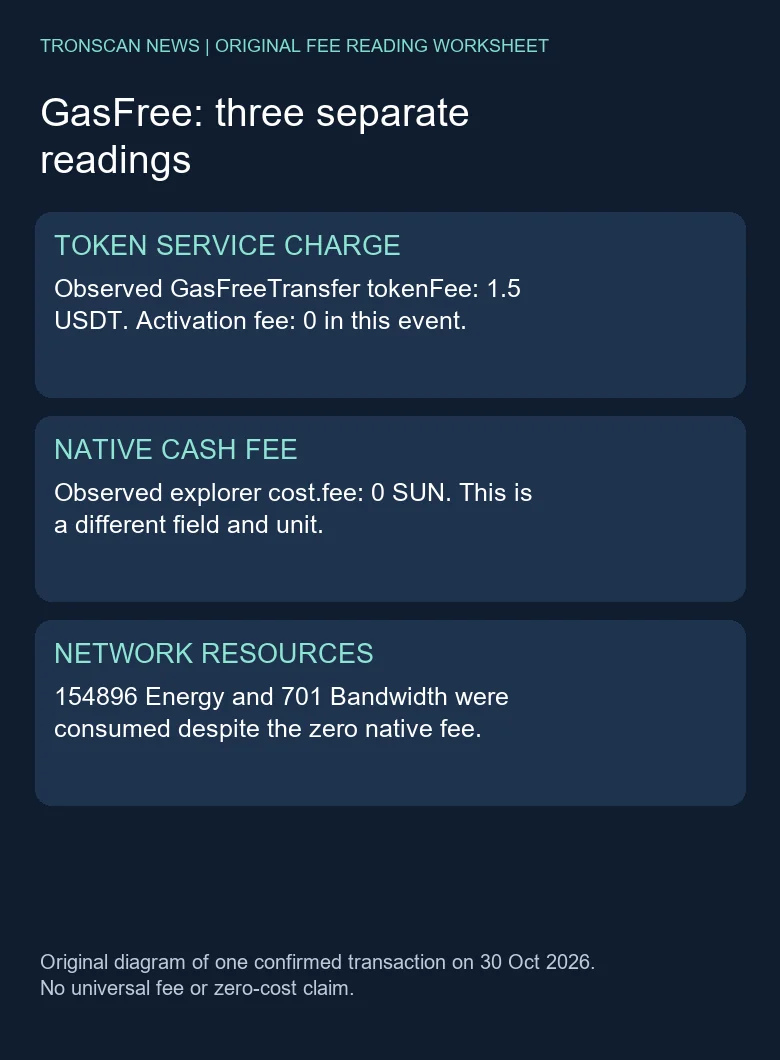
Table of Contents
What GasFree means for a USDT transfer
The official GasFree documentation separates the user’s ordinary account, a GasFree account and the service provider. In the documented flow, the provider submits an authorized operation to the blockchain and covers its gas resources; it may collect a handling fee. That is a different arrangement from assuming every sender must personally submit the on-chain transaction.
The TronLink GasFree guide, marked updated 10 October 2026 when checked, describes fees paid in the transferring currency and an activation charge when applicable. We reviewed those public explanations. We did not test the wallet creation, signature or sending screens described there.
For the underlying asset and network, start with our TRON USDT introduction. GasFree is a transfer arrangement; it does not turn USD₮ into native TRX or make a token amount interchangeable with an Energy count.
A checked GasFree USDT fees example
The public sample transaction is ddebcc05ba07be4deb06fe012aa00e28ac7c4a896862e555afdb9288849cfb0d, in block 87554292. Its block timestamp is 30 October 2026, 04:57:45 UTC. The explorer and saved transaction-detail response reported successful execution and confirmation.
The called endpoint was TFFAMQLZybALaLb4uxHA9RBE7pxhUAjF3U, matching the Mainnet controller identified in the GasFree documentation. The selected token was the TRON USDT contract TR7NHqjeKQxGTCi8q8ZY4pL8otSzgjLj6t. Contract-name and account labels remain explorer attribution, not proof of a person’s identity.
| Record item | Observed value | Scope |
|---|---|---|
| USDT recipient movement | 500 USDT | The decoded recipient’s token movement |
| GasFreeTransfer tokenFee | 1.5 USDT | Token fee in this event |
| GasFreeTransfer activateFee | 0 | Activation component in this event |
| Native cost.fee | 0 SUN | Native fee reported for the transaction |
| Energy usage total | 154,896 | Resource units, not USDT |
| Bandwidth usage | 701 | Resource units, not USDT |
The expanded resource panel described Bandwidth as staked/free and Energy as usage from the transaction account’s staked Energy. A native cash-fee field of zero therefore should not be rewritten as “no network work occurred.” Equally, those resource counts are not an extra USDT amount to add to the service charge.
GasFree USDT fees in the decoded event
The sample’s Event Logs view displayed two USDT Transfer logs and one GasFreeTransfer event. The latter explicitly named tokenFee and activateFee, so the fee interpretation does not depend only on guessing why a second token movement exists.
The event’s tokenFee was 1500000 and activateFee was 0. Using the checked USDT token’s six decimals, those format as 1.5 USDT and zero. A matching token movement sent 1.5 USDT to the address in the event’s serviceProvider field. The recipient movement was separately recorded as 500000000, or 500 USDT.
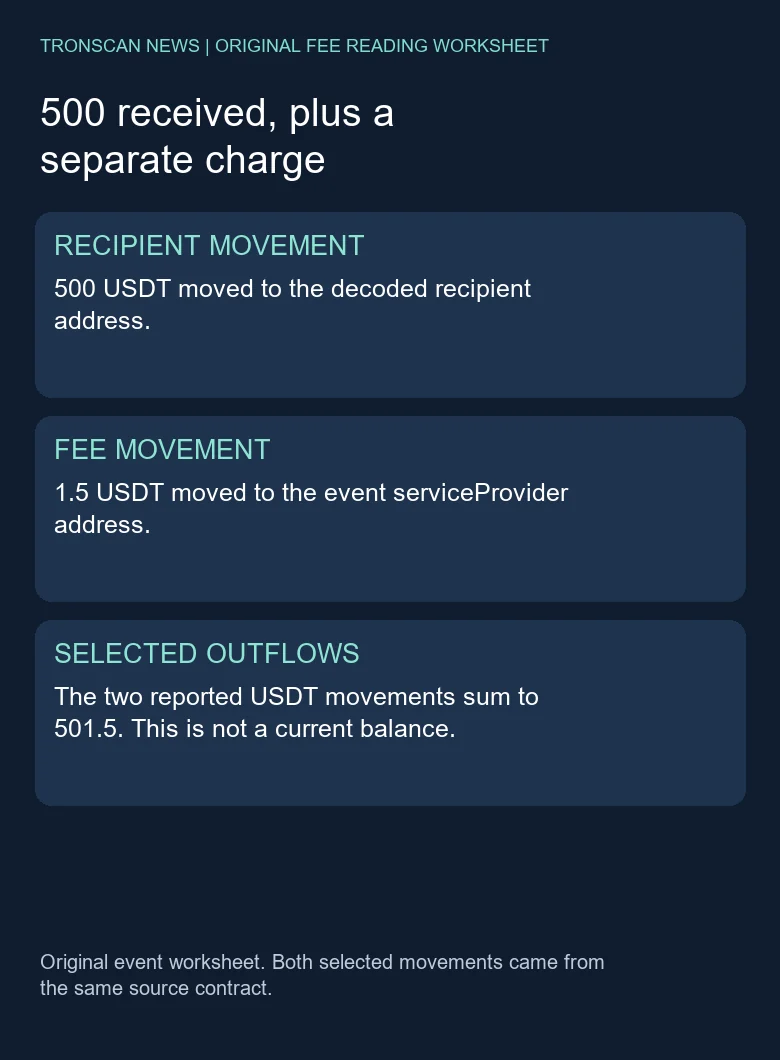
In this GasFree USDT fees example, the two selected outgoing movements total 501.5 USDT from the same source contract. This is arithmetic over the reported movements, not a current balance calculation. In this example, treating the 1.5 fee as already subtracted from 500 would misread the two recorded amounts.
The observed GasFree USDT fees do not establish a tariff for every provider, wallet, token or future transfer. The zero activation component describes this event; it does not independently establish the entire activation history of the user’s ordinary account.
Which address is paying which part?
| Field or role | Complete address in the sample | Reading limit |
|---|---|---|
| Transaction Owner Address | TFNX7TKYCm1kUYDECjkrogBwYZvt69XQNy | Top-level transaction account, labeled GasFree Service Provider by the explorer |
| USDT source in both movements | TEmJuZAmYt3G6kTLtc4VnKBEYikBH3H5HS | Contract from which the two token movements were reported |
| Event serviceProvider | TLntW9Z59LYY5KEi9cmwk3PKjQga828ird | Provider field in the event and recipient of the 1.5 USDT movement |
The transaction Owner Address and the event’s serviceProvider value are different addresses. Keep their field labels. A single word such as “sender” can otherwise hide the distinction between transaction submission, the token source and the fee recipient. Our checked transaction-sender role guide explains that broader reading problem.
GasFree USDT fees: keep two limits separate from charges
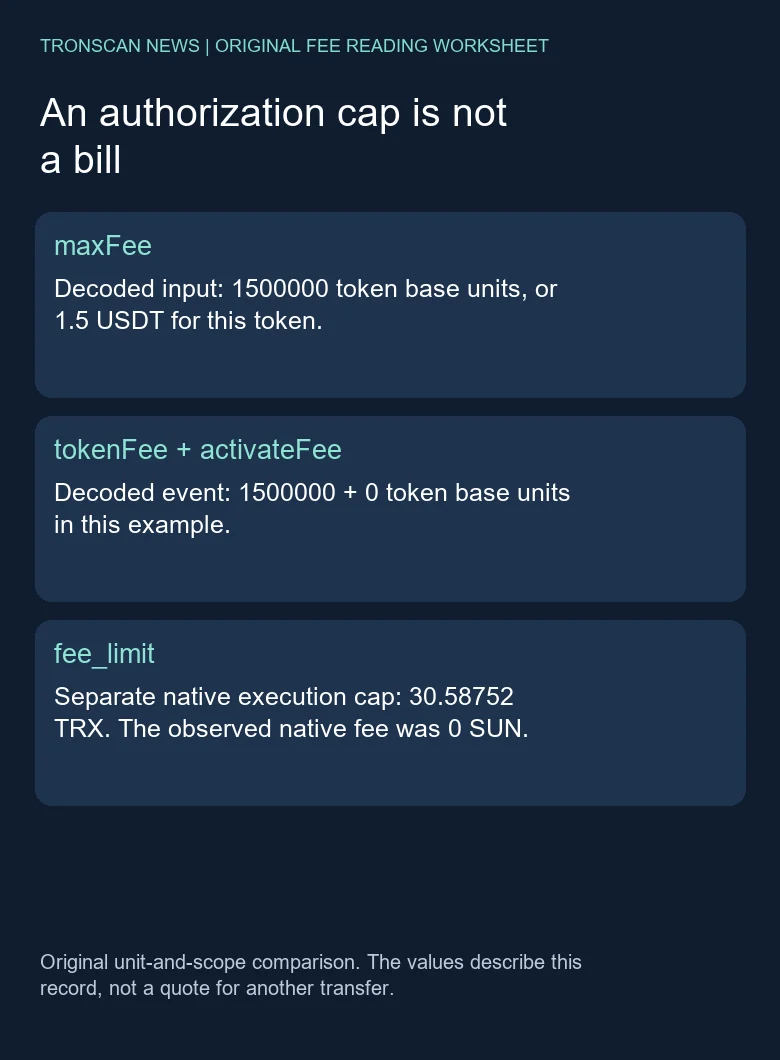
The decoded permit input included maxFee=1500000. The protocol document describes maxFee as the token-denominated maximum for transfer and activation fees. In this sample, the event’s 1.5 USDT tokenFee plus zero activateFee equaled that limit. Equality here does not make a limit field a universal record of actual charges.
A different field, native fee_limit, was 30587520 SUN, displayed as 30.58752 TRX. It is a native execution limit, not 30.58752 USDT and not the native fee actually charged in this receipt. The separately reported native fee was zero SUN.
How to review a GasFree USDT fees record
- Match the hash and network. Start with a particular Mainnet receipt, not a generic fee advertisement.
- Verify the token contract. Keep USDT amounts separate from a similarly named token or a different supported asset.
- Read each token movement. Compare the source, destination and exact decimal amount; avoid counting the same decoded Transfer twice.
- Inspect the GasFreeTransfer event. Record tokenFee and activateFee beside the event’s token and provider fields.
- Read native fee and resources separately. Preserve the unit for every number. The USDT transfer Energy comparison explains why resource use and a cash fee are different observations.
- Retain the observation time and limits. A historical record is not a current quote for another wallet or provider.
The success standard for a GasFree USDT fees review is a reconciled record: token amount, event fee, native fee, resource counts and cap fields remain distinguishable. We compared the explorer views with one saved public explorer API response and completed fourteen field checks. Both representations came from the same explorer provider; this was not independent-node consensus verification.
Five frequently asked questions
1. Are GasFree USDT fees always zero?
No. The checked event recorded a 1.5 USDT tokenFee even though the native receipt fee was zero SUN. It is one example, not a universal tariff.
2. Did the recipient receive 498.5 USDT in this example?
No. The reported recipient movement was 500 USDT, with a separate 1.5 USDT fee movement. We did not infer an exchange-account credit.
3. Are GasFree USDT fees the same as fee_limit?
No. The token charge and token maxFee have their own scope, while native fee_limit is a separate TRX-denominated execution limit.
4. Can GasFree USDT fees include activation?
The protocol documentation describes an activation component when applicable. This event’s activateFee was zero; that does not establish an account’s full history.
5. Did we test current GasFree USDT fees in a wallet?
No. This article interprets one public receipt. We did not check a personal wallet’s current quote or verify a global provider tariff.
Sources, method and corrections
The independent Tronscan News editorial team checked the cited sources and public record on 30 October 2026. Tables, arithmetic and diagrams are original. AI assisted drafting and diagram preparation. We did not connect a wallet, reuse a permit, sign, submit or send a transaction. Find our editorial and correction information from the Tronscan News homepage.
Leave a Reply