A TRON withdrawal fee shown by an exchange and a fee recorded in a TRON transaction receipt are separate observations. First identify what the service’s amount field means, then reconcile the USDT movement, and keep the receipt’s SUN or TRX charge in its own column. Subtracting a TRX fee from a USDT amount does not explain a missing token balance.
This practical audit supplies two exact amount models, a tested local calculator and a dated public receipt. The service examples are explicitly synthetic. The public transaction is real, but we do not attribute it to an exchange withdrawal or claim to have performed it. No private exchange account, wallet connection, signature or funded action was used.
Checked October 29, 2026. Tronscan News is independent of TRON, TRONSCAN, Tether and the exchanges mentioned as sources. The original worksheets, diagrams and code were prepared with AI assistance, source checks and local testing. This is a record-reading method, not a current tariff, provider recommendation or guarantee of future cost.
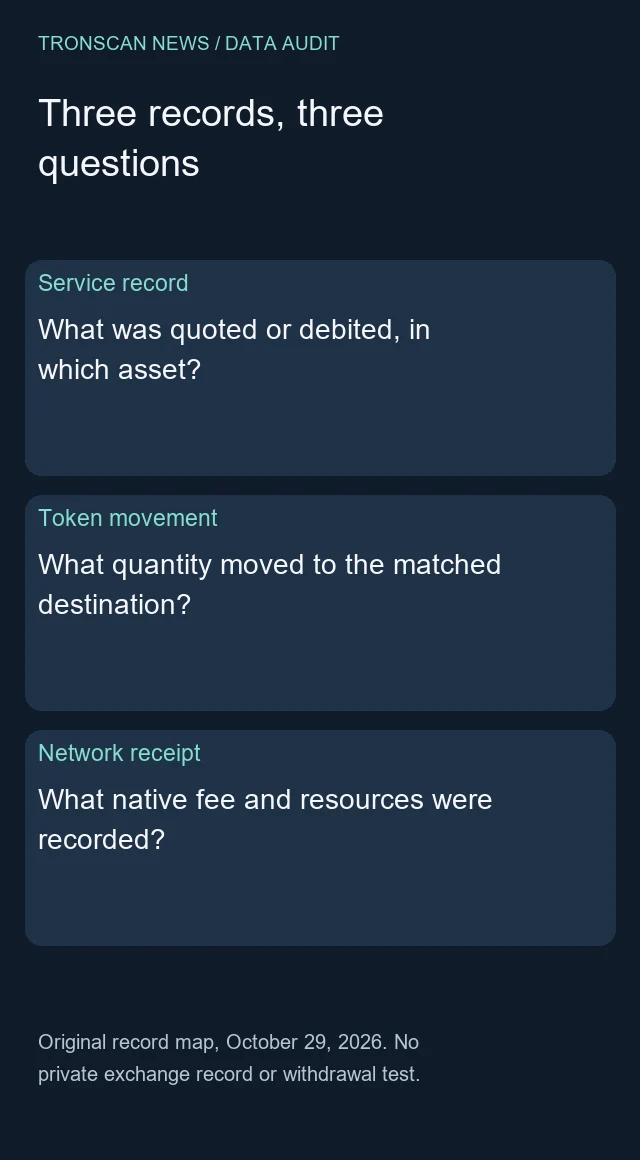
Table of Contents
1. Define the TRON withdrawal fee question
Write the question before comparing screens. Are you checking the amount deducted by a service, the amount sent to a destination, the token quantity credited by a recipient or the native fee in a blockchain receipt? Those questions can require different evidence even when a product displays them together.
Our TRON USDT main guide explains the wider asset and resource relationship. This support article concentrates on amount-field semantics and reconciliation. It does not create another general explorer guide or replace a service’s own account records.
As one provider example, Kraken’s withdrawal-fee reference says fees can change, may differ from its displayed reference and are shown at confirmation. The page observed during this review was labelled last updated December 31, 2025. We use that source for the need to preserve the actual confirmation quote, not as proof of today’s fee for a particular account, country or USDT network.
Do not import the invented fee in our calculator into a real provider’s tariff. Its purpose is to test arithmetic and source labels. For a real case, capture the network, asset, service’s exact field labels, displayed fee and time from the actual record you are authorized to view.
2. Keep three records in the TRON withdrawal fee worksheet
| Record | Preserve | What it cannot establish alone |
|---|---|---|
| Service confirmation or completed history | Provider, network, asset, amount label, service charge and operation reference | The exact on-chain native fee without the matching receipt |
| Token movement | Full transaction ID, exact token contract, destination and raw or properly scaled amount | The service’s private total debit or pricing policy |
| Execution receipt | Matching ID, block, outcome, fee units and resource fields | The customer’s exchange charge or receiving-service credit |
For a real reconciliation, confirm that records refer to the same operation. A service’s internal order number is not automatically a blockchain transaction hash. If the service supplies several hashes, preserve the mapping it provides rather than selecting a convenient transaction with a similar amount.
Retain the complete token identifier. Tether’s protocol reference links TRON USD₮ to TR7NHqjeKQxGTCi8q8ZY4pL8otSzgjLj6t. A ticker, logo or shortened address is insufficient to identify an observed token movement. The token contract is also different from a personal receiving address.
This article’s public receipt and synthetic service note are intentionally separate examples. They demonstrate the columns, not a real customer-to-exchange accounting match. Keeping that boundary explicit prevents a genuine transaction hash from lending false authenticity to an invented withdrawal.
3. Resolve gross and net amount semantics first
Synthetic model A: gross debit. Suppose a service field means that 100 USDT is the total debit and that an explicitly stated 1 USDT charge is deducted from it. Under this model, the expected recipient quantity is 99 USDT: 100 − 1 = 99. The equation follows from the assumed meaning of the field; it is not a universal exchange rule.
Synthetic model B: net recipient. Suppose instead that 100 USDT is the requested recipient quantity and the same invented 1 USDT charge is added separately. The expected recipient quantity remains 100 USDT and the model’s total debit is 101 USDT. The identical number in a field called amount can therefore lead to different expectations when its meaning changes.
| Explicit model | Expected recipient | Total debit in the model |
|---|---|---|
| Gross debit G, service charge F deducted | G − F | G |
| Net recipient N, service charge F added | N | N + F |
| Amount basis unknown | Unresolved | Unresolved until the provider defines the field |
These models assume the charge and amount use the same asset and an explicitly defined deduction rule. A charge paid in another asset, a bundled conversion or a separate invoice needs its own model. Do not force it into either equation just because the screen contains two numbers.
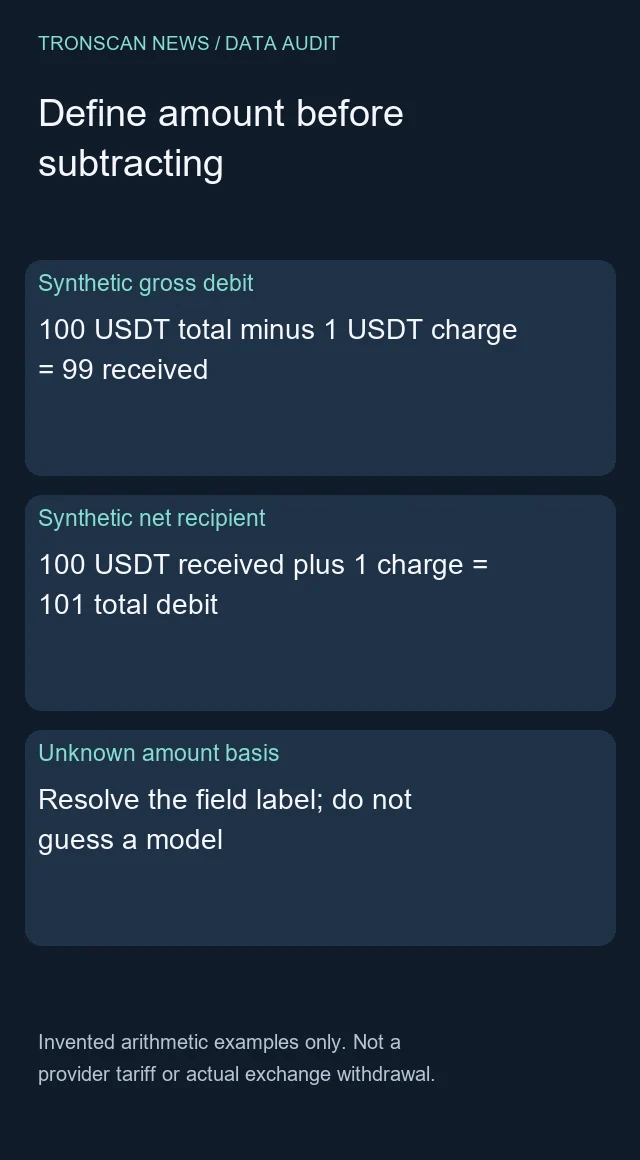
Record the expected quantity before reading the destination movement. Otherwise it is tempting to choose whichever interpretation happens to match the visible result. A reproducible method states the field meaning and equation first, then checks the observed quantity against that expectation.
4. Inspect the actual TRON receipt independently
At 01:11:35 UTC on October 29 we retrieved a Mainnet block and selected the first successful single-contract call to the issuer-linked token contract with the transfer selector. We then queried its body and execution receipt through api.trongrid.io. This one-record selection is not a network-cost survey and does not identify a service or customer.
| Actual source field | Observed value | Reading boundary |
|---|---|---|
| Transaction ID | 530fe4aa80f9427cb25a469abc5ebb08230db6dff8adcb97ce0ec895d3ad4a8e | Body and receipt identifiers matched |
| Block | 87520996 | One dated public observation |
| fee | 345000 SUN | 0.345000 TRX after unit conversion |
| receipt.net_fee | 345000 SUN | A named fee component, not an additional amount to add twice |
| receipt.energy_usage_total | 130285 Energy | Resource quantity, not 130285 SUN or USDT |
| receipt.result | SUCCESS | Provider-reported execution outcome |
| receipt.energy_fee | Field not present in the saved JSON | No explicit numeric zero is invented by this worksheet |
The official receipt API reference distinguishes the post-execution receipt from the transaction body. Our queries used the Mainnet host stated above; the documentation’s example host should not be copied into a different network investigation without checking it.
A later read-only walletsolidity/gettransactioninfobyid lookup returned the same complete transaction ID, 345000 SUN fee and SUCCESS label. We retained that response separately. This checks consistency between two endpoint observations from the same public provider; it is not an independent consensus audit or evidence of an exchange customer credit.
The source also returned energy_usage 130284 and origin_energy_usage 1. Their sum matches the returned energy_usage_total in this observation. That arithmetic is a consistency check on selected fields, not an independent audit of execution or a statement about the customer’s economic cost of acquiring resources.
The official Energy-cost guide states the SUN scale of one million per TRX and separates a caller’s fee_limit budget from settlement. Our conversion is therefore 345000 / 1000000 = 0.345000 TRX. It does not create a fixed fee for another transfer or convert the result into USDT.
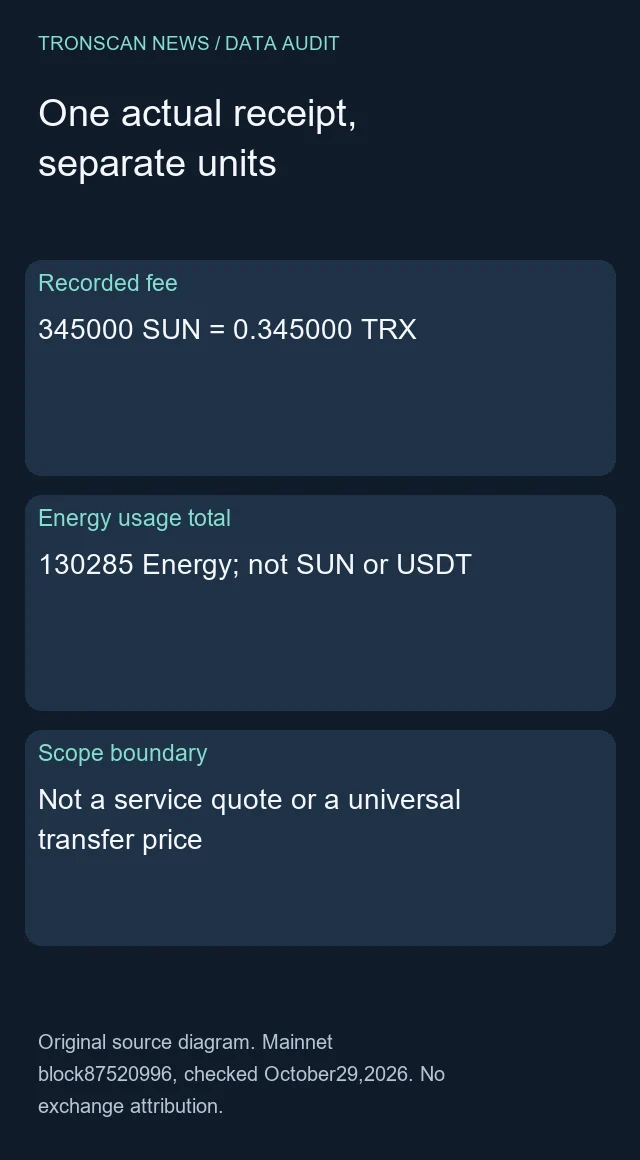
Do not add net_fee to fee automatically. In this record they have the same numeric value but different field scope. Adding a component to a total can double-count a charge. If you need a complete settlement analysis, establish the schema and coverage of every component before summing them.
5. Run the local TRON withdrawal fee calculator
The original program below keeps the synthetic service arithmetic and actual receipt conversion in separate functions. Save it as reconcile.py. It reads local JSON files only, uses exact decimal strings for the invented USDT quantities and uses integer division for SUN formatting. It does not connect to an exchange, quote a live fee or submit a transfer.
Save this clearly labelled example as synthetic-note.json. The synthetic flag is required so the demonstration cannot silently be described as a real customer record.
{"synthetic":true,"asset":"USDT","network":"TRON","amount_basis":"gross_debit","requested":"100.000000","service_fee":"1.000000","received":"99.000000"}For receipt.json, retrieve the exact public transaction’s execution receipt using the documented read-only request below. Check its complete ID and response fields. A later provider error, missing field or different source capture should be retained as such instead of being filled from our table.
curl -X POST https://api.trongrid.io/wallet/gettransactioninfobyid -H "Content-Type: application/json" -d '{"value":"530fe4aa80f9427cb25a469abc5ebb08230db6dff8adcb97ce0ec895d3ad4a8e"}' -o receipt.json
python reconcile.py
The command uses a shell supporting single-quoted JSON, such as Bash. Adapt shell quoting for your environment without changing the request body. This endpoint was publicly accessible during our test; later availability or rate limits are not guaranteed by this tutorial.
import json
import re
from decimal import Decimal
from pathlib import Path

def quantity(value):
    if not isinstance(value, str) or re.fullmatch(r"[0-9]+(?:\.[0-9]{1,6})?", value) is None:
        raise ValueError("Use a non-negative decimal string with at most six places")
    return Decimal(value)

def synthetic_withdrawal(note):
    if note.get("synthetic") is not True or note.get("asset") != "USDT" or note.get("network") != "TRON":
        raise ValueError("This demonstration requires an explicitly synthetic TRON USDT note")
    requested = quantity(note["requested"])
    fee = quantity(note["service_fee"])
    received = quantity(note["received"])
    if note.get("amount_basis") == "gross_debit":
        if fee > requested:
            raise ValueError("Fee exceeds the selected gross debit")
        expected = requested - fee
        debit = requested
    elif note.get("amount_basis") == "net_recipient":
        expected = requested
        debit = requested + fee
    else:
        raise ValueError("Resolve the amount field's meaning before calculating")
    return {"example": "synthetic only", "expected_recipient_usdt": str(expected),
        "observed_example_usdt": str(received), "difference_usdt": str(received-expected),
        "example_total_debit_usdt": str(debit)}

def observed_receipt(receipt):
    if not isinstance(receipt, dict) or "Error" in receipt:
        raise ValueError("Not a successful source response")
    txid = receipt.get("id")
    if not isinstance(txid, str) or re.fullmatch(r"[0-9a-fA-F]{64}", txid) is None:
        raise ValueError("Missing transaction ID")
    result = {"txid": txid, "scope": "public receipt, not attributed to an exchange withdrawal"}
    if "fee" not in receipt:
        result["fee_observation"] = "field not provided; no zero inferred"
        return result
    fee = receipt["fee"]
    if type(fee) is not int or not 0 <= fee < 2**63:
        raise ValueError("Expected non-negative integer SUN")
    whole, remainder = divmod(fee, 1_000_000)
    result.update(fee_sun=fee, fee_trx=f"{whole}.{remainder:06d}")
    return result

if __name__ == "__main__":
    def load(name):
        return json.loads(Path(name).read_text(encoding="utf-8"))
    print(json.dumps({"synthetic_service_example": synthetic_withdrawal(load("synthetic-note.json")),
        "separate_actual_receipt": observed_receipt(load("receipt.json")),
        "comparison": "USDT and TRX are not subtracted; these records are not asserted to be one withdrawal"}, indent=2))
For our saved inputs the synthetic model returned expected recipient 99.000000 USDT, observed example quantity 99.000000 and difference 0.000000. The separate actual receipt output returned fee_sun 345000 and fee_trx 0.345000. The program deliberately does not subtract those TRX units from the USDT example or assert that the sources describe one withdrawal.
Nine synthetic boundary checks passed locally: unknown amount basis, nonnumeric requested quantity, boolean quantity, excessive fee, wrong asset and an unlabelled real-looking note were rejected; the net-recipient model produced a 101.000000 total debit; a missing receipt fee remained unknown; and an explicit zero fee stayed distinguishable from an absent field.
Those altered inputs were local fixtures, not more network observations. The amount parser supports non-negative decimal strings with at most six places for this example. It does not interpret locale commas, scientific notation, arbitrary token scales or a fee paid in another asset. Rejecting those inputs defines the example’s scope rather than declaring every other financial record invalid.
6. Investigate a real TRON withdrawal fee mismatch
Unknown amount label: ask the service whether the field is a gross debit, a recipient amount or another measure. Preserve its explanation with the quote date. Changing the calculator’s mode until the numbers agree would hide the unresolved question.
Different asset units: keep the quantities apart. If a fiat comparison is genuinely needed, supply a separately sourced price and valuation time. This tutorial does not use a one-dollar assumption to make USDT and TRX interchangeable.
Correct token movement, different account credit: the receiving service’s own ledger is the next source. A public movement does not expose all deposit conditions or account adjustments. The reconciliation should state which column differs instead of treating every discrepancy as a blockchain fee.
Estimated budget mistaken for charge: use our TRON fee_limit explanation to separate a caller’s budget from a recorded settlement. A budget ceiling and a completed receipt are different kinds of evidence.
Old resource price used for a current estimate: our dated fee-parameter audit explains how to retain parameter units and observation dates. A parameter value alone still does not supply a provider’s withdrawal tariff.
No receipt or mismatched hash: preserve the gap. An empty response can have several causes and is not evidence of a zero-fee withdrawal. Verify the network and identifier through the original service record before importing another transaction into the worksheet.
7. Keep a reviewable TRON withdrawal fee conclusion
A useful conclusion names the matched sources, the equation applied and the unresolved difference. For a private case, share only relevant evidence through the provider’s established support route. Do not publish account identifiers or a complete financial history merely because a public transaction exists.
| Decision | Evidence needed | Honest result when absent |
|---|---|---|
| Expected recipient quantity | Actual amount label, asset and explicit charge rule | Amount semantics unresolved |
| Observed token movement | Correct network, hash, contract, destination and units | Movement not matched |
| Native recorded fee | Matching receipt with field scope and SUN units | Fee observation unavailable |
| Provider pricing explanation | Current quote, completed service record and provider policy | Not established by an explorer |
| Refund or adjustment | Actual service decision and applicable conditions | No promise of recovery or reimbursement |
Synthetic follow-up exercise: change the received quantity to 98.500000 while leaving model A unchanged. The arithmetic difference becomes negative 0.500000 USDT. That identifies a discrepancy under the assumed model; it does not identify its cause. The next step is to verify the amount meaning and source mapping, not to label the difference a hidden network charge.
For model B, a received quantity of 99.000000 would instead differ from its 100.000000 expectation. The same observed quantity supports a different discrepancy when the amount basis changes. This is why the field definition belongs in the evidence note, not just in an analyst’s recollection.
Preserve later corrections as new observations. If the provider adjusts a service record or explains a different deduction rule, record when that explanation became available and recompute the affected column. Keep the original quote so a reviewer can distinguish new information from an arithmetic correction.
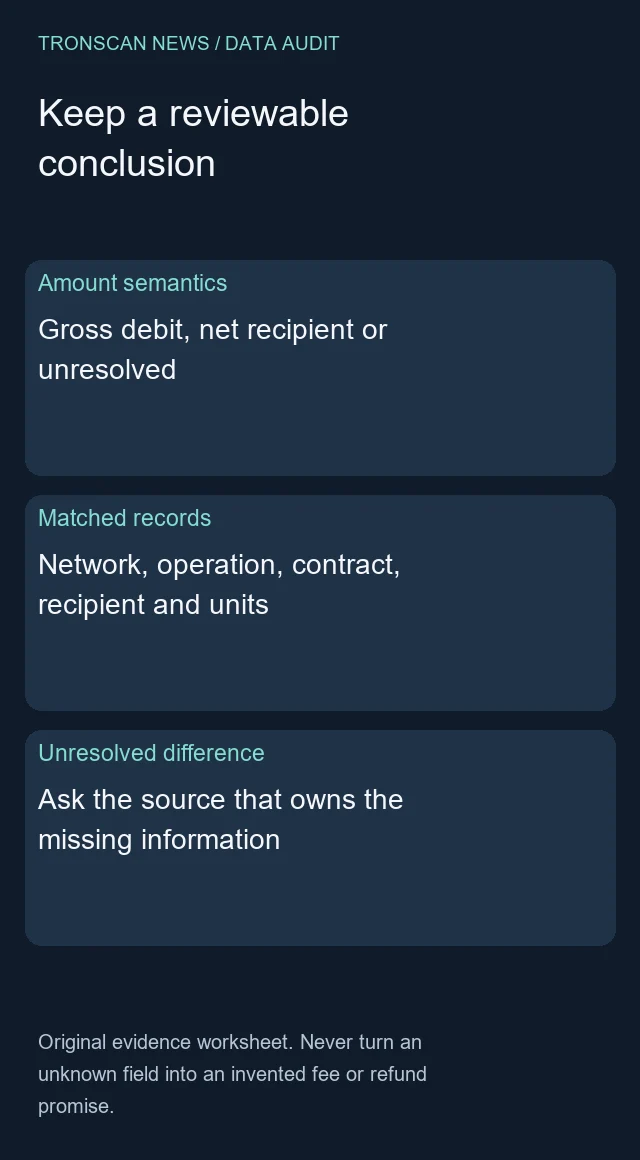
More English tutorials are available from the Tronscan News homepage. The practical endpoint is a source-backed explanation of what matches and what still needs a provider answer. A receipt can clarify one part of the record without settling every service-account question.
Frequently asked questions
Must an exchange’s TRON withdrawal fee equal the receipt fee?
No such equality is established by this method. The service charge and public receipt have different sources, units and scopes; inspect the actual provider record before drawing a conclusion.
Can I subtract a TRX fee from a USDT quantity?
Not as a same-asset reconciliation. Keep TRX and USDT separate. A fiat comparison needs an additional price source and observation time, which this example does not supply.
Does the actual 0.345 TRX observation quote my next transfer?
No. It describes one dated receipt. It is neither a current exchange tariff nor a prediction of another transaction’s resource settlement.
Does a missing fee field mean the TRON withdrawal fee was zero?
This worksheet does not infer zero from an absent JSON field. It preserves field presence separately; an explicit zero and missing evidence remain different observations.
Did the calculator perform an exchange withdrawal?
No. Its service amounts are labelled synthetic, while the actual public receipt is a separate observation. The program reads saved files and performs local arithmetic.
Leave a Reply