TRON rewards, liquid TRX and matured unstaking principal are three different records. A rewards query does not tell you how much Stake 2.0 principal is ready to withdraw, and neither query proves that a withdrawal completed. Start with the source of the amount before comparing numbers in a wallet or explorer.
This guide is for readers trying to understand a public unclaimed amount or a withdrawal label. We checked official references and anonymous Mainnet responses on 1 November 2026. No wallet was connected. We did not stake, vote, claim rewards, create an unsigned withdrawal, sign or broadcast a transaction.
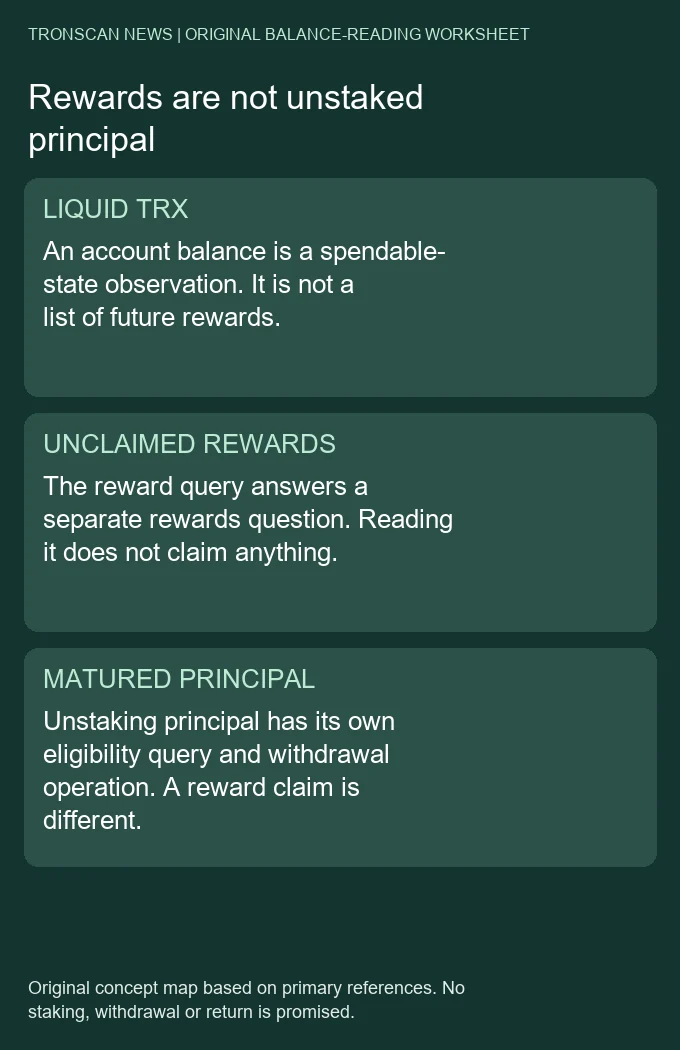
Table of Contents
Three balance records that answer different questions
The official reward-distribution explanation distinguishes rewards accruing to an account from moving them into spendable balance. It identifies a public query as a way to inspect unwithdrawn rewards. This does not make an unstaking request or return staked principal.
| Record | Question it answers | What it cannot establish alone |
|---|---|---|
| Liquid TRX balance | What native balance does this account result report? | The origin of every unit or the maximum amount a later operation can send |
| Unclaimed rewards | What rewards does the rewards endpoint report as unwithdrawn? | The amount of matured unstaking principal |
| Withdrawable unstaking principal | What unstaked principal is eligible at the query timestamp? | A completed withdrawal or future rewards |
The staked TRX and available-balance guide remains the starting point for principal states. This article adds a separate rewards-versus-principal investigation, including a real explicit-zero result and an empty principal-query result.
Choose the query before reading its amount
The official staking and rewards API map lists separate reading and state-changing operations. Here we used reading routes only. Similar words such as withdraw or balance do not make two endpoints interchangeable.
| Purpose | Named route | Role in this guide |
|---|---|---|
| Read the unclaimed amount | /wallet/getReward |
Actual read performed |
| Read eligible unstaking principal | /wallet/getcanwithdrawunfreezeamount |
Actual query attempted, then retried once after a rate limit |
| Claim the accrued amount | /wallet/withdrawbalance |
Documentation only; not called |
| Withdraw matured principal | /wallet/withdrawexpireunfreeze |
Documentation only; not called |
The rewards-withdrawal reference concerns moving rewards into account balance. The matured-principal reference concerns the Stake 2.0 flow after the network-defined pending period. No fixed delay, fee, APR or guaranteed return is inferred in this worksheet.
What our actual Mainnet check returned
We obtained a public account from the node’s witness list by selecting the first returned entry with isJobs: true. This was a reproducible sample-selection rule, not a ranking, recommendation or ownership claim. The full account was TN2W4cc7a4dsYyTLiLMWa9m7jVpdLjGvYs.
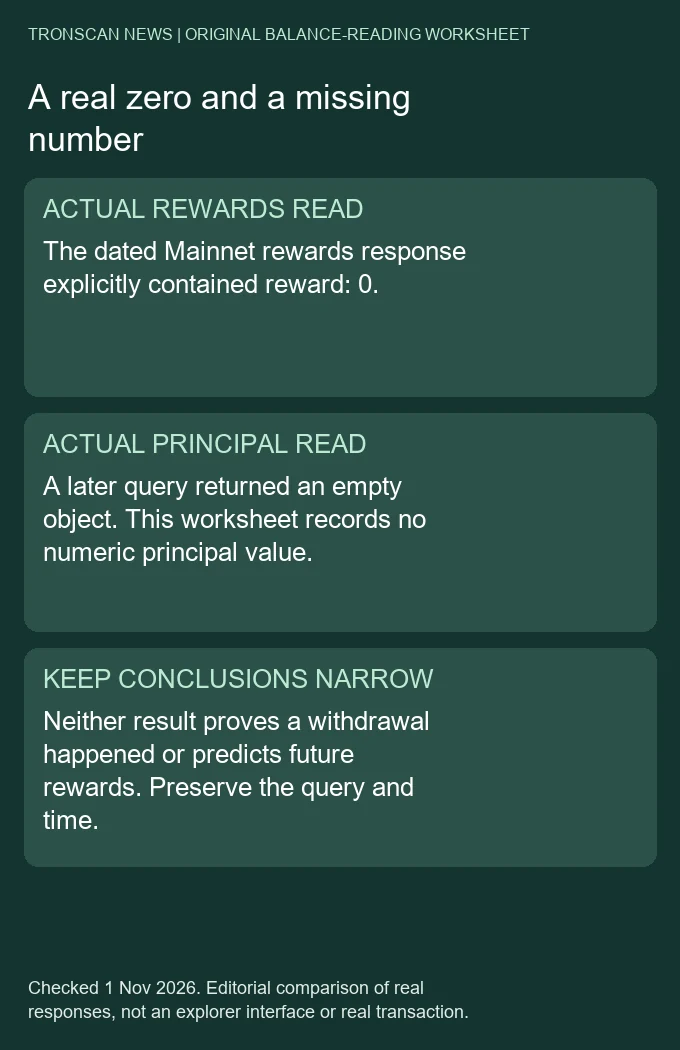
Our request to the Mainnet api.trongrid.io host’s getReward route used that address with visible: true. It returned HTTP 200 and the body {"reward":0}. The GetReward reference defines its reward amount in sun. The explicit zero is a dated result for that query and account.
It does not say that the account never received rewards, never withdrew rewards, has no liquid TRX, or will receive nothing later. A current unclaimed amount is not a lifetime earnings history. We retained the raw body without using it to estimate an annual return.
The principal query produced different evidence
The first principal-query attempt returned HTTP 429. We recorded that as unavailable evidence and did not turn the failure into zero principal. After separate research and acceptance work, one later request to the same host returned HTTP 200 with an empty JSON object, {}.
For that later request, the account was unchanged, visible was true and the timestamp argument was 1793506369677 milliseconds. The saved request time was 1 November 2026 at 04:12:49 UTC. The original failed attempt’s precise timestamp was not retained, so we do not invent one.
The principal-eligibility query reference makes the timestamp part of the question. Our empty object supplied no numeric amount for this evidence sheet. We leave that amount unprovided rather than publishing a measured zero or a withdrawable total.
| Actual observation | Recorded number | Permitted conclusion |
|---|---|---|
| Rewards: HTTP 200, reward key present | 0 sun | Explicit unclaimed rewards result at the read time |
| Principal: first attempt HTTP 429 | Unavailable | Rate-limited query, not a measured principal amount |
| Principal: later HTTP 200, empty object | Not provided in the retained body | No numeric principal value established by this worksheet |
The two reads were not one atomic snapshot. Preserve their separate times, fields and purposes. Adding an explicit zero to a missing amount cannot produce a verified total. A transport success also does not supply the business meaning of a missing field.
Read amounts without silently filling missing values
The local Python helper below accepts a named nonnegative integer field and converts sun to TRX using exact decimal arithmetic. It makes no network request and no withdrawal. Missing fields, Error objects, Boolean values and unsupported number representations return None, which means this helper has no usable number.
from decimal import Decimal, localcontext
import re

def read_sun(obj, key):
    if type(obj) is not dict or 'Error' in obj or key not in obj:
        return None
    value = obj[key]
    if type(value) is int and value >= 0:
        raw = str(value)
    elif type(value) is str and re.fullmatch(r'[0-9]+', value):
        raw = value
    else:
        return None
    with localcontext() as ctx:
        ctx.prec = max(80, len(raw) + 10)
        return Decimal(raw) / Decimal(1000000)
Ten local checks passed: the two retained real bodies and eight explicitly synthetic cases. The actual getReward body produced zero. The real empty principal body produced None when asked for an amount field. That result is the helper’s conservative reading rule, not a complete implementation of every node’s default-serialization behavior.
For invented input {"reward":"1500000"}, the helper returned 1.5 TRX. For the invented string 9007199254740993, it returned exactly 9007199254.740993 TRX. Neither value is an actual amount in this test. The large example tests precision preservation; it does not imply a plausible balance or an earning opportunity.
The other synthetic cases rejected a float, a negative integer, a Boolean, null, scientific-notation text and an Error object containing a tempting zero. This prevents a malformed or failed response from becoming a confident amount merely because a default value is convenient.
Four steps for reading a withdrawal-related record
- Identify the source category. Write rewards, liquid balance or unstaking principal before copying the number. Keep the exact public account and network with it.
- Separate a query from an operation. A response from getReward is a read. A withdrawal-related transaction needs its own genuine transaction identifier, recorded operation and execution result.
- Preserve units, timestamp and missing fields. Do not replace unavailable evidence with zero or carry a timestamped principal result into an undated rewards comparison.
- Write the narrow outcome. State which amount was actually returned, which remained unavailable, and whether any confirmed withdrawal was inspected. In this test, none was.
If you already have a genuine withdrawal transaction, start with the TRONSCAN record-selection guide. This article does not supply a transaction hash for these queries. Read-only requests and local arithmetic do not create withdrawal receipts.
Common disagreements and the next useful check
A wallet’s rewards label differs from a principal figure. Check the underlying category and timestamp first. A difference between unclaimed rewards and matured principal is not automatically a missing payment. They describe different sources of TRX.
The unclaimed value changed between two reads. Preserve both observations rather than overwriting the first. Accrual and withdrawal history can matter, but this test did not reconstruct either history or attribute a change to a particular event.
A success label is shown beside a query. Determine whether it describes HTTP transport, a query result or a confirmed chain operation. Our HTTP 200 empty object illustrates why success at one layer is insufficient at another.
A site promises a fixed yield from the displayed amount. This worksheet calculates no yield. A dated unclaimed amount, including a positive one, is not a guaranteed future income rate. We did not recommend a representative or assess an investment.
Copyable two-category evidence note
Public account / network:
Question: rewards, liquid balance or principal:
Exact source route / check time:
Timestamp argument, if applicable:
HTTP result / application error:
Literal amount field and original unit:
Missing fields / unresolved conditions:
Genuine withdrawal TxID, only if one exists:
Limited conclusion / next evidence needed:
For a different reward-reading question, use our Brokerage, voter-pool ratio and APR comparison. A current percentage setting is not the queried unclaimed amount or a completed withdrawal. Preserve the source, observation time and denominator before using a percentage to explain a reward figure.
Frequently asked questions
Are unclaimed rewards the same as unstaking principal?
No. The rewards query and principal-eligibility query answer separate questions, with separate withdrawal operations.
Does reading rewards claim them?
No. Our tested rewards request only returned a public amount. No withdrawal transaction was created or submitted.
Does reward zero prove there were never any rewards?
No. The observed zero describes one unclaimed-amount response, not lifetime accrual or withdrawal history.
Is an empty principal response a verified zero?
This worksheet did not establish a numeric principal value from the empty body. It records the missing number explicitly.
Did this test verify a successful withdrawal?
No. It checked public query responses, documentation and local number-reading cases. No withdrawal receipt or private account credit was tested.
Independent Tronscan News editorial review with AI-assisted drafting and source checks on 1 November 2026. Two original diagrams and a ten-case local numeric reader support the method. Actual query limitations, including HTTP 429 and an empty body, are preserved. No staking, voting, withdrawal, APR, future income or service-credit claim is made. Find other guides through the Tronscan News homepage; corrections can be raised through About & Standards.
Leave a Reply