A TRON message signature binds a signature format to specific message bytes. By itself, it is not a transfer receipt, proof of a fresh login or a complete audit of an account’s authority. A useful verification result must preserve the exact message and compare the recovered address with an independently expected address.
This guide is for readers given a signed text, rather than a transaction hash. On November 2, 2026, we ran a synthetic offline experiment with TronWeb 6.5.1. The key existed only in the local test process, was not saved or printed, and was never funded or used on chain. The published message, signature and expected address below are test fixtures, not a real user’s login or payment.
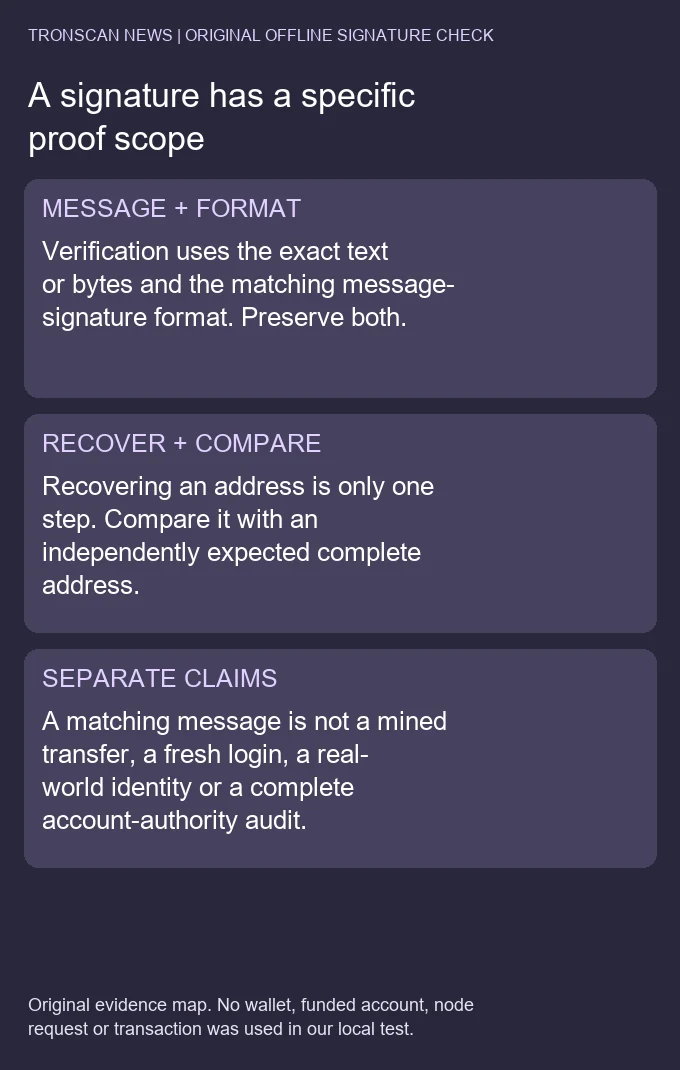
Table of Contents
Four limits of a message signature
- Exact input matters. Text, bytes, whitespace and the selected signing format belong to the record. A visually similar string can be different input.
- Recovery needs a comparison. The verifier can return an address even when the supplied text is not the original. A returned address must match the one expected for the actual task.
- Freshness is a separate check. Repeating cryptographic verification does not consume a message. A real login needs its own challenge and expiry handling.
- Transfer and authority claims need other evidence. A message signature does not supply a transaction receipt, token movement or the current signing rules of an account.
The official TronWeb message guide pairs signMessageV2 with verifyMessageV2 and distinguishes them from the older message APIs. It also explains that a string such as 0x1234 is text input, rather than automatically meaning two hexadecimal bytes. We tested that distinction locally instead of treating appearance as a type declaration.
What our offline test actually verified
We used the package pinned as tronweb 6.5.1 with Node 24.19.0. The script used static Trx methods without constructing a network-connected TronWeb instance. No provider host, API key, wallet session, account activation, balance query, transaction builder or broadcast was configured in the experiment.
The synthetic text included an example.invalid domain label and a local-test nonce label. Those labels were part of the message; we did not operate that domain or create a server challenge there. We derived a test address from an ephemeral local key, generated fixture signatures, discarded the key reference and retained only public fixture material and test results.
The successful result was narrow: the signature over the exact original text recovered the expected test address. It did not establish that a live account existed on Mainnet, that its balance was zero, that a person owned it or that a website had authenticated a visitor. We made none of those network or identity checks.
A copyable verification-only example
The verifyMessageV2 reference describes recovery of a Base58 address. This example uses the exact public fixture generated for our test. It needs the tested TronWeb package and performs local verification only. No private key is included or requested, and no signing step is part of this reader example.
const { Trx } = require('tronweb');
const message = "Tronscan News offline message fixture | example.invalid | nonce: local-test-20261102";
const signature = "0xdf46c0e8c3c4cd96a25719adfcffdadd0fc9c83801308f3c1f9273d9a061e8b87632cc01061c66054f10d5101df3e210da05ca5aa5571b4296fe980ab050b5411b";
const expectedAddress = "TFVxa6gUC3v3bUZthaZ2fTj4JNvphb1ytU";
try {
  const recovered = Trx.verifyMessageV2(message, signature);
  console.log(recovered === expectedAddress);
} catch {
  console.log(false);
}
Running this exact copyable example in our test environment printed true. The expected address was TFVxa6gUC3v3bUZthaZ2fTj4JNvphb1ytU. Matching that address is a fixture result, not an instruction to send assets to it. Treat the whole example as synthetic material, including its message and signature.
Keep the catch branch, but do not reduce all failures to one cause. A malformed encoding can throw, while a well-formed signature checked against different text can recover a different address. Both fail our expected-address comparison, but their evidence records differ. Preserving that distinction makes a support note reproducible.
The ten cryptographic checks
| Case | Observed result | Scope |
|---|---|---|
| exact text | Matched expected address | Synthetic offline fixture |
| trailing newline | Did not match expected address | Synthetic offline fixture |
| other claimed address | Did not match expected address | Synthetic offline fixture |
| different domain text | Did not match expected address | Synthetic offline fixture |
| 63-byte truncated signature | Rejected malformed input | Synthetic offline fixture |
| text hex exact | Matched expected address | Synthetic offline fixture |
| text signature against bytes | Did not match expected address | Synthetic offline fixture |
| bytes exact | Matched expected address | Synthetic offline fixture |
| bytes signature against text | Did not match expected address | Synthetic offline fixture |
| same signature reverified | Matched expected address | Synthetic offline fixture |
These are ten offline cases, not ten blockchain transactions. The malformed case removed two bytes from the generated 65-byte fixture and produced a 63-byte input that the tested verifier rejected. We do not claim that every non-65-byte representation is invalid. An initial one-byte-truncation assumption was not supported by the local test, so that broader assertion was withdrawn.
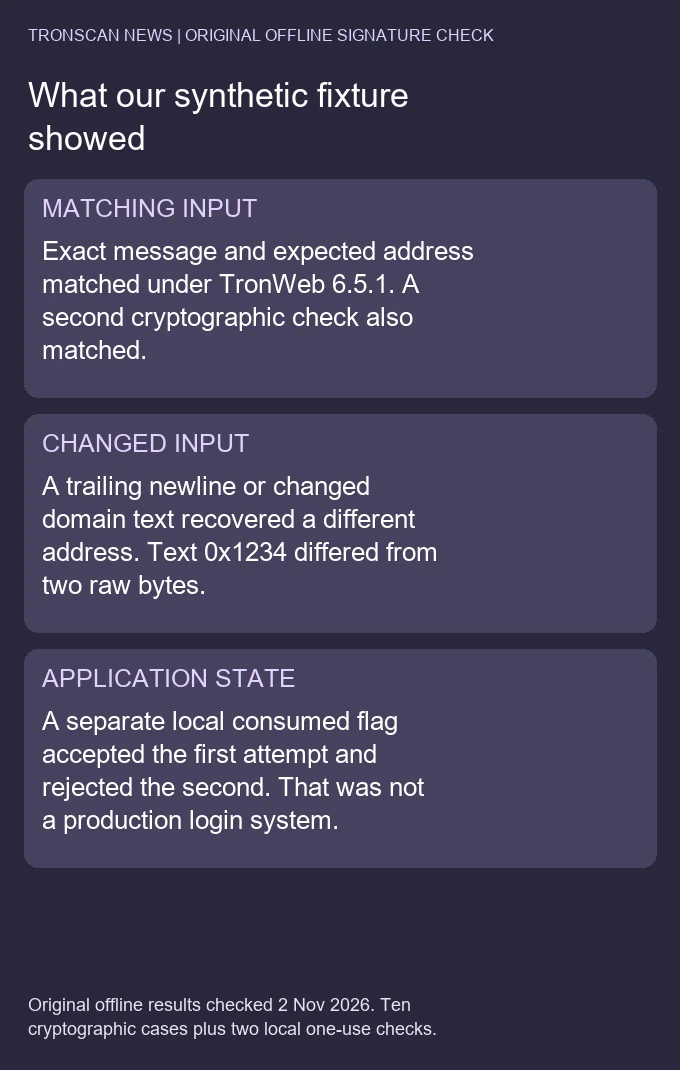
The result also shows why a verifier should compare addresses rather than accept any returned string. Appending one newline recovered a different valid-looking address in our fixture. The original signature was not evidence that the altered message came from the expected signer. A successful API return and a successful task-specific comparison are different conditions.
Text 0x1234 versus raw bytes
We tested the six-character string 0x1234 separately from Uint8Array([0x12, 0x34]), which contains two bytes. Each matched when signed and verified with its own representation. Crossing the representations did not match the expected address. The literal prefix 0x in a JavaScript string did not perform a conversion.
Do not repair a mismatch by trying input encodings until one gives a preferred address. Establish the format used by the original signing flow and preserve that format with the message. The TIP-191 signed-data specification supplies the broader format context; this guide tests the named V2 utility, not every signature format or smart-contract validator.
Our scope excludes legacy V1 compatibility, TIP-712 typed data, hardware-wallet prompts, contract-based account verification and multisignature threshold checks. Those are separate tasks. A passing V2 text fixture does not validate a message that was produced by a different method, nor does it establish that another library version behaves identically.
Why repeating the same signature still worked
The exact original message and signature matched again on the second cryptographic verification. That is expected for a deterministic verification question: the utility does not know that an application has already used the message. It has no session database or consumed-nonce record in this test.
We added a separate, explicitly synthetic in-memory consumed flag. Its first check accepted the matching fixture; its second check rejected reuse. Those two application-level checks bring the total to twelve. They demonstrate a boundary between cryptographic verification and application state, not a production-ready authentication implementation.
The official wallet sign-in guide describes a server-generated challenge, stored message, expected-address comparison and nonce consumption before issuing a session. Our small local flag did not implement that full flow, challenge expiry, durable storage, concurrency handling or origin policy. It must not be copied as a deployable login service.
Choosing a message record or a transaction record
If the question is whether text matches an expected signing address, preserve the message signature evidence. If the question is whether TRX or USDT moved, use a transaction hash, correct network and execution record. The TRON transaction lookup guide covers that transfer-reading path.
A signature-looking hexadecimal string is not automatically a TxID. If the record instead has a domain and named type definitions, use the separate TRON typed data verification guide, checked November 2, 2026. It tests structured-field coverage; the plain V2 text fixture on this page does not validate that different format or establish a transaction receipt.
For an account with current owner or active permissions, key recovery alone is not a threshold or permission audit. Use the account-permission reading guide to keep that question separate. We did not fetch the current permission structure of our synthetic address or claim it could authorize a token transfer.
A practical signature evidence note
The useful deliverable is a short note showing which exact input was tested, which format and version were used, and what comparison succeeded or failed. Avoid placing a real login challenge or sensitive message into a public support post; our published fixture was created specifically for public demonstration.
Purpose / message source / observation time:
Exact text or bytes, with whitespace preserved:
Signing and verification format / SDK version:
Public signature representation:
Independently expected complete address:
Recovered address / comparison result / thrown error:
Separate challenge freshness or reuse check:
What was not checked: account, permissions, receipt or identity:
A mismatch can be a useful result. Stop the claimed verification and ask for the original message and format rather than changing the expected address. A match is useful too, provided the conclusion remains limited to the tested message and expected-address comparison. Neither branch calls for a wallet connection or a new transfer in this tutorial.
Frequently asked questions
Is a TRON message signature a transfer receipt?
No. Our message check ran offline and created no on-chain record. Transfer execution needs separate transaction evidence.
Does any recovered address mean verification passed?
No. The result must match the independently expected address for the exact message and format.
Can I change spaces or add a newline before checking?
Our trailing-newline fixture did not match. Preserve the original input rather than normalizing it without an established rule.
Does cryptographic verification prevent replay?
No. The same fixture matched twice. Freshness and one-use challenges are application-layer checks.
Does the published example require a private key?
No. It contains only public synthetic message, signature and expected-address data. No signing, node call or broadcast is performed.
Independent Tronscan News review with AI-assisted drafting and primary-source checks on November 2, 2026. Evidence includes a pinned SDK, ten synthetic offline cryptographic cases, two local one-use checks, an exact executed reader example and two original diagrams. No funded account, production login, wallet prompt, on-chain authority, balance or payment is claimed. Browse the Tronscan News homepage; use About & Standards for corrections.
Leave a Reply