TRON JSON-RPC offers Ethereum-style method names, but each method still needs its own network, unit and coverage check. A successful hexadecimal response is not proof that every Ethereum assumption applies. Our read-only comparison found agreement for one native balance and one Energy price on November 3, 2026; it did not certify an entire application.
This guide is for a developer adapting a read-only dashboard or checking an unfamiliar RPC result. Success means recording the method, network response, exact integer, documented unit and comparison limit. We used no key, wallet connection, transaction builder, signature or broadcast.
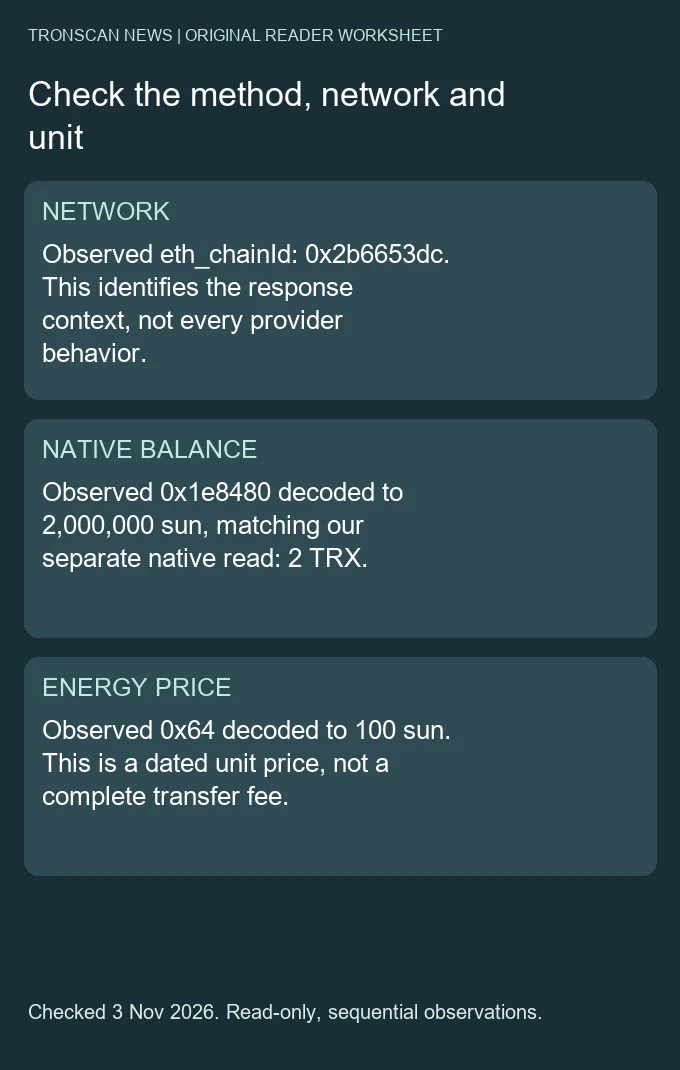
Table of Contents
Four critical TRON JSON-RPC compatibility checks
- Network: preserve the host and actual chain-ID response before interpreting a balance.
- Representation: decode the hexadecimal quantity exactly rather than reading it as decimal text.
- Unit: establish what the method measures. A native TRX balance is not a USDT holding.
- Evidence: label the observation time and whether comparisons shared a block. Preserve failures as failures.
The official API-layer guide separates node HTTP, gRPC and JSON-RPC from indexed ecosystem services. Its JSON-RPC interface covers a subset of Ethereum-style capabilities. A hosted endpoint responding to our requests does not mean JSON-RPC is enabled on every self-hosted node. We did not change node configuration or expose a new service.
The actual JSON-RPC network response
We called eth_chainId at https://api.trongrid.io/jsonrpc. The response was 0x2b6653dc, which our local integer conversion read as 728126428. It matches the Mainnet value in the official chain-ID reference. We did not query the Shasta or Nile hosts during this comparison.
A chain-ID match is a context check. It does not establish current node height, archive coverage, independent consensus verification or correct handling of every RPC method. Keep the host beside the returned value; a client configuration label by itself is weaker evidence than the actual response.
One address: native and JSON-RPC balance representations
For the TRON JSON-RPC balance comparison, our public source address was TN2W4cc7a4dsYyTLiLMWa9m7jVpdLjGvYs. Its 20-byte RPC form was 0x8440ffd578f7a5abf3537b5f46a6980d382db581. These are two representations used in our requests, not two accounts or a claim that we own the address.
| Read on November 3, UTC | Returned value | Our interpretation |
|---|---|---|
| 04:54:41, wallet/getaccount | balance 2000000 | 2,000,000 sun |
| 05:00:29, eth_getBalance latest | 0x1e8480 | 2,000,000 after hex decoding |
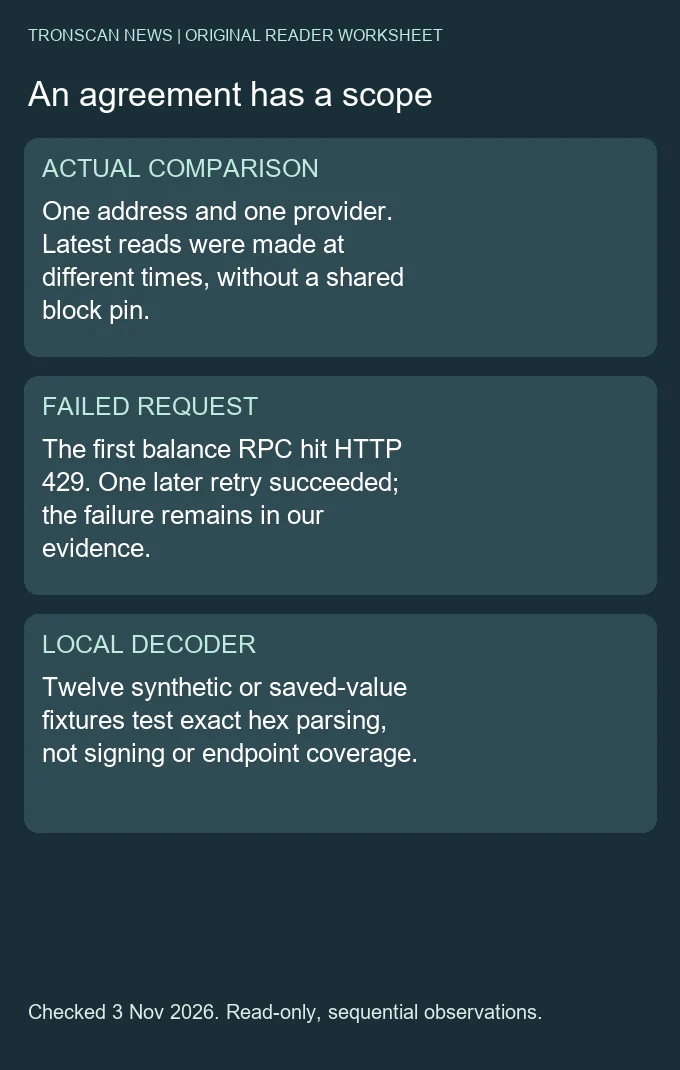
| Comparison | Equal recorded integers | Sequential observations, not one pinned block |
The TRON eth_getBalance reference specifies a 20-byte address and currently documents latest as the supported block argument. Its sample uses a Shasta endpoint; we used the Mainnet host named above. A sample host must not silently become the network assumed by an application.
For these native observations, 2,000,000 sun corresponds to 2 TRX. The official migration guide distinguishes TRX’s six native decimal places from ETH’s eighteen. Dividing our recorded integer by 10^18 would display 0.000000000002, a wrong unit interpretation for this TRX observation. This deliberately calculated contrast is not a second actual balance.
Token units are a separate task. This method did not call USDT’s balanceOf function or retrieve a token transfer. Even when a token uses six decimals, that coincidence does not turn a native-account balance read into a token-balance query.
JSON-RPC Energy price is not a complete fee quote
Our TRON JSON-RPC eth_gasPrice response was 0x64, decoded as 100. The official method description defines its result as the current Energy price in sun. A separate wallet/getchainparameters read at 05:02:52 UTC returned getEnergyFee 100. Those dated readings agreed.
We did not estimate an operation, calculate its complete charge or execute a transfer. This unit price does not by itself account for resource consumption, available resources, Bandwidth or service withdrawal fees. Do not label the integer 100 a universal transaction fee, an ETH-denominated quote or a permanent network parameter.
The failed request belongs in the result
The original eth_getBalance attempt returned HTTP 429. The execution log retained that failure, but its response body and exact failure timestamp were not preserved. After doing independent work, we made one later request at 05:00:29 UTC, which returned HTTP 200 and the recorded quantity. We did not rotate identities, use credentials or bypass provider limits.
A limited request is unavailable evidence for that attempt. It is not a zero balance, proof that the address vanished or a reason to compare an error object as if it were a quantity. The successful retry does not erase the earlier failure. A future application should retain its own status and error body through the provider’s normal access policy.
Our twelve-case exact quantity reader
For these TRON JSON-RPC quantities, we ran the following Python helper locally against twelve fixtures. It accepts a canonical non-negative hex quantity and returns an exact integer. This is a small reader policy, not a validator for RPC envelopes, addresses, transaction hashes or all provider-specific spellings.
import re
def read_quantity(value):
    if not isinstance(value, str) or not re.fullmatch(
        r"0x(?:0|[1-9a-fA-F][0-9a-fA-F]*)", value
    ):
        raise ValueError("Need a canonical hex quantity")
    return int(value, 16)
Accepted cases were 0x0, the three saved RPC values, and the synthetic 0xffffffffffffffff boundary. Rejected cases were 0x00, 0x, decimal text, non-hex characters, Boolean true, null and a negative spelling. All twelve matched their expected local result. The large synthetic integer was 18446744073709551615; it was not a real wallet balance.
Leading-zero rejection belongs to this canonical quantity helper. Do not use it on fixed-length DATA such as the 20-byte address above: leading zero bytes can be significant there. Likewise, an exact integer does not select its own unit. Keep quantity decoding, address decoding and asset scaling as separate steps.
Read the JSON-RPC response envelope before the quantity
A JSON-RPC quantity decoder should not receive an error object in place of a result string. We added eight local response-envelope cases to our twelve quantity cases. These are synthetic client fixtures, not eight more provider requests. Our narrow dashboard policy requires HTTP 200, a response object, JSON-RPC version 2.0, the expected integer request ID, no error member and a canonical result quantity.
The positive JSON-RPC fixture returned result 0x0 with ID 7. It decoded to the integer zero. The seven rejected fixtures represented HTTP 429, an RPC error, a missing result, a different ID, a Boolean ID, a null result and an object containing both result and error. Every case matched its expected local outcome. Other applications may use string IDs; this small test deliberately accepts only the integer IDs it sends.
Zero and unavailable must remain separate in a display. Our accepted zero fixture is a synthetic result with a complete matching envelope. It is not the balance of the actual source address, which returned 2,000,000 in our dated comparison. The rejected cases produce an unavailable state rather than an integer. We did not replace any failure with zero to make a report look complete.
For example, imagine a saved JSON-RPC request with ID 7 followed by a delayed response carrying ID 8. Even if the result looks like a plausible balance, our helper rejects the context mismatch. This invented case tests the client’s bookkeeping, not a claim that our actual provider mixed responses. Keeping the expected ID prevents a convenient-looking number from becoming evidence for the wrong request.
A Boolean needs a deliberate type check in Python because bool is a subclass of int. Our local policy uses an exact integer type check before comparing the ID. This is why the true-valued ID fixture does not accidentally satisfy a numeric comparison. That test concerns our reader implementation; it does not imply that all JSON-RPC IDs have to be integers.
Preserve a compact JSON-RPC comparison note with the HTTP status, request method, ID, parameters, response time, response result or error, decoding rule and unit. For the live comparison above, also retain the native read’s time separately. A note containing only the formatted 2 TRX would lose the hexadecimal representation and timing needed to reproduce the reasoning.
This response policy does not authenticate a server, verify chain state or handle every valid RPC response shape. It simply prevents the specific unavailable and mismatched cases in our executed fixtures from flowing into this quantity reader. No batch request, notification, subscription, transaction submission or complete Web3 client was exercised.
Repeat the comparison without expanding its claim
- Record the intended network, host and read-only method names.
- Save the original chain-ID response and check it against the network’s primary reference.
- For a public account, preserve both full address representations and the documented block argument.
- Retain native and RPC responses with their individual UTC times, decode exactly and compare only equivalent fields.
- Write whether they shared a block, whether any request failed and which methods remain untested.
The TRON JSON-RPC and native latest-state reads were minutes apart and had no common block pin. Matching values support this saved comparison, not an atomic snapshot guarantee. If two results differ, first inspect the address representation, network, served state and observation times. Do not silently overwrite one value or conclude that funds moved from a formatting difference alone.
Use our Mainnet-versus-testnet selection guide for explorer context, read-only indexed transfer API guide for transfer lists, and API number-precision tests for the separate decimal-string and client-parsing task. This article adds the RPC/native regression comparison rather than replacing those workflows.
Frequently asked questions
Does TRON JSON-RPC implement every Ethereum method?
No. Check each method’s current TRON documentation and your provider. Our live work covered three RPC methods only.
Did eth_getBalance read USDT?
No. Our comparison concerned a native-account TRX balance. A token balance requires the relevant token contract and method.
Was 0x64 a complete transfer fee?
No. It was our dated Energy-price response, decoded as 100 sun. We did not execute or fully price an operation.
Did the equal balances come from the same block?
No. They were sequential latest-state observations with separate times and no shared block pin.
Does HTTP 429 mean a zero balance?
No. It records a limited request. Preserve the failure and follow the service’s normal access policy.
Independent Tronscan News review, checked November 3, 2026 with AI assistance. Two original worksheets, one dated native/RPC balance comparison, one Energy-price comparison and twenty local fixtures (twelve quantities and eight envelopes) support the stated scope. No wallet, funds movement, arbitrary-provider guarantee or complete application migration was tested. The Tronscan News homepage links to our editorial standards and correction route.
Leave a Reply