A USDT amount is a quantity of tokens; its displayed USD value is a separate estimate using a price and a time. A changing dollar label does not, by itself, mean that tokens moved. Compare the quantity, token contract, valuation price and timestamp before diagnosing a discrepancy.
This guide helps readers reconcile explorer and wallet numbers. Its original worksheet uses explicitly hypothetical prices and exact decimal arithmetic. It makes no claim about today’s USDT price, a reader’s account, a redemption quote or future returns.
Table of Contents
Three numbers that should stay separate
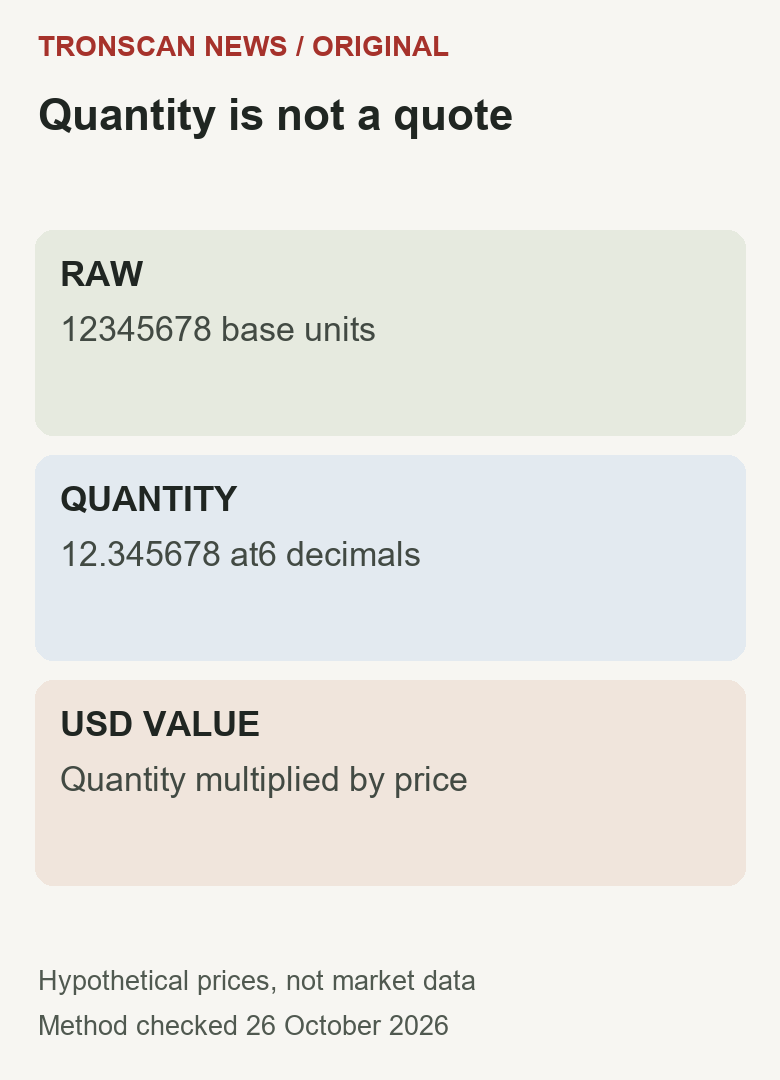
A raw on-chain token integer, a formatted token quantity and a USD value answer different questions. The first is the stored or reported unit count; the second applies the token’s decimal scale; the third introduces a currency price. Combining those steps in a single unlabeled number makes mistakes difficult to trace.
| Number | Example | What it means |
|---|---|---|
| Raw token integer | 12345678 | Base-unit count in a synthetic example |
| Formatted quantity | 12.345678 tokens, assuming 6 decimals | Token units after scaling |
| Estimated USD value | Quantity multiplied by a stated USD price | Valuation at a source and time |
The TRONSCAN price documentation separates USD and TRX prices and provides source and time fields. These are documented API concepts, not a claim that we tested every current interface or made an authenticated price request.
Six checks for a USD value discrepancy
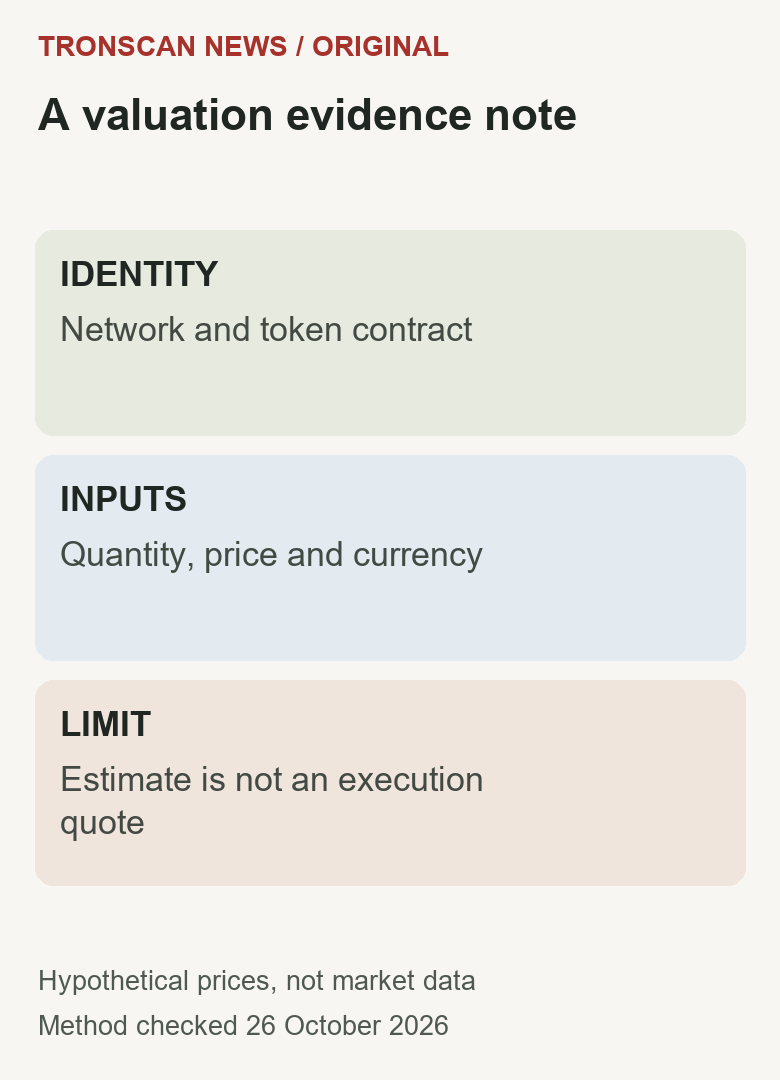
- Identify the exact asset. Keep the network and complete token contract. A ticker alone does not identify a token.
- Compare the same quantity. A single transfer, a current wallet balance and a portfolio total are different objects.
- Check the token scale and display rounding. Retain the exact quantity before shortening it for presentation.
- Record the valuation currency and price. USD and TRX price fields are not interchangeable.
- Record the price source and observation time. A historical receipt and a current quote can legitimately refer to different times.
- Separate valuation from actual execution and credit. An estimate is not a trade fill, withdrawal receipt or exchange deposit record.
For the network and record-selection step, use our USDT explorer network guide. The remaining steps here focus on why a dollar label can differ after you have located the intended asset.
A checked USD value worksheet
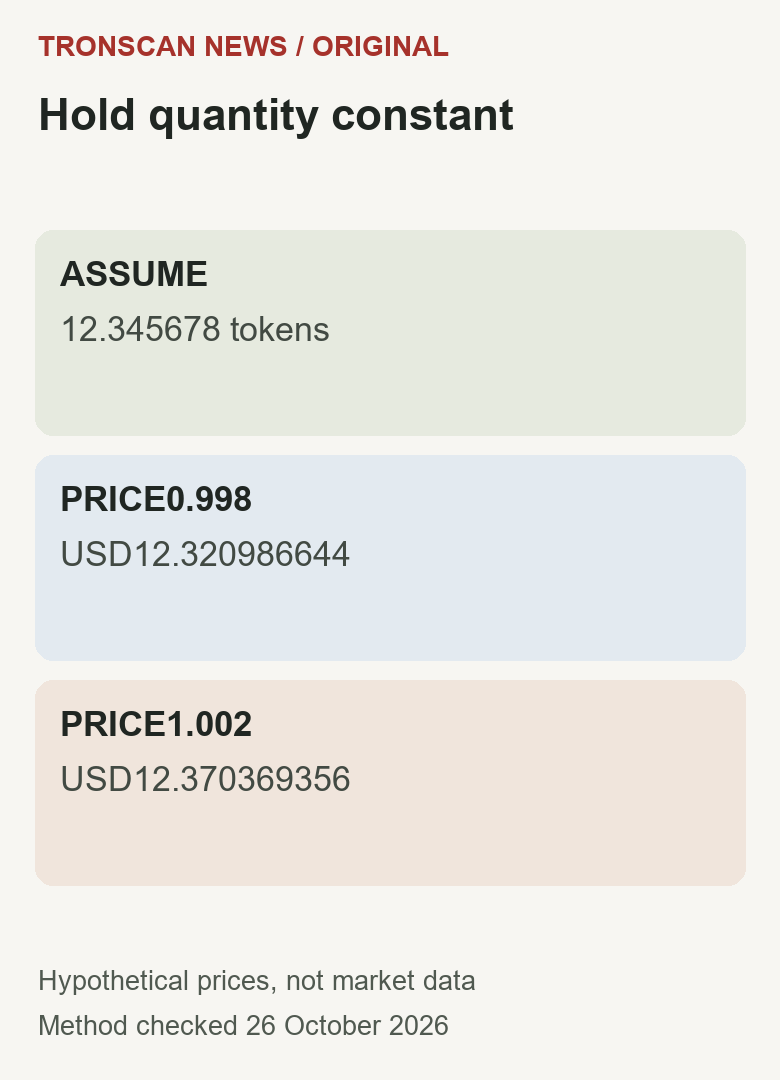
Use a hypothetical quantity of 12.345678 tokens. The following prices are assumptions for a calculation exercise, not market observations. We checked the multiplication using exact decimal arithmetic on 26 October 2026.
| Fixed quantity | Assumed USD price per token | Unrounded USD value |
|---|---|---|
| 12.345678 | 1.000 | 12.345678 |
| 12.345678 | 0.998 | 12.320986644 |
| 12.345678 | 1.002 | 12.370369356 |
The quantity stays fixed in all three rows. Only the assumed price changes. Under a stated round-to-nearest-cent presentation rule, the labels would be $12.35, $12.32 and $12.37. The worksheet retains the unrounded product so the reader can distinguish valuation arithmetic from presentation.
This is not evidence that USDT traded at any of those prices. Its purpose is to show that two USD value labels can differ without a token transfer. A real reconciliation needs the actual source price and its timestamp, not a convenient assumed price.
Rounding can hide a quantity difference
A wallet may shorten a token quantity to two decimal places while an explorer exposes more digits. Comparing only the shortened labels can conceal a small difference or make equal quantities look inconsistent. Keep the raw amount and scale when available, then apply the same display rule to both values.
For example, a hypothetical quantity of 12.345678 might display as 12.35 under one rule. That does not make its full quantity exactly 12.350000. Do not subtract a rounded USD value from an unrounded token quantity and call the result a network fee; the units do not even match.
Our token decimals worksheet explains the raw-to-formatted conversion. Here, that conversion is an input to the valuation. It should be completed and checked before calculating the USD value.
Historical transfer amount versus current valuation
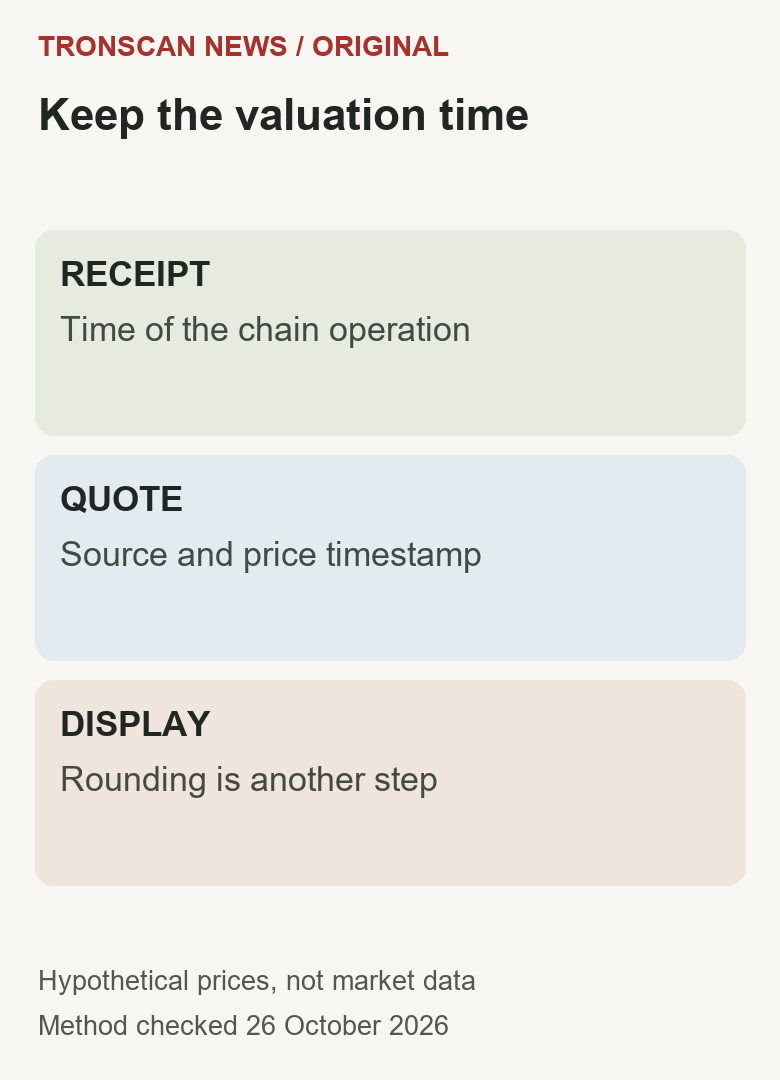
A receipt refers to an operation at a particular point in chain history. A price service may supply a later quote. If a page combines that old quantity with a current price, its dollar estimate is a current valuation of the quantity, not necessarily the dollar equivalent shown at the transfer’s time.
Before comparing screenshots, record when each was captured and which price time each uses. A screenshot taken today of an old transfer does not establish that the displayed estimate is a historical valuation. If the page’s valuation methodology is unclear, preserve that limitation instead of inventing a price timestamp.
A current USD value also differs from an execution quote. The amount received in an actual sale, exchange conversion or redemption can depend on that service’s terms and execution. This article does not estimate those proceeds. It explains the arithmetic behind a displayed estimate.
Missing USD value does not mean zero tokens
A token quantity can be present while a price field is unavailable. Conversely, a portfolio estimate can appear without being sufficient evidence of a particular incoming transfer. Keep missing, unavailable and numerical zero as separate states in the reconciliation note.
The cited price API documentation describes an empty response for an unknown token. Do not replace a missing quote with a price of zero in a reader-facing conclusion. “Quantity observed; valuation unavailable” is more accurate than reporting that all the tokens are worthless.
Likewise, a stale price cache is a possible explanation to investigate, not a fact to assert without evidence. If you have no source timestamp or refresh information, write “quote time not established.” This preserves the difference between a measured discrepancy and a proposed explanation.
Confirm token identity before trusting a familiar label
The issuer’s supported-protocols page is a primary starting point for matching network-specific USDt contracts. An unrelated token using a familiar symbol does not become the issuer’s token because an interface attaches a dollar sign to it.
Keep the network, full contract and quantity together. If you compare a TRON record with a record on another chain, establish that relationship explicitly rather than treating a matching ticker as sufficient. Different objects should not be forced into one USD value comparison.
For the underlying asset and fee distinction, see our TRON USDT guide. TRX used for network resources is a different asset from the USDT quantity being valued. For aggregate USD amounts, the thirty-date TRON USDT activity review shows the calculation and its limits.
An original discrepancy decision table
| Observed difference | Next check | Do not conclude yet |
|---|---|---|
| Same exact quantity, different USD value | Price, currency, time and rounding | That tokens disappeared |
| Different token quantities | Contract, record scope, scale and observation time | That price alone explains it |
| Quantity present, quote absent | Price availability and source | That token quantity is zero |
| Explorer success, platform credit missing | Receiving platform’s deposit requirements and record | That a dollar estimate proves credit |
The success criterion is a typed explanation of the discrepancy. For a valuation difference, retain the quantity, price, currency, source time, calculation and rounding rule. For a quantity difference, return to the relevant on-chain or account record. Do not spend time adjusting a price when the two inputs are different assets or different balances.
Ask a second reader to reproduce the USD value using only the retained inputs. If they cannot do so without guessing a scale or a timestamp, the note is incomplete. Preserve the actual discrepancy even if the final cause remains unresolved.
USD value FAQ
1. Does a lower dollar label prove tokens moved?
No. First compare exact token quantities. A changed valuation price or display rule can change the label without a transfer.
2. Is USDT quantity the same field as USD value?
No. One is a token quantity; the other introduces a currency price and valuation time.
3. Does a missing price mean my balance is zero?
No. Record the observed quantity separately and label the valuation as unavailable when there is no verified quote.
4. Can I compare a portfolio total with one transfer?
Not as equivalent objects. Define the assets, record scope and time before drawing conclusions from the numbers.
5. Are the worksheet prices current market data?
No. They are explicitly hypothetical assumptions used to test arithmetic, not a live quote, valuation recommendation or promised execution price.
Sources and testing scope
Checked 26 October 2026 by Tronscan News with AI-assisted drafting and official-source review. Exact decimal multiplication and the synthetic comparison table were tested locally. No live price API, trade, redemption or reader account was tested. Original diagrams illustrate the method. More independent guides and the corrections policy are available from Tronscan News.
Leave a Reply