A USDT token holders list shows addresses with recorded holdings for a particular token contract; it is not a list of individual people. Use the network, complete contract, amount, percentage and observation time together. A large address balance alone does not identify its beneficial owners or explain a future market move.
This guide includes a read-only check of the official TRONSCAN Holder view, an original field dictionary and a synthetic concentration worksheet. It does not classify a reader’s wallet, identify private customers or predict token prices.
Table of Contents
Open the correct token holders view
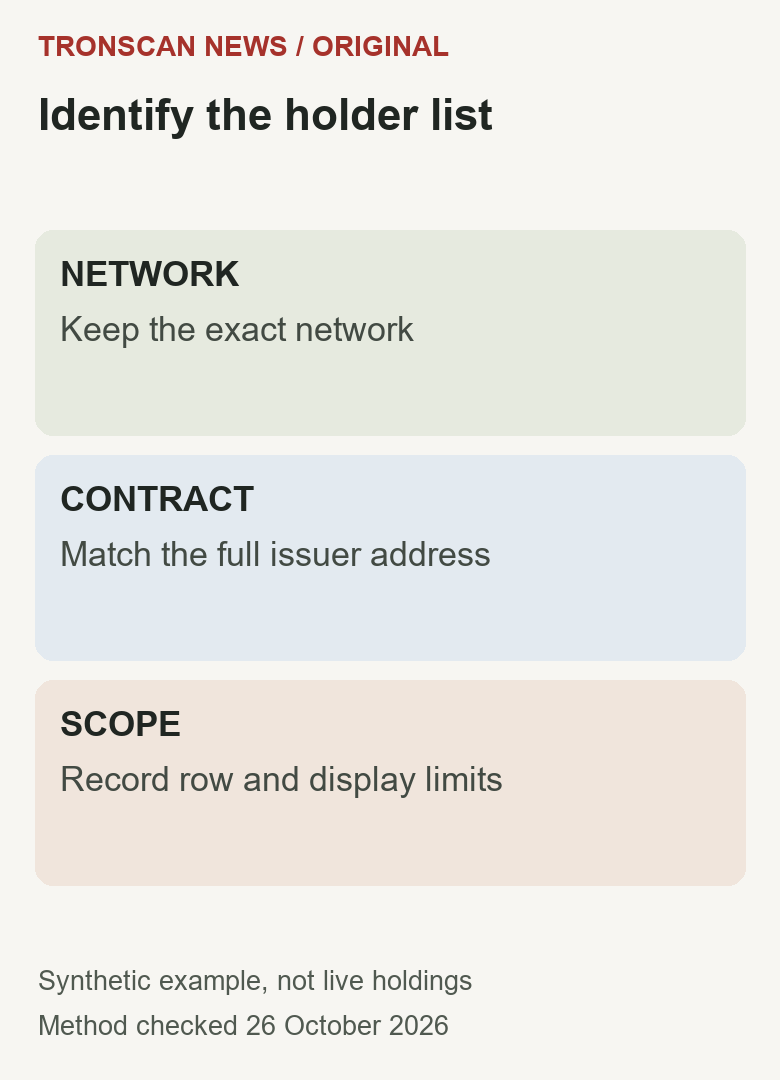
Start with the issuer’s supported-protocols reference, select the intended network and match the whole contract. On 26 October 2026 we followed the TRON USDt contract to TRONSCAN and opened its visible Holder tab without connecting a wallet.
The tested official TRON USDt Holder page displayed a distribution summary and a table with Address, Amount, Value, Percentage and Recent Transfers. It also stated that only the first 10000 holders were displayed. This is a dated interface observation, not a guarantee that every future version has the same layout.
For choosing a network before this step, see our USDT explorer guide. A token holders list on one chain should not silently become a global cross-chain holder count.
A field dictionary for token holders
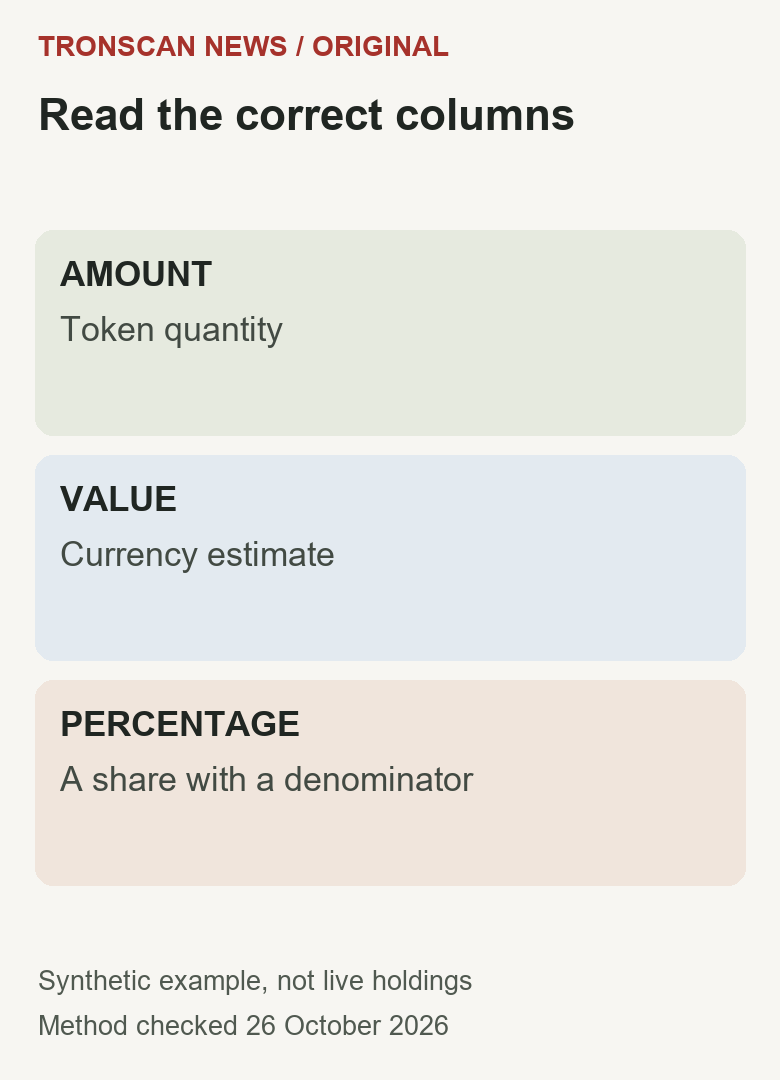
| Observed field | Useful interpretation | Boundary |
|---|---|---|
| Address | The on-chain holding account | Not automatically one person or one customer |
| Amount | Token quantity associated with that row | Keep contract, scale and observation time |
| Value | A currency estimate for the holding | Not the token quantity or a guaranteed sale price |
| Percentage | A share under the source’s denominator | Retain the denominator definition; do not guess it |
| Recent Transfers | The source’s transfer-recency label | Not account creation, last login or identity evidence |
| Rank | Position in the displayed ordering | Not proof of control over the token project |
The dictionary is an original reading aid based on the tested headings. A value shown on one row is not an audit of that account. Preserve the complete address in your retained evidence even when a page displays a shortened label.
Seven practical checks before drawing conclusions
- Fix the asset identity. Record network and complete contract before comparing rows.
- Record the source time. Treat the table as an observed snapshot, not a permanent ranking.
- Separate amount from currency value. Keep token quantity and price-based estimates in different columns.
- Read the list’s scope. Note the display cap, page range and any active search or filter.
- Preserve the share denominator. Do not assume total supply and circulating supply are interchangeable.
- Keep address and entity conclusions separate. Labels can guide investigation but do not establish the number of people behind an address.
- State the narrow result. Report which rows and quantities were observed, with the remaining limitations.
For token holders, success means a reproducible snapshot and a clearly defined calculation. It does not mean turning a ranked list into a prediction, an identity database or a complete ownership analysis.
An original concentration worksheet
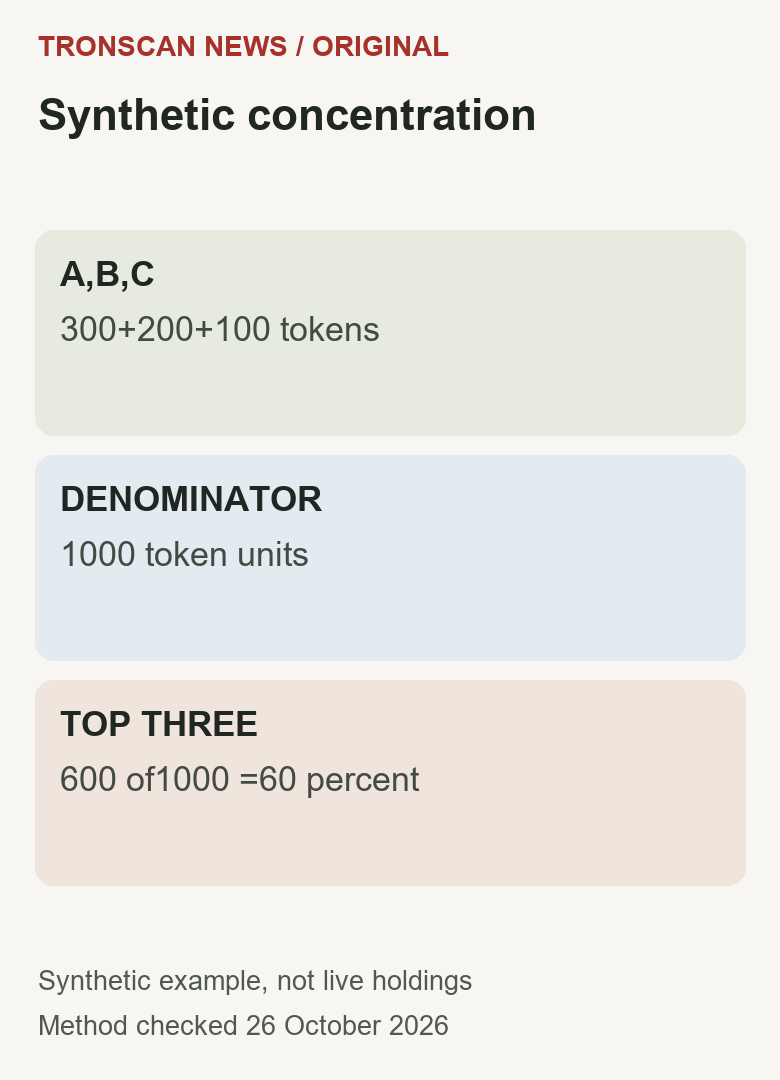
Consider a hypothetical token with a stated denominator of 1000 token units. Address A holds 300, B holds 200 and C holds 100. The remaining addresses collectively hold 400. These are invented labels and quantities for an arithmetic exercise, not live USDT holdings.
| Synthetic group | Quantity | Share of stated 1000-unit denominator |
|---|---|---|
| A | 300 | 30% |
| B | 200 | 20% |
| C | 100 | 10% |
| All remaining addresses together | 400 | 40% |
We checked locally that the quantities sum to 1000 and the shares to 100%. The three named rows total 600 units, or 60% of the stated denominator. That is an address-level concentration statement within this exercise. It says nothing about how many customers, organizations or people are represented.
If the denominator were changed to 1200 while the row quantities stayed the same, their shares would change. That would not be a valid comparison to the original table without explaining the new scope. When reviewing real token holders, copy the source’s supply definition and time before recreating a percentage.
Addresses and people are different units
One service may hold assets in an address associated with many customer accounts. One person or organization may also use multiple addresses. The holder table itself does not resolve that mapping. Therefore, an address count should not be presented as a verified count of unique investors or users.
Contract addresses can appear among token holders as well. Their balances might relate to a protocol or application, but the rank alone does not tell you the arrangement. Keep any explanation tied to a specific source and scope rather than inventing a wallet role from its size.
A label such as an exchange name is descriptive attribution supplied by a service. Record its exact spelling and observation date. Do not convert that label into an accusation about a named person, a legal ownership conclusion or an assertion that every transfer belongs to one customer.
Display limits are not full-distribution evidence
The tested token holders page explicitly limited the displayed list to its first 10000 rows. A distribution chart and a visible page of rows are different representations. A page cap does not mean all addresses beyond that cap have zero holdings.
The official holder API documentation separately describes a capped hit count, a full holder count and paginated rows. It also documents raw balance strings requiring token decimals. These are API definitions, not a statement that every field name is exposed in the tested web table or that we called that authenticated endpoint.
When collecting more than one page, preserve the page ranges and observation times. A changing list can move rows between pages. Deduplicate by the full address within the same token and network; do not use a shortened label or rank as the permanent identity key.
Amount, value and update time need separate checks
Before adding token holders’ quantities, confirm whether the source supplies raw integers or already formatted amounts. Dividing an already formatted value again would distort the comparison. Our token decimals worksheet covers that conversion step.
A currency estimate can change while a row’s token quantity stays fixed. The USDT amount versus USD value guide explains price time and rounding. Do not use the dollar column as a substitute for a token-unit sum.
Also distinguish a transfer-recency label in the web table from update timestamps in an API response. They describe different concepts unless the source explicitly defines them as equivalent. Preserve the original field name rather than renaming every timestamp “last active.”
A reusable token holders evidence note
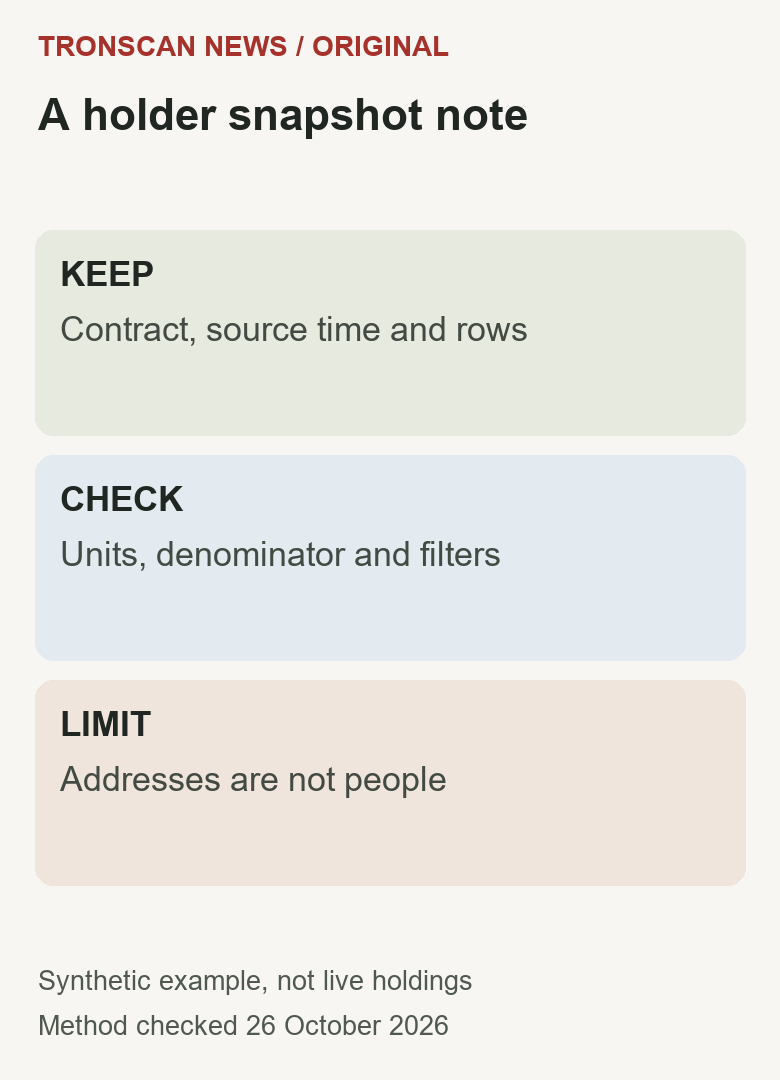
Keep the network, complete contract, source URL, observation date, page range, active filter, unit scale and share denominator. For each retained row, keep the full address, amount, any displayed value, label and original time field.
Write the calculation rule before reporting a result. For a top-three address share, identify the exact three rows and denominator. For a change between snapshots, keep both times and the same contract and scope. A newly visible row on a capped page is not necessarily a newly created holder.
Finally, state what the data cannot answer. The token holders list may support an observed distribution, while beneficial ownership, intent and future behavior remain unknown. A second reader should be able to reproduce the arithmetic without needing to accept an unsupported story about the addresses.
Token holders FAQ
1. Does each holder address represent one person?
No. The address-to-person relationship is not established by a holder table. Keep address counts distinct from user or investor counts.
2. Does a large holding prove a future sale?
No. A balance snapshot does not establish intent, a planned transaction or a price forecast.
3. Are all rows visible on the tested page?
No. The tested interface stated that only its first 10000 holders were displayed. Record that scope rather than assuming complete row coverage.
4. Is the Value column the number of tokens?
No. Keep token quantity separate from its currency estimate and price timestamp.
5. Is the concentration worksheet live USDT data?
No. Its quantities and labels are synthetic, with a specified denominator, solely to demonstrate a reproducible calculation.
Sources and checking scope
Checked 26 October 2026 by Tronscan News with AI-assisted drafting and official-source review. The Mainnet Holder tab and its column names were read directly; the concentration arithmetic was tested locally. We did not collect all holders, identify private customers or test the authenticated API. Original diagrams illustrate the method. More independent guides and corrections information are available from Tronscan News.
Leave a Reply