USDT circulating supply is an aggregate under a stated network and methodology; an individual wallet balance is one account’s holding. They are different quantities. Record the contract, network, definition, unit and date before comparing a supply statistic with a wallet or holder table.
This guide provides an original scope matrix and a tested synthetic transfer exercise. It is a method for reading metrics, not a current supply report, reserve attestation or forecast. No live supply total is asserted in the worked examples.
Table of Contents
Choose the scope before comparing circulating supply
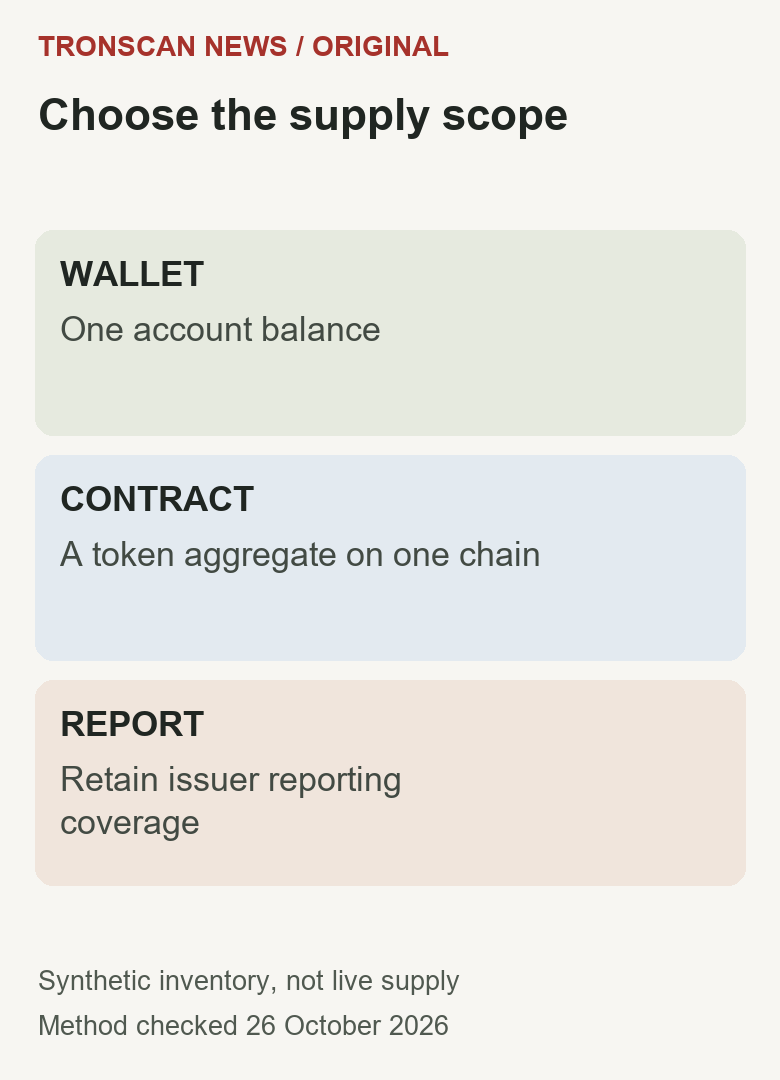
A contract-specific total, a network-specific circulating supply figure and an issuer’s cross-network reporting can have different coverage. A matching USDT label does not make them interchangeable. Begin by writing exactly what each number measures.
The issuer’s transparency page describes its net-circulation metrics and their reporting purpose. That reporting context should be retained when comparing it with an explorer’s contract-level field. We have not extracted a current issuer balance or reconciled its reporting methodology in this article.
| Object | Scope to retain | Not an equivalent substitute |
|---|---|---|
| Wallet token balance | One address, contract, network and observation time | Whole-network circulating supply |
| Contract total supply | Specified contract and chain state | A selected page of holder rows |
| Explorer circulating supply | Source’s circulation definition and network | An unexplained issuer-wide total |
| Issuer circulation report | Named asset, reporting coverage, date and definitions | A wallet’s private platform ledger |
This original matrix is a scope check. It prevents an aggregate from being mistaken for an account balance and keeps a potentially useful comparison from becoming a claim of equality without matching definitions.
Six essential checks for supply comparisons
- Identify the asset and network. Match the full contract when the metric is contract-specific.
- Copy the metric’s original name. Keep total supply and circulating supply in separate fields.
- Find the definition and exclusions. If the source does not establish them, record the methodology as unknown.
- Check whether the amount is raw or formatted. Do not apply a decimal conversion twice.
- Align dates and state. Two observations made at different times are not a same-time reconciliation.
- State the supported result and remaining gap. A difference is an observation, not an explanation of its cause.
Use our TRON USDT guide for the underlying token, network and TRX distinction. The comparison here concerns aggregate measurement rather than repeating transfer lookup steps.
A checked distinction on the official token page
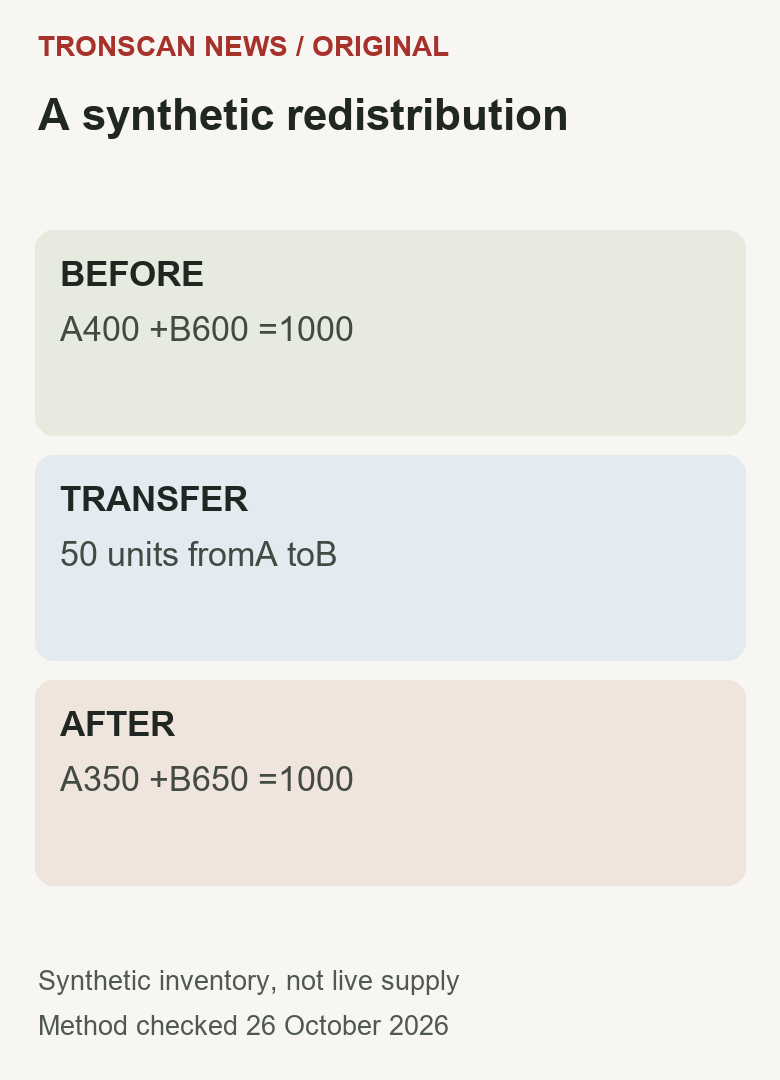
On 26 October 2026 we opened the official Mainnet USDt token page through the issuer-linked contract. Its overview displayed separate Total Supply and Circulating Supply rows, as well as separate market-cap labels. The Decimal row showed six.
Those observed headings are useful evidence that the interface distinguishes these concepts. They do not establish the cause of any difference between the two values. We did not verify the full exclusion methodology behind that circulating supply display and therefore do not label the difference as frozen, lost, reserve-backed or available for spending.
The values can change after an observation. This article deliberately uses the field structure rather than presenting a saved overview total as today’s permanent statistic. A dated data review would need retained numbers, source time, definitions and a separate reconciliation.
A synthetic transfer does not create token supply
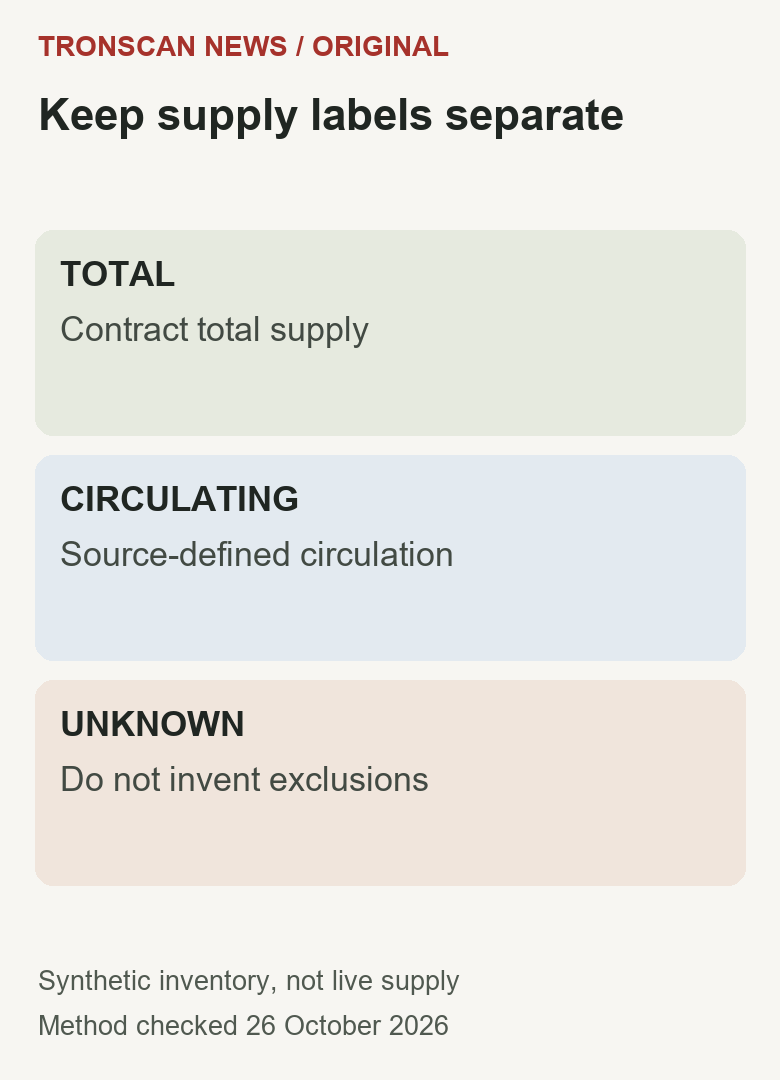
Consider a deliberately simplified token inventory containing only two accounts: A has 400 token units and B has 600. A transfers 50 to B, with no minting, burning or other balance change assumed. After the transfer A has 350 and B has 650.
| Synthetic account | Before | After |
|---|---|---|
| A | 400 | 350 |
| B | 600 | 650 |
| Combined inventory | 1000 | 1000 |
We checked the subtraction, addition and conserved sum locally. The account balances change while the combined token inventory stays at 1000. A 50-unit transfer is not added to the inventory as 50 newly created units.
This exercise does not define every source’s circulating supply methodology. If a real circulation definition excludes particular holdings, movement into or out of those categories can matter to that definition. Keep that classification question separate from the basic arithmetic. The example demonstrates balance redistribution under its stated assumptions, not a universal circulation rule.
Total supply and circulating supply need definitions
The TRC20 interface reference distinguishes totalSupply from balanceOf. One concerns the token aggregate and the other a specified account’s balance. A separate circulating supply label requires the reporting source’s own definition.
Do not derive a global supply figure by adding a few large wallet balances. A partial list is not complete coverage, and the selected rows may not match the source’s circulation categories. For a different balance-and-supply distinction, use the burn-address and supply-change worksheet; a destination transfer alone does not establish reduced token supply.
Nor should a supply change automatically be described as customer demand, exchange inflow or a price signal. The number alone does not supply those causal explanations. A useful note separates “the metric changed” from “we have established why it changed.”
A supply endpoint may already apply decimals
The TRONSCAN circulating-supply endpoint documentation describes its response as an already human-readable value, returned as a bare numeric string. That differs from a raw integer balance needing a decimal conversion. We reviewed the documentation; we did not make an authenticated request.
When reading a response, preserve the original representation and the documented unit. Dividing an already converted circulating supply by a million would introduce a new error. Conversely, treating a raw token balance as whole units would overstate its quantity.
For a conversion that really is needed, our token decimals worksheet provides exact-integer examples. The first decision remains whether that operation applies to the source field at all. For a worked dated comparison, use the October TRON USDT supply table and tested reconciliation.
Missing data and zero are different findings
The cited endpoint documentation notes that an invalid contract can return an empty string or zero. Consequently, a response must be checked against contract validity and response context before being described as a confirmed zero circulating supply.
A failed connection, absent field and numerical zero should remain separate states in a data sheet. If the request did not return usable evidence, write “not available.” Replacing every missing value with zero can create a fictional collapse in a supply chart.
Keep the same caution when comparing cached interface data with another source. A difference might involve time, scope or methodology. Without evidence identifying which one, retain the discrepancy and the next check rather than choosing a convenient explanation.
A reusable circulating supply reconciliation note
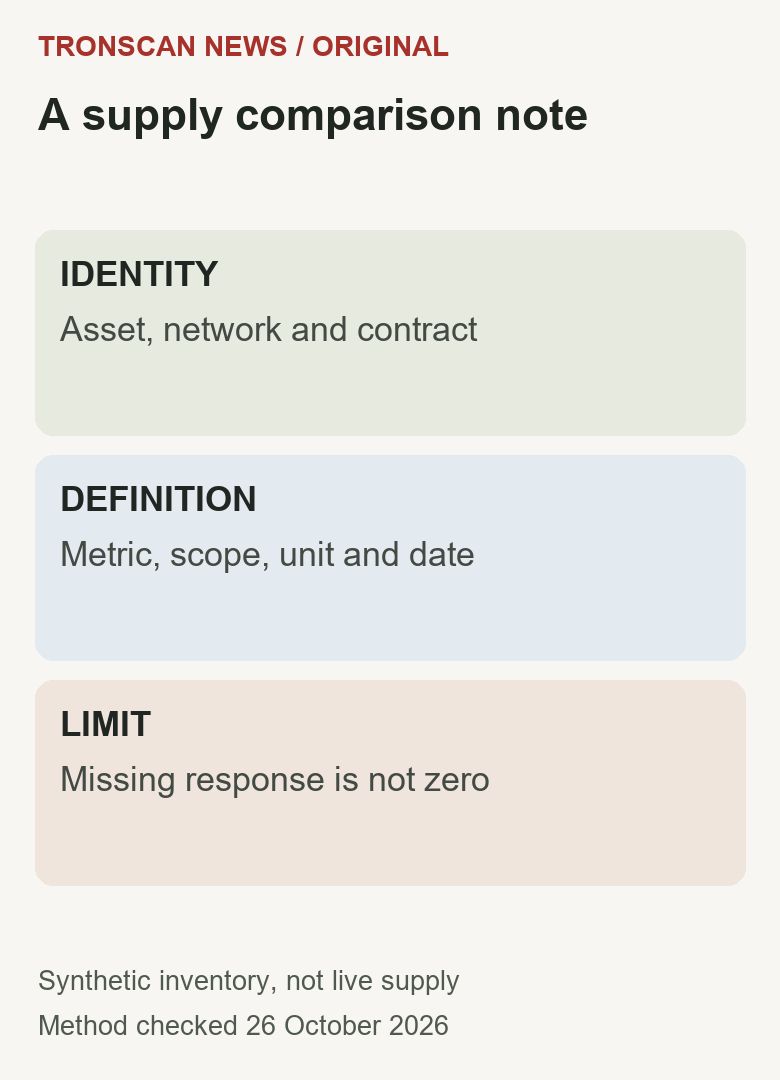
For each input, retain the source URL, asset, contract if applicable, network, metric name, raw response or displayed quantity, unit representation, definition and observation time. Preserve the source’s own timestamp separately from the time you opened the page.
Then classify the comparison. Same contract, definition and time supports a closer reconciliation than merely sharing a ticker. If one input is issuer-wide and the other network-specific, mark the scope mismatch before calculating a difference. Do not display that difference as unexplained missing tokens.
Finish with a narrow conclusion. You may establish that two documented fields differ, that a decimal conversion was applied twice or that the available definitions do not permit a direct comparison. Each is a useful result without pretending that one wallet balance reveals the whole circulating supply.
Circulating supply FAQ
1. Is my wallet balance the circulating supply?
No. A wallet balance is an account holding. A circulation figure is an aggregate under a source’s stated scope and methodology.
2. Does a transfer automatically create new tokens?
No. In the stated synthetic exercise it redistributes a fixed inventory. Minting, burning and circulation classifications are separate questions.
3. Can I compare TRON supply with an issuer-wide total?
Only after identifying the coverage and definitions of both inputs. A matching USDT label does not make their scopes equal.
4. Should I divide every supply response by a million?
No. Check whether the source already formats the amount. The cited TRONSCAN endpoint documents a human-readable response.
5. Does an empty or zero response prove zero circulation?
Not by itself. Check contract validity, response status and the endpoint’s documented behavior before drawing that conclusion.
Sources and checking scope
Checked 26 October 2026 by Tronscan News with AI-assisted drafting and primary-source review. The official token overview fields were read directly; the two-account arithmetic was tested locally. No issuer-wide supply reconciliation, reserve assessment or authenticated API request was performed. Original diagrams are conceptual. More independent guides and corrections information are available from Tronscan News.
Leave a Reply