TRON account labels are source-provided descriptions or classifications associated with addresses. Read the label’s type, source and checking date before using it for attribution. A displayed name is not, by itself, a complete explanation of address control, beneficial ownership or the customer behind a particular transfer.
Some public tags have a documented verification process. That is useful evidence to examine, not a reason to treat every label, behavior tag and transaction role as the same kind of claim. This guide provides an original attribution matrix and a read-only review method.
Table of Contents
Different account labels answer different questions
The official TRONSCAN account-tag documentation distinguishes public and other tag fields from behavior categories such as Assets, Activity, DeFi, NFT and Governance. It also documents refresh information. These are API definitions; this article does not claim to have called the authenticated endpoint.
A behavior classification and a project attribution are different objects. A tag describing activity does not establish a person’s name. A public name does not, by itself, explain the source of all funds held at an address. Keep the original wording and category rather than reducing everything to a single owner column.
| Observation | What to retain | Conclusion still requiring evidence |
|---|---|---|
| Project or service name beside an address | Exact label, source, address and date | Which customer initiated a particular transfer |
| Activity or asset category | Category definition and refresh information | A person’s identity or intent |
| Public-tag verification documentation | Process, address and scope of the evidence | Every future transaction’s purpose |
| Account signing permissions | Current permission roles and thresholds | The full off-chain ownership arrangement |
This original matrix is a claim-classification tool. It does not dismiss account labels; it helps a reader use each kind of evidence for the question it can actually address.
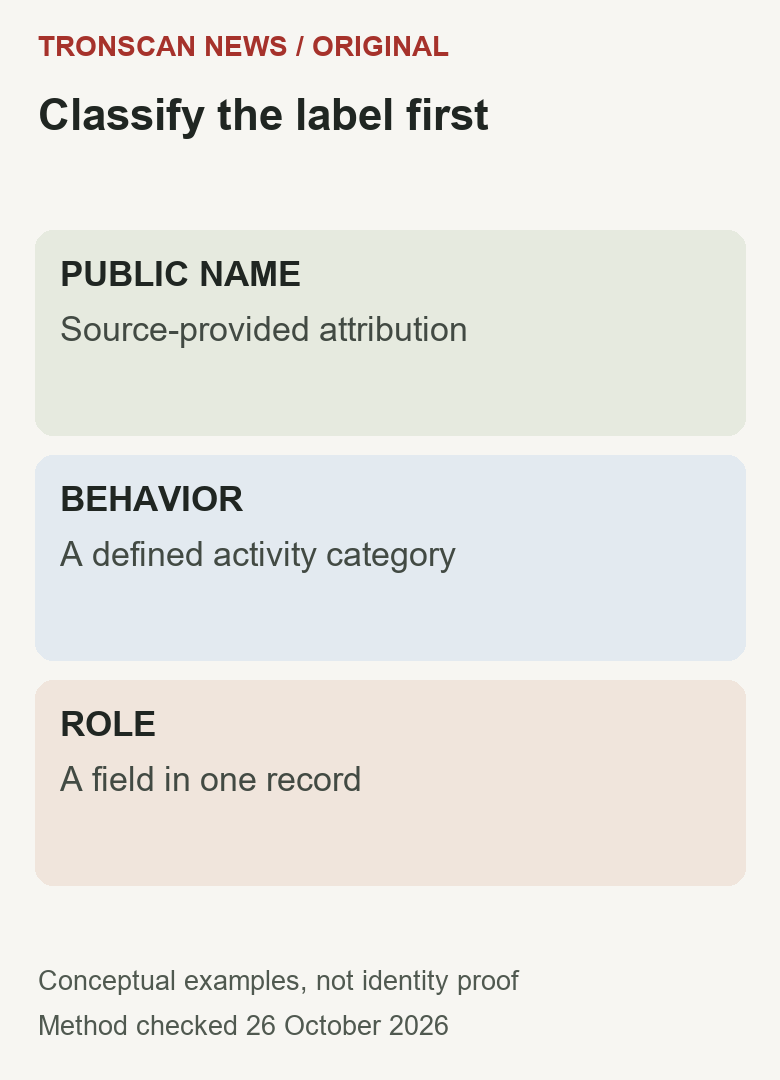
Seven critical checks when interpreting account labels
- Keep the complete address and network. Do not use a shortened name as the identifier in your retained note.
- Record the exact label and type. Separate public attribution, a behavior category and a risk-related label.
- Identify the source. Distinguish an explorer’s label from an issuer publication, a project’s claim or a private note.
- Check the available verification scope. If a process is documented, do not claim more than the particular evidence supports.
- Preserve time and refresh context. A saved screenshot does not automatically establish the current label or control state.
- Separate account roles from people. A sender, recipient, contract caller and signing permission can describe different roles.
- Write the narrow conclusion. State what was observed and which attribution question remains unresolved.
Our TRONSCAN guide covers the general explorer routes. This article focuses on interpreting account labels after the correct address and network have been located.
Public-tag account labels can have verification evidence
The TRONSCAN public-tag verification guide, updated 21 January 2026, describes a message-signing and submission process used to confirm the address association requested by a project. Do not confuse that documented process with a mere free-text label on an unrelated page.
Equally, this article has not performed that process or inspected the verification evidence for every displayed account label. A reader should record whether a particular tag’s verification scope is established, unknown or merely asserted by another source.
A documented control or address-association check concerns particular evidence. It does not automatically identify every customer using a custodial service, settle every off-chain ownership question or reveal the purpose of every transaction. Preserve those remaining questions rather than extending one verification result to unrelated claims.
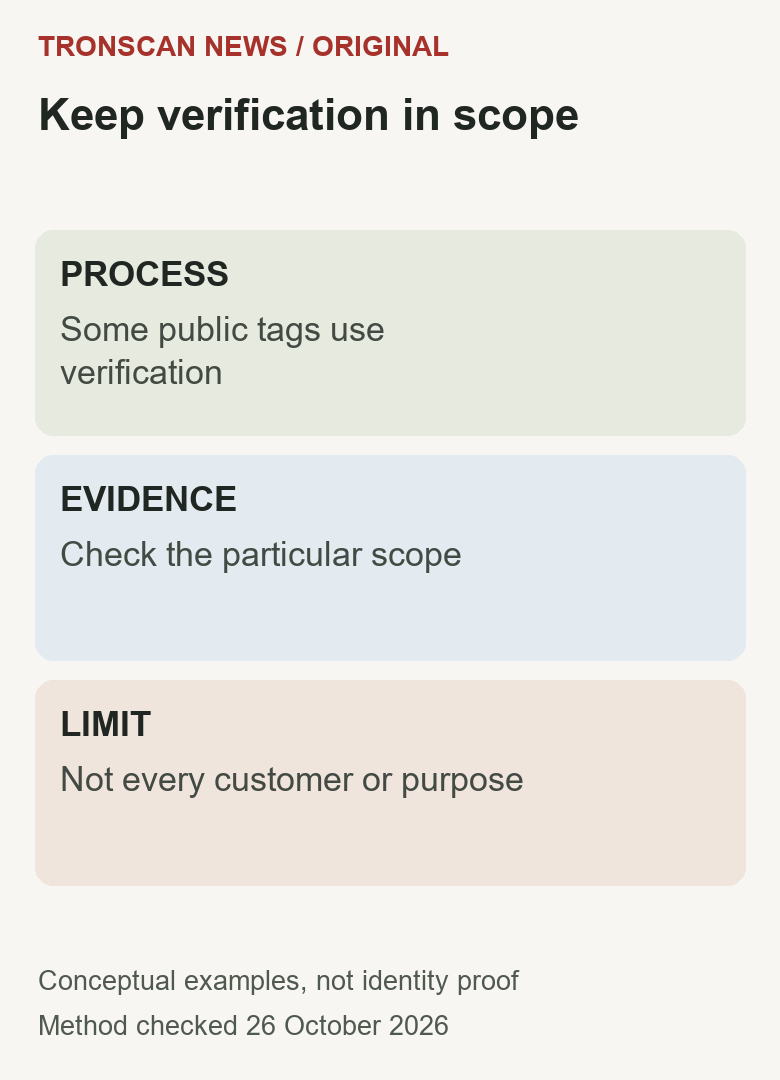
A real interface observation with a narrow conclusion
On 26 October 2026 we opened the official Mainnet USDt Holder view. Some rows displayed a service or treasury name alongside an address, while others displayed an address without such a name. That is the tested presentation observation.
We did not verify the private customer mapping behind those rows or perform a control challenge. The absence of a displayed name was not treated as evidence that the address lacked an owner. The presence of a name was not treated as evidence identifying an individual customer’s transfer.
Our token holders guide explains why address counts and holding quantities are not automatically counts of people. The same distinction matters when account labels appear in a ranked holder list.
A synthetic attribution exercise
Imagine three hypothetical observations. A screenshot shows Address A with the label “Example Service.” A separate page describes Address B as highly active. A copied transaction shows Address C in the recipient field. These are invented labels and placeholders, not allegations or claims about real addresses.
The first observation supports the statement that the source displayed that service attribution at the captured time. The second supports a classification under that source’s activity definition. The third identifies a role within the copied transaction. None alone establishes which individual authorized the transfer or why it occurred.
| Synthetic item | Retained finding | Next evidence question |
|---|---|---|
| A: Example Service label | Source attribution observed | What is the tag’s verification and date? |
| B: Activity category | Source classification observed | What definition and time window apply? |
| C: Recipient field | Transaction role observed | What asset, outcome and account context apply? |
The worksheet’s success criterion is correct claim classification. It does not require guessing a person’s identity. A second reader should be able to separate all three findings without being told that every description is an ownership certificate.
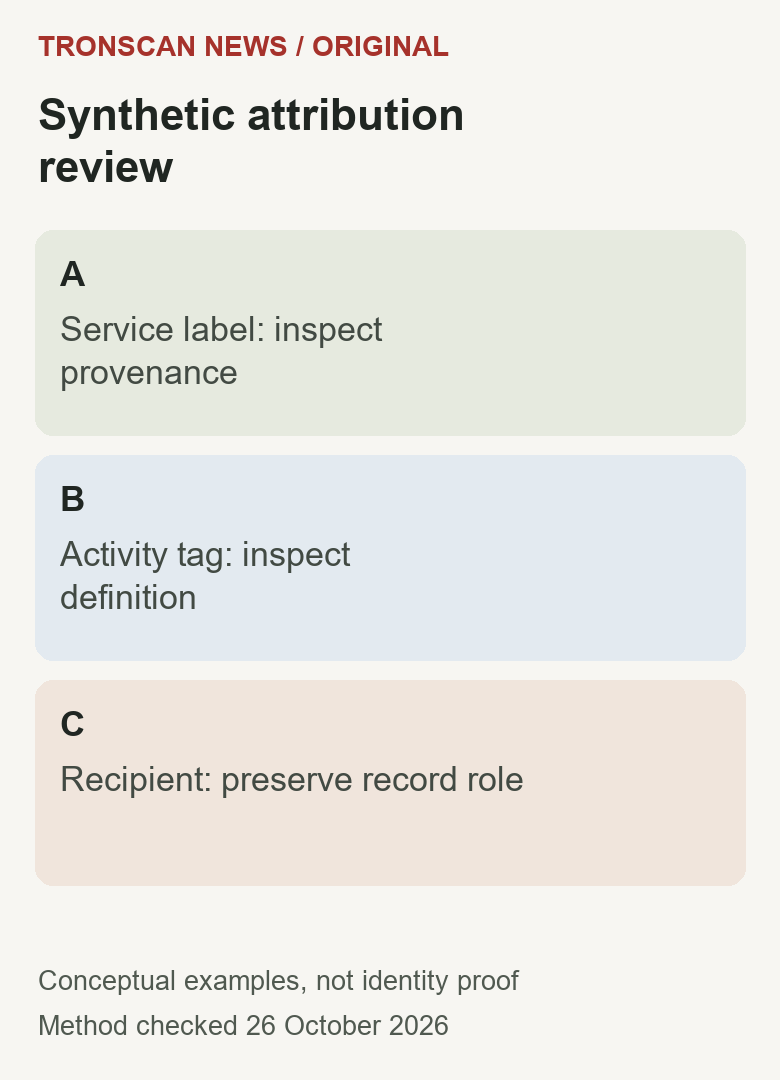
Account labels and signing permissions are separate
An account’s current signing permission structure is a different source of information from a descriptive name. Roles, keys, weights and thresholds address how authorization is configured. A service label does not replace reading that configuration when permission review is the intended task.
Use our TRON account permissions guide for that review. Even a technical permission observation should retain its checking time and scope. It should not be silently renamed as a comprehensive beneficial-ownership record.
For contract execution, also distinguish the transaction signer from event sender, contract caller and recipient roles. An address can appear in one role without supporting every other role. Copy the original field name into the evidence note before adding a human-readable interpretation.
When account labels change or disagree
Compare the sources, full addresses, networks and dates before treating different names as a conflict. Two services may have different coverage or refresh schedules. That is a possibility to investigate, not an explanation to assert without the relevant evidence.
If the same source displays a different label at two observed times, retain both captures and dates. Do not infer that control changed solely from the text change. A label correction, formatting change and actual control change are different explanations requiring different evidence.
An empty label is also not a negative identity proof. Record “no label displayed by this source at this time,” rather than “no owner” or “anonymous person identified.” Missing metadata should remain missing metadata in your report.
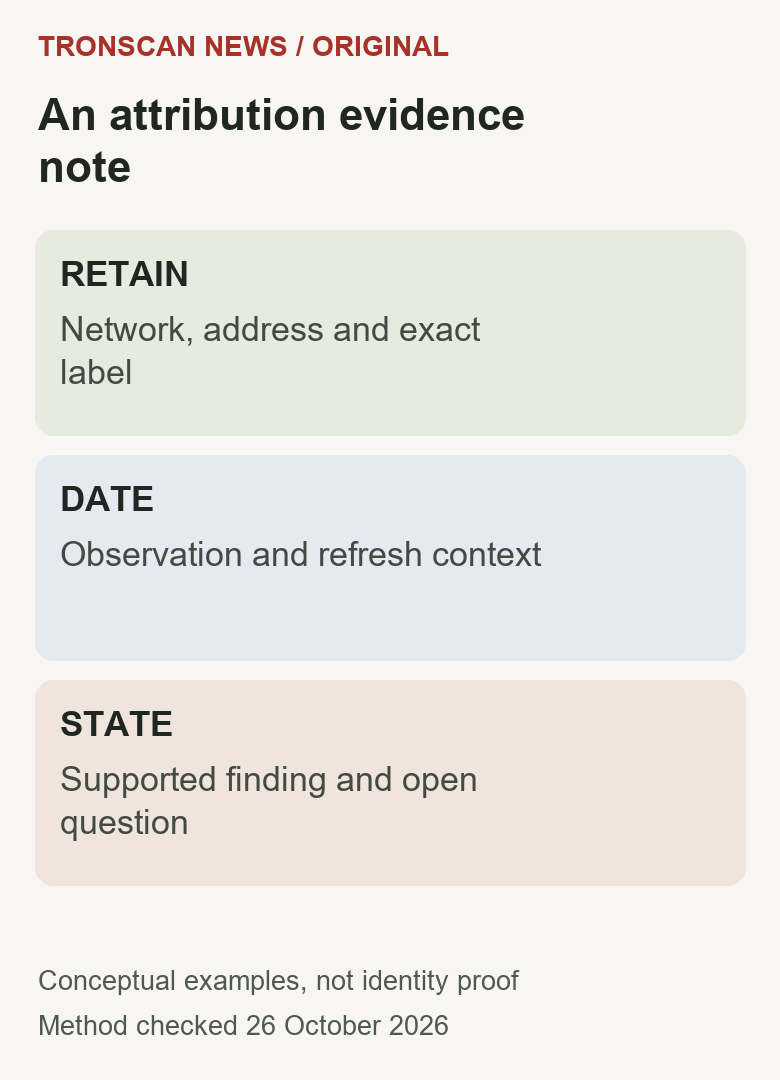
A reusable account labels evidence note
Retain the network, complete address, public source URL, exact label, category, observation time and any source-provided refresh time. Keep the original spelling next to your interpretation so another reader can distinguish the source’s claim from your analysis.
Add three separate fields: the question being investigated, the conclusion supported by available evidence and the next evidence needed. For a customer-credit issue, a named exchange label may locate relevant context, but it does not replace the receiving platform’s private deposit record.
When sharing account labels with a colleague, include the limitation beside the name. “Displayed service attribution, observed on this date; customer mapping not established” is more useful than an unsupported owner assertion. A source link helps reproducibility, but the link itself does not expand the evidence’s scope.
For network-wide account counts, our dated account growth counter audit shows another limit: aggregate address counts do not establish unique people. Keep that statistical question separate from the attribution questions addressed by account labels.
Account labels FAQ
1. Are all labels verified in the same way?
No. Keep the tag type and available verification evidence. The documented public-tag process should not be generalized to every behavior category or third-party note.
2. Does an exchange label identify its customer?
Not by itself. A service attribution and the private customer behind a transfer are different questions.
3. Does an unlabeled address have no owner?
No. It only establishes that the inspected source did not display a label in that observed context.
4. Does a changed label prove control changed?
No. Preserve both observations and investigate the change. The text alone does not establish its cause.
5. Must I sign a message to read labels?
No. This guide uses public read-only inspection. The separate public-tag application process is not required to read an existing page.
Sources and checking scope
Checked 26 October 2026 by Tronscan News with AI-assisted drafting and official-source review. Holder-row presentation was read directly; the attribution matrix and three-item exercise are original editorial materials. No address-control challenge, wallet signature, customer identification or authenticated tag API request was performed. Original diagrams are conceptual. More independent guides and corrections information are available from Tronscan News.
Leave a Reply