TRON USDT supply in the saved TRONSCAN dataset fell from 94,249,445,255.830382 USDT on 13 October to 94,245,475,626.145920 USDT on 26 October 2026. The difference is a decrease of 3,969,629.684462 token units, or approximately 0.004212% of the opening observation. These are dated levels for the specified TRON contract, not a measure of global USDT supply or money entering an exchange.
This report contains our own calculation, a fourteen-date evidence table and a reproducibility worksheet. We retrieved the official public API response on 27 October 2026 at 04:45 UTC, then filtered and calculated locally. The observation dates belong to the source dataset. The collection date is not presented as the date of a new issuance announcement.
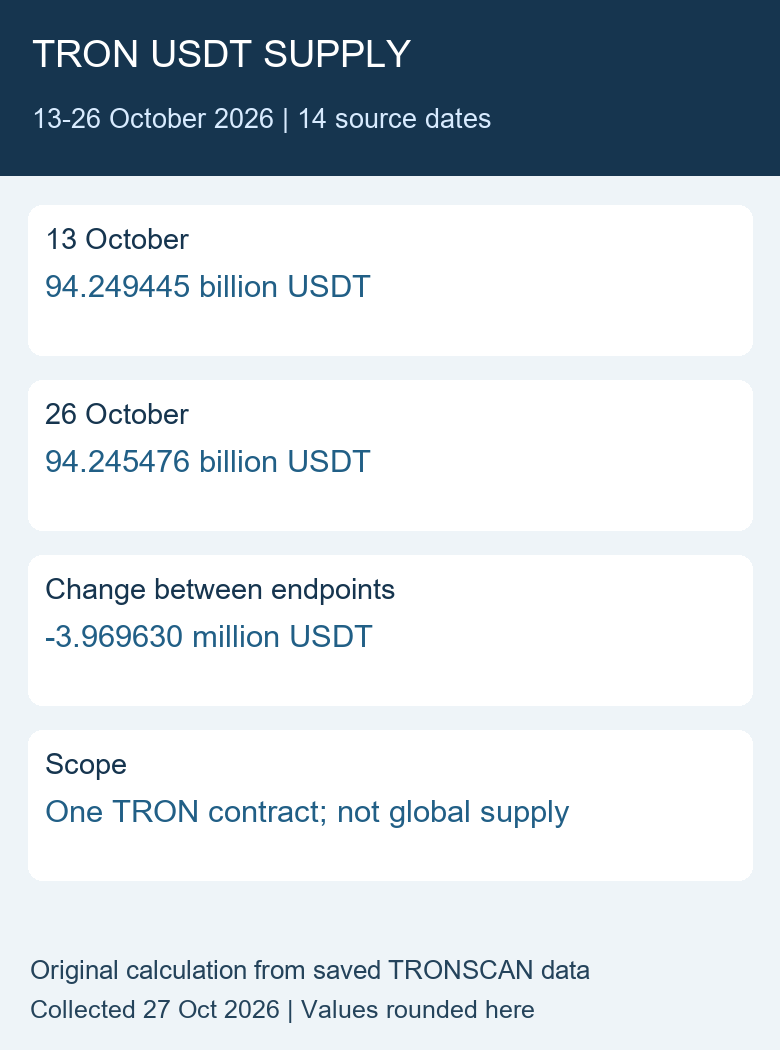
Table of Contents
TRON USDT supply: the result and its boundaries
The TRON USDT supply comparison uses the first and last category dates in the retained dataset. A small percentage difference can still correspond to millions of token units because the opening stock is large. Both descriptions belong together. Reporting only “millions disappeared” would exaggerate the scale; reporting only a rounded 94.25 billion at both endpoints would conceal the measured difference.
The minimum retained level, 94,245,475,626.145920 USDT, first appears on 23 October and remains the closing level on 26 October. The maximum is the opening observation on 13 October. This tells us about the recorded series within this window. It does not establish that these are historical all-time extremes.
We identify the asset by the full contract TR7NHqjeKQxGTCi8q8ZY4pL8otSzgjLj6t. The issuer’s supported-protocol reference is the primary place to check the applicable Tether network and contract information. A symbol or a similar-looking token name is insufficient for reproducing the filter.
Readers who need a general explanation of the asset and network can use our TRON USDT guide. This dated report has a narrower purpose: determine what one saved series supports, calculate its endpoint change and retain enough information to explain a later revision.
The fourteen-date evidence table
The following table preserves all fourteen category dates returned for the selected window. Values are expressed in USDT token units after applying six decimal places. Commas are display separators. They are not part of the underlying raw integer.
| Source category date | USDT token units |
|---|---|
| 2026-10-13 | 94,249,445,255.830382 |
| 2026-10-14 | 94,248,192,941.363764 |
| 2026-10-15 | 94,248,192,941.363764 |
| 2026-10-16 | 94,248,192,941.363764 |
| 2026-10-17 | 94,248,192,941.363764 |
| 2026-10-18 | 94,248,192,941.363764 |
| 2026-10-19 | 94,248,137,158.241966 |
| 2026-10-20 | 94,248,137,158.241966 |
| 2026-10-21 | 94,246,361,364.391341 |
| 2026-10-22 | 94,246,361,364.391341 |
| 2026-10-23 | 94,245,475,626.145920 |
| 2026-10-24 | 94,245,475,626.145920 |
| 2026-10-25 | 94,245,475,626.145920 |
| 2026-10-26 | 94,245,475,626.145920 |
These are source observations collected at one time. We have not independently reconstructed every historical contract state. The table should therefore be described as a saved TRONSCAN series rather than an independently audited statement of the issuer’s liabilities.
A date with an unchanged value is still an observation. It should not be removed merely because a chart looks cleaner without it. Conversely, an absent date would not justify inventing a zero. This response contained fourteen distinct consecutive dates, so no missing-date interpolation was required for this report.
How the source fields were selected
The official supply-change API reference identifies the endpoint and its fields. We used the category’s date and the entry matching the complete USDT contract. The raw supply integer was divided by ten to the power of the returned decimal value, which was six for every retained row.
The parent timestamp in each response block corresponds to the next UTC midnight, whereas the category provides the dated observation used in the table. Our local check compared those two fields across all fourteen records. Keeping both values in the working evidence prevented a one-day labeling shift.
The response also contains other stablecoin categories with different decimal conventions. We did not use its mixed-category raw aggregate to calculate USDT. Adding integers before normalizing their units would produce a result that has no useful token-unit interpretation for this report.
If you are unfamiliar with raw values, the TRC20 decimal-reading guide explains the general conversion. The exact decimal evidence matters here because a chart can look plausible even when its entire vertical scale is wrong by a factor of a million.
Reproduce the TRON USDT supply comparison
- Define the scope before collecting data. Write down TRON, the full contract, source category dates 13-26 October 2026 and token units. Do not begin with an undefined “USDT total.”
- Retain the response and collection time. Our saved response was collected on 27 October at 04:45 UTC. A later retrieval may contain revisions; that is a new snapshot, not a reason to silently replace the old evidence.
- Filter by exact contract. Require one matching category entry per observation. A missing match or duplicate match should stop that row’s calculation until explained.
- Check the decimal field. We required six on every retained row and used decimal arithmetic. Do not convert a long raw integer through a floating-point spreadsheet format that silently rounds its last digits.
- Sort and check dates. Require fourteen distinct consecutive category dates. Keep the parent timestamp separately, and do not relabel it as the observation date.
- Subtract the opening level from the closing level. Closing minus opening equals -3,969,629.684462 USDT. Divide that signed difference by the opening level and multiply by 100 for the percentage.
- Write the limited conclusion. This source series decreased slightly over the chosen endpoints. Leave explanations about the cause, reserve movements or customer behavior unclaimed unless separate evidence supports them.
An original TRON USDT supply reconciliation worksheet
Our worksheet pairs each result with a condition that would invalidate it. This makes the analysis more useful than a stand-alone number. A reader can apply the same checks to a later window and identify why a comparison should be withheld.
| Question | Check used here | When to stop |
|---|---|---|
| Is the asset consistent? | Exact contract on all fourteen dates | Missing, changed or duplicated contract match |
| Are quantities comparable? | Six decimals on each matching entry | Unknown unit or unexplained decimal change |
| Does the date window match? | Fourteen unique consecutive category dates | Gap, duplicate or shifted date label |
| Was the calculation preserved? | Decimal subtraction and opening-level denominator | Rounded intermediate values or a different denominator |
| Does the conclusion fit? | Stock difference within one saved series | Claim of gross issuance, reserve backing or capital inflow without evidence |
The four local data checks passed: a single exact contract match for each date, constant six-decimal conversion, fourteen unique consecutive dates and the expected relationship between parent timestamp and category date. The worksheet does not test the complete upstream indexing pipeline. Passing local consistency checks cannot prove that the source itself is infallible.
Where the TRON USDT supply difference appears
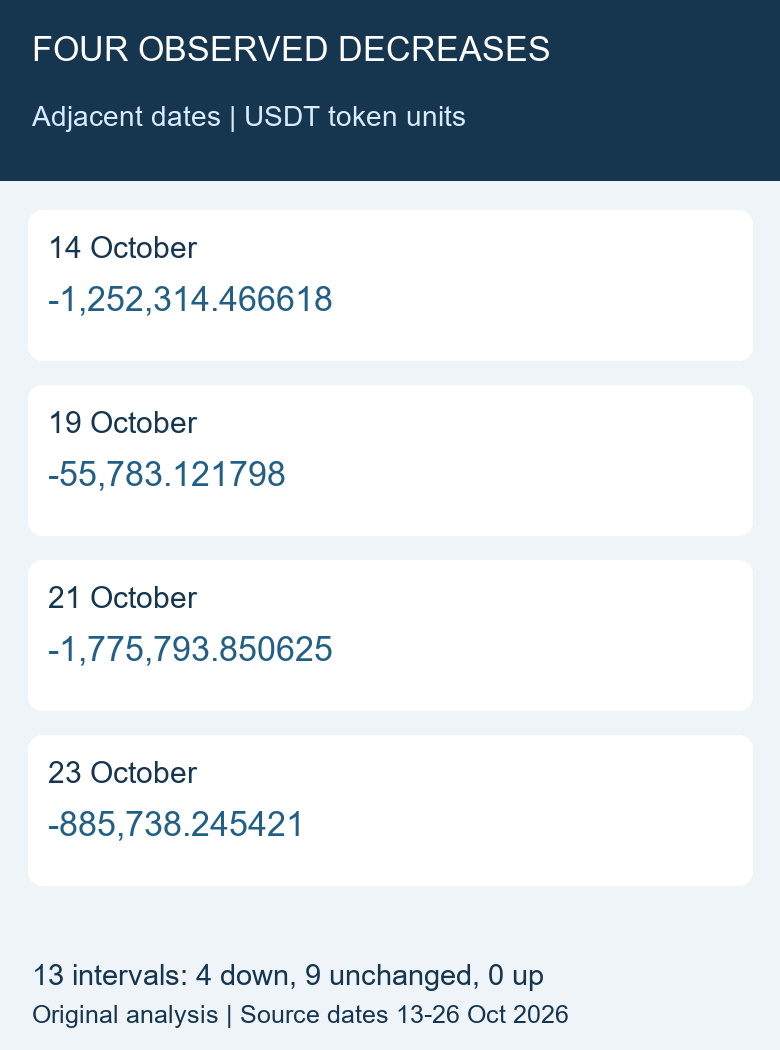
Our second calculation checks the thirteen adjacent-date intervals rather than relying only on the endpoints. Four intervals have a lower closing observation and nine have an unchanged observation. None has a higher closing observation in this saved window. The sum of the thirteen signed differences exactly equals the endpoint difference, which provides a separate arithmetic reconciliation.
| Closing category date | Change from preceding date, USDT |
|---|---|
| 14 October | -1,252,314.466618 |
| 19 October | -55,783.121798 |
| 21 October | -1,775,793.850625 |
| 23 October | -885,738.245421 |
The largest adjacent-date decrease in this TRON USDT supply series is the 21 October observation compared with 20 October. That identifies the interval with the largest observed difference. It does not identify the precise intraday time, transaction or organization responsible. Answering those questions requires a different investigation with appropriate records.
The nine unchanged intervals matter to the interpretation. They mean that the retained daily levels are equal, not that no USDT transfers occurred. Supply is a stock measure. Ordinary movements between accounts can change ownership or control of balances while leaving the token’s total quantity unchanged. This is why a supply table should not be used as a transaction-activity calendar.
For a repeatable TRON USDT supply comparison, retain negative signs until the final display. A calculation that turns every decrease into an absolute positive number would no longer reconcile to the signed endpoint difference if increases were present. This particular window contains no observed increases, but the worksheet should still work correctly for a future mixed-direction series.
There are fourteen source dates and thirteen adjacent intervals. Calling the result fourteen daily changes would be an off-by-one error. The four nonzero differences shown here describe only intervals whose two endpoint dates are present. We have not calculated a change for 13 October because the required 12 October observation lies outside this report’s retained window.
This decomposition is original analysis of the saved TRON USDT supply observations. We checked the interval count, counted positive, negative and unchanged differences, and reconciled their signed sum to the opening-to-closing change. These checks can catch a missing row or subtraction mistake. They cannot establish an upstream data revision policy or substitute for an issuer explanation of the underlying events.
What a supply difference does not measure
An endpoint difference is a stock comparison. It cannot reveal all additions and removals that may have occurred between those observations. Two opposite changes can partly cancel. Consequently, the magnitude of the net change is not a substitute for a complete gross issuance and redemption history.
Transfer activity is a different quantity. The same existing units can be transferred repeatedly without increasing supply. A period with large transfer amounts and a nearly unchanged supply is therefore not automatically a contradiction. Compare the definitions before deciding that either series is wrong.
A wallet balance is narrower still: it concerns a particular account at a particular observation point. The supply-versus-balance comparison covers that distinction. The TRON USDT supply level is not a customer’s available balance or evidence that a service has credited a deposit.
The values are token quantities, not a direct measurement of dollar reserves. This analysis has no independent reserve, bank-account or redemption investigation. We do not use the small change to make a price forecast, infer a solvency outcome or recommend a financial transaction.
Handle a later disagreement without hiding revisions
If a later source view shows another value, compare the full contract, category date, decimal conversion and retrieval time first. Then compare the raw integer. Comparing only two rounded chart labels can hide the reason for a difference.
If the raw integer changed for the same date and scope, preserve both snapshots and label the newer one as a revision. Do not overwrite an old report’s number while retaining its old checking time. A correction should state the affected dates, the changed calculation and whether the conclusion changed.
If the source has no observation for a requested date, report that limitation. Extending this fourteen-date report backward or forward requires new data and a new window check. It is not appropriate to carry the last value indefinitely and present it as newly observed.
The practical success standard is a traceable result: another reader can identify the same asset, understand the date convention, reproduce the subtraction and recognize the limits. A dramatic headline or an extra decimal without that context does not improve the evidence.
A tested offline checker for the saved observations
The following Python example reads a previously saved response file. It does not connect a wallet, send a transaction or call an API. We ran this code locally against the retained TRON USDT supply response on 27 October 2026 and obtained the opening, closing and signed difference printed in this report.
Save a response from the documented supply-change endpoint as supply.json, save the example below as check_saved_supply.py, and run python check_saved_supply.py supply.json. The example requires a Python environment and the standard library only. No password, signing key or private account information belongs in either file.
"""Offline arithmetic check; usage: python check_saved_supply.py supply.json"""
import json
import sys
from pathlib import Path
from decimal import Decimal, getcontext
from datetime import date, timedelta

getcontext().prec = 45
contract = "TR7NHqjeKQxGTCi8q8ZY4pL8otSzgjLj6t"
data = json.loads(Path(sys.argv[1]).read_text(encoding="utf-8"))
observations = []
for block in data["statistics"]:
    matches = [r for r in block["category"] if r["address"] == contract]
    assert len(matches) == 1, "Contract match is missing or duplicated"
    row = matches[0]
    assert row["decimal"] == 6, "Unexpected decimal convention"
    day = date.fromisoformat(row["date"])
    if date(2026, 10, 13) <= day <= date(2026, 10, 26):
        observations.append((day, Decimal(row["totalSupply"]) / Decimal(10) ** 6))
observations.sort()
assert len(observations) == 14, "Expected fourteen dates"
assert len({d for d, v in observations}) == 14, "Duplicate category date"
assert all(observations[i][0] - observations[i-1][0] == timedelta(days=1)
           for i in range(1, len(observations))), "Date gap"
opening = observations[0][1]
closing = observations[-1][1]
differences = [observations[i][1] - observations[i-1][1]
               for i in range(1, len(observations))]
assert sum(differences) == closing - opening, "Reconciliation failed"
print("Dates:", len(observations), "Intervals:", len(differences))
print("Opening:", opening, "Closing:", closing)
print("Signed change:", closing - opening)
print("Percent of opening:", (closing - opening) / opening * 100)
print("Down:", sum(v < 0 for v in differences),
      "Unchanged:", sum(v == 0 for v in differences),
      "Up:", sum(v > 0 for v in differences))
The expected result for our saved response is fourteen dates, thirteen intervals, four decreases, nine unchanged intervals and no increases. The signed change is -3,969,629.684462. The percentage output contains more digits than the headline because the code retains decimal precision during the calculation; the report rounds only the final display.
A failed assertion is a reason to inspect the input, not an invitation to delete the check until a preferred number appears. For example, a missing contract match might mean that the response structure, asset selection or source coverage differs. A duplicate date might mean that two snapshots were accidentally combined. The code deliberately does not guess which duplicate to retain.
The date range is explicit in the example. Changing it requires changing the expected count and reviewing whether the new source response actually covers the requested dates. Do not modify the dates while leaving the fourteen-date assertion as a misleading badge of success. For a later comparison, retain the original script and create a clearly labeled new version.
The checker is intentionally conservative about the decimal convention. If a matching entry reports another value, it stops rather than silently scaling an unfamiliar quantity. That behavior makes the unit assumption visible to the reader. It is suitable for reproducing this specific saved dataset, not a claim that every future response will always have the same structure.
Our local execution is an arithmetic and consistency test. It does not authenticate the API operator, independently verify the blockchain’s historical state or determine why a supply change occurred. The same limitation applies if another reader runs it successfully. A reproducible calculation strengthens the explanation of an observation; it does not enlarge the observation’s scope.
For review work, keep a short run note containing the response collection time, script version, selected contract, date window and console output. If a later snapshot produces a different result, those fields let you distinguish a changed source observation from a changed calculation. Preserve both records before deciding whether a published correction is necessary.
Frequently asked questions
What was the closing TRON USDT supply in this review?
The saved source reports 94,245,475,626.145920 USDT for category date 26 October 2026. We collected the response on 27 October; it is not a live balance quote.
How large was the fourteen-date change?
The closing level minus the 13 October opening level is -3,969,629.684462 USDT, approximately -0.004212% of the opening observation. The fourteen observations span thirteen date-to-date intervals.
Does the decrease prove that money left TRON?
No. A token-supply stock difference does not independently identify capital flows, customer withdrawals, reserve changes or their causes.
Why not use the total for every stablecoin category?
This report concerns one contract. Other entries have their own assets and decimal conventions, so a mixed raw aggregate cannot be substituted for TRON USDT supply.
Can I reproduce the values without connecting a wallet?
The public statistical response used here required no wallet connection or signature. Respect the provider’s access rules and limits; this report does not promise unlimited API access.
Method and editorial note: Tronscan News prepared this independent analysis with AI assistance and local decimal calculations. Original graphic and worksheets were created for this report. Sources and calculations were checked on 27 October 2026. No live wallet operation, reserve audit or independent historical chain reconstruction was performed. See the editorial-standards link in the site navigation for corrections and contact information.
Find the site’s topic guides and dated reviews through the Tronscan News home page.
Leave a Reply