A TRON burn address is a commonly used destination generally treated as uncontrolled. Sending tokens there does not, by itself, prove that the token contract’s totalSupply decreased. Native TRX fee burn is a separate protocol-accounting question with a historical change in how totals are recorded.
This guide separates three records that are often called a burn: a token transfer to an address, execution of token-contract burn logic, and TRX consumed through network fees. We checked the official references and one public Mainnet address on 1 November 2026. No transfer, burn, wallet connection or recovery attempt was performed.
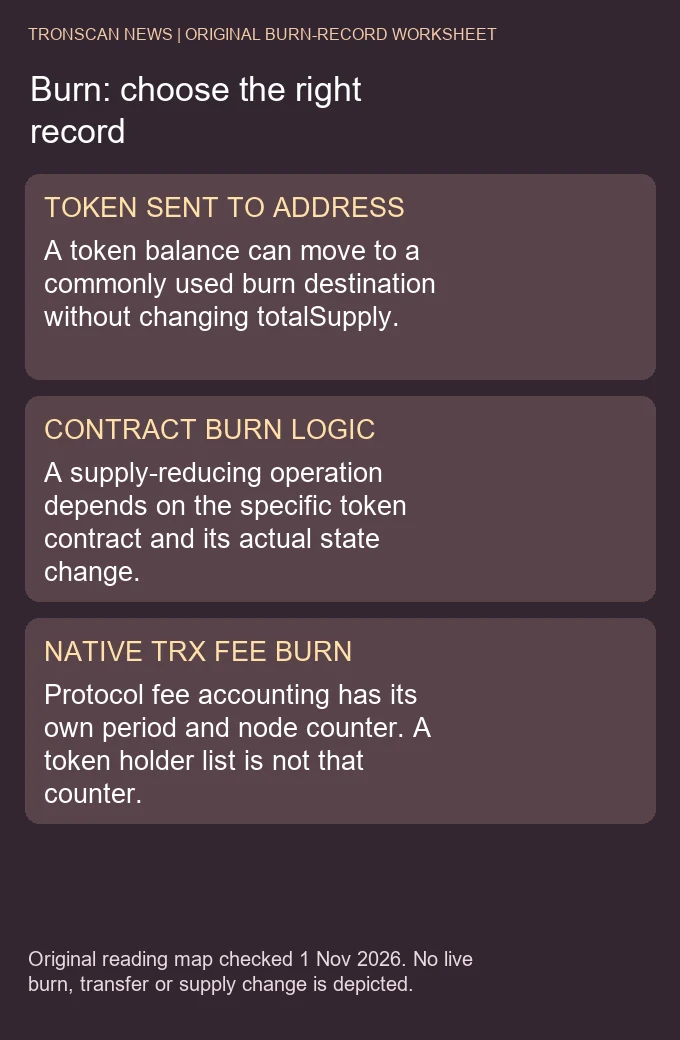
Table of Contents
Common token burn addresses in the official reference
The TRON developer FAQ lists four commonly used token burn destinations. It says they are generally treated as uncontrolled and tokens sent to them usually cannot be transferred out. It also distinguishes those transfers from contract logic that reduces totalSupply. These addresses are reference identifiers here, not instructions to send funds.
| Reference suffix | Complete Base58Check address |
|---|---|
| 0 | T9yD14Nj9j7xAB4dbGeiX9h8unkKHxuWwb |
| 1 | T9yD14Nj9j7xAB4dbGeiX9h8unkKLxmGkn |
| 2 | T9yD14Nj9j7xAB4dbGeiX9h8unkKT76qbH |
| dead | T9yD14Nj9j7xAB4dbGeiX9h8upfCg3PBbY |
We locally encoded each corresponding 21-byte Hex address from the FAQ with a Base58Check checksum and reproduced all four strings. That validates the representation comparison used in this worksheet. It does not prove anything about possession of a private key or the recoverability of a real transfer.
The TRON Base58 and Hex address guide explains the format distinction. For a reading task, compare the complete identifier. These four examples have long shared prefixes, so matching only the first or last few characters is not enough.
What our public address check established
We opened the Mainnet address ending in KHxuWwb. The explorer identified it as Black Hole Address(0). We retained the complete address and the network with the visible label.
This was an address-identification observation. We did not sum its holdings, reconstruct its history, certify that every listed token had been economically removed from circulation, or infer a token’s supply change from the address page. A label is context for the record, not a complete accounting statement.
Choose among three different burn questions
| Question | Relevant evidence | Insufficient shortcut |
|---|---|---|
| Did a particular token move to a listed address? | Matched network, token contract, transaction receipt and token movement | A ticker or address-name tag alone |
| Did the token’s total supply decrease? | The specific contract’s burn behavior and corresponding state evidence | A transfer row whose recipient looks like a burn address |
| How much native TRX was burned for fees in a defined period? | Applicable protocol counter or dated accounting source with its units and period | A current token balance at one commonly used destination |
Start by writing the asset and the operation in separate fields. “TRX fees” and “40 units of a TRC20 token” do not become the same quantity because both use the word burn. A single transaction can have token movements and network charges; the two records still need their own units.
A transfer can leave totalSupply unchanged
Suppose a hypothetical token has an assumed total supply of 1,000 units. One sender holds 600 and other holders hold 400. Under an ordinary transfer model, the sender sends 40 units to a listed burn destination. The resulting inventory is 560 with the sender, 400 with other holders and 40 at the destination.
The combined inventory is still 1,000. In this synthetic case, the balance moved but the totalSupply variable did not change. This does not describe a real token or claim that every contract allows such a transfer. The contract’s actual behavior determines the real result.
Now assume a different operation: contract burn logic removes 40 units from a total supply of 1,000. Under that stated assumption, the supply becomes 960. That is a different state change from redistributing a fixed inventory. We verified both calculations locally without executing a contract.
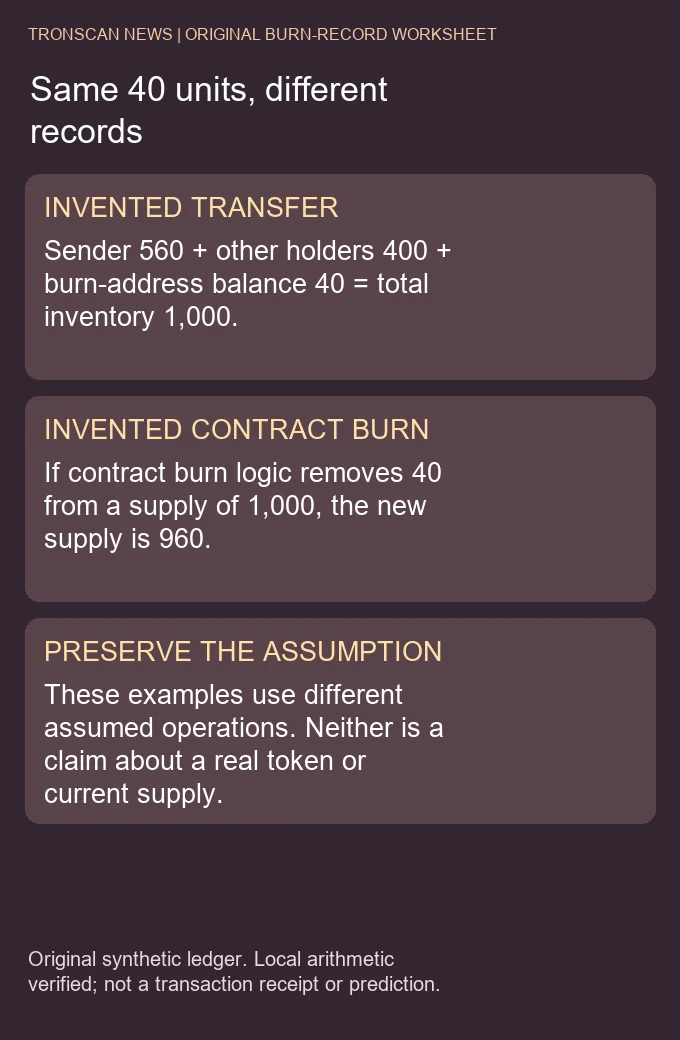
The existing supply and individual-balance comparison explains the broader inventory distinction. Here the extra check is whether an apparent burn is merely a destination transfer or an operation that changes the particular contract’s supply accounting.
Why historical TRX fee burn needs a separate route
The FullNode GetBurnTRX reference describes a change associated with committee proposal No. 54. Before that change, transaction-fee TRX was transferred to TLsV52sRDL79HXGGm9yzwKibb6BeruhUzy. Afterward, burned TRX is recorded directly in the node database. The endpoint covers fee burn since that proposal took effect.
The document’s pre-change approximation subtracts the black-hole address’s initial balance from its observed balance; the initial value comes from node configuration. We did not obtain a historical configuration value or use a current address balance to publish a real estimate. Without that baseline and a matching scope, a numerical total would be unsupported.
The Solidity-node GetBurnTRX reference identifies the solidified-state version. Keep the state source with the observation rather than comparing head-state and solidified-state results as if their times were identical. We did not query either endpoint for a current Mainnet burn total.
The examples on those API reference pages use a Shasta host. That is not a Mainnet measurement. A copied example URL or a numeric response from a test network cannot establish a global Mainnet fee total. This article uses the documentation to explain the accounting boundary, not to claim a live API statistic.
Four synthetic accounting checks
All values below are invented for the worksheet. They are not balances, current fee rates, protocol statistics or predictions. Each row preserves its own assumption and unit.
| Assumed case | Local calculation | Permitted conclusion |
|---|---|---|
| Ordinary token transfer | 560 + 400 + 40 = 1,000 token units | Inventory redistribution under the stated model |
| Supply-reducing contract operation | 1,000 − 40 = 960 token units | Supply after an assumed valid burn operation |
| Historical balance baseline | 170 − 100 = 70 TRX | Difference only; a real estimate still needs the correct baseline and scope |
| Two matching, non-overlapping periods | 70 + 30 = 100 TRX | A combined amount only if coverage and definitions match |
Do not add the token units in the first two rows to the TRX units in the last two. Do not add overlapping daily and cumulative counters. A sum can be arithmetically correct while its accounting interpretation is wrong. The worksheet’s purpose is to make those assumptions visible before any total is reported.
Four practical checks for an apparent burn record
- Identify the asset and network. Preserve the token contract for a token question. For native TRX, label the unit explicitly rather than describing every number as a token transfer.
- Identify the record type. Is it a transfer receipt, contract state observation, address balance or protocol counter? Do not promote one type into another without the corresponding evidence.
- Match the period and baseline. A historical fee estimate and a post-proposal cumulative counter have different coverage. Missing initial balances, dates or state-source details remain unresolved.
- Write the narrow conclusion. State what moved or changed and what was not checked. If the only evidence is a destination transfer, do not claim a measured reduction in totalSupply.
When a contract method name contains “burn,” that name alone also does not establish successful execution or the magnitude of a supply change. The actual result and contract behavior matter. Conversely, a source-code function that could burn tokens does not show that it was executed in the transaction under discussion.
Common mistakes and useful stopping points
A balance is being called the lifetime burn total. Stop and ask for the counter definition, period and initial balance. The historical fee reference makes clear why the current holdings of a familiar address are not automatically the required modern total.
An address is shortened to a shared prefix. Compare the complete string with the intended reference. Our four examples are deliberately similar; a prefix match can conceal a different destination. The local checksum tests validate their encodings, not their ownership.
A page is missing or still loading. Record the observation as unavailable. Do not turn an absent supply result into zero supply or interpret an empty movement list as proof that no earlier transfers exist.
A claimed burn is used to predict price. This worksheet supplies no market model. Neither a transfer to a listed address nor a correctly measured supply reduction, by itself, establishes a future price, an investment return or a personal financial outcome.
A fee quantity is confused with a fixed fee. Resource charges and unit prices have their own rules and can change. The dated TRON fee-parameter worksheet explains how to preserve those units and observation dates. No fixed fee is inferred from the address examples here.
Copyable burn-record note
Question being answered:
Network / asset / token contract if applicable:
Record type and exact source URL:
Full address or genuine transaction hash:
Observed time / block or state source:
Amount and original unit:
totalSupply evidence, if actually checked:
Counter period / initial balance, if required:
Narrow conclusion / unanswered question:
A completed note distinguishes an actual observation from a synthetic explanation. Do not fill an empty transaction-hash field with one of the example addresses. Our local representation and ledger tests created no chain transaction and therefore have no transaction receipt.
Frequently asked questions
Does a transfer to a burn address always reduce totalSupply?
No. The official FAQ distinguishes an inaccessible destination balance from supply-reducing contract logic. Check the specific token’s behavior and state evidence.
Is every TRON black-hole address the same?
No. The common token destinations and historical native fee-accounting address have different roles. Preserve the complete identifier and the question being answered.
Can I use a burn-address balance as today’s TRX fee total?
Not without the applicable definition and period. The GetBurnTRX references describe a post-proposal counter and a separate historical baseline calculation.
Do the four address tests prove funds can be recovered?
No. They test Hex-to-Base58Check correspondence only. No private-key, transfer or recovery operation was attempted.
Does a burn prove that a token price will rise?
No price or return follows from this reading worksheet. We did not model markets or evaluate an investment.
Independent Tronscan News editorial review with AI-assisted drafting and source checks on 1 November 2026. Two original diagrams, four local address-representation tests and four invented ledger examples were produced for this article. Actual UI scope: public Mainnet address identification only. No burn, transfer, API total, recovery or current supply analysis is claimed. Browse the Tronscan News homepage; corrections can be raised through About & Standards in the navigation.
Leave a Reply