TRON solidified state and the latest head answer different read-only questions. A /wallet route can show the node’s latest view, while the corresponding /walletsolidity route reads its solidified view. Choose the view deliberately, and keep execution success separate from whether a record is solidified.
This guide demonstrates a dated comparison of two Mainnet block responses, with tested offline code and an evidence worksheet. It is for readers deciding which data to use for a current display or a confirmation-oriented report. It does not submit, sign or replace a transaction. The Tronscan News homepage provides our independent explorer guides.
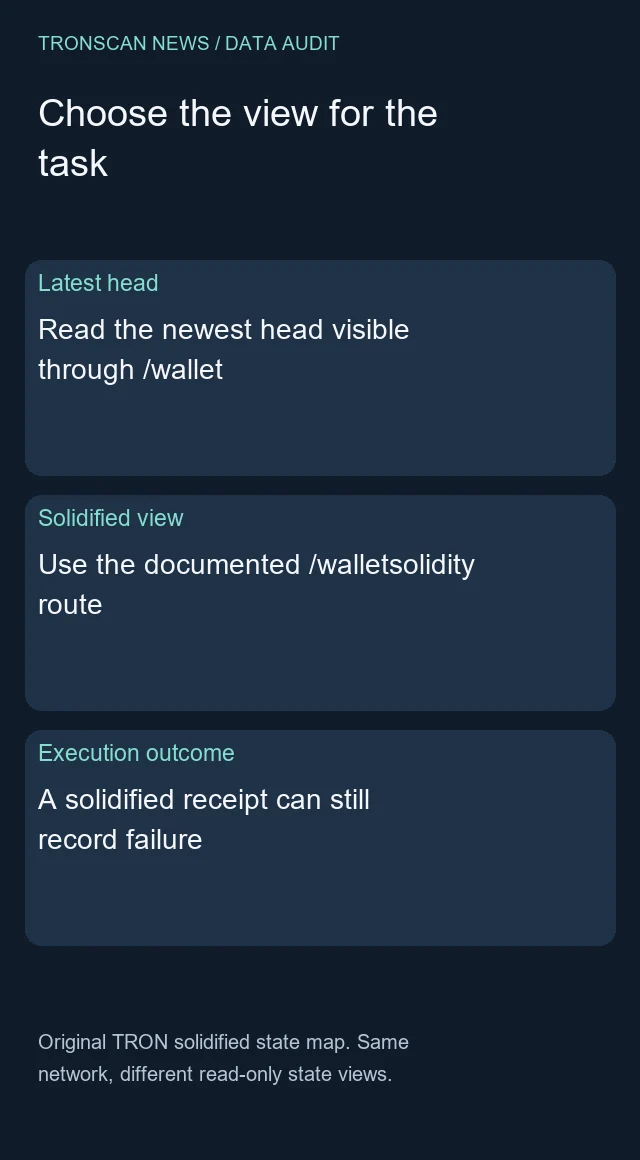
Table of Contents
1. Choose the state view before reading the number
The official confirmation-semantics guide distinguishes latest-head bodies, execution receipts, solidified records and indexed service data. Those stages should not be compressed into one generic “success” label. A body identifies submitted content; a receipt supplies execution information.
For a display intended to track the newest head, a latest-state read can be appropriate. For a workflow that depends on solidified state, use the documented solidified route and preserve that scope. The reader’s task should determine the source, rather than whichever response happens to appear first in a search result.
| Reader’s question | Evidence to seek | Boundary |
|---|---|---|
| What is the latest head this node sees? | Latest-head block response | Not automatically solidified |
| What is the latest solidified height this service returns? | Solidified block response | Not a universal timing promise |
| Did a contract call succeed? | Matching execution receipt and relevant fields | Block height alone is insufficient |
| Has an indexer processed a transfer row? | That indexer’s dated response and filters | Not the same measurement as native node state |
The TRON block-page guide explains the visible block fields. This article adds a practical comparison between state views after you have identified the network and endpoint. It does not replace the basic distinction between a block number and a transaction ID.
2. Collect one bounded pair with provenance
- Choose the same intended network for both reads. Mainnet and a test network should not be compared as if their heights shared one chain history.
- Record the provider and the complete two endpoint paths.
- Read
https://api.trongrid.io/wallet/getnowblockfor the latest-head observation in this example. - Read
https://api.trongrid.io/walletsolidity/getnowblockfor the solidified observation. - Save both complete responses with request start and finish times.
- Inspect response content for a usable header rather than treating HTTP 200 alone as a block result.
Our requests were sequential, not simultaneous. We paused between them and retained their separate timestamps. The node could process additional blocks between reads. A comparison therefore describes two observations in a short collection window; it is not an atomic snapshot of two internal state pointers.
The official solidified GetNowBlock reference identifies that endpoint’s role and explains that a lower solidified height is not, by itself, a node fault. Its example host is Shasta testnet; our actual endpoints above were Mainnet. Provider access rules and historical availability remain separate concerns.
Do not put wallet secrets or private support correspondence into this evidence package. These are public block reads. A gateway’s authentication policy, if applicable, should be handled through its normal access process rather than by changing the network or endpoint silently.
3. Inspect the October 29 observation
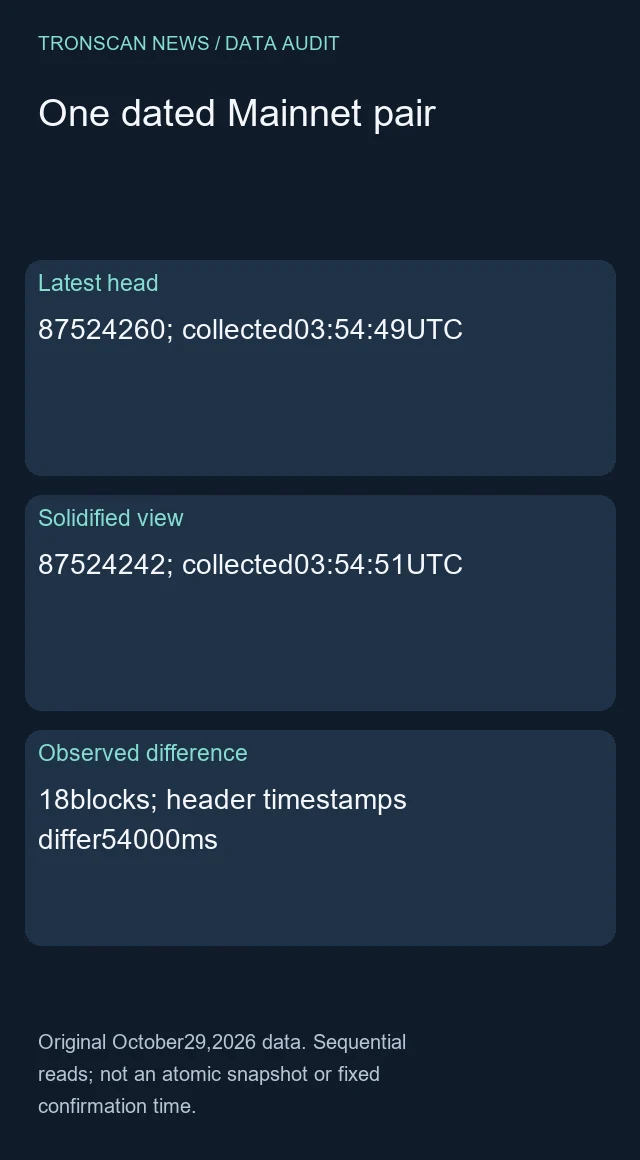
The latest-head request began at 03:54:48 UTC and completed at 03:54:49 UTC on October 29, 2026. It returned block 87524260. The solidified request began at 03:54:51 UTC and completed during that same second, returning block 87524242. Both HTTP responses were 200 and contained usable block headers.
| Observed field | Latest head | Solidified view |
|---|---|---|
| Block number | 87524260 | 87524242 |
| Header timestamp, milliseconds | 1793246082000 | 1793246028000 |
| Number-prefix hex in full ID | 00000000053783a4 | 0000000005378392 |
| Request route | /wallet/getnowblock | /walletsolidity/getnowblock |
| HTTP status | 200 | 200 |
The observed height difference was 18 blocks. Subtracting the two block-header timestamps gave 54000 milliseconds, or 54 seconds. This is a timestamp difference between the returned headers. It is not the network request latency, an independently measured consensus duration or a guaranteed confirmation deadline.
The complete latest ID was 00000000053783a419852c9043264edb3e4628714f42badd717d36e26b41c6d5. The complete solidified ID was 0000000005378392053b38bccde5d644440c1f4257aa4696de24050a9c49cbd5. We retained these values so a later review can identify the exact observations rather than relying on the heights alone.
This example does not establish an average or maximum lag. It uses one provider, one network and one pair of reads. We did not operate an independent node, audit consensus participation or measure how every public service behaved during that interval.
4. Compare TRON solidified state with offline code
Save the responses locally as latest-block.json and solidified-block.json. Save the code below as compare_views.py. With Python available, run python compare_views.py latest-block.json solidified-block.json. The program reads local files only; it does not poll a node or send a transaction.
import json
import re
import sys


def integer(value, name):
    if type(value) is not int or not 0 <= value <= 9223372036854775807:
        raise ValueError(name + ' must be a nonnegative int64 integer')
    return value


def header(block):
    if not isinstance(block, dict) or 'Error' in block:
        raise ValueError('Expected a block response, not an API error')
    raw = block.get('block_header', {}).get('raw_data', {})
    number = integer(raw.get('number'), 'block number')
    timestamp = integer(raw.get('timestamp'), 'timestamp milliseconds')
    identifier = block.get('blockID')
    if not isinstance(identifier, str) or not re.fullmatch(r'[0-9a-fA-F]{64}', identifier):
        raise ValueError('Expected a complete 32-byte hexadecimal block ID')
    if int.from_bytes(bytes.fromhex(identifier)[:8], 'big') != number:
        raise ValueError('Block ID number prefix disagrees with header number')
    return {'number': number, 'timestamp_ms': timestamp, 'block_id': identifier.lower()}


def compare_views(latest_block, solidified_block):
    latest = header(latest_block)
    solidified = header(solidified_block)
    same_height = latest['number'] == solidified['number']
    return {
        'latest': latest, 'solidified': solidified,
        'observed_height_difference': latest['number'] - solidified['number'],
        'header_timestamp_difference_ms': latest['timestamp_ms'] - solidified['timestamp_ms'],
        'same_height': same_height,
        'same_height_same_id': same_height and latest['block_id'] == solidified['block_id'],
        'same_height_conflicting_ids': same_height and latest['block_id'] != solidified['block_id'],
        'solidified_above_observed_latest': solidified['number'] > latest['number'],
        'scope': 'Two supplied snapshots; no atomic view, finality SLA or transaction execution check'
    }


if __name__ == '__main__':
    if len(sys.argv) != 3:
        raise SystemExit('Usage: compare_views.py latest-block.json solidified-block.json')
    with open(sys.argv[1], encoding='utf-8') as source:
        latest = json.load(source)
    with open(sys.argv[2], encoding='utf-8') as source:
        solidified = json.load(source)
    print(json.dumps(compare_views(latest, solidified), indent=2))
The function requires nonnegative integer heights and timestamps, plus a complete 32-byte block ID. It confirms that the ID’s height prefix agrees with the header number. The official block documentation describes that composite ID structure. This consistency check does not recompute the full content-derived suffix or verify the producer signature.
The output separates a numeric difference from equality and conflict flags. When the heights differ, different block IDs are expected to identify different blocks. A different ID in that case is not evidence of a fork. When the supplied heights are equal but IDs differ, preserve the discrepancy and investigate provenance rather than immediately attributing a cause.
The program also flags a supplied solidified height above the observed latest height. That can be a clue to check collection order, source mix or input labels. The flag is not a diagnosis of the live network. The tool cannot establish which network either supplied JSON file came from.
5. Reproduce the validation and ambiguity tests
We ran the displayed function against the saved real pair and altered local fixtures. The real output reported a height difference of 18 and header timestamp difference of 54000 milliseconds. Neither same-height flag was set, because the observations were at different heights.
| Controlled fixture | Expected outcome | What it tests |
|---|---|---|
| Real saved pair | 18 blocks and 54000 ms | Observed arithmetic |
| Identical block supplied twice | Same height and same ID | Equality path |
| Same height, synthetic changed ID suffix | Conflict flag | Disagreement without automatic causal attribution |
| Labels reversed in a synthetic copy | Negative height difference and reverse-order flag | Timing and input-label review |
| Number prefix disagrees with header | Reject | Internal record consistency |
| Negative or Boolean numeric field | Reject | No silent integer coercion |
| Malformed ID or missing header | Reject | Input completeness |
| API Error object | Reject | Transport success is not a usable block response |
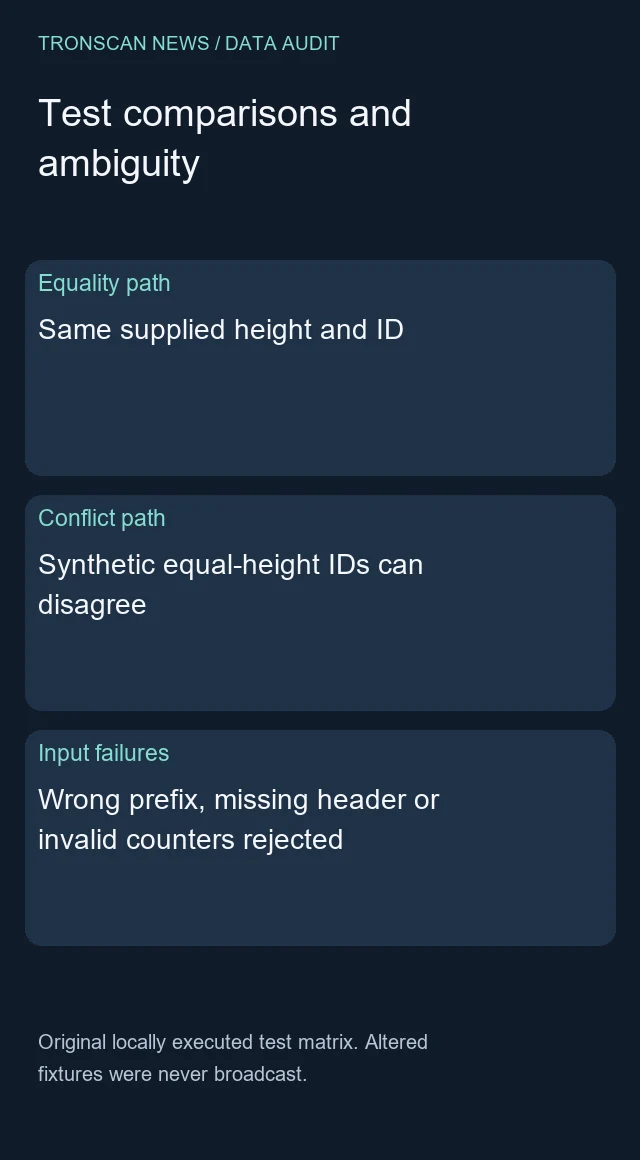
The changed suffix and reversed-label cases are synthetic. They were never published to the chain and do not describe a real conflicting block observation. They test how the local program reports disagreement and invalid input.
A normal process exit means that the comparison ran. It does not automatically mean that every flag is satisfactory for your application. Inspect the named output fields, keep exceptions separate from completed comparisons and define any operational policy outside this small analysis utility.
6. Do not turn a solidified record into a success claim
A solidified receipt can record a failed contract execution. Read the execution status and the business-relevant token or internal-transfer evidence, rather than using the presence of a receipt as a substitute for its contents. Likewise, a block-height comparison does not identify whether a particular customer payment was included.
For a specific contract call, preserve the original TxID and retrieve its matching body and receipt through the documented routes. The contract-input interpretation guide demonstrates why intended arguments and actual execution need separate checks. A correctly decoded call can still fail.
An empty query response also needs careful wording. Record that the chosen endpoint did not return the requested object at that time. Check the exact ID, network and source response before concluding that the transaction never existed. Do not create a replacement payment or initiate a repeat transfer on the basis of this comparison utility.
If the question concerns a receiving service’s internal credit, use that service’s own completed ledger or support process. The node’s state view cannot establish when an exchange posted an internal customer balance. Keep these evidence layers separate in any support note.
7. Use a view-aware record note
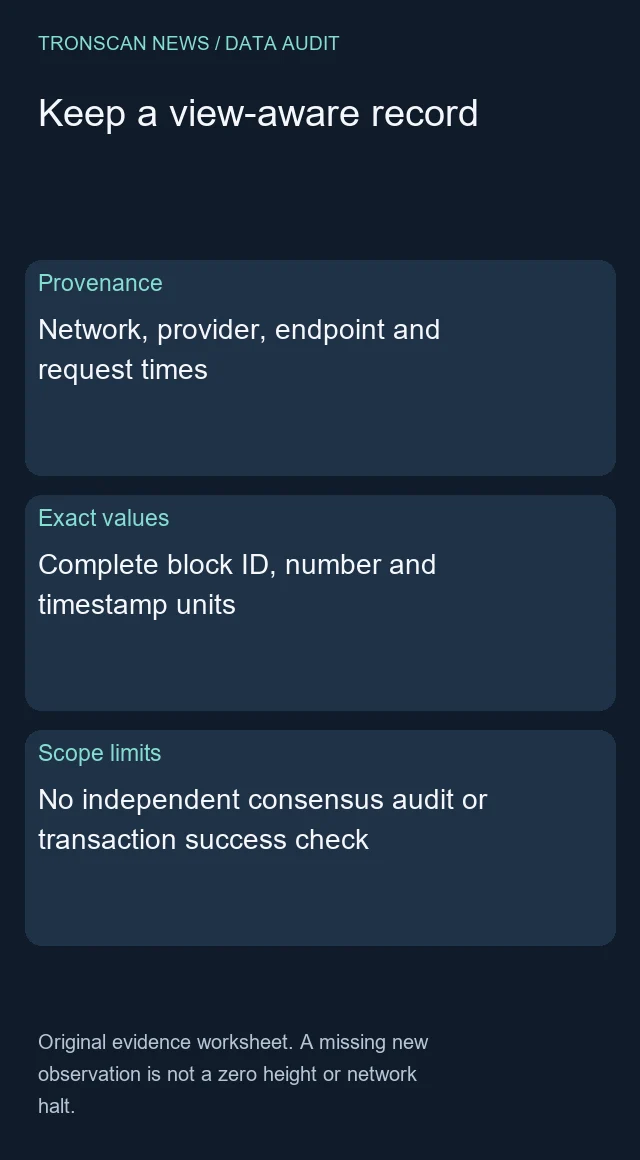
For each saved result, label the network, provider, endpoint, intended view, request times, block number, complete ID and header timestamp units. The existing read-only record-preservation guide helps keep original response bytes and later copies reviewable.
When you compare another pair, retain it as a new observation with new request times. Do not overwrite the first pair and describe only the most convenient difference. A sequence of observations needs an explicit sampling method before it can support an average or a trend claim.
Do not combine a current latest-head response from one provider with an old solidified response from another and call the result “current network lag.” A useful cross-provider investigation is possible, but it needs its own source and timing design. The simple same-provider example here does not perform that investigation.
If a provider becomes unavailable or limits requests, retain the last completed pair under its original date. An unavailable new observation is not a zero height or proof of a network halt. Resume within normal provider access conditions rather than silently substituting another source into the same row.
8. Complete the comparison worksheet before reporting
Use the following worksheet to turn the displayed calculation into a reviewable result. Its purpose is to prevent a correct subtraction from being attached to the wrong question. Complete a row for each collection window, and keep the unmodified inputs beside the resulting JSON. Blank fields remain unknown; a reviewer should not have to infer a network or timestamp unit from a filename.
| Worksheet entry | Entry for this observation | Review action |
|---|---|---|
| Requested question | Compare latest head with solidified state | Exclude payment-credit conclusions |
| Source relationship | Same public provider and intended Mainnet | Retain both complete endpoint paths |
| Collection window | 03:54:48.887981 to 03:54:51.573438 UTC | Keep the ordering visible |
| Arithmetic inputs | 87524260 minus 87524242 | Read the header numbers, not a filename label |
| Timestamp arithmetic | 1793246082000 minus 1793246028000 | Keep milliseconds until the final conversion |
| Conclusion | Observed difference: 18 blocks and 54 header seconds | Do not convert this pair into an SLA |
| Unanswered question | Any specific transaction’s outcome | Obtain matching transaction evidence separately |
For a manual cross-check, subtract the smaller header timestamp from the larger one before dividing by 1000. The retained difference is 54000 milliseconds. Dividing that difference once gives 54 seconds. Dividing each already converted value again would introduce a unit error. Keep the original integer values in the note so another reader can reproduce the calculation without depending on a formatted date display.
Review the request window separately. The interval between the first request’s start and the second request’s finish describes the collection process. It is a different interval from the gap between the returned block-header timestamps. Neither interval measures when a particular user’s transaction became solidified. Reporting these under separate labels avoids an apparently precise but unsupported confirmation-time claim.
For a later observation, compare each view with its own earlier observation before interpreting the difference between views. If the latest head advances while the solidified state observation stays at its earlier height, that describes your collected results. It does not identify the cause. A stale response, a delayed service or a collection mistake requires additional evidence. Preserve the response, endpoint and time instead of replacing the older row with a guessed explanation.
If the two views return the same height and complete ID, report that equality for that pair. Do not report zero transaction-confirmation time: the collection did not observe an individual transaction’s submission and solidification. If the same-height conflict flag is true, do not average the IDs or retain only one. Keep both inputs, check the network and source labels, and record the discrepancy as unresolved until the evidence supports a narrower explanation.
A monitoring application should define its own observation schedule, missing-response policy and review threshold before collecting a series. Keep successful pairs distinct from incomplete pairs. An average calculated only from successful responses must disclose that selection. This article’s single pair supplies a reproducible example, not the evidence needed to choose a universal alert threshold.
The practical success criterion is a note that another reader can reproduce: the same two retained inputs produce the same arithmetic and flags, while the conclusion stays within those inputs’ scope. That standard is stronger than a screenshot of two heights because the complete IDs, units and collection order remain available for inspection.
Frequently asked questions
Are /wallet and /walletsolidity different networks?
Not when they are configured for the same intended chain. They expose different state views. Mainnet versus a test network is a separate selection that must be recorded independently.
Does a lower solidified height prove a node is broken?
No. The solidified view can trail the latest head. Diagnose an actual fault with dated source and service evidence rather than treating one positive height difference as a failure.
Is 54 seconds a guaranteed confirmation time?
No. It is the difference between two returned header timestamps in one dated pair. It is not a service-level promise or a measured maximum for future transactions.
Can a solidified transaction still have failed?
Yes. Solidification and execution outcome are different properties. Inspect the matching receipt and relevant business fields to determine what the contract call actually did.
Does this code prove a block is authentic?
No. It checks selected relationships in supplied JSON and compares two observations. It does not verify signatures, reconstruct the entire header hash, audit consensus or establish provider trust.
Checked October 29, 2026 by the Tronscan News editorial team. AI assisted drafting; the displayed code and synthetic tests were executed against retained public Mainnet responses. Independent publication, not official TRONSCAN support. Report a correction through this page’s comments with the affected step and public source details; exclude signing secrets and private account information.
Leave a Reply