sTRX is JustLend’s liquid-staking receipt token for TRX on TRON. It is an 18-decimal TRC20 token, separate from native TRX, a wallet’s staked-TRX field and WTRX. The sTRX quantity, reference conversion into TRX and withdrawal state answer different questions.
This guide shows how to read those distinctions without connecting a wallet or starting a financial action. On 31 October 2026 we checked the public Mainnet token page and five no-argument read methods through the proxy’s explorer view. We did not stake, approve, swap, withdraw or claim.
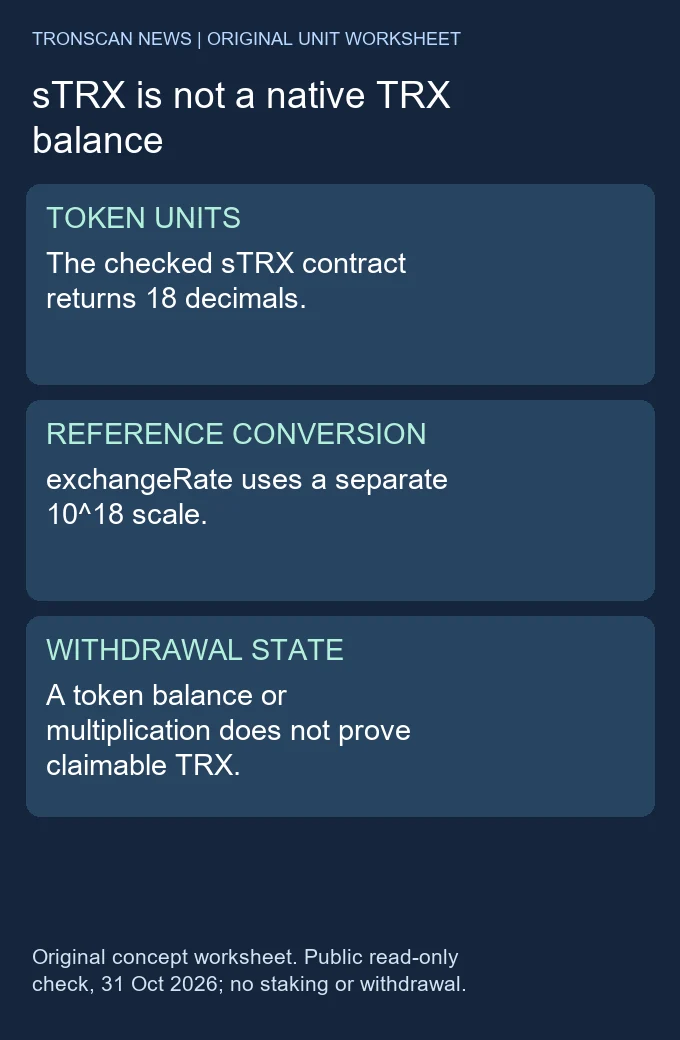
Table of Contents
What sTRX represents, and what it does not
The official JustLend Staked TRX reference identifies the Mainnet contract TU3kjFuhtEo42tsCBtfYUAZxoqQ4yuSLQ5. It describes a receipt token and a separate exchange-rate method. That contract reference is the starting point for the identity check, rather than the letters in a wallet’s asset list.
A liquid-staking token can be shown as a transferable asset while its protocol’s withdrawal process remains a separate workflow. Holding a token is not proof that native TRX is immediately available for a particular account. The number shown in an explorer is useful only when its asset, unit and observation time are retained.
Our native staked TRX versus available-balance guide owns the ordinary account-balance task. This page addresses a different question: identifying a protocol receipt token and reading its conversion scale.
sTRX, TRX and WTRX: choose the correct quantity
| Item | What the displayed quantity describes | Do not assume |
|---|---|---|
| Native TRX | The network’s native asset, with SUN as its smallest unit | Every native holding is currently spendable |
| Native staking field | A staking position recorded for an account | It is the same object as an sTRX balance |
| sTRX | A quantity of the identified liquid-staking token | One token is one immediately claimable TRX |
| WTRX | A separate wrapped-token contract and record | It shares the receipt token’s rate or withdrawal queue |
The WTRX identity and deposit-event example explains the wrapped asset separately. Similar names on the same blockchain do not make contracts interchangeable. No conversion or swap is required to complete this reading exercise.
How to read the sTRX identity and methods
- Compare the full contract with the project reference. We opened the Mainnet token page. It showed Staked TRX (sTRX), TRC20 and 18 decimals.
- Follow its full Contract address. The linked page identified the proxy. A proxy’s own basic ABI and the implementation’s token methods are different views.
- Choose Read as proxy. On our check this view displayed an implementation ABI at
TUAV6ZSCXtF8KVvDKSeVmAbJEovTBf4HtG. Keep the original proxy as the target being read. - Expand the no-argument read methods. We used decimals, exchangeRate, ONE_TRX, SCALE and getUnfreezeDelayDays. Their displayed return types matter alongside the integers.
- Record the observation and stop. We used the read view only. A similarly named write view is a separate operation, not the next step in this exercise.
These interface steps were tested on the stated date. If the implementation or interface changes, recheck the methods and units instead of assuming that a later screen must reproduce our exact values. A missing method is not a reason to connect a wallet or enter a recovery phrase.
Our sTRX read-result worksheet
| Method or field | Observed return | Reading |
|---|---|---|
| decimals() | 18, uint8 | sTRX token precision |
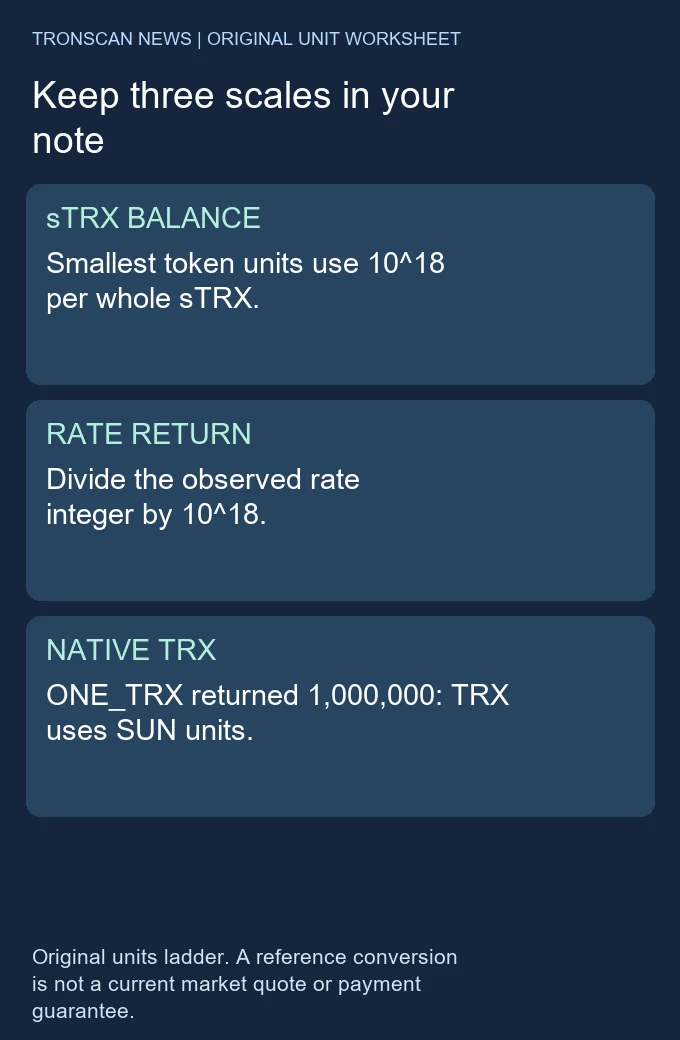
| ONE_TRX() | 1000000, uint256 | Native TRX-to-SUN unit reference |
| SCALE() | 1000000000000000000, uint256 | 10^18 scale used in the documented rate interpretation |
| exchangeRate() | 1322458027776735294, uint256 | 1.322458027776735294 TRX per whole sTRX under the documented scale |
| getUnfreezeDelayDays() | 14, uint256 | The observed protocol delay parameter, not a personal completion timestamp |
These were sequential explorer reads, not a block-pinned snapshot or an independent-node reproduction. The implementation address records which ABI the interface displayed at the time. The table does not report a particular account’s balance, queue position, fees or current claimable amount.
Convert an observed sTRX rate without losing the units
First divide the returned rate by 10^18. For the integer in the table, the result is 1.322458027776735294 TRX per sTRX. That is a dated protocol reference, not a DEX market price or a promise about future returns.
Now use an explicitly hypothetical holding of 10 sTRX. Multiplying by that observed human-readable rate gives 13.224580277767352940 TRX before reducing precision. We checked the multiplication with exact decimal arithmetic; the hypothetical quantity is not a real account balance.
The same unit exercise can begin with 10000000000000000000 smallest sTRX units. Multiplying by the rate integer and dividing by 10^30, with integer flooring, produces 13,224,580 SUN, or 13.224580 TRX. The 10^30 divisor accounts for the difference between the two assets’ smallest units as well as the rate scale.
This calculation is an educational scale check. It is not an executed withdrawal result. It does not incorporate a personal queue, a platform quote, transaction costs, available liquidity or an account’s eligibility. Keep those untested conditions outside the arithmetic conclusion.
Why 14 does not tell you a claim date
The returned delay parameter and the official description concern the protocol’s unbonding process. They do not identify when an individual account submitted a request, which round applies or whether that request is already claimable. Those are additional state questions.
For an existing request, preserve its actual hash and the account’s specific withdrawal record. Do not invent a calendar date by adding 14 days to the time you opened the token page. The page-view time is not the request’s event time. We did not read a personal request in this exercise and provide no individual claim instruction.
sTRX observation versus a personal entitlement
| Observation | Supported conclusion | Further evidence needed |
|---|---|---|
| Token contract and 18 decimals match | The identified asset uses the observed precision | A particular account’s holdings |
| The sTRX rate method returns an integer | A scaled reference can be interpreted using the documented unit | A market execution quote or personal withdrawal outcome |
| A token balance is visible | The selected account holds that quantity at that observation | Current native availability and protocol request state |
| A delay parameter is 14 | The current read returned that parameter | Request time, round and claimable state |
Keep the task-specific question in the left column of your note. If you are trying to explain a wallet display, compare asset identity and quantity first. If you are investigating an existing withdrawal, a generic token price or total supply is not the evidence that settles the request.
Keep a read-only note another person can reproduce
Use a local note with separate lines for the network, full proxy address, implementation ABI shown by the interface, method name, raw return, return type, unit definition and observation time. Copy the full rate integer before formatting it. A screenshot that cuts off the middle digits is less useful than an exact text record beside the image.
For our exercise, a reviewer can identify the same contract and repeat the no-argument reads through the official explorer. A later rate need not equal our earlier observation. The useful comparison is whether the target, method, unit and time are aligned, rather than whether every live value is identical to a saved article.
If two readings differ, retain both original notes. Check the full target address first, then confirm that both used the proxy view and the same method. Compare times before interpreting the difference. Because our reads were not pinned to one block, the worksheet should not imply that every return came from a single atomic state.
Finish the note with a separate question such as “Which request belongs to this account?” or “What does this return represent?” A multiplication can answer a unit-conversion question; it cannot fill in a missing personal withdrawal record. Mark that remaining question unverified instead of replacing it with a calculated entitlement.
Resolve a mismatch before interpreting a balance
Your displayed name matches but the contract differs: return to the official reference. Do not borrow this rate for an unmatched token. Your number looks a million or a trillion times too large: check whether it is already formatted, and keep 18-decimal receipt units separate from six-decimal SUN.
The read screen shows only proxy administration methods: confirm which ABI view is open. Our tested interface used Read as proxy. Do not switch to a write method to make a read result appear. The public service refuses a query: record the limit. Our anonymous requests to the separate documented API returned HTTP 403, so we did not retry or use them as successful data evidence.
The token amount and the TRX estimate differ: these can be different units related by a rate. Compare the observation time and calculation before calling it a missing balance. For broader navigation, our TRONSCAN public-record guide explains which record type belongs to each question.
Five frequently asked questions
1. Is sTRX native TRX?
No. It is the identified JustLend receipt token. Native TRX, native staking fields and a token balance are separate records.
2. Is one sTRX always one TRX?
Do not assume that. The checked rate was interpreted as 1.322458027776735294 TRX per whole token on the stated date, not a permanent quote.
3. Did the sTRX page show 18 decimals?
Yes. Both the token page and our decimals() read returned 18.
4. Does the 14-day parameter prove I can claim now?
No. A personal request’s state and timing were not checked here.
5. Did this tutorial stake or withdraw anything?
No. We read public fields and checked a hypothetical unit conversion. We did not connect a wallet or sign an action.
Sources, method and corrections
The independent Tronscan News editorial team checked the cited official reference, token page and proxy read view on 31 October 2026. The field/result tables, synthetic arithmetic and two diagrams are original. AI assisted drafting and diagram preparation. The five reads were sequential and not block-pinned; no personal position, transaction execution or independent-node verification is claimed. Editorial standards and corrections are linked from the Tronscan News homepage.
Leave a Reply