Tether published its Q3 2026 USDT reserves announcement on 30 October, reporting about $191.5 billion of reserve assets and a $7.95 billion excess over total liabilities at 30 September 2026. The underlying report is a dated company-level reserves snapshot. It is not a live TRON balance, a promise about every redemption or evidence that an individual exchange credited a payment.
We reviewed the issuer’s announcement and its linked 11-page Financial Figures and Reserves Report on 31 October. This news explanation adds an original arithmetic reconciliation and a source-scope worksheet so readers can keep the numbers and their limitations together.
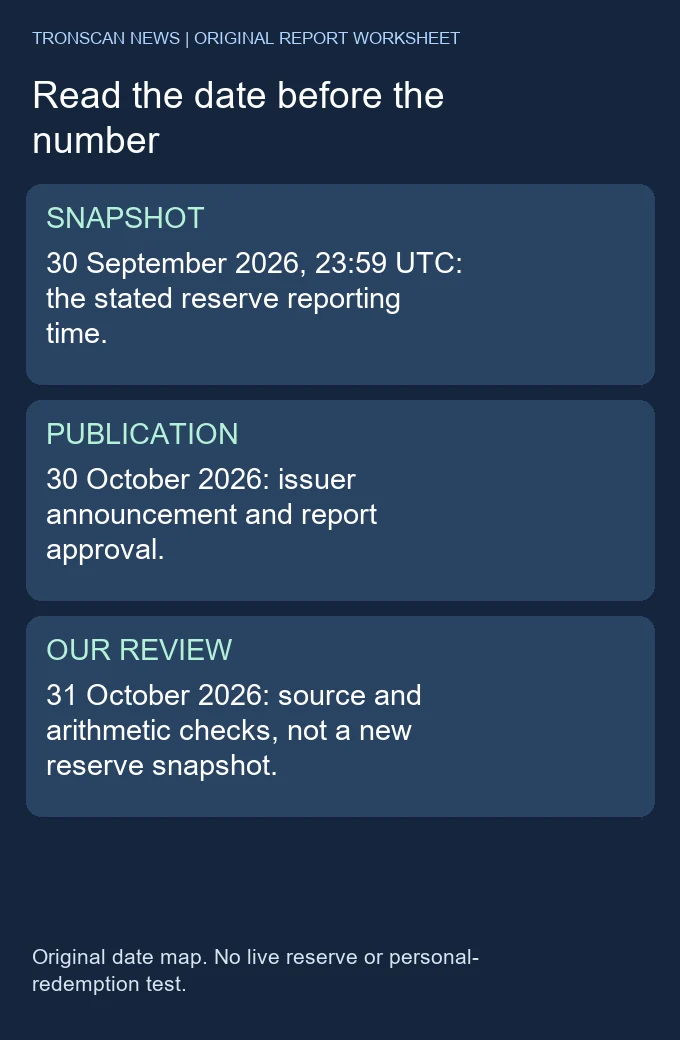
Table of Contents
What the USDT reserves announcement actually reports
The 30 October issuer announcement reported $1.5 billion of Q3 net operating profit and $4.5 billion across the first three quarters of 2026. It also described a reserve buffer of $7.95 billion. Profit over a period and excess assets at a particular date are different measures; the headline’s profit figure should not be substituted into the reserve subtraction.
The announcement links a Financial Figures and Reserves Report with BDO assurance. The reserve section covers fiat-denominated Tether tokens at company level. Its asset and liability amounts are not a breakdown of USDT held on each blockchain.
USDT reserves: three scopes to keep apart
| Question | Relevant evidence | Keep separate |
|---|---|---|
| What did the company report at quarter-end? | Dated reserves report and its stated criteria | Current market conditions and later changes |
| How many tokens appear on TRON? | That network’s token records at a stated time | Company-wide assets and liabilities |
| Did my transfer reach the intended address? | Correct network, token contract and receipt | Issuer accounting and service crediting |
| Did my exchange credit my account? | The receiving service’s own ledger and rules | All three public observations above |
Our TRON USDT introduction explains the token, native asset and transfer record. A reserve headline does not replace those basic checks. Conversely, a successful token transfer does not independently verify the issuer’s off-chain assets.
Reconcile the published USDT reserves figures
We transcribed the following exact US-dollar amounts from the reserves page of the PDF, internally numbered page 3 (PDF page 8). The reporting time is 30 September 2026 at 11:59 PM UTC. Use full units before rounding to billions.
| Reported field | US dollars | Role in the check |
|---|---|---|
| Total assets | 191,451,091,374 | Starting amount |
| Total liabilities | 183,496,460,904 | Denominator for the stated excess-assets comparison |
| Liabilities related to digital tokens issued | 183,469,787,261 | A component, not the whole liability figure |
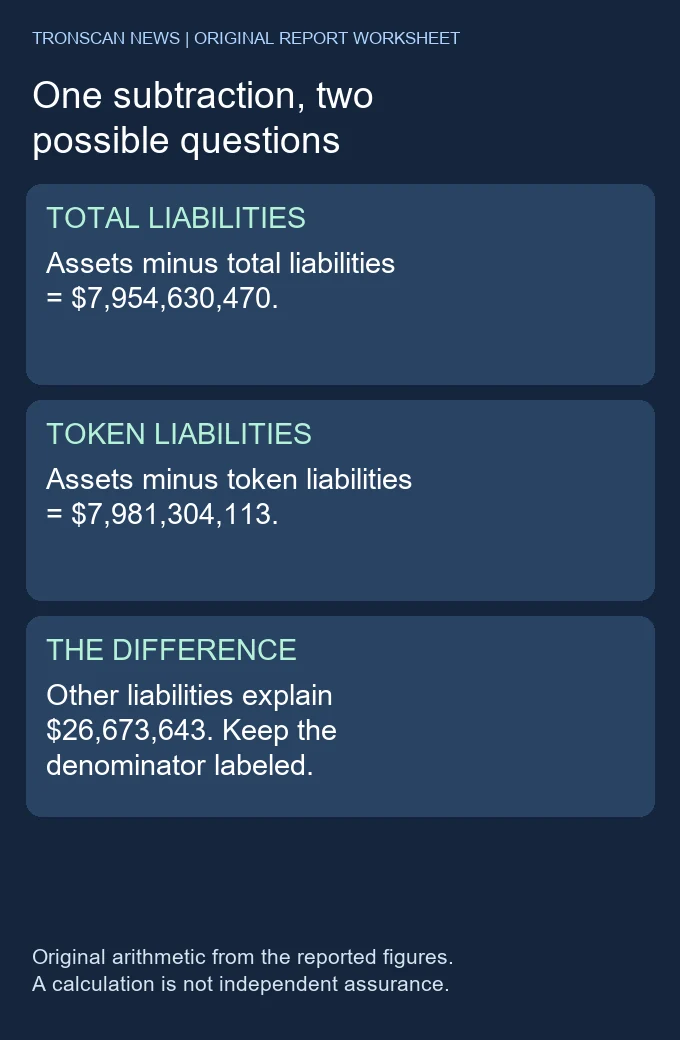
| Assets less total liabilities | 7,954,630,470 | Reported excess, reproduced by our subtraction |
Our arithmetic gives 191451091374 - 183496460904 = 7954630470. Rounded to two decimal places in billions, that is approximately $7.95 billion. This verifies that the selected published numbers reconcile with one another. It does not independently confirm their existence, valuation or completeness.
Why a different subtraction gives a different answer
If a reader subtracts only token-related liabilities, the answer is $7,981,304,113. That is $26,673,643 higher than the excess calculated using total liabilities. The difference equals total liabilities minus the token-related component.
The two calculations are not competing discoveries of a missing amount. They answer differently labeled questions. A spreadsheet should preserve the original field names so a future reviewer can see which subtraction was performed. Calling both results simply “the buffer” would conceal the change in scope.
A reproducible arithmetic worksheet
- Write the reporting timestamp and entity. Copy them from the report itself before entering any amount.
- Record exact figures in dollars. Keep the unrounded integers in separate cells or a local note.
- Label each field. Assets, total liabilities and token-related liabilities are separate inputs.
- Perform the stated subtraction. Reproduce the reported excess using assets minus total liabilities.
- Check any alternative denominator explicitly. Label the token-only calculation rather than quietly replacing the whole-liability input.
- Round only for presentation. Keep the original numbers alongside any billion-dollar summary.
- State the limit. Arithmetic consistency is one check of a document, not an independent asset audit.
Using total liabilities, assets divided by liabilities is approximately 104.34%, and the excess divided by liabilities is approximately 4.34%. These are our ratios from the reported integers, rounded to two decimal places. They are not cash-only ratios, a probability of redemption or a forecast of future coverage.
For a spreadsheet, avoid entering a headline rounded to $191.5 billion in one row and an exact liability figure in another. That mixes precision levels. Retain a column for units and a column for source page so someone else can reproduce the calculation without guessing how zeros were added.
Rounding the reserves figures: a worked comparison
A reader who first rounds assets to $191.5 billion and total liabilities to $183.5 billion obtains a difference of $8.0 billion. The exact subtraction above is $7,954,630,470. The rounded-input result is therefore $45,369,530 higher. We reproduced both calculations; the difference is a consequence of the chosen input precision, not evidence of an unexplained asset.
For a reproducible reserves note, perform the subtraction with exact dollars and then format the answer. If you instead need a short approximate headline, label it as approximate and retain the unrounded inputs in the worksheet. Do not use extra decimal places in an output to imply accuracy absent from the inputs.
This also explains why a quick calculation from rounded news figures need not exactly match a financial table. First compare units, precision and field definitions. Only after those agree does an unexplained residual warrant a separate question. A correct rounding explanation still does not verify the underlying reserves or predict their future value.
Check the asset subtotal without counting it twice
The asset breakdown on internally numbered page 4 (PDF page 9) contains a subtotal for cash, cash equivalents and other short-term deposits, followed by six other asset categories. We added that subtotal and the six categories once each. Their sum reproduced the reported $191,451,091,374 total.
Do not add both a subtotal and each of its underlying lines into the same grand total. That would double-count part of the table. The useful method is to mark which rows are components, subtotals and grand totals before doing the addition. Our check leaves the report’s categories intact rather than renaming all reserves as cash.
What the assurance scope does and does not cover
The BDO document describes a reasonable-assurance engagement under ISAE 3000 (Revised) on the specified report. Its scope is tied to the reporting date, and it excludes assurance on the accompanying Notes. The management report also says it is not the company’s financial statements. Do not expand that described scope into an assurance statement about every later day or every company activity.
A useful reading order is the report title, reporting date, conclusion, scope limitations and relevant financial table. The label “attestation” in a headline is not a reason to skip those sections. Equally, a scope limitation should be described accurately rather than used to invent an adverse conclusion the practitioner did not state.
We checked the source’s wording and arithmetic. We did not contact custodians, obtain bank confirmations, revalue investments or conduct our own assurance engagement. The report’s published scope remains the source for what BDO examined; our worksheet is a separate reader aid.
How this relates to a TRON explorer task
If your question concerns one payment, start with the network and full transaction hash rather than a company reserve number. Our USDT explorer network-selection guide explains that workflow. You still need the intended contract, recipient, quantity and result to interpret a particular movement.
If your question concerns supply, identify whether the number represents a company-wide liability, one chain’s token supply or tokens in a particular address. Our supply versus individual-balance comparison explains that distinction. This report does not allocate an individual reserve asset to your particular wallet balance.
A synthetic correction exercise
Suppose a draft note reads: “The report proves today’s TRON deposits are all backed by cash and every withdrawal will arrive.” That invented sentence joins a reporting-date claim, a network-specific claim, an asset-composition claim and a service-outcome claim. The reserve subtraction alone cannot support the combined conclusion.
A narrower note would identify the issuer, the September snapshot, the published asset/liability fields and the arithmetic result. It would leave today’s balances, the composition needed for a cash-only claim and any particular service outcome as separate questions. This is an explicitly hypothetical editing exercise, not a quotation from Tether or BDO.
Five frequently asked questions
1. Is this USDT reserves figure current to 31 October?
No. Our review is dated 31 October, but the report’s reserves snapshot is 30 September 2026.
2. Is the $1.5 billion Q3 profit the same as the reserve buffer?
No. A period’s net operating profit and a dated excess of assets over liabilities are different measures.
3. Did our USDT reserves calculation independently verify the assets?
No. We reproduced arithmetic from reported amounts. That is not independent custody or valuation verification.
4. Does the report give a TRON-only reserve balance?
The reviewed reserves figures are company-level amounts, not a per-chain reserve allocation.
5. Does a reserve headline establish exchange deposit credit?
No. A receiving service’s customer ledger remains a separate source of evidence.
Sources, method and corrections
The independent Tronscan News editorial team reviewed the 30 October issuer announcement and linked 11-page PDF on 31 October 2026. We visually checked the reserve and scope pages, retained the original PDF and reproduced the integer subtractions, ratios and asset-category sum. The diagrams and worksheets are original; AI assisted drafting and their preparation. No current reserve, redemption or exchange-account test was performed. Editorial standards and correction information are linked from the Tronscan News homepage.
Leave a Reply