JST is the TRC20 governance token used by JUST DAO on the TRON blockchain. It is a separate asset from native TRX and from the USDT token. Seeing JST in a transfer record does not mean the account cast a governance vote, received stablecoins or paid a fee in JST.
This introduction helps you identify the correct token, read a real mixed-asset receipt and decide which evidence is still missing. We checked public documentation and TRONSCAN on 31 October 2026. We did not connect a wallet, trade, lock tokens or vote.
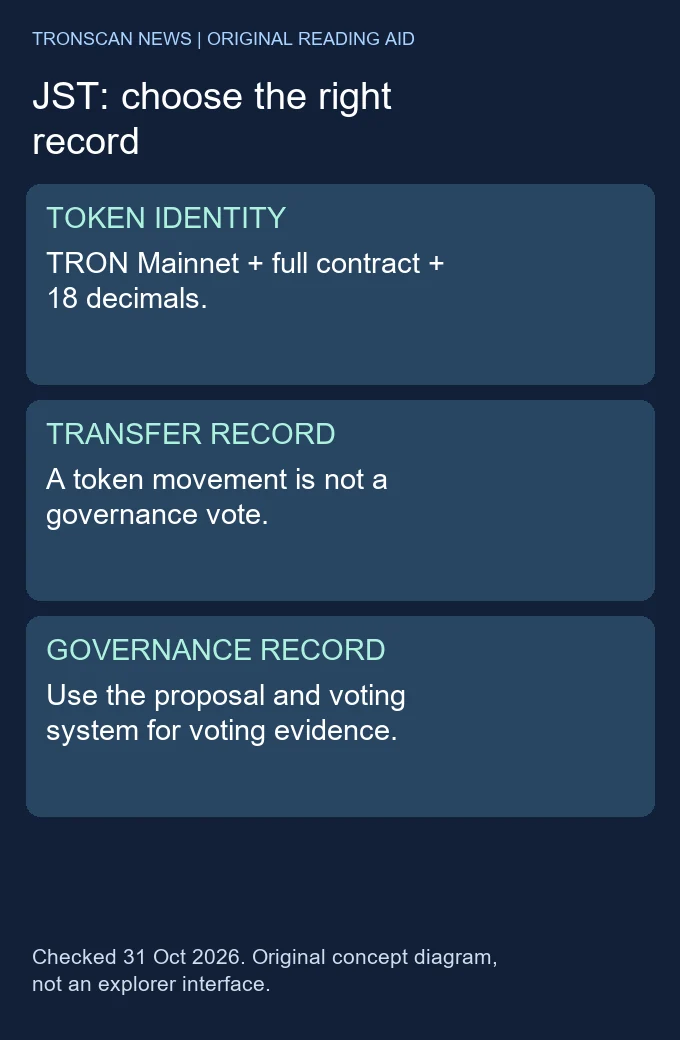
Table of Contents
What JST means in the JUST ecosystem
The official JustLend tokenomics documentation, marked updated 21 October 2026 when reviewed, describes JST as the core governance token of JUST DAO. Its identity table lists TRON, TRC20 and the contract TCFLL5dx5ZJdKnWuesXxi1VPwjLVmWZZy9. That full address is the reference to compare with the token page, rather than a logo or ticker alone.
The documentation describes governance participation in protocol decisions. This is a role within the JUST ecosystem; it does not make the token the native currency of TRON. For the explorer itself, start with our TRONSCAN introduction and record selector. An explorer is where we read the evidence, not the issuer of the asset.
JST, TRX and USDT: a practical distinction
| Item | Role for this exercise | Record to identify |
|---|---|---|
| JST | JUST DAO governance token | TRC20 contract ending mWZZy9, compared in full above |
| TRX | TRON native asset | Native amount and network-resource fields |
| USDT | A separate Tether token on TRON | Its own contract and individual transfer rows |
| WJST | Governance-system voting representation described in the project documentation | Governance state, not an ordinary wallet token count alone |
Do not use the same numeric balance for these four roles. For policy and treasury figures, our JST buyback source and receipt review, checked November 2, 2026, separates funding, reported totals and a specific burn transaction. The present exercise identifies JST and separates its ordinary movement from governance activity.
How to check the JST token page without connecting
- Start with the official project reference. Copy the full token contract from the cited identity table. A search result containing the same three-letter symbol is not enough.
- Open the corresponding public Mainnet token page. We used this TRONSCAN entry. Confirm that the network indicator says Mainnet.
- Compare the full contract. On our check the page displayed JUST (JST), type TRC20 and 18 decimals. Keep those observations together in one note.
- Choose the question. Token identity belongs to this page; a particular movement needs its transaction hash; an account holding needs an address and a current observation.
- Stop before an unrelated operation. Reading these public fields did not require a connection or signature. A request to approve a contract would be a separate action.
Success means you have a network, a complete contract and an observed precision field that agree with the intended asset. A familiar symbol with another contract is an unresolved identity mismatch; it is not resolved by assuming the name must be unique. A reputation label is also separate from identity and does not establish investment quality.
A checked receipt: JST and USDT appear together
We opened the real Mainnet transaction 58bb7699f44a735f33972d4a50f3acd063f6688d50ae314a56f568609eacad75. TRONSCAN displayed Successful and CONFIRMED, block 87578417, timestamp 31 October 2026, 01:04:24 UTC. These are observations of that receipt, not a transfer performed by our team.
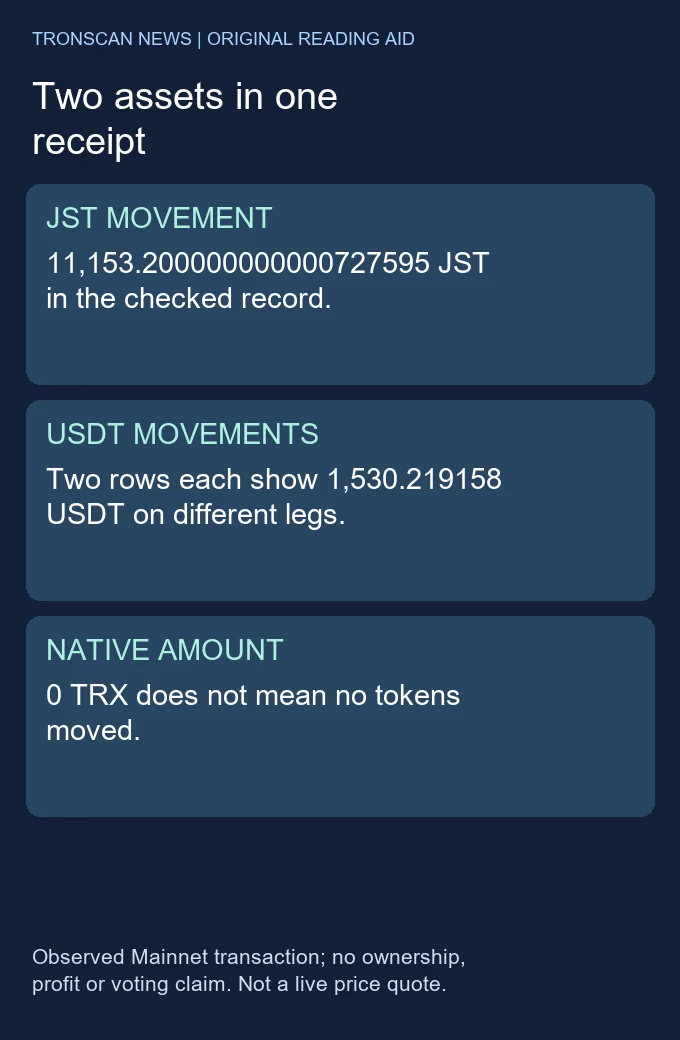
The overview showed three token-transfer rows. One moved 11,153.200000000000727595 JST from TK2nJVdoyfBL2Htee1NLsiAU2QnuZzCBAQ to TVjuTE3V5bMVdpfNhid8kD2v35T2k1u1Br. Two separate USDT legs each displayed 1,530.219158 USDT. The native Amount field was 0 TRX.
Our narrow conclusion is that the explorer showed these distinct asset movements in one successful receipt. The displayed zero belongs to the native amount field; it does not say that zero tokens moved. The two USDT rows are different legs, so adding them and calling the sum a person’s received payment would be unsupported.
JST evidence worksheet: observed facts and limits
| Evidence | Observed value or source | What it does not establish |
|---|---|---|
| Network | TRON Mainnet in the explorer | Support by a particular receiving platform |
| Identity | Project contract matched the full token-page address | Safety, price or issuer solvency |
| Precision | 18 on the token page | The precision of USDT or another token |
| Receipt result | Successful and CONFIRMED | A governance vote or exchange-account credit |
| JST row | 11,153.200000000000727595 | Current balance or beneficial owner |
| Other asset legs | Two USDT rows, each 1,530.219158 | A payment twice that amount to one person |
| Native amount | 0 TRX | Zero token activity or a universally free operation |
| Governance participation | Not tested in this exercise | Voting power, a vote cast or proposal execution |
This original worksheet combines the dated project reference with fields actually read in the explorer. It is a one-record exercise, not an account audit. We did not independently reproduce the receipt through a separate node, identify the people behind the addresses or inspect every event to assign an economic purpose.
Keep JST precision separate from token price
The following is an arithmetic illustration using the displayed quantity and observed precision, not a claim that we retrieved the raw event integer. With 18 decimals, the integer 11153200000000000727595 divided by 10^18 is exactly 11153.200000000000727595. We checked this calculation using decimal arithmetic.
Dividing that same integer by a six-decimal scale would answer the wrong question. Do not borrow USDT’s precision simply because both assets use TRC20. Our token-decimal reading guide explains the general method; this worksheet applies the observed JST field to the checked amount. Neither the decimal scale nor a token quantity is a current dollar valuation.
Why a JST transfer is not proof of a vote
The official JustLend proposal guide distinguishes the governance process from simply holding or moving JST. It describes WJST, voting and later proposal stages. A transfer receipt with a token row is not a substitute for a particular proposal’s state or a recorded voting action.
For a governance question, write down the proposal identifier and the exact state you need to verify. Leave current voting power, eligibility, locks and execution unverified until the appropriate governance evidence is checked. This article does not quote live thresholds or tell a reader to deposit tokens into a governance contract.
A synthetic handoff: write the claim your evidence supports
Imagine a reader sends a colleague the checked receipt above with the note “This account voted.” The receipt identifies a transaction and token movements, but the proposed conclusion introduces a different action. A useful response is to ask for the proposal identifier, the relevant governance record and the observation time. This is a hypothetical discussion, not a claim that either address in the receipt voted.
Now imagine the note instead says “The public overview displayed a transfer of the identified token to this contract at this block.” That claim stays within the observed fields. It still does not identify a person, certify a current balance or establish the reason for the transfer. Keep those unanswered questions in a separate column rather than expanding the conclusion.
For a practical handoff, write three short lines: Observed: the network, full hash, asset contract, row direction and displayed quantity. Not checked: current holdings, account credit, voting power and proposal activity. Next source: an account record, receiving service or governance record, according to the unresolved question. Use “not observed” where a field is unavailable.
This wording gives the next reviewer a reproducible starting point. It avoids both dismissing a real movement because the native amount is zero and promoting an ordinary movement into evidence of governance participation. Revisiting the same receipt repeatedly will not supply a missing proposal record.
When your result differs
The name matches but the contract differs: return to the official reference and compare the entire string. Do not relabel an unmatched asset as the intended token. The page is on testnet: switch your investigation to the correct network before comparing any balances or receipts.
The amount seems enormous: check whether you copied an integer or an already formatted token quantity, then use that token’s own decimals. A receipt has several assets: identify each row by its contract and direction, preserving intermediate legs rather than treating every row as a final payment.
A service has not credited a deposit: the successful chain record does not settle that service’s supported-asset or account rules. Preserve the exact evidence and use its official support route. An explorer cannot convert the token or update a private ledger.
Five frequently asked questions
1. What is JST used for?
The cited project documentation describes it as JUST DAO’s governance token. A token transfer alone is not evidence that governance rights were exercised.
2. Is JST the same asset as TRX or USDT?
No. They have different roles and records. Native TRX and the two TRC20 tokens must be identified separately.
3. How many decimals did the JST page show?
It showed 18 on our 31 October 2026 Mainnet check. Use that asset’s own precision rather than a value copied from another token.
4. Does 0 TRX mean the checked transaction moved nothing?
No. The native amount was zero while its overview displayed one JST movement and two USDT legs.
5. Does owning JST prove a particular vote was cast?
No. Voting power and a vote are governance-specific evidence. We did not connect, lock tokens or vote in this exercise.
Sources, checking method and corrections
The independent Tronscan News editorial team compared the cited official documents, public token page and one receipt on 31 October 2026. The identity/receipt worksheet, exact arithmetic illustration and diagrams are original; AI assisted drafting and diagram preparation. The source documents were marked updated 21 October 2026. No trade, governance action or account-credit test was performed. Editorial standards and correction information are available through the Tronscan News homepage.
Leave a Reply