The JST buyback mechanism announced on October 23, 2026 separates a treasury safety floor, recurring funding and staged surplus deployment. The later quarterly summary reports historical burns. Neither a policy allocation nor a reported dollar valuation is proof of a newly executed on-chain burn.
We reviewed the official policy, brand update and quarterly announcement on November 2. This is a dated news and data interpretation review, not a claim that JUST launched another program today. Our added material is a source-unit comparison, overlap analysis, local arithmetic checks and one source-linked Mainnet receipt. We did not buy tokens, cast a vote or independently audit an entire burn round.
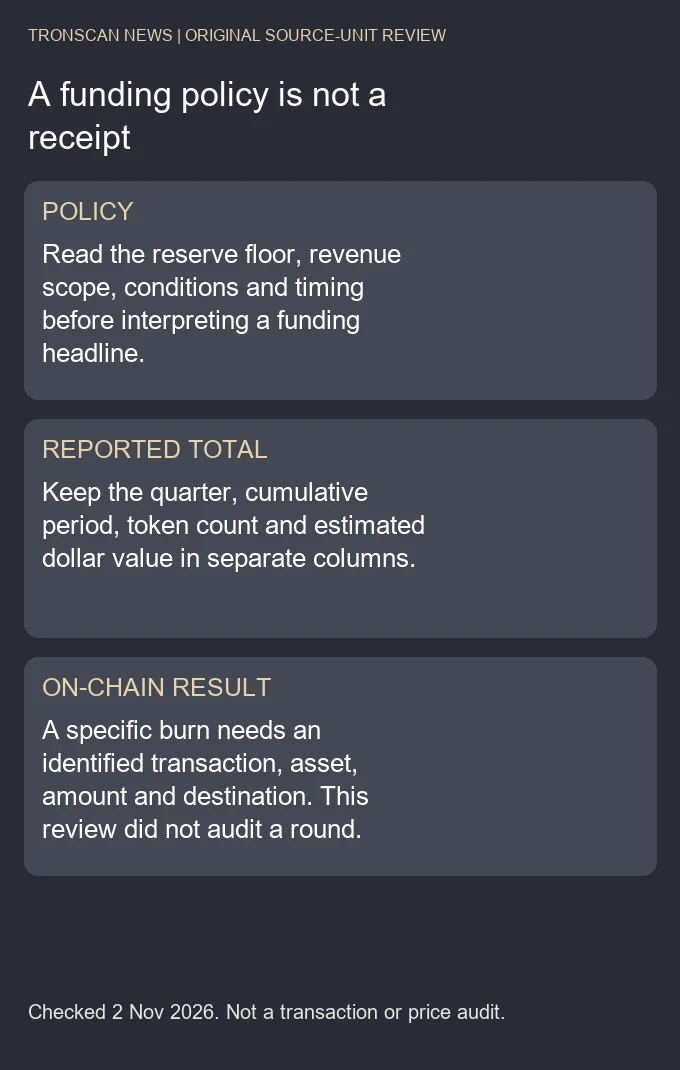
Table of Contents
What changed in the JST buyback policy
The official October 23 mechanism announcement specifies a minimum $50 million treasury buffer, ongoing revenue funding and an estimated $20.34 million surplus deployed in four installments from Q4. It describes GasFree revenue entering the funding scope from Q4 and conditional USDD net revenue above $10 million. It also moves the named operator from JustLend Grants DAO to JUST DAO, with scheduled burns and published transaction hashes.
These are the issuer’s policy descriptions. We did not establish the current treasury composition, the size of a future round or the satisfaction of every operational condition. The amount described as surplus is not automatically four equal payments, and the funding statement is not a price forecast.
The companion JUST brand update, also signed October 23, identifies JustLend, GasFree and USDD as its core product lines and describes unified governance and buybacks under JUST DAO. That organizational context does not turn an ordinary JST token transfer into a governance or burn record.
Four questions before comparing the numbers
- What is the unit? Separate a token quantity from a dollar-denominated estimate. They cannot share one arithmetic column.
- What is the period? Distinguish a quarter, a cumulative history and an intended future allocation.
- Does one amount include another? A part and a total can overlap even when they appear in separate paragraphs.
- What is the evidence stage? A stated policy, a reported outcome and an independently checked receipt support different claims.
For a JST buyback review, success means each number has a unit, period, scope and source. A missing field is an unresolved comparison, not permission to choose the interpretation that produces the largest headline. Keep an amount unclassified until the source supplies enough context.
The quarterly report adds a different evidence layer
The quarterly release summary signed October 26 reports 170,723,144 JST burned in Q3 and 1,881,973,007 cumulatively across five rounds since October 2025. It describes the latter as 19.01% of the initial maximum supply and gives estimated dollar valuations separately. It also discusses treasury reserves and later funding changes. We reviewed this public summary; we did not independently verify the linked full report or every transaction behind it.
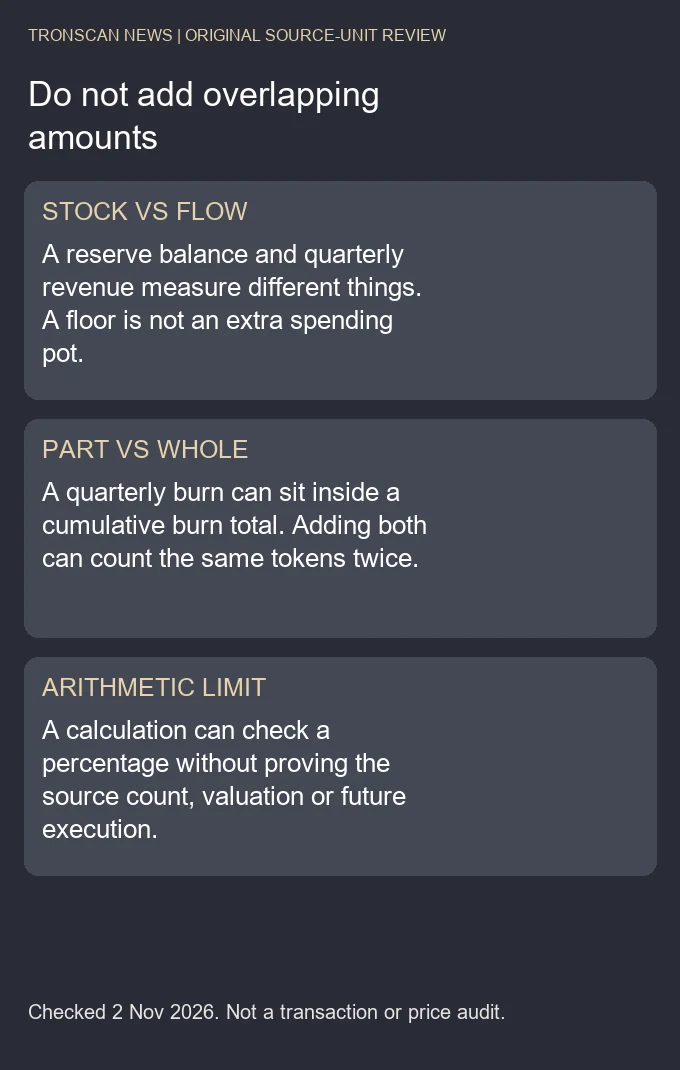
Our original comparison below deliberately avoids treating a stock of reserves as interchangeable with a flow of revenue. Nor does it use an estimated valuation as a live token price. Without a valuation methodology and matching dates, dividing or adding such amounts can produce a number with a misleading meaning.
| Source amount | Classification for comparison | Unsupported use |
|---|---|---|
| $50 million | Policy safety floor | Add it to a buyback budget |
| Estimated $20.34 million | Described staged surplus | Assume four equal executed payments |
| 170,723,144 JST | Reported Q3 burn quantity | Add it again to a cumulative total that already contains the quarter |
| 1,881,973,007 JST | Reported cumulative five-round burn quantity | Call the entire amount a new Q3 burn |
| 19.01% | Reported share of initial maximum supply | Call it a share of current wallet balances or today’s circulating supply |
A percentage check with an explicit denominator
Using 9,900,000,000 as the initial-supply denominator, dividing 1,881,973,007 by it and multiplying by 100 gives approximately 19.0098%, which rounds to 19.01%. This checks arithmetic consistency for that denominator. It does not validate the underlying burn count or establish today’s circulating supply.
The reported Q3 quantity is about 9.0715% of the reported cumulative quantity. That is a second, different ratio: quarter divided by cumulative burn, rather than burn divided by initial supply. Changing the denominator changes the question even though both calculations use a token amount in the numerator.
The JST buyback worksheet labels these results by their full meanings. We do not shorten either to “the burn percentage” without a denominator. A percentage copied into another report should travel with its unit definition, period and rounding rule. Reproducing the arithmetic is a useful check; it is not an independent attestation.
The live buyback dashboard defines its dollar total
We followed the official site’s Buyback & Burn Details link to the Grants DAO dashboard. It displayed $118,414,855.73 as total value burned, split into $118,152,576.00 for JST and $262,279.73 for LP tokens. The page explicitly says the LP value is already included in the total. The two components sum exactly to the displayed amount.
The dashboard defines this as execution-time USD value, excluding upcoming buybacks and later market-price fluctuation. We recorded an upcoming-buyback figure of $34,061,660.91 separately. Adding that future bucket to executed burns would change the evidence stage. The source labels, not the size of a headline number, determine which comparison is valid.
This buyback-dashboard check also prevents an asset-unit mistake. A count of LP tokens cannot simply be added to a count of JST. The page’s dollar aggregation is a different calculation from a token-supply calculation. We did not reproduce its valuation model or independently audit the underlying LP reserves.
The fifth buyback round has an October execution record
The dashboard associates the 170,723,144 JST row with October 16, 2026, at 21:27:21 Singapore time. The linked fifth-round announcement, signed October 17, identifies October 16 execution and Q3 net income among its funding sources. Keep the quarterly reporting label, income period and burn timestamp separate; we did not silently move the receipt date into Q3.
For that buyback-round check, we queried the announcement’s complete hash through anonymous Mainnet gettransactionbyid and gettransactioninfobyid reads. Both returned the same identifier and successful execution results. The receipt reported block 87161427 and October 16 at 13:27:21 UTC, matching the dashboard’s Singapore timestamp. These are new reads of an old transaction, not a transfer performed today.
| Checked buyback-round receipt field | Actual result |
|---|---|
| Hash | 0cb7d79bd0511ed98b061edb586bf36a868cb510158071ca6fbe3dc56ff86f93 |
| Log asset contract, converted to Base58 | TCFLL5dx5ZJdKnWuesXxi1VPwjLVmWZZy9 |
| Transfer log recipient | T9yD14Nj9j7xAB4dbGeiX9h8unkKHxuWwb |
| Raw event quantity | 170723144000000000000000000 |
| Quantity at the previously checked JST precision of 18 | 170,723,144 JST |
Our parser matched the Transfer event topic, converted its contract and recipient fields, and compared the raw integer with 170,723,144 times 10^18. The asset address matches the JST identity in the existing token guide. We did not fetch a new precision field in this run, prove beneficial ownership of the sender or infer a fiat purchase cost from the event.
The narrow buyback-review conclusion is that this source-linked transaction contains the matching JST transfer to the zero address. Calling it a supply-method change, a complete purchase history or a verified dollar-cost figure would require additional evidence. The policy’s burn label remains attributed, while our own claim stays with the observed record.
Four installments does not specify four equal payments
For illustration only, dividing 20.34 million by four yields 5.085 million. That is an equal-allocation hypothesis, not a published payment schedule we verified. A count of installments supplies no individual dates, sizes or execution records by itself.
A reviewer can preserve a four-row schedule with every amount blank until a source supplies it. If later records give different sizes, the rows can still reconcile to a total without contradicting the original installment count. Conversely, a neat equal split in a spreadsheet does not prove that four transfers occurred.
The same discipline applies to a cumulative revenue figure and a described surplus. Without a reconciliation showing that they are disjoint, adding them can count the same funding twice. We leave that reconciliation unverified rather than promote two neighboring numbers into a larger spending promise.
What would verify a specific burn next?
- Identify the round and its stated period. Record the official source and when you checked it.
- Obtain the complete transaction hash from the official round record, along with the network and asset contract.
- Read the transaction result, token quantity and destination. Keep an intermediate purchase, a transfer and a claimed destruction event distinct.
- Compare the checked event with the report’s scope. If one round contains multiple records, reconcile them before producing a total.
We checked one source-linked transaction, not a round-by-round purchase and burn audit. The TRON burn-record interpretation guide covers why a destination label, a token supply change and a native resource fee are different evidence. A policy’s promise to publish hashes is not a substitute for checking the hashes themselves.
For asset identity and token precision, use the existing JST token record guide. The GasFree fee-record guide handles the separate question of a user’s transfer fee. Adding a business line to a funding policy does not independently establish a new fee for every transaction.
A practical JST buyback evidence note
Official source / source date / current check time:
Policy, reported total or checked transaction:
Asset unit / dollar valuation unit / valuation time:
Quarter or cumulative period / denominator:
Possible overlaps / conditions / unreconciled amounts:
Round identifier / full hash, only if actually checked:
Observed result / remaining evidence needed:
This note gives another reader a reproducible question instead of an overstated conclusion. If the source is temporarily unavailable, retain the last dated observation and mark the fresh state unknown. Do not silently replace it with a third-party headline or a later number from a different period.
Frequently asked questions
Was this JST buyback policy announced today?
No. The policy is dated October 23, 2026; our review date is November 2.
Does a treasury floor represent additional spending?
No. It is a constraint in the described policy, not an extra amount to add to funding.
Does 19.01% describe current circulating supply?
The cited comparison uses initial maximum supply. Other denominators answer other questions.
What did the buyback receipt check establish?
One source-linked successful transaction contained the matching JST transfer to the zero address. Complete purchase costs, supply-method changes and every round remain unverified.
Does the announcement predict JST price or returns?
This review makes no price or return prediction. Reported funding and burn evidence do not establish a future market outcome.
Independent Tronscan News analysis with AI-assisted drafting. Primary announcements checked November 2, 2026. Two original diagrams, source-unit and receipt tables, local arithmetic and one anonymous Mainnet record support the method. Issuer-reported totals remain attributed; no complete round audit, trade, vote or future execution is claimed. Browse the Tronscan News homepage; use About & Standards for corrections.
Leave a Reply