USDC on TRON is a legacy-network case: an explorer record can remain visible after the issuer has ended support for that network. USDC is Circle’s dollar-backed stablecoin, separate from Tether’s USDT. A familiar token name, readable page or successful historical transfer does not establish a currently supported deposit route.
This guide compares a real legacy token page with Circle’s current public contract list and its dated discontinuation notice. It helps you decide what each source can answer. We did not test a personal account, deposit, conversion, redemption or recovery.
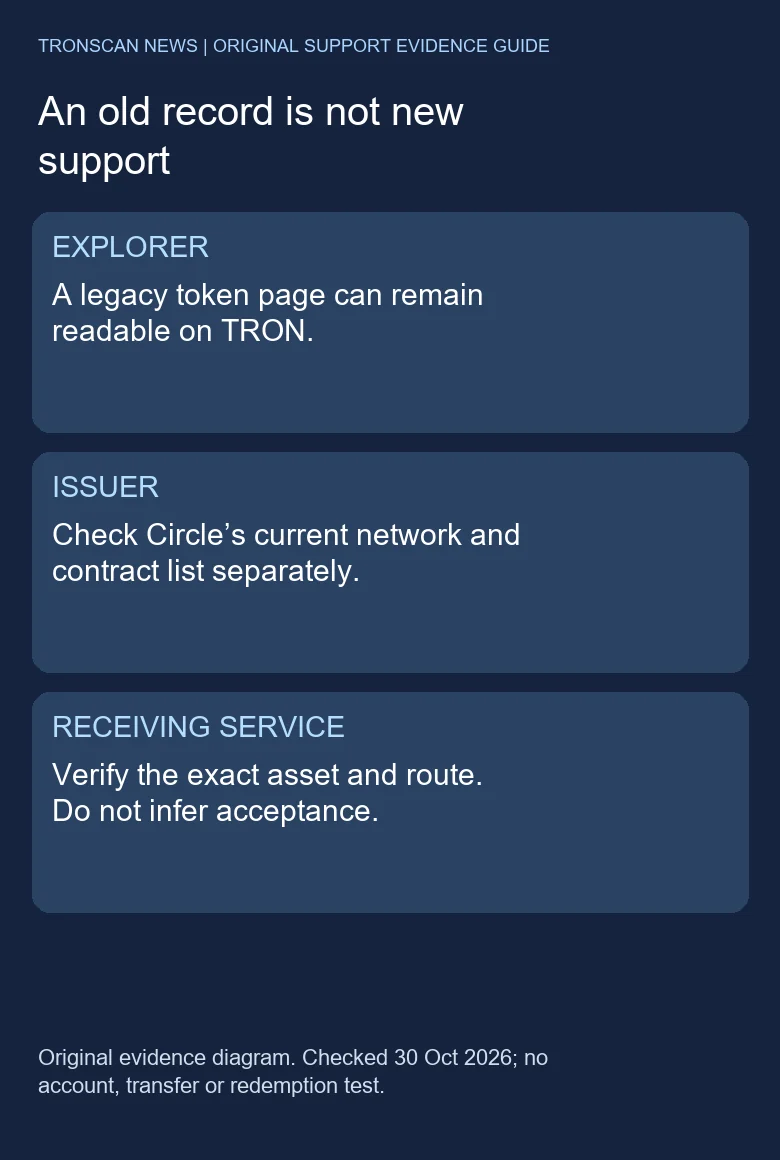
Table of Contents
What USDC is, and why USDT is a different asset
Circle’s USDC page identifies its issuer context and current network coverage. USDT belongs to a different issuer and uses different contracts. Even where both assets exist on one blockchain, choosing one does not authorize treating the other as an equivalent deposit.
Our TRON USDT introduction explains the Tether token separately. The present task is narrower: reading a legacy USDC record without mistaking it for evidence of current issuer or platform support.
USDC on TRON: the dates that change the reading
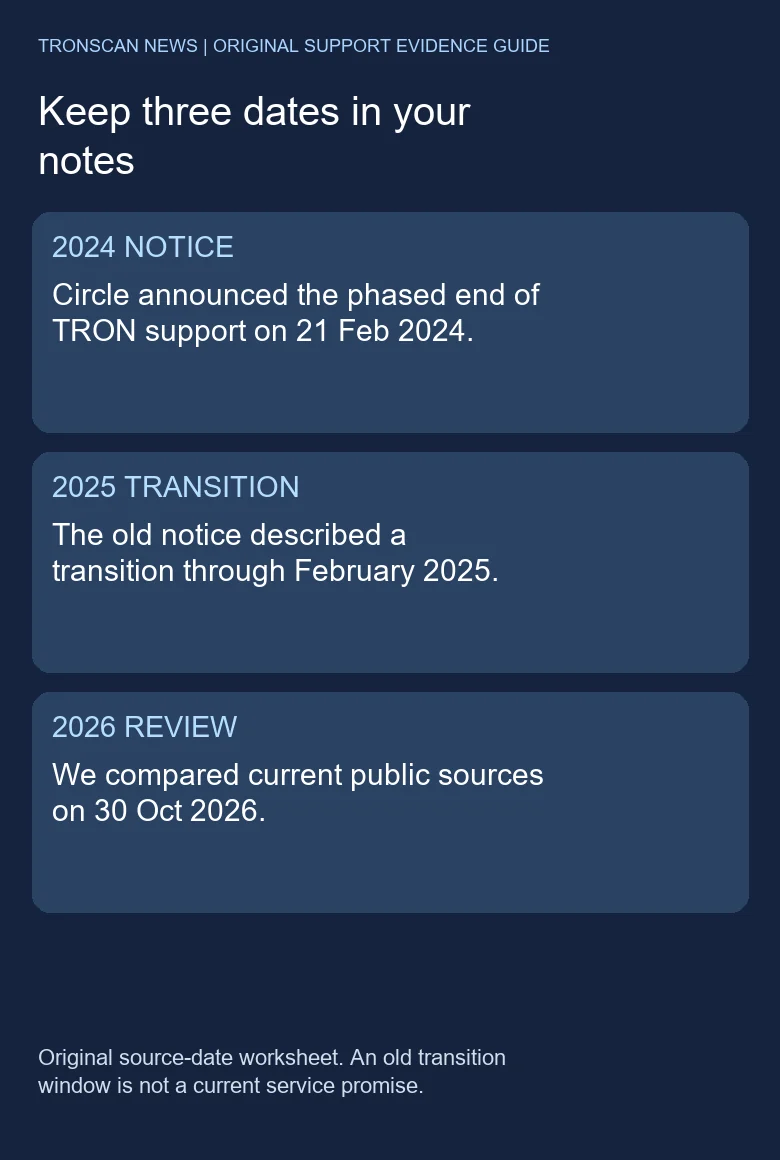
Circle’s 21 February 2024 announcement said it would stop minting USDC on TRON immediately and described a phased transition. It stated a transition window through February 2025 for Circle Mint customers, with specific institutional-service conditions.
Those are historical terms in a dated notice. They are not an open-ended promise that a retail user can use the same process today. Equally, an old deadline is not enough evidence to decide every present holder’s legal rights, service eligibility or possible recovery outcome.
We reviewed the sources on 30 October 2026. This is a current explanatory check of old and current material, not news that Circle discontinued support today.
What the legacy explorer page showed
We opened this TRONSCAN token page on Mainnet. It displayed USD Coin Old (USDCOLD), type TRC20, the contract TEkxiTehnzSmSe2XqrBj4w32RUN966rdz8, and six decimals.
The same full address is labeled USD Coin Old in Liminal’s TRON token catalog. That catalog is a provider’s own listing, marked updated about a year ago when checked. We use it as a second label/address reference, not as Circle’s current supported-network list or a fresh promise of Liminal account availability.
The live explorer page establishes the record and fields we could see. We do not treat its older descriptive text, reputation badge, price or activity counters as a current issuer-support statement. “Old” is the observed label here; it does not establish that there is a new replacement USDC token on TRON.
Check current issuer contracts separately
We read the Mainnet section of Circle’s current USDC contract-address documentation. TRON was not listed in that table on the check date. The table did include the following examples, reproduced to demonstrate the network-specific comparison.
| Selected Mainnet network | Contract in Circle’s table | Reading scope |
|---|---|---|
| Ethereum | 0xA0b86991c6218b36c1d19D4a2e9Eb0cE3606eB48 | That network’s listed native USDC contract |
| Base | 0x833589fCD6eDb6E08f4c7C32D4f71b54bdA02913 | Another network with its own address |
| Polygon PoS | 0x3c499c542cEF5E3811e1192ce70d8cC03d5c3359 | Do not substitute an older wrapped representation |
| TRON | Not listed in the reviewed current Mainnet table | Legacy explorer visibility is a separate observation |
This is a selected comparison, not an exhaustive supported-network catalog. A contract in the issuer’s table still does not prove that your particular exchange accepts deposits through that network. Testnet entries on the same documentation page are a different section and should not be copied into a Mainnet task.
USDC on TRON evidence worksheet
| Question | Best evidence in this exercise | Conclusion or limit |
|---|---|---|
| Does this legacy token page exist? | Public Mainnet explorer page | Yes; its full address and six-decimal field were visible |
| Does Circle’s current Mainnet table list TRON? | Current issuer contract list | No entry found in the reviewed table |
| Did a particular receiving service credit a deposit? | That service’s account record and current policy | Not checked here |
| Can a particular transfer be recovered or redeemed? | Case-specific service process and applicable conditions | Not established by this comparison |
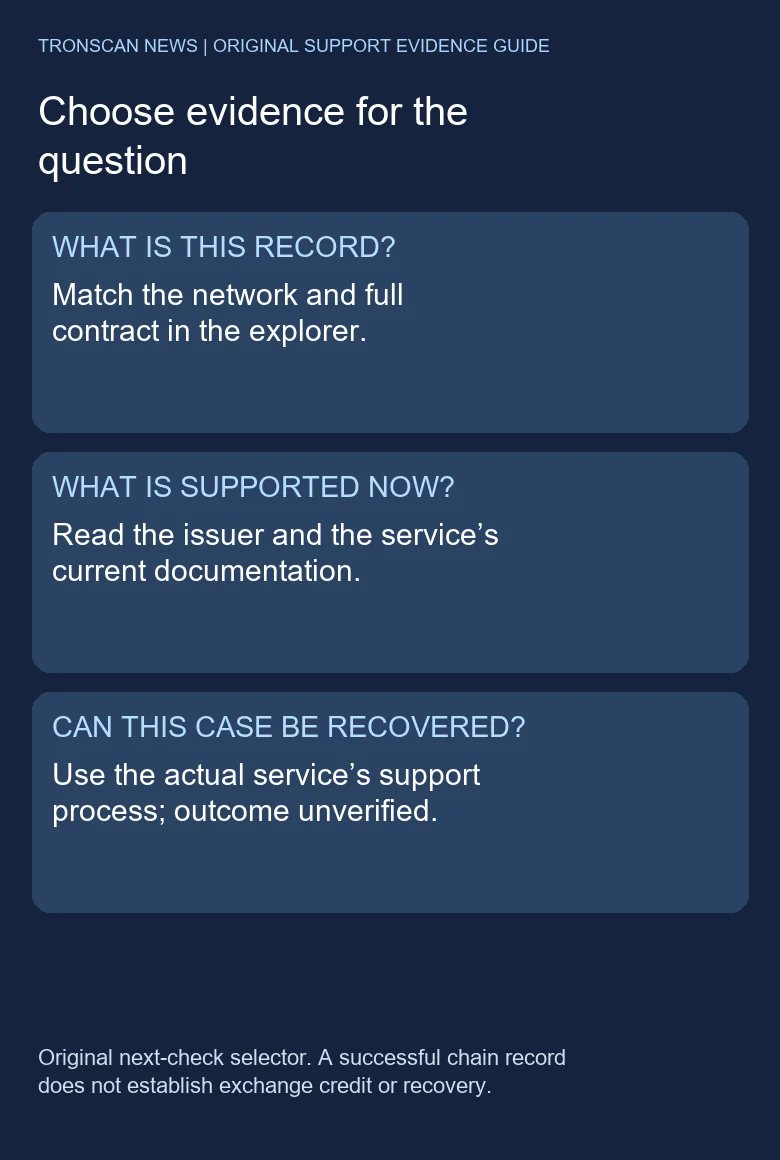
The worksheet prevents a common reasoning jump: evidence that answers the first question should not be reused as the answer to all four. It also prevents the opposite jump—current support ending does not erase the historical blockchain record you are inspecting.
How to inspect USDC on TRON without sending anything
- Identify the actual asset. Write USDC or USDT explicitly. Do not abbreviate both to “USD token.”
- Record the network and full contract. For a legacy record, preserve the exact address and explorer label rather than silently modernizing them.
- Separate event time from check time. A transaction’s block date, an issuer notice date and today’s review date describe different facts.
- Read the current Mainnet issuer table. Keep Mainnet and testnet sections apart.
- Check the receiving service separately. Match its exact asset/network wording and date. Leave acceptance unverified when you cannot access that evidence.
- If investigating an existing transfer, retain the receipt. Use its actual hash, token contract, recipient, amount and result; then use the service’s official support process.
The success standard is a clear evidence record, not moving funds to prove a theory. Network selection principles are explained in the USDT explorer guide; those principles do not turn that guide into a current USDC support list.
Two illustrative USDC on TRON decisions
Synthetic case A: a reader finds a legacy token page and a receiving service’s help page that mentions only USDT on TRON. The token page answers the identity question; the help page does not establish acceptance of the different asset. The next step is to verify the exact service route, not to reinterpret USDT as USDC.
Synthetic case B: a reader finds a Base contract matching Circle’s current list. That resolves one asset-identity check on Base. It does not prove that the reader’s exchange account supports Base deposits, that a prior TRON transfer was converted, or that an exchange credited anything. Those remain separate checks.
For a case file, keep the source title and date beside each conclusion. Preserve “unverified” for missing service evidence. A dated historical notice, a current issuer list and an explorer observation should each have their own line, so a later reviewer can tell why a conclusion was made and which fact still needs checking.
When the record and service wording disagree
The explorer says success but the service has no credit: preserve the chain result and check the service’s separate asset and network requirements. A chain success field does not establish off-chain credit.
The platform accepts USDT on TRON: that does not imply USDC acceptance. Our Peso asset-and-network comparison shows a concrete public support table where those two rows differ. Its findings apply to that documented service scope, not every platform.
An old help page describes a transition: record its date and customer scope rather than assuming it is still actionable. A page offers a new “replacement” contract: do not infer authenticity from the old record’s label. Verify it through current issuer documentation before treating it as a supported asset.
Five frequently asked questions
1. Does a USDC on TRON page prove current issuer support?
No. Explorer visibility and the issuer’s current supported-network list answer different questions.
2. Is USDCOLD the same asset as TRON USDT?
No. The full contracts and issuer contexts differ. Similar dollar-token branding is not an identity match.
3. Did Circle discontinue TRON support today?
No. The cited announcement is dated 21 February 2024. This guide’s source review took place on 30 October 2026.
4. Does an old TRON record prove a new replacement contract exists?
No. The legacy label does not establish a replacement. Check the issuer’s current contract list.
5. Did we test USDC on TRON redemption or recovery?
No. We read public sources and explorer fields. Current account eligibility, service acceptance and recovery outcomes remain unverified.
Sources, method and corrections
The independent Tronscan News editorial team checked the cited sources on 30 October 2026. The source-date ledger, issuer/explorer comparison, decision worksheet and diagrams are original. AI assisted drafting and diagram preparation. No wallet was connected and no deposit, redemption, support message or recovery test was performed. Editorial and correction information is linked from the Tronscan News homepage.
Leave a Reply