USDT0 is part of a cross-chain system for moving a USDT-based token representation between supported networks. It is not the name of a new blockchain, and an address labeled OFT is not automatically the token contract you should use to identify a balance.
For TRON readers, the practical distinction is the project’s Legacy Mesh: its documentation connects the existing TRON USDT deployment with the wider system. This guide checks the published contract roles and two public read-only fields. It does not execute or recommend a bridge transfer.
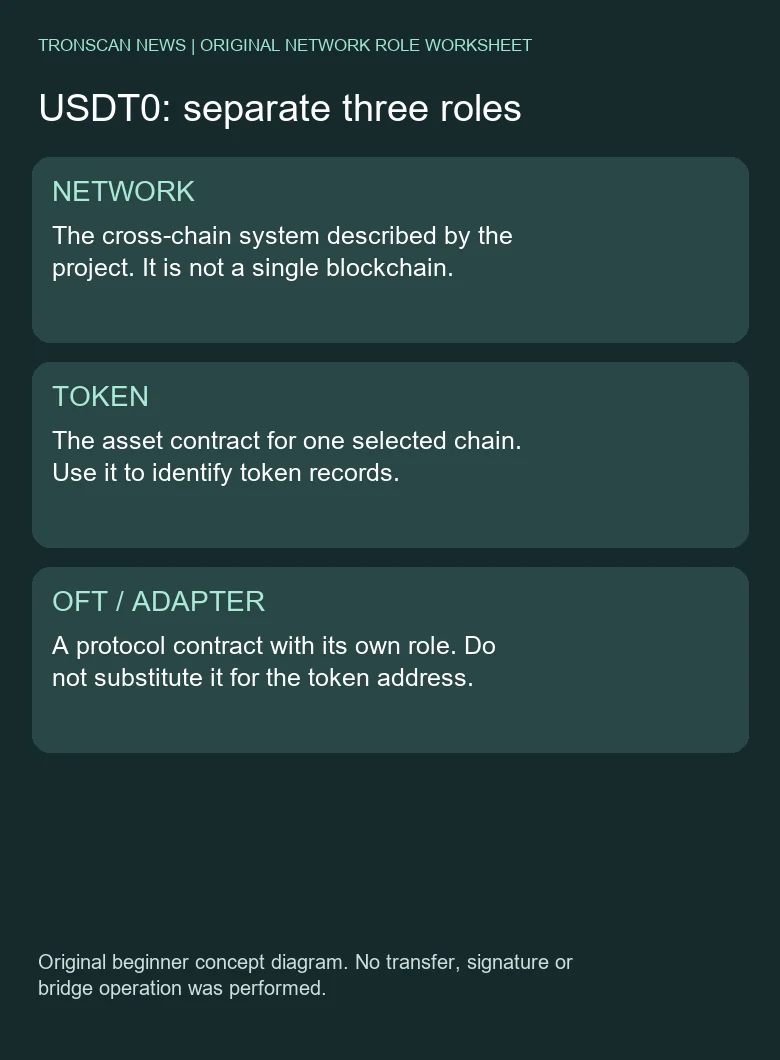
Table of Contents
What USDT0 means before you read an explorer
The project’s technical overview describes an Omnichain Fungible Token, or OFT, architecture. Its Ethereum-to-destination explanation uses an adapter that locks original USDT and a corresponding token on the destination. That is the project’s design description, not an independent reserve or security audit by this site.
The same documentation describes a different flow between chains that already run OFT deployments. Do not assume that every route creates an Ethereum transaction, or that a normal same-chain token transfer proves a cross-chain operation occurred.
First establish which chain and actual asset you are reading. Our USDT explorer network guide handles that basic choice. This page adds the contract-role distinction and the checked TRON Legacy Mesh example.
USDT0 and the TRON Legacy Mesh
The Legacy Mesh documentation explicitly lists TRON with its existing TRC20 USDT deployment. It describes connectivity without replacing the existing token contracts. Therefore, finding TRON in that section is not evidence that the familiar USDT token address has been replaced.
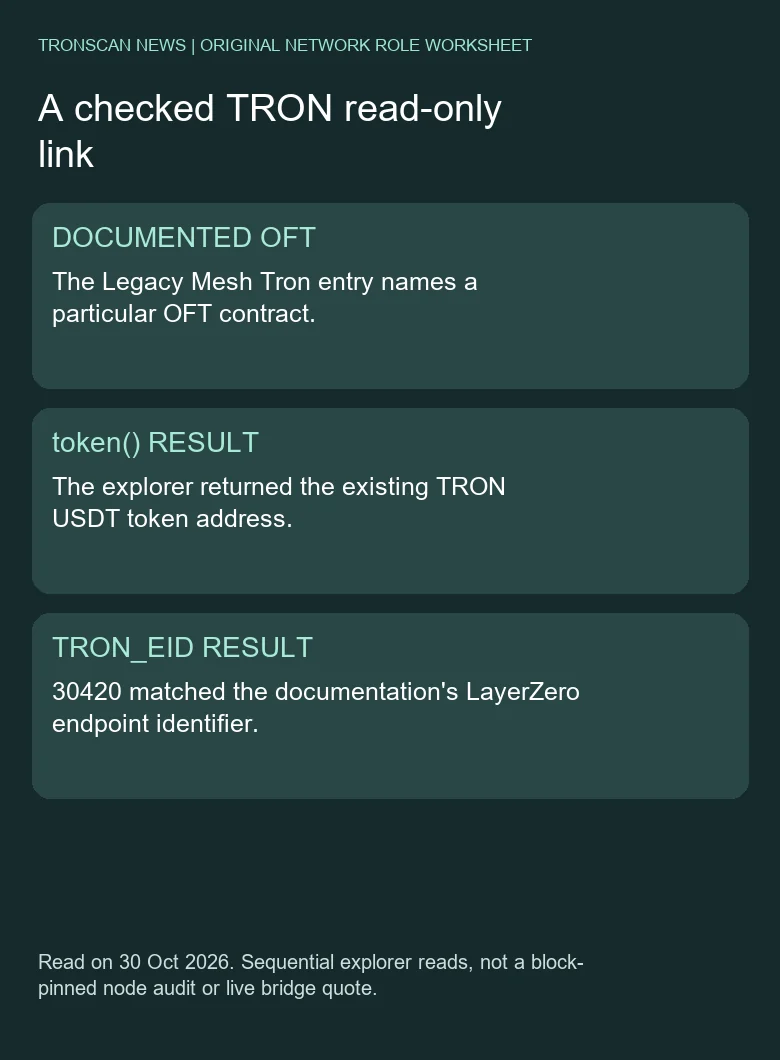
The official deployment page has separate Native Deployments and Legacy Mesh views. We selected USDT0, switched to Legacy Mesh and entered Tron in the network search. The filtered result named an OFT and LayerZero endpoint ID, not a replacement TRC20 token.
| TRON role | Complete checked value | Use in this exercise |
|---|---|---|
| Legacy Mesh OFT | TFG4wBaDQ8sHWWP1ACeSGnoNR6RRzevLPt | Protocol contract from the selected documentation entry |
| Existing USDT token | TR7NHqjeKQxGTCi8q8ZY4pL8otSzgjLj6t | Asset contract returned by the OFT’s token() field |
| LayerZero TRON EID | 30420 | Endpoint identifier, not an EVM chain ID or token address |
The two addresses have different roles even though both use TRON’s familiar address format. Copying the OFT address into an asset-identity worksheet as if it were the token would lose that distinction. Neither contract address is a general-purpose personal deposit instruction.
A checked USDT0 read-only example on TRONSCAN
From the deployment page we followed its TRON OFT explorer link. The contract page displayed the name UsdtOFT. We then selected Read Contract and expanded the no-argument token() and TRON_EID() fields.
The first returned TR7NHqjeKQxGTCi8q8ZY4pL8otSzgjLj6t. The second displayed 30420 with type uint32. Both values agreed with the role mapping above. We viewed their returned values without connecting a wallet, signing or using Write Contract.
| Evidence item | Observed result | Limit |
|---|---|---|
| Documentation tab and filter | Legacy Mesh, Tron, one filtered entry | Snapshot of the page checked on 30 October 2026 |
| Contract link target | Full OFT address matched the selected entry | Matching an address does not prove contract safety |
| Read Contract token() | Existing TRON USDT address | Contract field, not a personal wallet balance |
| Read Contract TRON_EID() | 30420, matching the deployment entry | Endpoint identifier, not a transaction status |
These were sequential explorer reads. They were not pinned to a specified block, repeated through an independent node or used to test a live route. We did not obtain an executable quote, assess liquidity or measure delivery time.
Why the USDT0 deployment list contains several addresses
The same page’s Arbitrum One entry separately labels a Token and an OFT. The token is 0xFd086bC7CD5C481DCC9C85ebE478A1C0b69FCbb9; the Native Deployments OFT is 0x14E4A1B13bf7F943c8ff7C51fb60FA964A298D92. Those labels illustrate why a chain name alone is not enough to choose an address.
Its Ethereum entry uses an OFT Adapter label. An adapter, token, Safe and composer serve different documented roles. This guide does not ask you to interact with any of them; it teaches you to preserve those labels when collecting evidence.
The foundational asset distinction is covered in our TRON USDT introduction. USD₮ on TRON remains a token record separate from native TRX, regardless of whether a wider application connects it to another network.
How to classify a USDT0-related record
- Write down the intended task. A same-chain balance lookup and a cross-chain transfer investigation require different records.
- Open the official deployment list. Select the correct product, network and Native or Legacy view.
- Copy the role with the full address. Keep Token, OFT, Adapter and other labels intact.
- Open the linked explorer. Confirm the network and complete target address. If using a public read field, record its name and returned value.
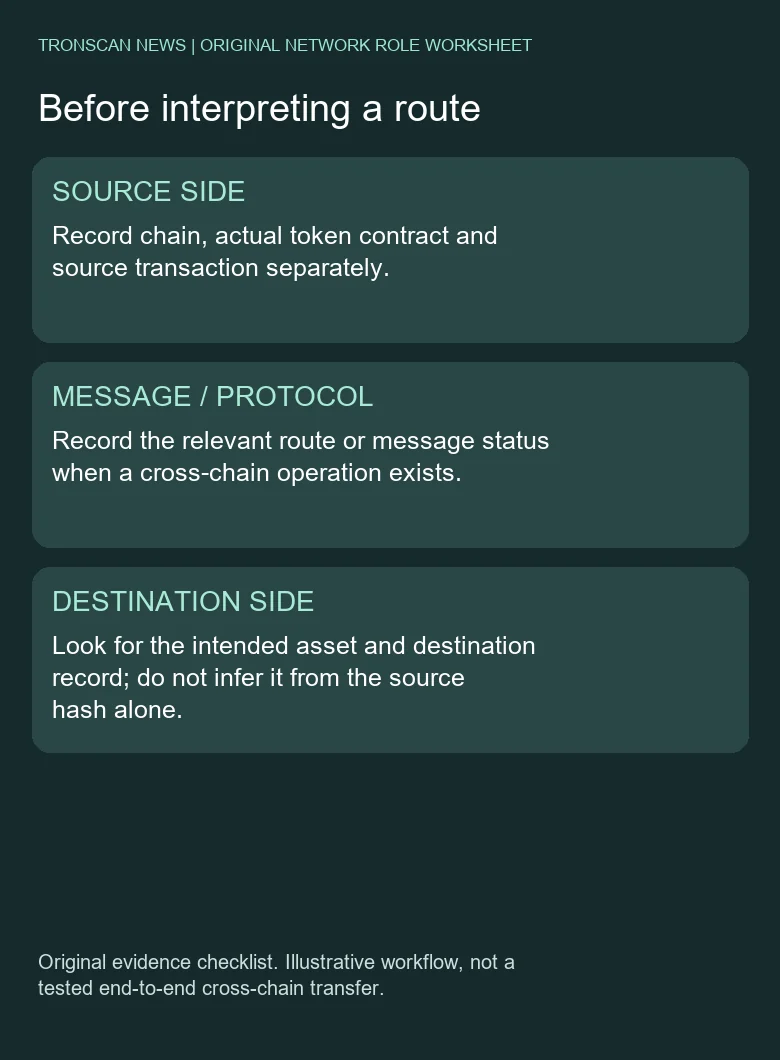
- For an actual cross-chain case, keep separate evidence for both sides. A source transaction hash alone does not establish destination delivery.
- Check service support separately. Documentation connectivity does not prove that your exchange accepts that asset through the chosen route.
The success standard for this guide is a correct role map, not a completed transfer. The public-field check above is reproducible without a wallet. If a page requests a signature merely to view the listed addresses, stop and verify the destination rather than treating the request as part of this exercise.
A practical identifier worksheet
For each row in your notes, keep five cells: source URL, check date, network, role and complete value. Do not put different identifiers into one unlabeled “network number” cell. In the selected deployment page, Arbitrum One had chain ID 42161 and LayerZero EID 30110. Those are different fields even though they describe the same named network.
Illustrative note, not a transaction: “TRON / Legacy Mesh / OFT / full address / checked date” is a role record. “TRON / token / full USDT address / checked date” is an asset record. A destination hash or delivery state remains blank until you have evidence for it; it should not be filled with the source hash simply to complete the worksheet.
USDT0 mismatch: what to do next
The address is an OFT rather than the token: return to the role label and identify the asset contract. The TRON record shows ordinary USDT: that can be consistent with the Legacy Mesh description; it does not establish that the token was replaced.
Only the source side is successful: retain that result and investigate the separate destination or message status. Do not declare delivery based on one chain alone. The USDT transfer tracing guide explains why each movement needs its own record and why ownership should not be inferred from address paths.
The service does not list the route: leave support unverified. Do not send to an incompatible endpoint to test a theory. Current fees, eligibility and liquidity are outside this read-only check.
Five frequently asked questions
1. Is USDT0 a separate blockchain?
No. It belongs to a cross-chain token system operating across supported networks. Select the actual blockchain before choosing an explorer.
2. Did the Legacy Mesh replace TRON’s USDT token contract?
The reviewed documentation says existing deployments are retained. The checked OFT token() field returned the existing TRON USDT contract.
3. Is an OFT address always the token address?
No. The deployment page can list them separately. Keep the exact role beside each address.
4. Does a successful source transaction prove destination delivery?
No. A cross-chain case requires evidence for the intended destination and any relevant message or protocol status.
5. Was a USDT0 bridge transfer tested here?
No. We reviewed documentation, tested the public deployment filter and read two no-argument contract fields. No wallet or transaction was used.
Sources, method and corrections
The independent Tronscan News editorial team checked the cited sources and public interface on 30 October 2026. The contract-role matrix, field ledger, workflow and diagrams are original. AI assisted drafting and diagram preparation. This is a dated explanation, not a new launch announcement, current quote or security audit. Editorial and correction information is linked from the Tronscan News homepage.
Leave a Reply