USDD is a dollar-targeting stablecoin with its own token contract; it is not USDT. On TRON, a second distinction matters: the new USDD and USDD OLD have different contract addresses. Similar names and the same blockchain do not make these assets the same explorer entry.
This guide helps you classify an address or token record before interpreting its amount. It reviews public documentation and two live token pages. It does not test a migration, quote a swap, recommend holding either asset or guarantee a dollar redemption.
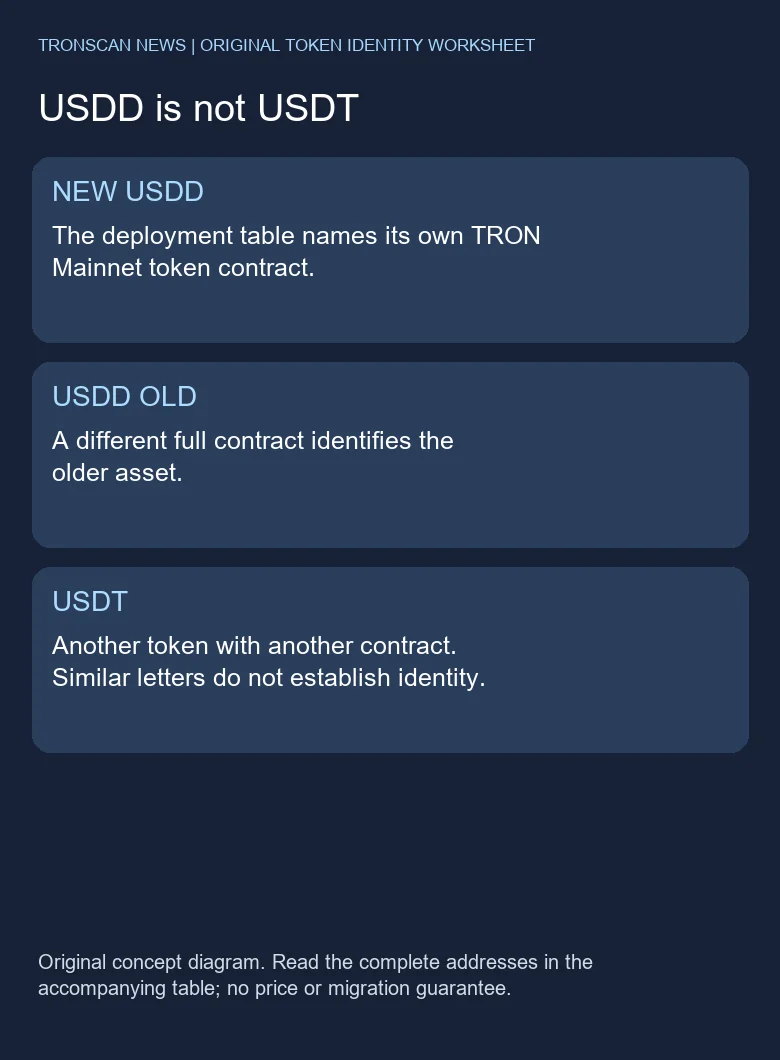
Table of Contents
What the current project documentation means
The USDD project introduction describes the new version as crypto-collateralized and designed to target the US dollar. It explicitly says that “USDD” in that documentation refers to the new version. That version scope matters when following a link from an older article.
A peg is a design target, not our promise about market price, liquidity, reserves or a reader’s ability to redeem. We did not independently audit the project’s collateral or repeat its broader security assurances as verified findings.
For the separate Tether token, read our TRON USDT beginner guide. USDD, USDT and native TRX should remain separate entries in your notes even when a wallet displays all three under the same network.
USDD contract identity table for TRON Mainnet
The project deployment table names the new USDD token contract. The SUN support notice about the new USDD separately lists the new and old token contracts.
| Asset or role | Complete TRON Mainnet address | How it is used here |
|---|---|---|
| New USDD token | TXDk8mbtRbXeYuMNS83CfKPaYYT8XWv9Hz | Token identity in the current project deployment list |
| USDD OLD token | TPYmHEhy5n8TCEfYGqW2rPxsghSfzghPDn | Older token identity in the SUN notice |
| USDT token | TR7NHqjeKQxGTCi8q8ZY4pL8otSzgjLj6t | Different token, provided for identity comparison |
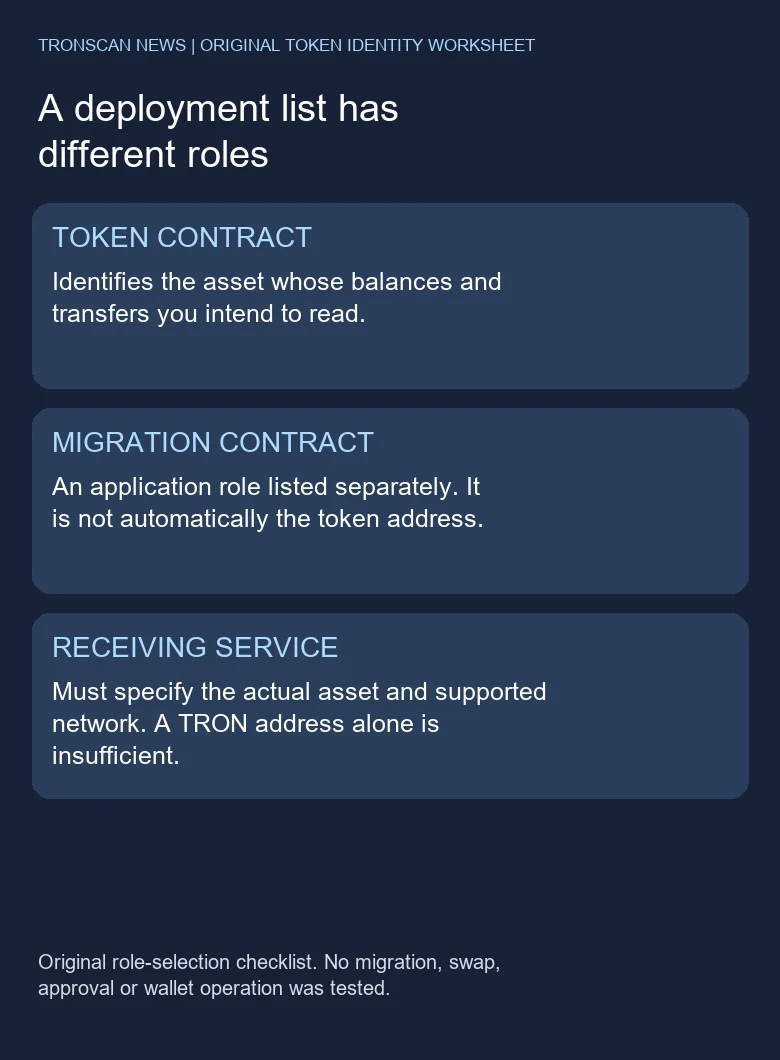
| USDD Migration | TQrq2p1aoAkNK94q3Q69ubJcv5nQ9y675R | Separately named application role; not the new token contract |
The SUN notice describes a change effective 10 February 2025, and the page is marked updated 23 March 2025. We checked it on 30 October 2026. Those are different dates: this guide is not announcing a new migration or support change today.
Its historical PSM and routing statements are context, not a freshly tested quote or an assurance that a particular wallet, exchange, pool or migration route is currently available to you.
What the two live token pages showed
We opened the new token’s TRONSCAN page on Mainnet. It displayed Decentralized USD (USDD), type TRC20, the full new contract above, and 18 decimals.
The older contract’s token page displayed Decentralized USDOLD (USDDOLD), type TRC20, its different full contract and 18 decimals. Explorer naming helps navigation, but the full contract is the comparison key.
| Check performed | New token page | Older token page | What this establishes |
|---|---|---|---|
| Full contract matches cited source | Yes | Yes | We opened the intended records |
| Token standard | TRC20 | TRC20 | Same standard, not same contract |
| Displayed decimal precision | 18 | 18 | The scale used for each token’s raw amount |
| Current migration executed | Not tested | Not tested | No operational success is claimed |
We deliberately exclude changing price, supply and holder counters from this identity exercise. A displayed price is not a guaranteed execution price. A page being visible is not proof that a service accepts deposits of that asset.
Amount worksheet: do not borrow another token’s decimals
A token standard does not require every token to use the same number of decimals. The checked USDD pages used eighteen. The separately documented TRON USDT uses six. Applying the USDT scale to a raw USDD integer would produce a very different number.
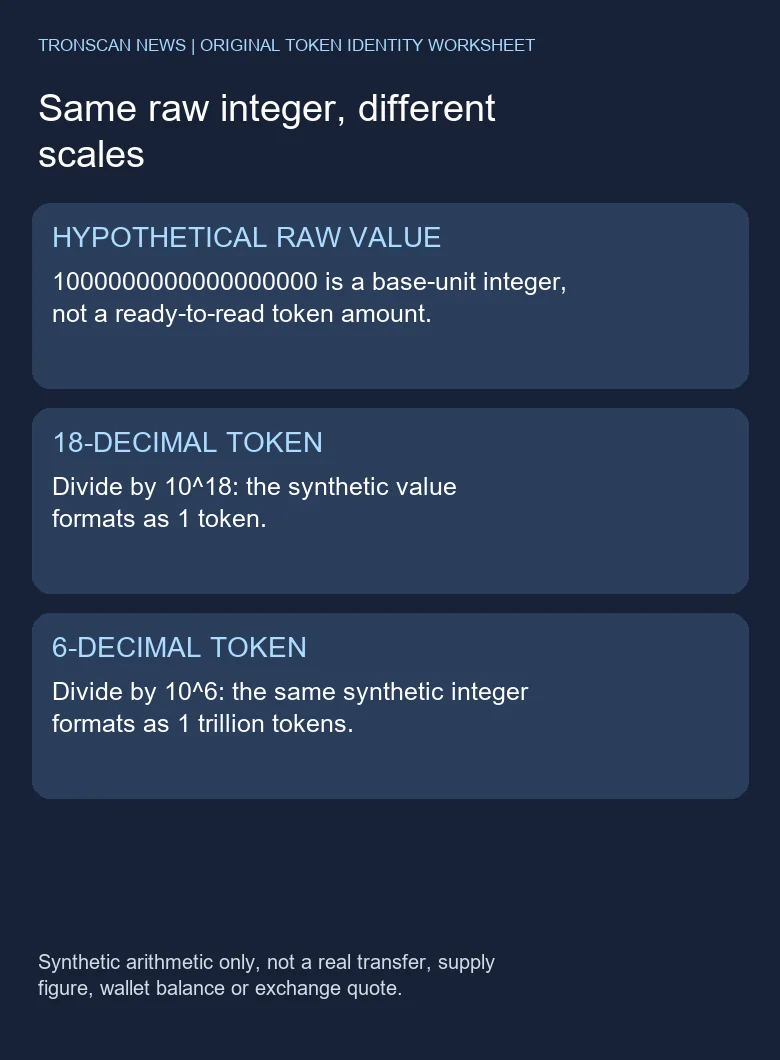
Synthetic example, not a real transaction: take the integer 1000000000000000000. With eighteen decimals it formats as 1 token. With six decimals the same integer formats as 1,000,000,000,000 tokens. The example isolates a unit error; it does not describe a transfer, wallet balance, dollar value or supply.
The safe method is to record the raw integer and the precision of the exact contract together. Our token-decimal reading guide explains the underlying conversion. A formatted token amount remains a token amount; it is not automatically a market quote.
How to identify the record before using it
- Write the task first. Are you identifying an asset, reading a historical transfer or checking a receiving service? Those need different evidence.
- Read the source’s version scope. Note whether it refers to new USDD, USDD OLD, USDT or an application contract.
- Match the full Mainnet contract. Do not rely on the first letters of an address, a logo or a wallet nickname.
- Read the token page’s type and decimals. Retain those fields beside the address and your check date.
- For a transfer, open its actual receipt. Confirm the network, token contract, result, addresses and amount for that hash.
- For a deposit, verify the service’s current asset and network choice. A general “TRON supported” statement is not enough to identify the accepted token.
The success standard here is an unambiguous asset record: network, version, full token contract, precision and source date agree. No swap or migration is necessary to achieve that read-only result.
When the record does not match: choose the next check
The name looks right but the contract differs: stop and classify the other contract. Do not rename it to fit the intended asset. The record is USDD OLD: preserve that label and compare its exact address with the historical notice; do not relabel it as the new contract.
A migration address appears: read its named role. It is not interchangeable with the asset contract or a personal deposit address. A service lists USDT only: do not treat USDD as an accepted substitute. Ask that service about the exact asset through its own support route.
The raw amount is enormous: recheck precision before interpreting value. For network and explorer selection, the USDT explorer network guide supplies the broader principle: chain and token identity must be established together.
Five frequently asked questions
1. Is USDD another spelling of USDT?
No. They have different token contracts and project contexts. Similar letters do not make them the same asset.
2. Are new USDD and USDD OLD one contract?
No. The project and SUN sources distinguish the addresses reproduced above. Keep the version with the full address.
3. Does every TRC20 token use six decimals?
No. Both token pages checked in this exercise displayed eighteen decimals. Read the exact token’s precision.
4. Can I send USDD to any service accepting TRON USDT?
Do not infer support that way. The receiving service must explicitly accept the actual asset and network.
5. Was a migration tested for this guide?
No. We compared public sources and explorer fields. We did not connect a wallet, approve, migrate, swap or send funds.
Sources, method and corrections
The independent Tronscan News editorial team checked the cited documentation and explorer pages on 30 October 2026. The identity matrix, role selector, synthetic arithmetic and diagrams are original. AI assisted drafting and diagram preparation. Public record checks establish the displayed fields, not contract safety or service availability. Editorial and correction information is linked from the Tronscan News homepage.
Leave a Reply