A TRON swap exchanges assets through a smart contract; its token-transfer rows are the movements inside that execution, not separate parent transactions. A displayed amount of 0 TRX can coexist with several token movements. Read the called function, execution result, full token contracts and account-specific net changes together.
This beginner worksheet examines one real Mainnet swap on 31 October 2026. It follows a seven-token route that returns to its starting asset, compares the explorer’s All Transfers and Net Transfers views, and reconciles the receipt’s event counts. We did not connect a wallet, approve anything or trade. The observed token difference is not a claim about anyone’s profit or strategy.
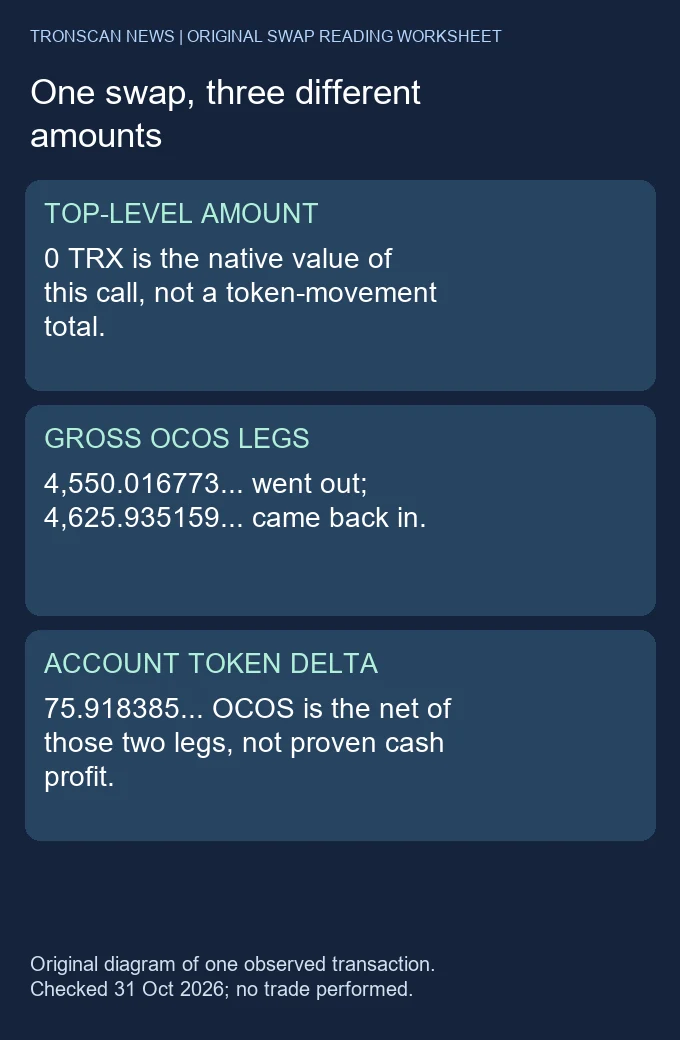
Table of Contents
1. Identify the swap before reading its amounts
Start from the complete transaction hash, not a cropped token row. The inspected swap is ae65a87d4a57c784ced3fd16259ffbc276abccb2f1a3a11fa54ec998b50b4a8f. The official explorer record displayed a successful, confirmed call at block 87,581,273, with block time 2026-10-31 03:27:12 UTC.
The called address was TNJVzGqKBWkJxJB5XYSqGAwUTV15U24pPq. SUN.io’s V2 contract-address reference lists it as the TRON router. The explorer’s code page displayed UniswapV2Router02 and said its source code was not verified there. Matching a deployment reference does not turn that status into a code audit or asset-safety endorsement.
The official V2 interface reference defines swapExactTokensForTokens with amountIn, amountOutMin, path, recipient and deadline. Those supplied swap arguments describe the requested operation. They do not replace its execution result or actual output movements.
- Open the hash on the intended network and check its execution result.
- Match the called contract to an official deployment reference for that protocol version.
- Read the method and supplied path, including its first and last asset.
- Expand every token-transfer row before deciding which address received which asset.
- Compare the relevant account’s gross movements with its net view.
- Keep actual event records and input constraints in separate worksheet columns.
The TRONSCAN beginner guide covers the main explorer record types. This page’s distinct task is reconstructing one routed exchange without confusing its input, output and intermediate legs.
2. Read the supplied swap path as a route
The swap method was swapExactTokensForTokens. Both amountIn and amountOutMin were the raw integer 4550016773487970405232. The path contained seven entries, with the same first and last contract. Seven path entries describe six adjacent pool transitions here, not seven independent swaps initiated by seven people.
The displayed swap route was OCOS → ETHB → WTRX → MYR → USDT → PROS → OCOS. These symbols are convenient labels for the exact contracts in this record, not an endorsement of similarly named assets. In particular, an ETHB label does not make the record an Ethereum transaction. The network remained TRON throughout the inspected execution.
The repeated endpoint contract was TQ4VkSbKXB3YUDoD6PZSYmpeuFj6QzCf39. Its token page displayed 18 decimals and an unknown reputation. We used that page for precision and contract correspondence, not as independent proof of the project’s claims, price or redeemability.
The USDT row’s contract was TR7NHqjeKQxGTCi8q8ZY4pL8otSzgjLj6t. It appeared at an intermediate point between two pool addresses. That is different from saying the initiating account received a USDT payment.
3. Expand all swap transfer legs
We clicked More (4) under All Transfers. The view then exposed seven movements. The original role table below preserves their direction and displayed quantities. A is the initiating and final receiving address, TCeKLAgA3mQhrWLtLZJHBiFXbcnh55qrcV; P1–P6 identify the six intermediate contract addresses listed after the table.
| Leg | Direction | Displayed asset | Displayed amount |
|---|---|---|---|
| 1 | A → P1 | OCOS | 4550.016773487970405232 |
| 2 | P1 → P2 | ETHB | 0.000099473446841264 |
| 3 | P2 → P3 | WTRX | 0.666992 |
| 4 | P3 → P4 | MYR | 0.852234 |
| 5 | P4 → P5 | USDT | 0.228958 |
| 6 | P5 → P6 | PROS | 9.692872180442911868 |
| 7 | P6 → A | OCOS | 4625.935159354295389709 |
P1: TCxWi7K2Qooo7WNqZbhrkPnTEynKF9qa75
P2: TCd33fPbq8tCjCTUxQXsgSCNU2Wg3nGjsg
P3: TFJHo49WrTkEDdTGAQQQjymnrXg3wdVfiN
P4: TYQ49g8mEg1f6siu2CjvPntQLmdMW3YmJy
P5: TQNyKQSSWTyN98zd8iMXgtsmTknXfEqaFV
P6: TMH8BBRFFbMFSH78LVdp8v6ZM1xjggimzW
Preserve the full contracts and row references when repeating this exercise. Do not sum 0.666992 WTRX and 0.228958 USDT as if they shared a unit. Likewise, do not count a protocol’s intermediate receipt as an external customer’s deposit merely because the same parent hash contains both.
Our transaction-sender role comparison explains why the initiator, called contract, event sender and beneficiary can differ. Here the pool-to-pool rows make that distinction concrete without identifying a real-world person behind A.
4. Compare gross swap amounts with the net view
We selected Net Transfers and expanded its additional entries. For A, the explorer displayed Received 75.918385866324984477 OCOS. That is the difference between the outgoing and incoming endpoint movements, not the gross incoming 4625.935159354295389709 OCOS shown in All Transfers.
We reproduced that narrow calculation from raw Transfer data, using exact integers: 4625935159354295389709 minus 4550016773487970405232 equals 75918385866324984477 smallest units. Applying the observed 18-decimal scale gives 75.918385866324984477 OCOS. The calculation matched the tested net view.
The two swap displays are useful for different tasks. Gross movements explain the route and actual legs. An account-specific net groups the same asset’s incoming and outgoing movements within this parent swap transaction. Neither display establishes the account’s opening balance, current total holdings, purchase cost, token liquidity or cash proceeds.
Do not label this difference as realized profit. We did not establish the account owner’s purpose, basis, funding arrangements, broader transactions or the asset’s realizable value. The row also does not measure a customer’s exchange credit. This article reports observed records and exact arithmetic only.
5. Keep swap inputs and event counts separate
amountOutMin is a supplied output constraint, not the realized output. In this example it equalled the raw input value because the route ended in the same asset; the actual swap output Transfer carried the larger integer above. That equality is specific to this record and is not a general rule for routed exchanges.
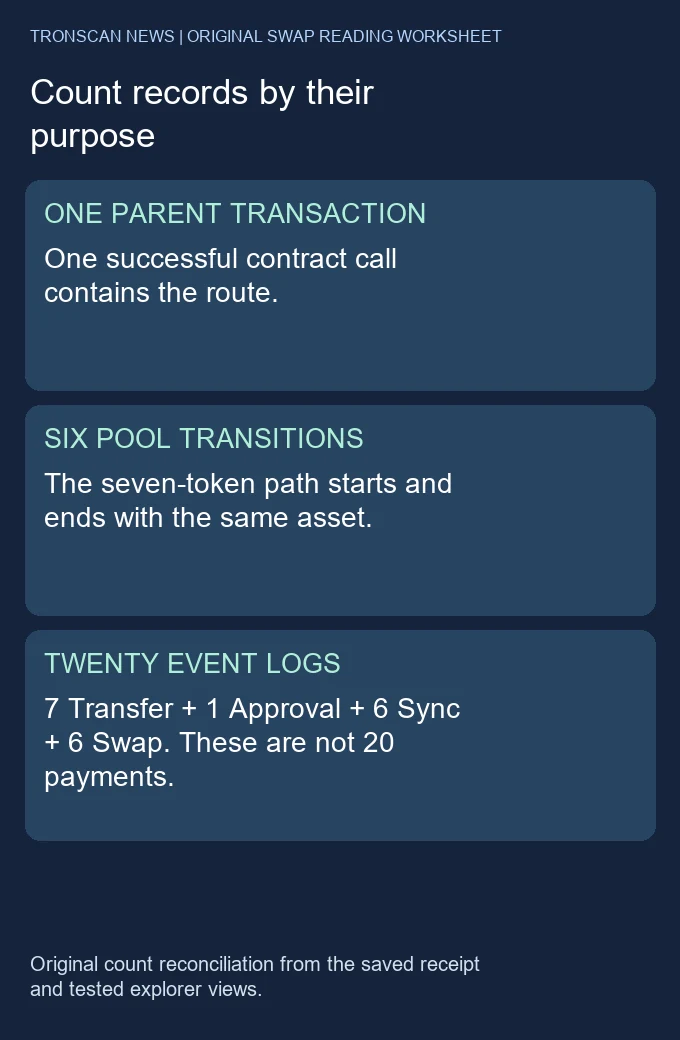
The saved receipt contained 20 logs. Their signature topics, cross-checked against the explorer’s decoded labels, classified as seven Transfer, one Approval, six Sync and six Swap records. These sum to 20. Six pool-level events do not mean six parent transaction hashes, and an Approval event is not an extra token payment.
The first Transfer appeared at log position 0; the endpoint return appeared at position 17. Positions are zero-based in the saved receipt. The intervening USDT Transfer was at position 11 and carried raw value 228958. Use a log’s emitting contract and endpoints to identify it, rather than choosing an event because its name or amount looks familiar.
This record adds a real multi-asset reconciliation: do not add event counts, internal-call counts and token-row counts together as a number of economic payments. The interface also listed 31 internal transactions, which we did not independently classify. A service announcement counts a different object again: our Mercuryo pair and route-count review separates marketing coverage from an actual on-chain route or completed order.
6. Interpret zero TRX and other incomplete evidence
The overview displayed Amount 0 TRX. The raw call did not carry a nonzero native call_value. That field describes the native value attached to the top-level call; it does not say that no tokens moved or that network resources were unused. The receipt separately reported 404128 Energy and 699 Bandwidth.
The input fee_limit was 10000000 SUN, corresponding to the displayed 10 TRX limit. A limit is not a receipt fee. We did not calculate an economic trading cost or a general fee schedule from that number. Resource accounting, protocol costs and token-quantity differences require their own evidence and units.
If the method decodes but execution fails, keep the supplied route separate from completed movements. If the interface omits later rows, expand the list before calling the visible subset complete. If a token’s precision is not established, retain the integer instead of inventing a scale. If an address label is unclear, use the full address and state the role as unresolved.
Our API checks read the body and receipt for this hash through public Mainnet provider endpoints. They both returned usable HTTP 200 responses and SUCCESS execution labels. These swap observations came from one provider and were not an independent-node consensus audit. The deliberately chosen closed route is one example, not a representative sample of all TRON activity.
Five frequently asked questions
1. Can a swap contain several token transfers?
Yes. This successful parent transaction contained seven displayed token movements and six pool transitions.
2. Does Amount 0 TRX mean nothing moved?
No. It is the top-level native value field. The token rows and resource receipt answer different questions.
3. Is amountOutMin the amount actually received?
No. It is an input constraint. Check the completed output movement and recipient separately.
4. Did A receive the intermediate USDT?
The inspected USDT row moved from P4 to P5, not to A. The endpoint returned the same OCOS contract as the starting asset.
5. Does the positive token difference prove profit?
No. It is a within-record token-quantity calculation. Value, basis, purpose, wider holdings and realized proceeds were not established.
Sources, method and corrections
The independent Tronscan News editorial team checked the cited official project references, public explorer views, token precision and two read-only provider responses on 31 October 2026. The route-role table, exact endpoint calculation, event reconciliation and diagrams are original. AI assisted drafting and diagram preparation. We performed no funded transaction and make no asset-safety, trading-return or ownership claim. Editorial standards and corrections are accessible through the Tronscan News homepage.
Leave a Reply